Direct Answer: At initial scope and loss-walkthrough intake, the Contents Estimator and Claim Packet Specialist defines whether the assignment requires a chain-of-custody pack-out record, a priced total-loss valuation schedule, or both, establishes room and asset-tier capture boundaries with field leads, and locks in carrier-platform formatting rules before crews mobilize.
.md twin for estimator QA and carrier file documentation.
Most contents claim delays begin during the first two hours after dispatch, long before a line item is typed into XactContents or Symbility. When a project manager sends a crew to a fire or water loss without a formal intake brief from the Contents Estimator and Claim Packet Specialist, technicians photograph rooms for physical custody and cleaning logistics rather than valuation defensibility. The desk then inherits hundreds of box labels and wide-angle snapshots that lack dimensions, model plates, pre-loss condition indicators, or clear room boundaries.
The estimator’s intake function solves this mismatch upstream. Rather than waiting passively for a completed pack-out folder to land in an inbox, the specialist reviews the initial assignment, peril characteristics, structure-versus-contents boundary, and carrier reporting instructions while the walkthrough is still fresh. Naming the exact deliverable in writing at intake prevents the classic operational failure examined in A Pack-Out Record Is Not a Priced Inventory.
Effective intake also respects clear licensing and professional boundaries under ANSI/IICRC S320 and Restoration Industry Association (RIA) standards. The estimator gathers factual scope parameters, asset tiers, and documentation requirements without making policy coverage determinations or promising claim outcomes to the insured.
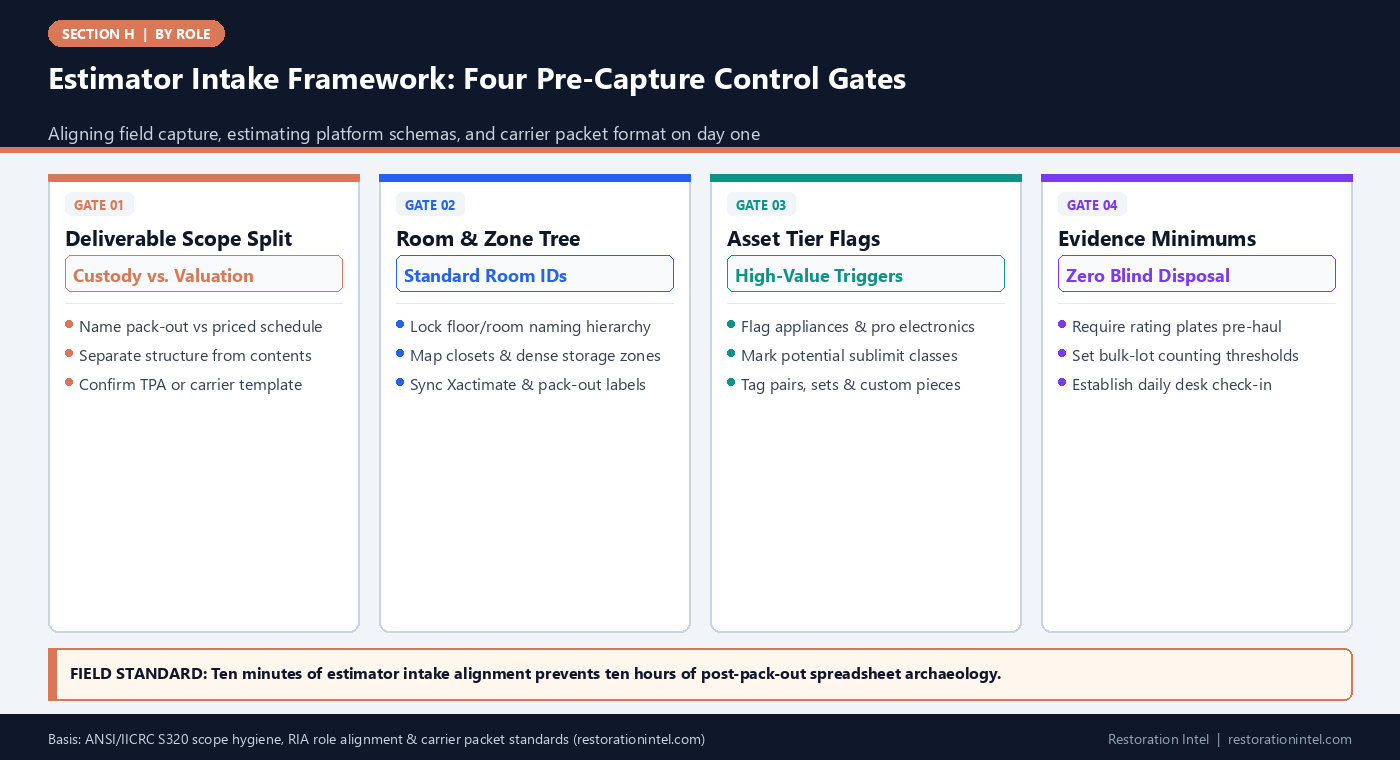
Estimator Intake Framework: Four Pre-Capture Control Gates
Initial Scope Intake Matrix for the Contents Estimator & Claim Packet Specialist
Key intake checks completed during loss onboarding to prevent field-to-desk rework and carrier formatting rejections.
| Intake Element | Estimator Verification Question | Required Source Input | Field Action Triggered | Risk Prevented |
|---|---|---|---|---|
| 1. Deliverable Mandate | Is the assignment custody/cleaning only, total-loss valuation, or split? | Work authorization & carrier/TPA assignment sheet | Issue single-sentence scope brief to Crew Lead before mobilization | Submitting a pack-out log when adjuster expects priced RCV/ACV |
| 2. Platform & Export Target | Does the claim require XactContents ESX, Symbility export, or itemized XLSX? | Carrier vendor guidelines & adjuster intake note | Configure category tree, tax rate, and room IDs at file creation | Re-keying hundreds of lines between incompatible schemas |
| 3. Structure vs. Contents Line | Where do built-in cabinets, blinds, appliances, and flooring sit? | Structure estimator scope & walkthrough sketch | Tag built-ins as excluded or structure-side on the intake checklist | Double-billing building fixtures inside personal property totals |
| 4. Peril & Triage Profile | Are items facing Cat 1-2 water, Cat 3 sewage, soot/protein, or mold? | PM moisture/peril briefing & initial walkthrough photos | Set non-salvageable photo rules prior to emergency debris haul-off | Discarding ruined goods without model/brand proof for RCV pricing |
| 5. High-Dollar & Sublimit Flags | Are commercial machines, fine art, jewelry, or specialty tools present? | Walkthrough overview & owner initial disclosure log | Assign Tier-1 close-up photography & owner-verification tags | Missing specs on top-decile items that drive over half of loss value |
| 6. Access & Timeline Constraints | Are rooms restricted by structural shoring, hazmat, or utility shutoff? | Site safety briefing & PM schedule | Mark inaccessible zones as Pending/Unresolved in initial packet | Silently omitting rooms or guessing unseen closet contents |
Separating Deliverable Mandates Before Field Capture Starts
The first task of the Contents Estimator and Claim Packet Specialist at intake is clarifying what the assignment actually buys. A full-service contents restoration assignment frequently involves three distinct workstreams: emergency stabilization and pack-out custody, off-site cleaning and storage billing inside Xactimate, and a non-salvageable or total-loss personal property valuation schedule. When those deliverables are not named explicitly on day one, crews treat every box as pure warehouse logistics while adjusters wait for a priced claim schedule.
During intake, the estimator confirms in writing whether the team is responsible solely for a custody and processing scope, solely for a priced inventory of damaged goods, or for a dual-track file where cleanable items carry restoration labor and condemned items carry replacement research. Writing this boundary into the job file header keeps everyone working toward the same output.
Clarifying the deliverable early also protects the company from billing disputes over scope overlap. As outlined in How Do I Write an Estimate in Xactimate?, estimators must keep mitigation equipment, pack-out labor, and personal property replacement valuation cleanly separated so carrier desk reviewers never suspect duplicate charging.
- Written deliverable tag: Label every job folder header as Custody Only, Valuation Only, or Split Clean-and-Replace on day one.
- Authorization alignment: Confirm that signed homeowner or commercial work authorizations match the documentation depth requested.
- Adjuster preference check: Note early whether the carrier accepts combined spreadsheets or requires native platform files.
Locking Down Room Trees, Platform Schemas, and Naming Rules
Incompatible room names between the structure estimate, the pack-out box manifest, and the contents pricing file create hours of reconciliation friction. If the mitigation lead calls a space ‘Back Den’, the pack-out crew labels boxes ‘Family Room’, and the structure sketch calls it ‘Living Room 2’, the desk estimator must stop and cross-map every container before pricing can begin.
At intake, the Contents Estimator imports or establishes a canonical room tree matched to the structure sketch and assigns unique zone identifiers for closets, pantries, attics, and garage bays. When working across Xactimate vs. Symbility environments, establishing exact category and room hierarchies upfront avoids painful CSV remapping when the schedule reaches pre-submission audit.
Standardizing room names at intake also improves photo indexing. Field technicians know exactly which folder or tag corresponds to each physical threshold, allowing the estimator to spot missing closets or unphotographed utility rooms during the first 24 hours.
- Single source of truth for rooms: Mirror the PM’s sketch room sequence clockwise from the main entry.
- Sub-zone numbering: Assign distinct labels to walk-in closets, hall pantries, and detached sheds so dense lots stay traceable.
- Tax & jurisdiction preset: Lock the loss-site ZIP code tax profile and freight assumptions in the estimating template at setup.
Flagging High-Value Assets, Sublimits, and Pre-Disposal Traps
Walkthrough intake is the estimator’s best opportunity to identify items that carry disproportionate valuation risk. In typical residential and light-commercial losses, the highest-value 10 percent of personal property—appliances, prosumer electronics, specialty tools, musical instruments, custom furnishings, and commercial equipment—accounts for a majority of disputed claim dollars.
By reviewing the initial walkthrough video or PM notes before debris removal begins, the specialist flags which assets require rating-plate close-ups, dimensional measurements, and multi-angle condition shots prior to movement or disposal. Once a soot-damaged commercial espresso unit or flooded smart refrigerator hits a roll-off dumpster without a readable model sticker, no amount of desk research can recover its true replacement tier.
Intake is equally critical for spotting potential policy sublimit categories and built-in structure overlaps. Flagging jewelry boxes, firearms safes, silverware, fine art, and business property kept at home ensures field leads isolate them for careful owner verification rather than bundling them into generic ‘bedroom miscellaneous’ containers.
- Pre-haul stop rule: Instruct field leads that no Tier-1 appliance, electronic device, or specialty asset may be discarded without estimator photo sign-off.
- Built-in boundary check: Confirm whether ranges, dishwashers, wall ovens, and window treatments sit on the structure or contents side.
- Pair-or-set alert: Flag matched dining sets, sectional sofas, and stereo pairs at intake so partial damage is documented as a unit.
Running the Day-One Handoff Call Between Estimator and Field Lead
Paper checklists fail when field crews never read them. High-performing contents divisions replace passive email attachments with a 10-minute day-one alignment call between the Contents Estimator, the Restoration Project Manager, and the Pack-Out Crew Lead. The call confirms room priorities, identifies safety or hazmat holds, and agrees on how daily photo batches will reach the desk.
This cadence transforms the estimator from a back-office typist into an active scope partner. If the crew encounters an unexpected collector’s basement or three unopened storage pods, they notify the estimator immediately so intake expectations and labor budgets adjust in real time rather than three weeks later.
Documenting the intake call inside the job log creates an auditable trail from day one. When an adjuster later asks why a certain room was tagged as pending or why specialty items were held for appraisal, the claim packet shows clear, contemporaneous decision records.
- 10-minute mobilization huddle: Review room tree, Tier-1 capture rules, and first-24-hour non-salvageable priorities verbally.
- Daily upload cutoff: Agree on an end-of-shift time for field photos and box manifests so desk enrichment begins the next morning.
- Exception escalation path: Give crew leads a direct trigger to pause and call the estimator when encountering high-dollar collections or inaccessible spaces.
Practitioner Verification Checklist (H-17)
- Confirm and document the exact deliverable mandate in writing at intake: custody record, priced valuation schedule, or split clean-and-replace file.
- Align room names, sub-zones, and carrier platform format (XactContents, Symbility, or itemized XLSX) with the structure estimate before capture begins.
- Flag all Tier-1 appliances, electronics, commercial tools, matched sets, and potential sublimit categories for mandatory rating-plate and condition photos.
- Enforce a strict pre-disposal hold requiring clear identity and damage evidence before any non-salvageable item is hauled away.
- Hold a 10-minute day-one intake huddle with the PM and Pack-Out Crew Lead to lock daily photo upload timing and exception escalation rules.
Standards, Authority References & Related Reading
Primary standards, insurance definitions, and sibling Restoration Intel guides referenced in this brief:
- Verisk XactContents Platform Overview
- Verisk Xactimate Estimating Platform
- ANSI/IICRC S320 Standard for Professional Contents Restoration
- Restoration Industry Association (RIA)
- Related Guide: Contents Estimator & Claim Packet Specialist: Capture & Documentation Execution Workflow
- Related Guide: A Pack-Out Record Is Not a Priced Inventory
- Related Guide: How Do I Write an Estimate in Xactimate?
- Related Guide: Xactimate vs. Symbility
- Related Guide: Restoration Project Manager & Contents Division Lead: Initial Scope & Loss-Walkthrough Intake
.md twin for desk QA and team training.Frequently Asked Questions
When should the Contents Estimator get involved in a new loss?
Immediately after initial dispatch and walkthrough—ideally before pack-out mobilization or emergency debris disposal—so room naming, platform formatting, and non-salvageable evidence rules are locked in before field teams start packing.
Why is clarifying structure vs. contents boundaries critical at intake?
Built-in items such as cabinetry, flooring, lighting fixtures, and certain plumbed appliances are often scoped under the dwelling or building estimate. Separating them at intake prevents duplicate billing and adjuster pushback.
Should a contents estimator interpret policy coverage limits during intake?
No. Estimators identify asset categories—such as jewelry, firearms, fine art, or commercial equipment—that commonly carry sublimits so documentation is thorough, while leaving coverage interpretation and limit application strictly to the adjuster.
What single intake step eliminates the most downstream estimating rework?
Standardizing the room hierarchy and naming the exact deliverable type in writing before field capture begins, ensuring box logs and photo folders map directly into the estimating platform without manual translation.