Direct Answer: Commercial losses frequently stall between landlord building insurers and tenant Business Personal Property (BPP) carriers over custom millwork, trade fixtures, MEP drops, and low-voltage cabling—friction that pre-loss lease boundary mapping resolves by tagging physical assets against lease responsibility clauses for review by the insured, landlord, and adjusters.
.md twin for estimator QA and carrier file documentation.
In a single-owner residence, the same insurance policy generally covers both the dwelling structure and the personal property inside it. In a leased commercial suite—whether a dental clinic, restaurant, boutique retail store, or regional office—responsibility splits across at least two separate leases and two separate insurance towers: the landlord’s commercial building policy and the tenant’s Business Personal Property (BPP) and Tenants’ Improvements and Betterments (TIB) coverage.
When a sprinkler pipe bursts above a commercial tenant suite, that boundary turns into an immediate operational roadblock. Who pays to detach, dry, or rebuild custom reception millwork? Does the specialized hood suppression system, walk-in cooler panel, or structured Cat6 cabling belong to the landlord’s building claim, the tenant’s TIB claim, or movable trade-fixture contents? While two carriers and two legal teams debate lease paragraphs, wet millwork swells and business interruption losses climb daily.
Compliance and Legal Disclaimer: Restoration contractors, project managers, and estimators are NOT attorneys, licensed insurance brokers, or public adjusters. Never render legal interpretations of commercial lease clauses or issue coverage determinations on whether an item is covered under Building, TIB, or BPP. Pre-loss lease boundary mapping documents physical attachment, installation provenance, and exact lease-section cross-references so the tenant, landlord, legal counsel, and assigned adjusters can settle scope cleanly on Day 1.
Commercial Lease Boundary Matrix: Structure vs. TIB vs. Contents
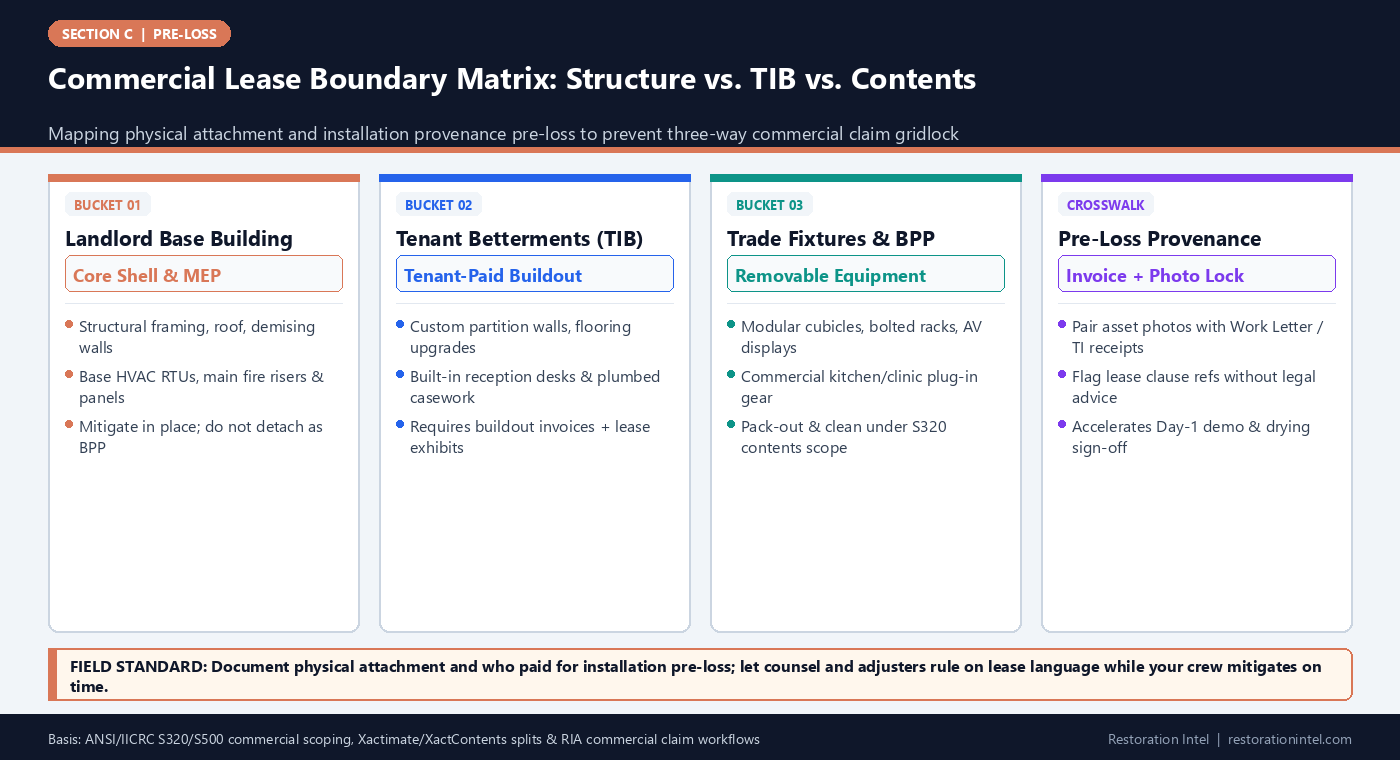
Commercial Suite Asset Boundary Map: Physical Signals & Pre-Loss Proof
How field teams classify physical attachment and gather provenance during commercial pre-loss walkthroughs without practicing law or adjusting.
| Commercial Component | Physical Attachment Signal | Common Boundary Friction Point | Pre-Loss Documentation Required | Mitigation / Pack-Out Consequence |
|---|---|---|---|---|
| Custom Reception Desk & Built-In Millwork | Scribed to walls, caulked, hardwired task lights/data | Landlord claims tenant betterment; tenant assumes movable BPP | Photo of wall/floor scribing + tenant GC buildout invoice + lease Work Letter ref | Determines whether crew dries in place/rebuilds (Xactimate) vs. packs out |
| Modular Cubicles & Demountable Partitions | Freestanding or clipped to floor tracks; unplugged whip | Mistaken for permanent partition walls in wide photos | Show whip disconnect & freestanding base feet + furniture vendor invoice | Cleanly classified as movable BPP for S320 disassembly and vaulting |
| Commercial Kitchen Hoods, Walk-Ins & Grease Traps | Penetrates roof deck, tied to building fire suppression | Split between tenant trade-fixture lease clause and landlord base shell | Close-up of mechanical tie-ins, serial plates, and tenant fit-out contract | Prevents wrongful demolition before carrier subrogation/scope check |
| Structured Data Cabling, Patch Panels & AV Racks | Cabling stapled in plenum; switches mounted in rack | Plenum wire often treated as building infrastructure; switches as BPP | Photo rack front/back, ceiling bundle entry, and IT vendor install bill | Guides IT disconnection vs. structure-drying access cleanly |
| Specialty Flooring (Epoxy, Hardwood, Acoustic Tile) | Adhered or poured directly over landlord concrete slab | Tenants spend $40k on custom floors then lose TI proof after flood | Macro floor edge shot + original flooring contractor invoice saved off-site | Establishes pre-loss upgrade quality over builder-grade concrete/carpet |
| Signage, Security Cameras & Access Controls | Bolted to exterior fascia or wired into suite doors | Municipal/landlord sign riders vs. tenant BPP electronics | Exterior/interior mount photos + security vendor contract/permit copy | Prevents orphaned security repairs during emergency board-up |
Where Commercial Losses Stall: The Structure, Betterments, and BPP Three-Way Gap
When a restoration contractor walks into a flooded medical suite or smoke-damaged restaurant, technical drying under ANSI/IICRC S500 and pack-out under ANSI/IICRC S320 can begin within hours—yet estimate approval routinely stalls for weeks over a single question: Whose policy owns the damaged asset?
Commercial leases commonly allocate base building shell and primary MEP systems to the landlord, while holding the tenant responsible for non-structural interior buildouts, tenant-funded upgrades (Improvements and Betterments), trade fixtures, and movable Business Personal Property. Unfortunately, post-loss debris hides who originally installed the upgraded glass conference wall, whether the custom cabinetry was screwed to blocking or glued permanently, and whether the tenant paid for the supplemental HVAC unit serving the server closet.
As discussed in The Adjuster Desk: One Standard, Two Chairs, splitting estimates cleanly between Xactimate structural/TIB scopes and XactContents movable property schedules starts with pre-loss provenance, not post-loss guesswork.
- Three-way finger-pointing: Without pre-loss buildout receipts, landlord insurers point to tenant TIB, while tenant adjusters argue the fixture became landlord realty upon attachment.
- Hidden tenant-funded upgrades: Tenants often pour $50,000+ into acoustic ceilings, specialty plumbing, or epoxy floors over a ‘vanilla shell’ lease without keeping itemized invoices off-site.
- Day-1 authorization risk: Removing soaked custom cabinetry before clarifying who owns the betterment can leave the restoration contractor caught between two carriers.
Physical Attachment vs. Trade Fixture Signals on Walkthroughs
Because restoration PMs are field building-science practitioners rather than attorneys, your pre-loss walkthrough classifies commercial assets by observable physical attachment and installation provenance. Walk every commercial suite with an eye on how items connect to walls, floors, plumbing, and electrical panels.
Group visible improvements into three clean visual buckets: (1) Plug-and-Play / Movable BPP (items connected by standard cord plugs or quick-disconnects that sit on wheels, pads, or freestanding frames), (2) Attached Trade Fixtures (specialized business machinery, salon stations, dental chairs, or walk-in coolers bolted or plumbed specifically for the tenant’s trade), and (3) Permanent Leasehold Betterments (upgraded partitions, tile, recessed lighting, scribed reception millwork, and built-in counters).
Photograph the exact connection points—under-counter plumbing manifolds, ceiling electrical whips, floor anchor bolts, and wall scribing—because those close-up images give both building and contents adjusters undeniable physical context when splitting scopes.
- Connection-point photography: Shoot the back/underside of islands, hoods, and racks to show hardwired conduit versus removable plug connections.
- Label landlord base equipment: Photograph mechanical tags on landlord-maintained base RTUs and main electrical gear so crews know what belongs to base building management.
- Flag multi-tenant shared corridors: Note lobby directories, common-area restrooms, and shared riser closets outside the tenant’s demised footprint.
Mapping Lease Clauses to Physical Rooms Without Crossing Into Legal Advice
A pre-loss lease boundary map is most powerful when it pairs physical room photos with a simple reference table pointing to where ownership and maintenance duties live inside the lease—specifically the Premises Description, Landlord’s Work Letter, Tenant Improvements Allowance exhibit, Repairs & Maintenance section, and Insurance/Surrender clauses.
Keep a strict professional boundary when assembling this reference sheet. Never tell a commercial client, ‘Your lease makes this the landlord’s problem’ or ‘Your TIB coverage will pay for the flooring.’ Instead, record neutral, verifiable facts: ‘Custom walnut reception desk scribed to north lobby wall; Tenant Buildout Invoice #2023-08 ($18,400) attached; see Lease Section 9.2 (Surrender & Alterations) for owner/counsel/adjuster review.’
Pairing that factual provenance index with your Emergency Services Agreement helps facility managers and corporate risk officers resolve insurance boundary questions with their brokers long before an emergency.
- Index the lease, don’t interpret it: Record exact page/section numbers of the Work Letter and Alterations clause alongside buildout photos for attorney/adjuster review.
- Preserve the ‘Vanilla Shell’ baseline: Save the landlord’s pre-buildout handover photos or architectural plans inside the same folder so tenant-paid upgrades stand out clearly.
- Track subsequent remodels: Log mid-lease tenant buildouts (new exam rooms, added glass offices) whenever CapEx funds are spent.
High-Friction Commercial Components: Millwork, MEP Drops, Low-Voltage, and Specialty Suites
Across commercial restoration jobs, the same four component classes trigger the vast majority of TIB-versus-contents disputes: custom millwork, tenant-added MEP (mechanical, electrical, plumbing) drops, low-voltage IT/security cabling, and specialty industry installations such as dental vacuum lines or restaurant exhaust hoods.
Custom millwork is the classic gray zone. A freestanding laminate credenza is straightforward BPP, whereas a 14-foot quartz-topped reception counter scribed into drywall with concealed conduit belongs on the structural/TIB side of the estimate. Similarly, low-voltage Cat6 runs above ceiling tiles often stay behind when a tenant vacates, whereas the patch-panel switches, firewalls, and UPS batteries mounted inside the rack are classic removable BPP.
Medical, dental, and laboratory suites add another layer explored in Pre-Loss Readiness for Healthcare and Dental Practices: sub-slab plumbing trenches, medical-gas manifolds, and lead-lined X-ray walls sit firmly in leasehold buildout, while chairs, autoclaves, and portable imaging sensors sit on equipment schedules.
- Millwork detachment test: Document whether cabinetry is fastened with exposed brackets or scribed, glued, and integrated into wall base trim.
- Server room split: Separate tenant-added supplemental mini-split AC units (TIB/MEP) from portable server racks and switches (BPP).
- Plumbing/gas stub-outs: Photograph where specialized tenant equipment connects to wall shutoffs so demo crews cap cleanly without damaging landlord mains.
Day-1 Mitigation and Pack-Out Impact: Preventing Wrongful Demo and Split-Carrier Disputes
When water floods a leased retail or office space at midnight, mitigation crews face conflicting pressures: tear out wet base trim and swollen millwork fast to stop microbial growth under ANSI/IICRC S500, yet avoid destroying custom tenant betterments or landlord property without proper authorization and proof.
A pre-loss lease boundary dossier solves this Day-1 dilemma. Before a saw touches wet cabinetry or a crew unbolts a trade fixture, the project manager checks the boundary map: movable BPP and unbolted modular workstations pack out promptly to protect them from secondary humidity, while attached TIB millwork and landlord walls get rapid moisture-mapping, stabilization drying where feasible, and immediate photo/invoice packets sent to both the tenant and property manager.
By separating structural/TIB line items cleanly from movable contents in Day-1 reconciliation, contractors avoid billing one carrier for another party’s asset—keeping cash flow smooth across both building and BPP adjusters.
- Dual-authorization awareness: Keep both the tenant executive and the landlord/property manager emergency contacts inside the pre-loss dossier.
- Stabilize before demo on gray-zone millwork: Dry or contain high-value attached millwork in place while tenant, landlord, and adjusters confirm TIB replacement vs. repair.
- Separate invoice coding from Hour 1: Track mitigation and pack-out labor in distinct job phases (Base Building vs. TIB vs. Movable BPP) from the first work ticket.
Practitioner Verification Checklist (C-06)
- Obtain the tenant’s lease Work Letter, Alterations clause references, and original GC/vendor buildout invoices for off-site cloud storage.
- Walk every commercial room to photograph physical attachment points (wall scribing, plumbing drops, hardwired conduit, floor bolts).
- Group suite assets into three factual provenance buckets—Landlord Base Shell, Tenant-Paid Betterments (TIB), and Movable BPP/Trade Fixtures.
- Keep ‘vanilla shell’ handover photos or architectural floor plans paired with post-buildout walkthrough media to prove tenant-funded upgrades.
- Attach a written compliance note reminding field teams never to interpret lease terms or insurance coverage—refer boundary rulings to counsel and adjusters.
Standards, Authority References & Related Reading
Primary standards, insurance definitions, and sibling Restoration Intel guides referenced in this brief:
- ANSI/IICRC S320 Standard for Professional Contents Restoration
- ANSI/IICRC S500 Water Damage Standard
- Verisk Xactimate Estimating Platform
- Verisk XactContents Platform Overview
- IRMI Insurance Glossary: Replacement Cost Value (RCV)
- Restoration Industry Association (RIA)
- Related Guide: Commercial Business Personal Property (BPP) Pre-Loss Schedules: Aligning Fixed Asset Ledgers with Physical Reality
- Related Guide: Documenting Custom Millwork, Built-In Audio, and Smart-Home Integrations Pre-Loss
- Related Guide: Pre-Loss Readiness for Healthcare and Dental Practices: Separating Leasehold Build-Out from Scheduled Equipment
- Related Guide: From Pre-Loss File to Day-1 Claim Schedule: How Estimators Reconcile Surviving vs Damaged Items After a Loss
- Related Guide: Agreement Is the Product: Emergency Services Agreement
- Related Guide: The Adjuster Desk: One Standard, Two Chairs
.md twin for desk QA and team training.Frequently Asked Questions
Why do commercial claims stall over Tenant Improvements and Betterments (TIB) vs. Contents?
Because a leased suite splits insurance responsibility between the landlord’s building policy and the tenant’s BPP/TIB coverage. Without pre-loss invoices and attachment photos showing who installed upgraded millwork, flooring, cabling, or fixtures, carriers often dispute which policy responds.
Can a restoration contractor determine from a lease whether custom cabinets are Building or BPP?
No. Interpreting commercial lease provisions or insurance policy definitions is legal and adjusting work outside a contractor’s license. Contractors should document physical attachment, installation invoices, and lease section references so the parties’ counsel and adjusters make that determination.
What is the difference between a trade fixture and a permanent leasehold betterment in field terms?
In practical field walkthroughs, trade fixtures are specialized business installations bolted or connected for the tenant’s specific trade (such as dental chairs or bolted kitchen gear), whereas betterments are structural interior upgrades like partition walls, custom flooring, or scribed millwork. Final classification depends on the lease and policy.
Why should tenants save pre-buildout 'vanilla shell' photos alongside finished walkthroughs?
Showing the bare concrete shell before tenant buildout proves that upgraded glass partitions, specialty lighting, epoxy floors, and custom cabinetry were tenant-funded improvements rather than pre-existing landlord property.
How does pre-loss boundary mapping help Day-1 emergency water mitigation?
It gives arriving crews immediate clarity on which movable workstations and equipment can be packed out or manipulated right away versus which attached walls, MEP drops, and custom millwork require coordination with both tenant and building property management.