Direct Answer: Agribusiness pre-loss baselines separate unscheduled farm personal property—tack, shop tools, small implements, and consumable feed—from scheduled rolling machinery and structures while logging chemical/fuel hazards for safe post-loss triage.
.md twin for estimator QA and carrier file documentation.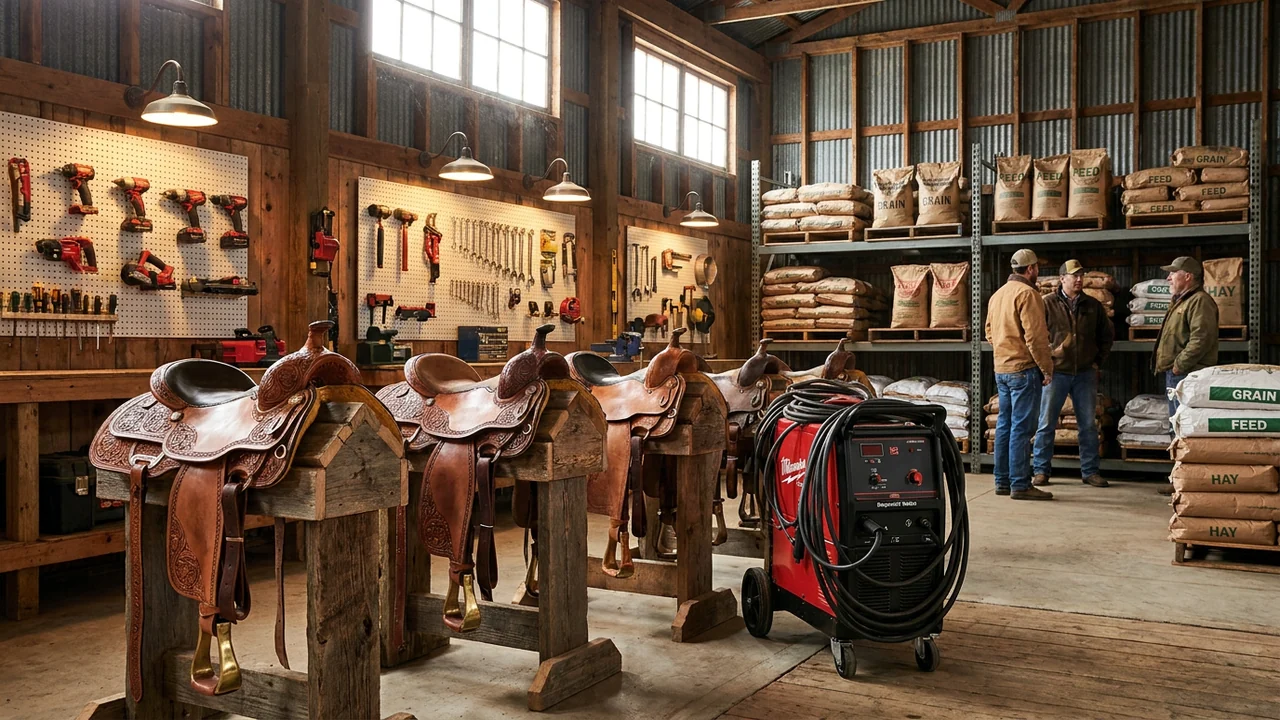
Farmsteads, equestrian facilities, and agribusiness operations concentrate enormous value inside detached barns, pole sheds, tack rooms, and machine shops—often with far looser itemization than urban warehouses. A single outbuilding fire or windstorm can destroy tens of thousands of dollars in mechanic tool chests, custom leather saddles, portable welders, irrigation fittings, veterinary supplies, utility-vehicle attachments, and tons of bagged feed or seed within twenty minutes.
After the event, farm owners and restoration estimators face an immediate documentation hurdle. Heavy tractors and combines are usually scheduled individually by VIN or serial number on agricultural machinery endorsements, whereas thousands of smaller unscheduled items sit under blanket Farm Personal Property or outbuilding contents limits—often without a single photograph or receipt saved off-site. Worse, intense barn fires melt plastic tool cases and char leather tack beyond recognition, leaving only twisted steel remains.
Structured pre-loss capture grounded in ANSI/IICRC S320, IRMI valuation principles, and IRS Publication 547 casualty record concepts bridges that gap, while flagging OSHA HazCom and EPA hazardous material storage zones before emergency crews step inside. Disclaimer: Agricultural policy forms vary significantly across states and carriers; coordinate coverage classifications between scheduled machinery, blanket farm personal property, and commercial agribusiness endorsements with a licensed farm insurance broker.
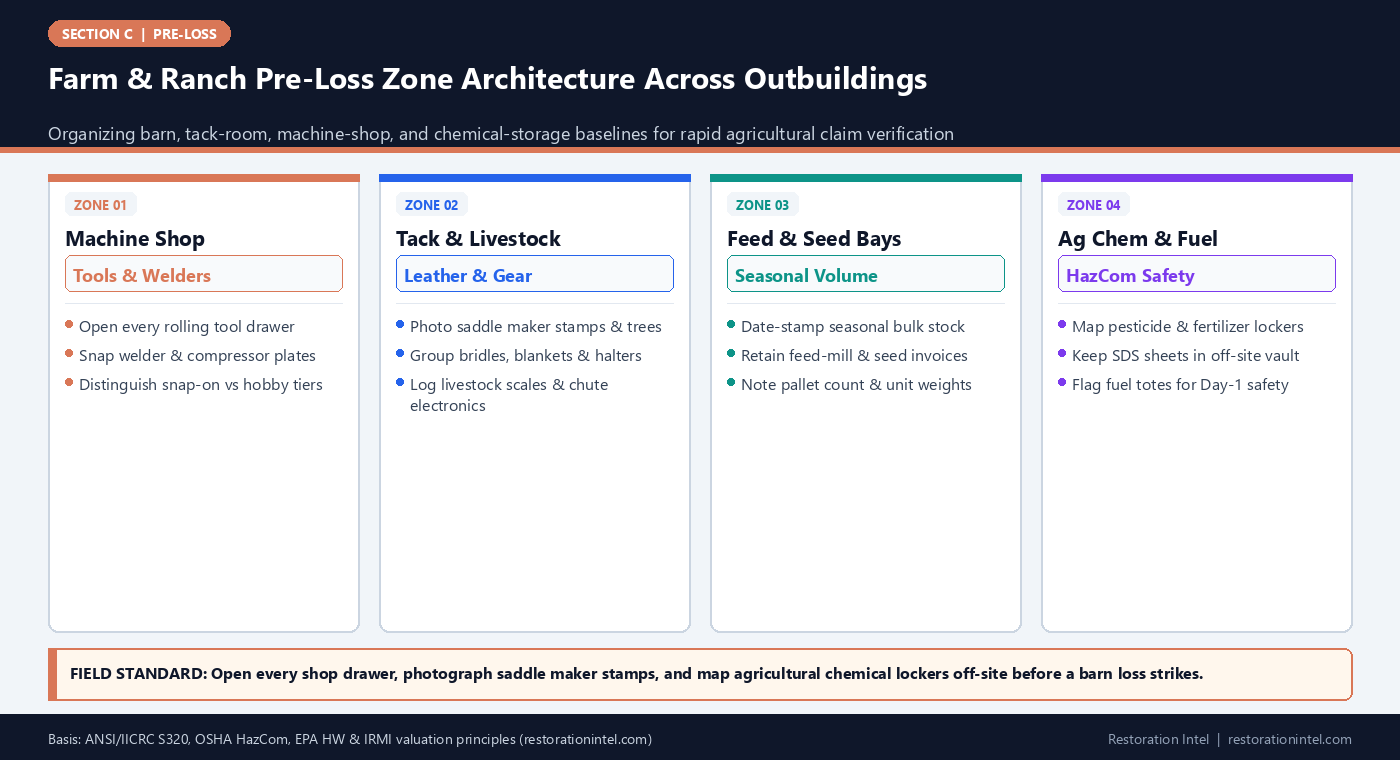
Farm & Ranch Pre-Loss Zone Architecture Across Outbuildings
Agricultural Contents Zones, Proof Requirements & Post-Loss Triage Focus
Practical documentation standards across core farmstead and agribusiness outbuilding categories.
| Agri-Contents Zone | High-Value / Vulnerable Items | Why Claims Stall Without Pre-Loss | Minimum Pre-Loss Proof Set | Safety / Compliance Flag |
|---|---|---|---|---|
| Farm Shop & Fabrication | MIG/TIG welders, plasma cutters, air compressors, hydraulic presses, mechanic drawers | Heat destroys chrome/tool brands; drawer contents impossible to recall from memory | Open-drawer overhead photos + macro plates on welders, compressors, and lifts | Log acetylene/oxygen cylinders & solvent cabinets |
| Tack Room & Equestrian | Custom leather saddles, bridles, horse blankets, clippers, portable stalls | Handcrafted saddle maker stamps & silver trim determine wide price spreads | Individual saddle front/side/maker-stamp shots + rack counts for blankets/tack | Separate boarder-owned tack from ranch-owned tack |
| Small Machinery & Attachments | Chainsaws, pole saws, ATVs/UTVs, brush cutters, loader buckets, post-hole augers | Confusion between scheduled farm vehicles vs unscheduled portable tools | Serial-plate close-up + wide unit photo tied to barn/shed ID | Confirm scheduled vs unscheduled status with broker |
| Feed, Hay, Seed & Grain | Bagged rations, mineral tubs, certified seed pallets, hay bales, bulk bin stores | Inventory swings wildly by harvest and winter stocking cycle | Monthly/quarterly stock photos + feed-mill delivery tickets vaulted off-site | Flag wet-hay spontaneous combustion & mold risks |
| Vet, Barn & Irrigation Parts | Vaccines/refrigerated vet kits, submersible pumps, drip manifolds, solar fencers | Tiny high-dollar brass valves and electronics melt into unrecognizable scrap | Bin-level parts shelf photos + supplier invoice folder by season | Quarantine expired or temperature-abused biologics post-loss |
| Ag Chemicals, Oils & Fuels | Herbicides, pesticides, bulk lubricants, DEF, diesel transfer tanks | Undocumented chemical inventories block crew entry after fire or flood | Locked cabinet exterior/interior photos + digital SDS binder off-site | OSHA HazCom & EPA waste protocols govern disposal |
Mapping Every Outbuilding and Separating Scheduled vs. Unscheduled Gear
Urban properties have street addresses and numbered rooms; working farms and ranches have ten or twelve outbuildings scattered across acreage—East Hay Barn, Quonset Shop, Calf Shed, Tack Room, Pump House, and Grain Annex. Without a master site map assigning unambiguous building IDs, post-loss claim schedules blur which tools sat inside Building 3 versus Building 7, creating headaches when separate outbuilding sublimits or deductibles apply.
Start the agribusiness baseline with a clean aerial or sketch site map labeling every barn, shed, container, and lean-to. Inside each structure, apply the same room-zone discipline outlined in Detached Outbuilding Pre-Loss Capture: walk the perimeter clockwise, then document central bays. Crucially, cross-check heavy equipment against the owner’s insurance schedule with their broker so scheduled tractors, trailers, and combines carry a distinct tag from unscheduled hand tools, three-point attachments, and portable generators.
That boundary prevents double-counting while ensuring unscheduled attachments—such as pallet forks, rotary cutters, auger bits, and PTO sprayers parked along fence lines or shed walls—are fully documented with serial tags and purchase records.
- Building ID signage: Post weather-resistant building numbers or names visibly inside the main barn door so wide photos self-identify.
- Three-point attachment sweep: Photograph detached tractor implements lined up in machinery rows; they are frequently forgotten during shop walkthroughs.
- Condition baseline: Capture honest overall condition photos on older machinery and tools to support Actual Cash Value (ACV) vs RCV discussions fairly.
Tack Rooms and Rolling Tool Chests: Proving Quality Tiers Before Fire or Theft
Two agricultural rooms carry massive hidden value per square foot: the tack room and the mechanic’s tool chest. To an untrained desk examiner, a saddle looks like a saddle and a wrench drawer looks like generic hardware. In reality, a custom handcrafted roping or dressage saddle, solid-brass harness hardware, or a 72-inch professional mechanic chest packed with USA-made impact sockets and diagnostic scan tools can represent tens of thousands of dollars in specialized replacement cost.
Standard wide-room video fails inside both environments. To protect quality tiers, open every rolling tool cabinet drawer one by one from top to bottom, holding the camera 18 to 24 inches overhead for a sharp still photo while narrating brand tiers (e.g., professional truck-brand vs big-box) and approximate set completeness. In tack rooms, photograph every saddle individually on its rack, including a macro shot of the maker’s leather stamp, serial number under the skirt, and tree/seat specifications.
If the operation boards horses or allows ranch hands to store personal tools on site, separate personal or boarder-owned tack onto visibly labeled racks. Mixing third-party property into general barn photos creates ownership disputes during claim settlement.
- Open-drawer cadence: Pull only one heavy tool drawer open at a time so cabinets never tip during rapid capture.
- Saddle maker macro: Always capture the leather builder stamp, rigging hardware, and billet condition on every saddle.
- Boarder boundary tag: Mark client-owned tack stalls clearly so ranch baselines reflect true ownership.
Handling Volatile Consumables: Feed, Seed, Fertilizer, and Fuel Stocks
Unlike office furniture, agricultural consumables fluctuate dramatically by season. A feed room or seed shed holds minimal volume right before spring planting or late summer harvest, then fills with pallets of mineral supplements, baled forage, bulk seed totes, and winter rations a few weeks later. A static annual photo taken during an empty off-season month understates peak exposure when a storm hits right after delivery.
The most practical pre-loss control for consumables is pairing baseline bay capacity photos with a rolling digital receipt trail. Capture photos showing typical full pallet stacks alongside painted bay markers, then drop feed-mill tickets, fertilizer delivery invoices, and seed-dealer statements into an off-site cloud folder monthly. After a casualty loss, estimators can reconcile delivery invoices from the preceding 60 to 90 days against consumption rates—consistent with documentation principles in IRS Publication 547.
Remember also that wet grain, soaked bagged feed, and damp baled hay rapidly develop mold and exothermic heating risks after water intrusion; pre-loss delivery tickets prove volume even when spoiled feed must be hauled away quickly for animal health.
- Peak-season snapshot: Capture an extra 5-minute walkthrough right after major fall hay/feed or spring seed deliveries.
- Delivery ticket vault: Snap smartphone photos of paper feed-mill and co-op scale tickets into a dated cloud folder before tossing originals.
- Veterinary refrigeration log: Note backup-generator status and typical vaccine/biologic inventory stored in barn refrigerators.
Agricultural Chemical, Fuel, and Hazard Mapping for Day-1 Crew Safety
Every farm shop and chemical shed stores materials that become acute hazards during fire, flood, or structural collapse: restricted-use pesticides, anhydrous or granular fertilizers, hydraulic fluid drums, gasoline/diesel transfer tanks, oxy-acetylene torches, and lithium battery packs for cordless fencing and tools. When restoration crews arrive after a fire or flood, undocumented chemical storage halts entry until hazmat screening clarifies what ruptured.
Incorporating a hazard zone map inside the pre-loss baseline protects both human responders and claim documentation. Photograph chemical lockers, fuel containment berms, and welding-gas racks clearly, and maintain digital Safety Data Sheets (SDS) in the off-site dossier in alignment with OSHA HazCom practices. Note plainly which zones require environmental/hazmat clearance under EPA hazardous waste rules before standard contents technicians enter.
Giving first responders and restoration PMs an exact chemical inventory on Day 1 speeds safe perimeter setup, prevents illegal disposal of fire-damaged ag chemicals, and keeps non-hazardous shop equipment moving cleanly into stabilization.
- Digital SDS binder: Keep current PDFs of Safety Data Sheets for stored herbicides, cleaners, and fuels in the cloud dossier.
- Pressurized cylinder mark: Pin propane, welding gas, and compressed-air cylinder locations on the barn sketch map.
- Containment separation: Store agricultural chemicals in dedicated cabinets away from feed, veterinary supplies, and leather tack.
Practitioner Verification Checklist (C-23)
- Assign unique building IDs to every barn, shop, tack room, and outbuilding on a master site map synced to photo folders.
- Open every mechanic tool drawer top-to-bottom and capture close-ups of welder, compressor, and small-implement serial plates.
- Photograph each saddle individually with maker stamps and separate boarder-owned or employee-owned gear onto labeled racks.
- Pair bay capacity photos with rolling off-site cloud storage of feed-mill, seed, and co-op delivery tickets for seasonal stock proof.
- Document agricultural chemical lockers, fuel tanks, and welding cylinders with off-site SDS sheets for safe Day-1 hazmat triage.
Standards, Authority References & Related Reading
Primary standards, insurance definitions, and sibling Restoration Intel guides referenced in this brief:
- ANSI/IICRC S320 Standard for Professional Contents Restoration
- OSHA Hazard Communication Standard (HazCom)
- US EPA Hazardous Waste Framework
- IRMI Insurance Glossary: Actual Cash Value (ACV)
- IRS Publication 547: Casualties, Disasters, and Thefts
- Related Guide: Garage, Shed, and Detached Outbuilding Pre-Loss Capture: Power Tools, Lawn Equipment, and Recreational Gear
- Related Guide: Pre-Loss Serial Plate and Invoice Vaulting: Organizing Digital Proof So Fire or Flood Doesn't Destroy It
- Related Guide: Pre-Loss Baseline Refresh Cadence: Triggering Updates After Remodels, CapEx, and Holiday Acquisitions
- Related Guide: From Pre-Loss File to Day-1 Claim Schedule: How Estimators Reconcile Surviving vs Damaged Items After a Loss
- Related Guide: A Price Tag on a Lost Item Is Worth Nothing
.md twin for desk QA and team training.Frequently Asked Questions
How should farm tools and attachments be separated from scheduled machinery in a pre-loss file?
Cross-check your policy’s scheduled equipment list with your farm insurance broker, tag VIN/serial-scheduled tractors separately, and group unscheduled shop tools, portable generators, and three-point attachments under building-indexed farm personal property.
What is the fastest way to document a large mechanic's tool chest without logging every single wrench?
Shoot a wide shot of the cabinet, then pull one drawer open at a time for sharp overhead photos while narrating the brand tier (e.g., truck-brand vs retail) and drawer function.
Why do feed and seed inventories need rolling invoices in addition to photos?
Agricultural stock levels swing sharply with harvests and seasonal deliveries; recent co-op and feed-mill delivery tickets paired with bay photos verify quantities on hand at the date of loss.
Why include pesticide and fuel lockers in a contents pre-loss baseline?
Because fire- or flood-damaged agricultural chemicals pose severe safety and EPA disposal hazards; giving crews an off-site inventory and SDS packet accelerates safe triage and prevents improper disposal.