Direct Answer: A 30-day contents technician onboarding curriculum turns zero-experience hires into audit-ready field operators by sequencing PPE safety and custody habits in Week 1, room-sweep and macro-capture drills in Week 2, dish-pack and vault-labeling craft in Week 3, and live supervised room sign-offs in Week 4.
.md twin for estimator QA and carrier file documentation.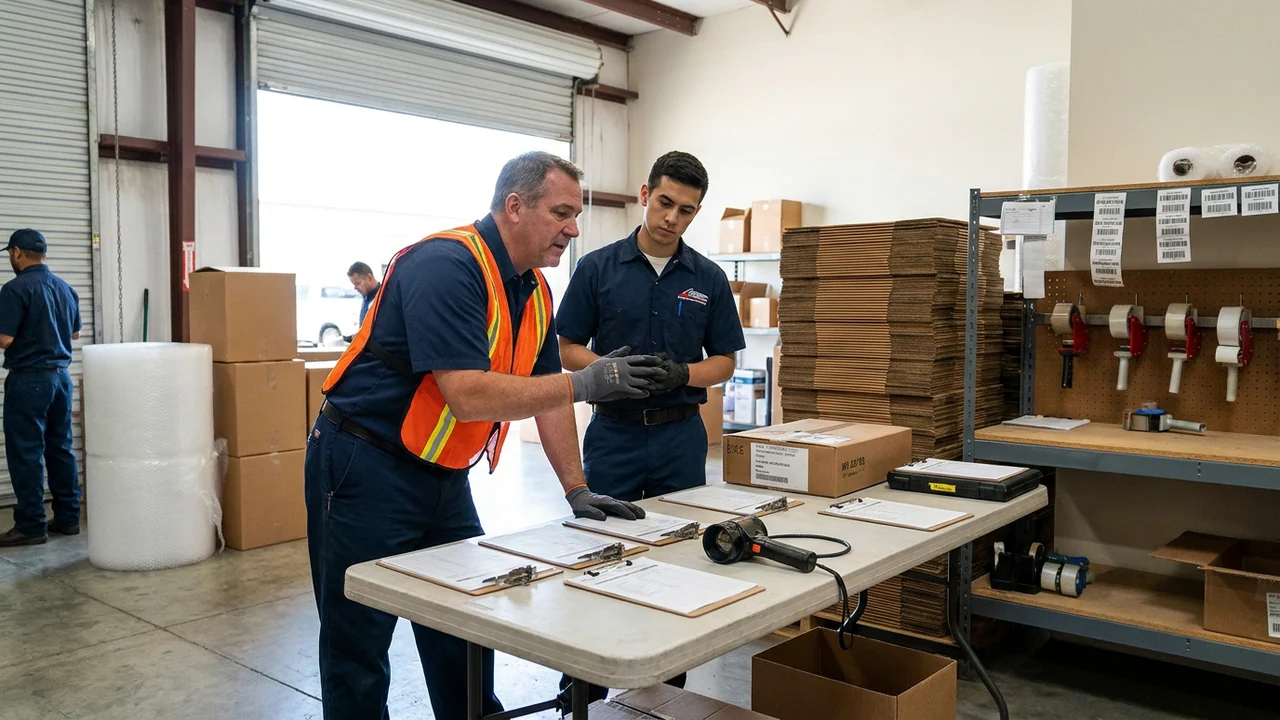
Most contents divisions lose new hires—and burn estimator hours—because they treat onboarding as riding along with a busy crew and carrying boxes until something breaks. Without a structured 30-day curriculum, a brand-new technician picks up whatever shortcuts the nearest lead uses on a rushed Friday afternoon: unlabeled cartons, blurry rating-plate photos, flat-stacked dinner plates, and silent walkthrough clips that give the estimating desk zero usable specifications.
Building audit-ready field technicians requires separating physical moving stamina from forensic custody craft. Under the ANSI/IICRC S320 Standard for Professional Contents Restoration and Restoration Industry Association (RIA) field expectations, every technician touching a policyholder’s belongings is simultaneously protecting physical condition and generating the evidentiary trail that justifies XactContents line items and storage custody.
As explored in The Hands Were Always the Bottleneck, software only scales as fast as the crew holding the tablet and packing paper. A week-by-week onboarding ladder with objective pass gates turns raw labor into reliable room-capture operators inside a single payroll month.
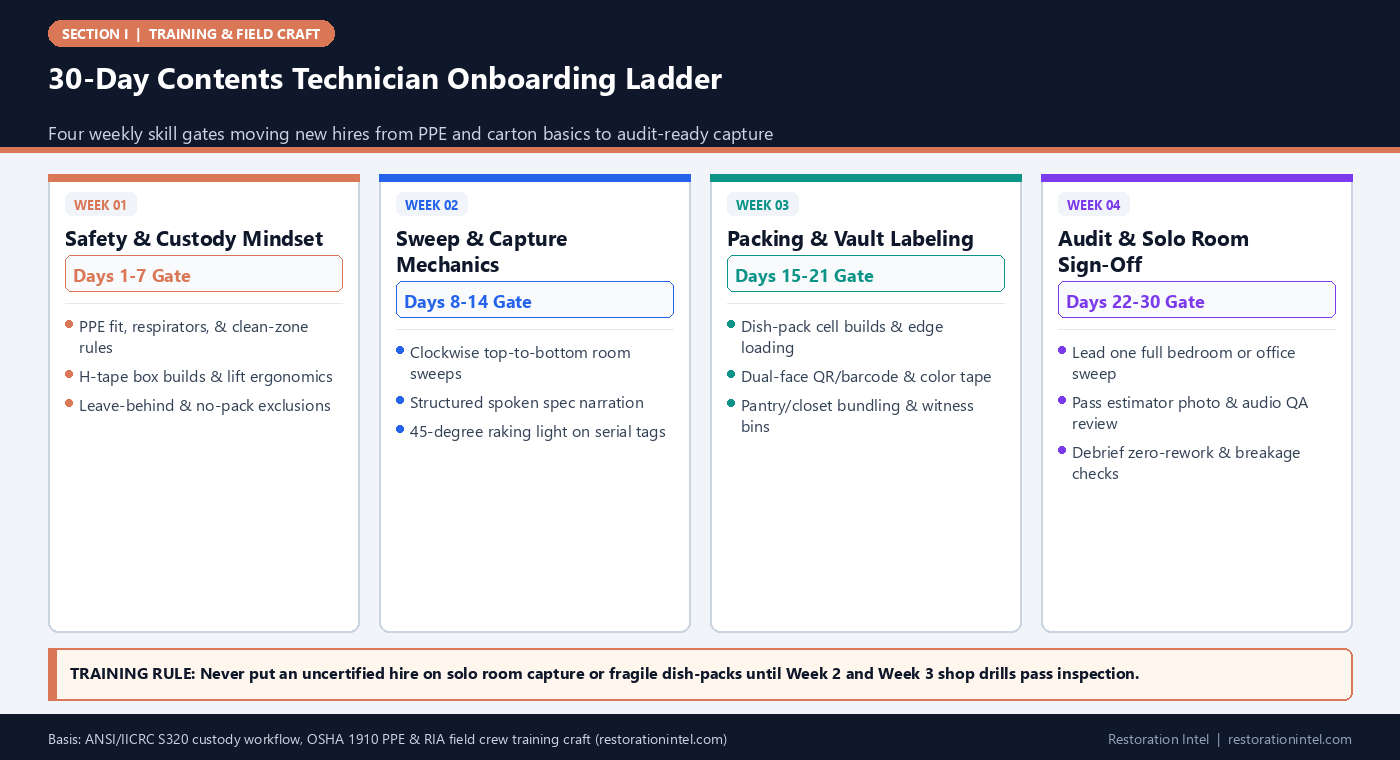
30-Day Contents Technician Onboarding Ladder
30-Day Field Technician Progression & Certification Gates
Objective weekly competencies and verification drills before advancing a trainee to independent room custody.
| Training Phase | Core Field Craft Modules | Shop / Mock-Room Drill | Live Job Role Boundary | Pass Gate Verification |
|---|---|---|---|---|
| Week 1: Foundations | OSHA 1910 PPE, respirator seal, clean/dirty containment zippers, carton assembly, H-taping, team lift limits | Build 10 double-wall boxes and stage a mock clean-zone entry barrier | Runner and staging helper only; no solo room capture or fragile wrapping | Crew lead signs off PPE donning/doffing and carton seam strength |
| Week 2: Capture Craft | Clockwise top-to-bottom room sweeps, spoken object narration, raking-light macro photos, leave-behind list | Capture a mock 40-item office with obscured serial plates and noisy fan audio | Shadow lead on capture tablet; second-chair photo verification | Estimator confirms 100% legible serial plates and clear spoken specs |
| Week 3: Packing & Custody | Dish-pack cell geometry, vertical plate loading, dual-face barcode/QR + color tape, pantry bundling, witness bins | Pack a 24-piece china and stemware mock dish-pack and pass drop-tilt shake test | Pack standard hard goods and linens; supervised fragile wrapping | Warehouse lead verifies zero rattle, correct weight, and dual-face labels |
| Week 4: Integrated Execution | Split-room zone handoffs, partial pack-back prep, customer boundary language, end-of-shift manifest audit | Run end-to-end capture, pack, label, and digital manifest reconciliation | Lead one low-complexity room end-to-end under spot supervision | RPM + estimator audit shows zero double-logged or missing custody IDs |
Week 1: Safety, Leave-Behind Boundaries, and Physical Carton Discipline
Day one belongs to hazard control and custody boundaries, not camera apps. Before a trainee opens a closet door on a fire or Category 3 loss, they must demonstrate proper donning, doffing, and decontamination awareness aligned with OSHA 1910.132 PPE standards and OSHA 1910.134 respiratory protection. Putting an untrained hire into soot or microbial dust without fit-checked protection and clean-zone hygiene creates both medical risk and cross-contamination across clean staging hallways.
Alongside safety, Week 1 drills physical box craft inside the shop before touching a client’s kitchen. Trainees learn how to square double-walled cartons, seal bottom flaps with an H-tape overlap that holds under humidity, and enforce safe single-person weight caps so heavy books never burst out of medium cartons.
Equally critical in Week 1 is the no-pack list. New hires must memorize what never leaves with the crew—cash, prescription medications, firearms, unsecured jewelry, vital deeds, and open aerosols—so they immediately summon the crew lead rather than tossing high-liability items into an everyday dresser box.
- No blind box grabs: Trainees learn to stop and call the lead whenever they encounter safes, pill bottles, currency, or unmarked chemical jugs.
- Containment etiquette: Practice zipping poly barriers closed behind every cart pass and wiping glove surfaces before handling clean tape guns.
- Safe lifting posture: Pair heavy case goods automatically and cap book/linen carton weights before loading dollies.
Week 2: Building Audit-Ready Room Sweeps, Narration, and Macro Capture
Once physical habits are steady, Week 2 teaches the trainee to see a room like an estimator and an insurance desk reviewer. Shop mock-ups set up with a bookshelf, desk, utility corner, and small closet let new hires practice repeatable clockwise, top-to-bottom sweep paths without the pressure of an upset homeowner watching over their shoulder.
During these mock drills, instructors pair every tablet movement with spoken audio narration: room name, quantity, object type, material or brand tier, visible peril damage, and target box ID. Trainees immediately hear how mumbling, talking while turning away from the mic, or skipping brand names leaves gaps when they listen back to their own footage.
Macro lighting rounds out Week 2. Using a pocket inspection light at a 45-degree oblique angle, trainees practice photographing faded aluminum HVAC tags, tarnished brass plaques, and dark under-sink appliance stickers without flash glare obscuring the model and serial digits needed for XactContents valuation.
- Same-day playback review: Have trainees watch ten minutes of their own practice video beside an estimator to spot missing angles immediately.
- Zero digital-zoom rule: Coach hires to step physically closer or use optical lens framing rather than pinching digital zoom on rating plates.
- Establishing shot habit: Require four-corner untouched room stills before opening any drawer or moving a single chair.
Week 3: Fragile Packing Geometry, Bundling, and Dual-Face Vault Labeling
Week 3 shifts from capture into protective pack-out craft—the work that prevents transit breakage claims while items sit in climate-controlled vaults for months. Inside the warehouse training bay, trainees build dish-packs from scratch: crumpled paper base cushions, individually wrapped stoneware standing vertically on edge, cell dividers for stemware, and top void fill that absorbs vertical pallet stacking.
They also learn when NOT to individually photograph low-value bulk items. Pantry cans, spice racks, bathroom linens, and closet hangers follow structured count-and-bundle rules so a two-hour closet pack does not turn into four hundred redundant photos that choke estimating queues.
Every box packed in Week 3 receives dual-face barcode or QR custody tags and room color-coded tape strips before leaving the packing table. Trainees test label adhesion on dry-wiped corrugated faces and reconcile each box ID against the job manifest, reinforcing why a pack-out record must preserve exact traceability.
- Shake-and-press test: Gently rock every sealed dish-pack and press the lid; any internal shift or soft dome requires repacking before tape-off.
- Witness-bin staging: Practice laying out non-salvageable items in clear grid rows with scale references rather than tossing them into contractor bags.
- Dual-corner labeling: Place labels on adjacent side panels so warehouse rack operators never have to unstack pallets to scan a box.
Week 4: Supervised Live Room Ownership and Estimator Audit Feedback
In the final week of the 30-day curriculum, the trainee transitions from helper to supervised room lead on an actual loss. Rather than throwing them into a soot-heavy kitchen or fine-china dining room, the crew lead assigns a guest bedroom, home office, or secondary den where they execute the entire cycle: baseline stills, clockwise sweep, audio capture, carton packing, dual-face labeling, and vault manifest handoff.
The decisive test happens after the truck returns to the shop. The estimator or QA lead audits the trainee’s room packet against five criteria: zero missed closets or drawers, readable brand/model stills, clean spoken descriptions, accurate box-to-item counts, and zero unmarked fragile or high-value gaps.
Instead of treating audit flags as disciplinary write-ups, the division lead reviews them in a structured 10-minute morning huddle. When a new technician fixes one recurring habit—such as forgetting to close drawers after shooting them or omitting material callouts on picture frames—within 24 hours of feedback, the 30-day ramp closes with genuine field autonomy.
- Signed graduation rubric: Require both crew lead field sign-off and estimator desk sign-off before solo room dispatch.
- Breakage and rework log: Track any repacked cartons or missing photo requests during Days 22-30 to target follow-up coaching.
- Cross-track visibility: Have the trainee sit beside the estimator for 30 minutes watching their own room packet turn into a claim schedule.
Practitioner Verification Checklist (I-01)
- Verify OSHA PPE fit, clean-zone barrier habits, and memorized leave-behind exclusions during Week 1 before live site dispatch.
- Require trainees to pass a mock 40-item room-sweep, audio-narration, and oblique serial-plate macro drill in Week 2.
- Inspect trainee-packed mock dish-packs via shake test, edge-loaded plate orientation, and top-crush resistance in Week 3.
- Audit dual-face barcode/QR placement and room color-tape consistency across every carton sealed during training.
- Complete an estimator and crew-lead dual sign-off on one full supervised room capture before clearing the tech for solo zones.
Standards, Authority References & Related Reading
Primary standards, insurance definitions, and sibling Restoration Intel guides referenced in this brief:
- ANSI/IICRC S320 Standard for Professional Contents Restoration
- Restoration Industry Association (RIA)
- OSHA 1910.132 Personal Protective Equipment Standard
- Verisk XactContents Platform Overview
- Related Guide: Room-Sweep Discipline: Teaching Technicians a Repeatable Clockwise & Top-to-Bottom Capture Pattern
- Related Guide: Audio Narration Training: Coaching Field Crews to Speak Specs Clearly Without Slowing Pack-Out Speed
- Related Guide: Macro Lighting & Focus Technique for Faded Serial Tags, Brass Nameplates, and Dark Utility Closets
- Related Guide: Box Packing Geometry & Dish-Pack Engineering: Preventing Transit Breakage Claims During Vault Storage
- Related Guide: The Hands Were Always the Bottleneck
.md twin for desk QA and team training.Frequently Asked Questions
How long does it take to train a zero-experience contents hire to run rooms solo?
With a structured 30-day curriculum pairing shop mock-ups with daily estimator QA feedback, most attentive hires can safely capture and pack low- to medium-complexity rooms by Week 4. High-value kitchens, fine china, and complex AV racks still require experienced lead oversight beyond Day 30.
Why should trainees learn estimating quality and photo audits before solo pack-out?
Watching an estimator try to price blurry photos or vague ‘misc decor’ box labels teaches new technicians immediately why angle, lighting, and spoken brand callouts matter in the field.
What is the biggest mistake companies make when onboarding contents technicians?
Using new hires strictly as muscle to haul tape-sealed boxes for months without teaching room-sweep sequences, narration, or macro focus, then suddenly expecting them to lead documentation on a busy CAT loss.
Should Week 1 trainees handle customer-facing total-loss conversations?
No. New hires should refer any salvageability, coverage, or disposal questions directly to the crew lead or project manager while learning empathetic listening and clean-zone professionalism.