Direct Answer: Vault labeling systems survive high-humidity sites and multi-month rack stacking when crews wipe dry carton corners, apply dual-face barcode or QR custody labels sealed under clear acrylic tape on two adjacent sides, pair each room with distinct color-coded tape bands, and lock every scan to a digital vault index.
.md twin for estimator QA and carrier file documentation.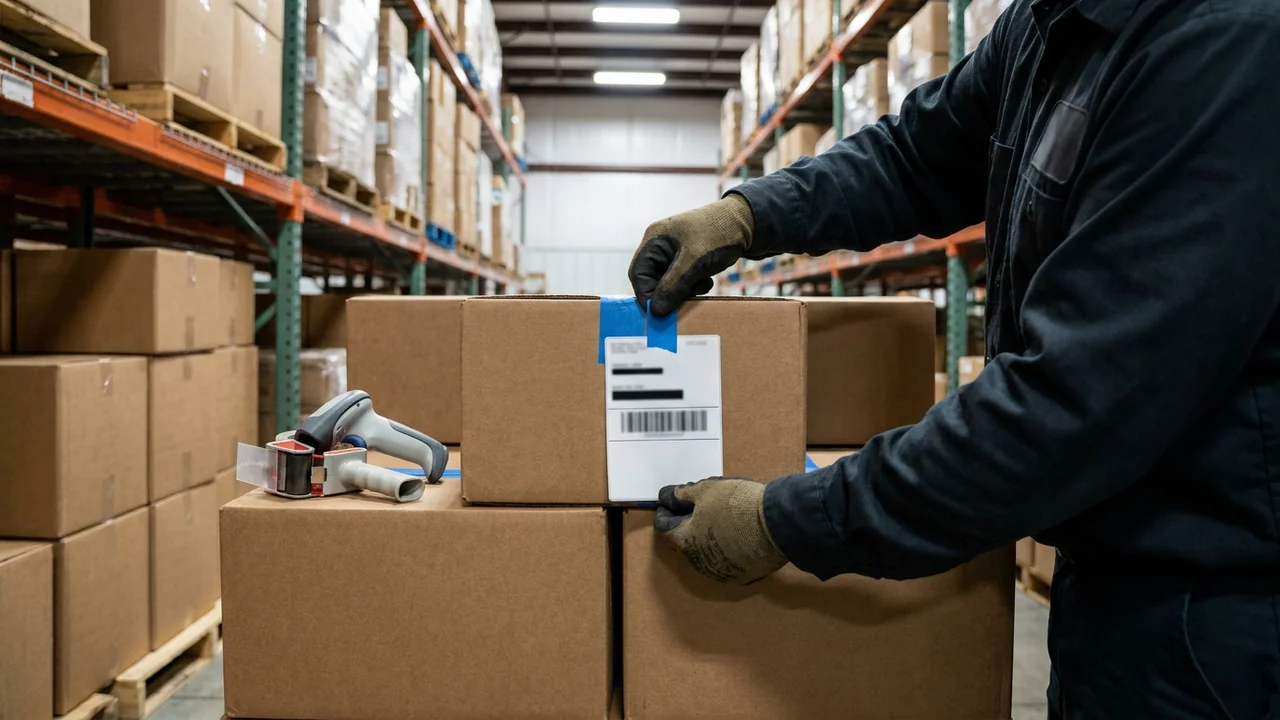
A handwritten Sharpie note scrawled across the top flap of a moving box works fine when a homeowner moves across town on Saturday afternoon. Inside an active restoration claim—where boxes sit in damp mitigation staging rooms, ride wet liftgates, undergo deodorization fogging, and stack five-high inside wooden storage vaults for four months—flimsy labeling fails completely. Top-flap labels disappear the moment another carton stacks on top, cheap thermal stickers fade dark or peel off in humidity, and illegible handwriting forces warehouse staff to cut open twenty boxes just to locate one winter coat.
Under ANSI/IICRC S320 chain-of-custody standards, box identification is a physical system as well as a digital record. As underscored in Nobody Could Tell Me Where the Rug Was, the moment a carton or wrapped rug loses its readable link back to room origin and line-item inventory, customer trust collapses and unbilled warehouse search labor climbs rapidly.
Combining scannable barcode or QR tags with room color-coded tape bands, moisture-resistant adhesive discipline, and dual-face corner placement creates a vault labeling system that works as cleanly on day ninety of pack-back as it did on day one.
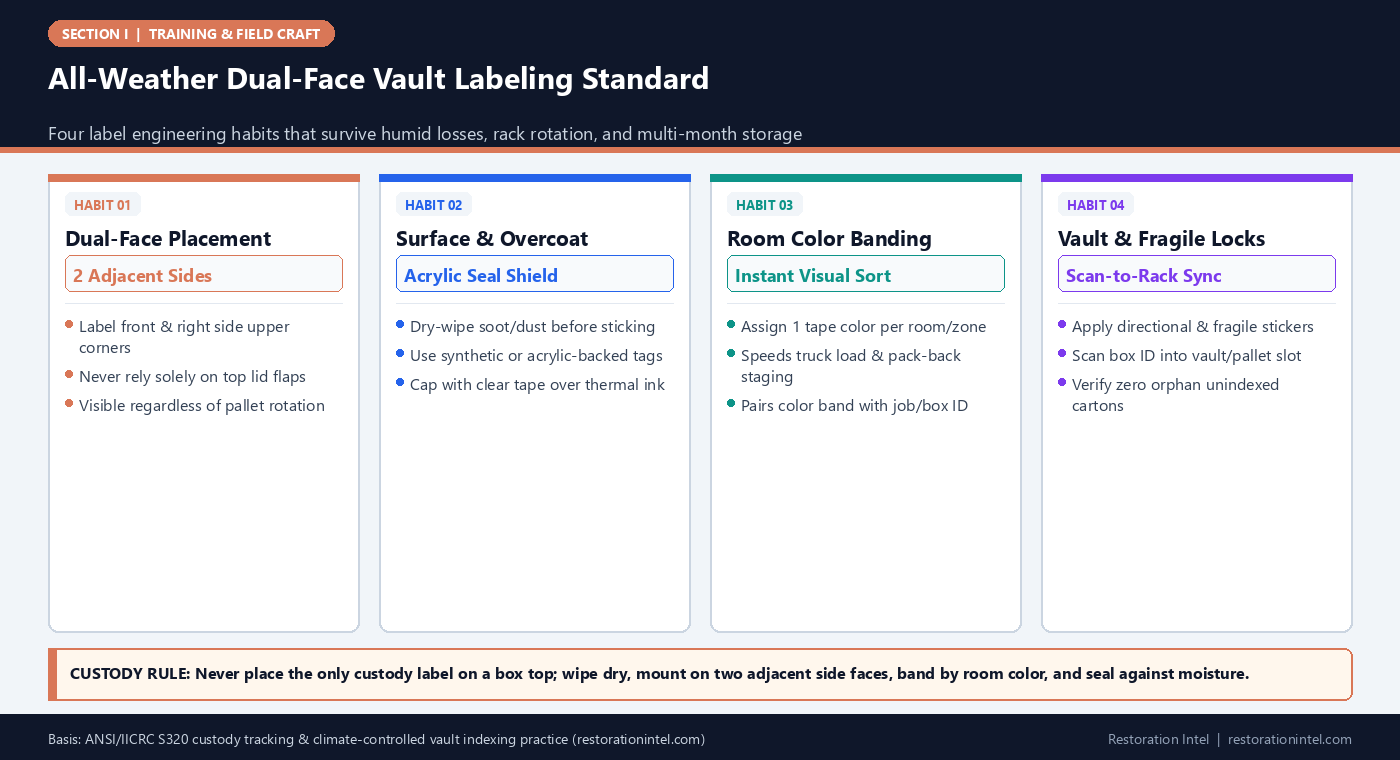
All-Weather Dual-Face Vault Labeling Standard
Labeling Materials, Adhesive Risks & Vault Survival Controls
Why standard office labels peel or fade on restoration sites and the exact field specification that holds through rebuild storage.
| Label / Marker Component | Common Field Failure Mode | Site Condition Trigger | Restoration-Grade Spec | Placement & QA Rule |
|---|---|---|---|---|
| Custody Barcode / QR Sticker | Corners curl and sticker drops onto truck floor inside 48 hours | High indoor humidity, cold garage air, or dusty corrugated surface | Polypropylene or coated thermal-transfer stock with high-tack acrylic adhesive | Dry-wipe box corner first; press firmly across full surface and seal under 3-inch clear tape |
| Direct Thermal Printed Labels | Print darkens black or fades unreadable after warm warehouse storage | Heat exposure, ozone/hydroxyl odor treatment, or friction rub | Thermal-transfer ribbon labels or laser-printed polyester stock | Avoid direct-thermal shipping stickers for multi-month vault claims; shield with clear film |
| Room Color-Coded Tape Band | Wrong rooms mixed into same rebuild drop-off zone on pack-back | Multiple bedrooms or commercial offices carrying similar box counts | 2-inch high-visibility colored painter's or vinyl packing tape per room | Wrap short visible flag on same two adjacent corners next to the barcode label |
| Permanent Marker Backup Text | Alcohol ink bleeds or fades on brown kraft cartons after fogging | Solvent/deodorizer mist or wet wiping during clean-zone exit | Industrial paint-marker or bold broad-tip archival ink over white label zone | Write Job ID, Room Code, and Box # (e.g., KIT-04) beside printed barcode as human fallback |
| Soft Furniture / Rug Tyvek Tag | Paper hang-tags tear off during forklift handling or ultrasonic/wet cycles | Tight strap friction, wet cleaning, or long rack suspension | Tear-proof Tyvek tag looped with heavy zip-tie plus secondary frame sticker | Attach directly to non-removable structural frame/strap and match scan to photo |
Why Top-Flap Labeling Fails and Dual-Face Corner Geometry Wins
Watch a warehouse crew unload a packed box truck into five-foot-tall wooden storage vaults. Boxes are rotated sideways to lock tightly like Tetris blocks, stacked four layers high, and pushed flush against rear vault walls. Any custody sticker placed solely on the top lid becomes completely invisible the second box number two lands on top of it, and single-side labels vanish whenever a loader turns that face toward the interior wall.
Solving blind stacks requires one rigid placement geometry: apply identical custody labels on the upper-left corner of TWO adjacent vertical side panels—front and right side, or front and left side—every single time. No matter how a loader rotates a carton to fit a vault bay or pallet rack, at least one scannable barcode and room code faces the aisle.
Placing labels consistently in the upper corner rather than dead center also protects them from strapping bands and dolly forks while keeping codes at natural standing eye level during vault rack audits.
- Two-face minimum: Every sealed carton, mirror box, and wardrobe receives matching custody IDs on two adjacent upright walls.
- Never rely on lid-only tags: Top flaps may carry ‘THIS SIDE UP’ orientation arrows, never the sole tracking barcode.
- Consistent upper-corner zone: Keep labels within three inches of the top-left corner so pallet scanners find them at a glance.
Surviving Humidity, Soot Film, and Deodorization Cycles
Standard office address labels rely on thin rubber-based adhesives designed for dry climate-controlled mailrooms. Stick one onto a damp basement cardboard carton or a soot-dusted garage box, and within two days the adhesive softens or dust breaks contact, leaving loose barcodes scattered across the truck floor.
Before peeling any custody label off its liner, teach crews the two-second dry-wipe step: sweep the cardboard corner with a clean dry rag or gloved palm to clear loose ash, drywall dust, or surface condensation. Use polypropylene or synthetic thermal-transfer labels backed with high-tack acrylic adhesive—which actually builds bond strength over 24 hours rather than drying brittle in cold storage.
On jobs exposed to high humidity, wet-cleaning wash bays, or thermal/hydroxyl deodorization chambers, press a single smooth strip of clear acrylic packing tape straight over the printed label (smoothing out bubbles without crinkling barcode bars). That protective overcoat shields ink from moisture smear and prevents carton friction from peeling corners during loading.
- Skip cheap direct-thermal paper: Heat-sensitive shipping labels turn black near deodorizing heaters or fade over 90-day summer storage.
- Clear-tape barcode test: Always test-scan a taped-over barcode with crew phones in the shop—matte or frosted tapes can scatter scanner beams; use optical-clear acrylic tape.
- Tyvek tags for textiles and rugs: Loop tear-resistant Tyvek tags onto rolled rugs, mattresses, and wrapped sofas where cardboard stickers do not adhere.
Pairing Room Color-Coded Tape With Structured Human-Readable Codes
Barcodes and QR tags excel at database lookup, yet crews still need instant macro visibility when staging twenty boxes onto a truck ramp or dropping forty cartons back into a finished four-bedroom house. Waiting for a helper to scan every box just to tell a master bedroom carton apart from a basement office carton slows pack-back delivery to a crawl.
Assigning one distinct 2-inch color tape band per room or building wing solves sorting speed instantly: blue for Primary Bedroom, green for Kitchen, yellow for Living Room, orange for Basement, red for Non-Salvageable / Quarantine, and bright white/black stripe for High-Priority Return items. Place a clean four-inch color strip right beside the barcode on both labeled corners.
Pair the color band with a bold human-readable code matching the digital manifest—such as Job Shortcode + Room Prefix + Box Sequence (`SMITH-KIT-08`)—so even if a tablet battery dies mid-unload, any team member can route boxes accurately by sight and shared room taxonomy.
- Color key on truck door: Tape the job’s room-to-color legend inside the box truck rear frame and inside Vault 01 so relief drivers never guess.
- Reserve red tape strictly: Dedicate red tape exclusively to quarantine, hazmat, or non-salvageable witness bins so clean rooms never receive contaminated items.
- Priority return stripe: Add a bright neon dot or ‘OPEN FIRST’ band on daily medications, coffee makers, kids’ school supplies, and work essentials.
Locking Physical Labels to Digital Vault and Rack Manifests
A pristine QR sticker means nothing if the warehouse rack it sits inside is unmapped. Custody breaks most often at the transition between truck tailgate and warehouse bay: a crew packs fifty boxes accurately on site, unloads them at 6:00 PM Friday into two vaults and an overflow rack, and forgets to scan the container-to-vault link.
Enforce a strict two-scan custody handoff: scan box ID at room exit (or load onto truck), then scan every box ID into its exact Vault ID or Pallet Rack Bay (`V-12` or `RACK-B3`) as the vault doors close. Before signing off the job shift sheet, run a 60-second exception check verifying zero packed box numbers lack a warehouse bay assignment.
This physical-to-digital lock supports both ANSI/IICRC S320 traceability and phased room pack-backs. When a contractor finishes kitchen cabinets three weeks before basement drywall, warehouse staff pull green-banded `KIT-*` boxes from indexed vaults in minutes instead of opening sealed wooden crates across the floor.
- Pre-printed sequential rolls: Issue consecutive pre-printed barcode rolls per truck rather than relying on flaky on-site thermal printers when power is out.
- Orphan-box check at close: Count physical cartons loaded against digital box IDs before locking the truck roll-up door each evening.
- Clean-facility tag transfer: When items leave cartons for ultrasonic or textile wash bays, clip matching waterproof rack tags directly to the batch basket.
Practitioner Verification Checklist (I-06)
- Dry-wipe soot, dust, or moisture from two adjacent upper-left carton corners before applying any custody barcode or QR sticker.
- Use polypropylene/acrylic-adhesive labels (or thermal-transfer stock) and shield barcodes under smooth optical-clear acrylic tape against humidity.
- Apply room color-coded tape strips beside both corner labels and post the job’s color-to-room key inside the truck and lead vault.
- Include bold human-readable codes (Job-Room-Box #), fragile/up arrows, and tear-proof Tyvek tags on wrapped rugs and upholstery.
- Scan every packed container into its exact Truck and Warehouse Vault/Rack ID before closing daily shift custody.
Standards, Authority References & Related Reading
Primary standards, insurance definitions, and sibling Restoration Intel guides referenced in this brief:
- ANSI/IICRC S320 Standard for Professional Contents Restoration
- Restoration Industry Association (RIA)
- Verisk XactContents Platform Overview
- IRMI Insurance Glossary: Subrogation
- Related Guide: Box Packing Geometry & Dish-Pack Engineering: Preventing Transit Breakage Claims During Vault Storage
- Related Guide: Truck Loading, Vault Mapping, and Climate-Controlled Rack Indexing for Multi-Month Claims
- Related Guide: Handling Partial Pack-Backs and Phased Returns When Structure Repairs Finish Early in Select Rooms
- Related Guide: Spanish/English Bilingual Labeling and Audio-Prompt Standardization for Diverse Contents Crews
- Related Guide: Nobody Could Tell Me Where the Rug Was
.md twin for desk QA and team training.Frequently Asked Questions
Why do standard thermal shipping labels fail in restoration warehouses?
Direct-thermal paper labels darken completely or fade over time when exposed to summer warehouse heat, deodorizing thermal fog, ozone/hydroxyl chambers, or moisture. Thermal-transfer or laser-printed synthetic stock overcoated with clear tape holds cleanly.
Where should barcode labels be placed on packed contents boxes?
Place matching labels on the upper-left corner of two adjacent vertical side faces (front and side), never exclusively on the top lid where stacked boxes cover them.
How do crews handle labeling on upholstered sofas, rugs, and loose furniture?
Loop tear-resistant Tyvek tags with zip ties onto structural frames, rug wraps, or leg pads, and pair a duplicate adhesive barcode on the stretch-wrap outer corner where flat surfaces allow.
Does clear tape over a QR or barcode break scanner readability?
Frosted or matte tapes can scatter laser scanners, whereas optical-clear acrylic packing tape laid smooth without bubbles scans cleanly with mobile cameras and 2D imagers while waterproofing the label.