Direct Answer: Audit-proof commercial equipment capture pairs an establishing unit shot, a glare-free macro of the OEM rating and serial plate, a sub-assembly or motor plate shot when applicable, and the facility's internal fixed-asset tag—cleaned gently without solvents so inked data survives intact.
.md twin for estimator QA and carrier file documentation.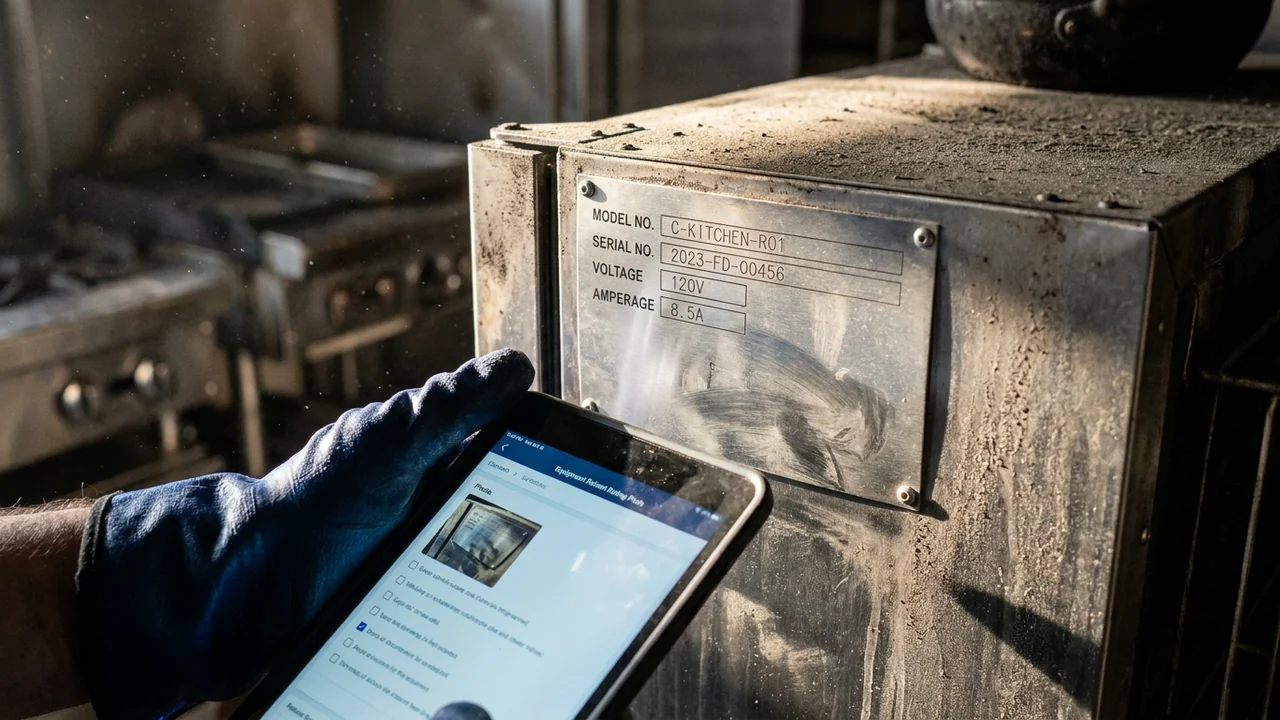
Every commercial equipment claim eventually hits the same valuation bottleneck: an estimator needs to prove the exact model, configuration, capacity, power rating, and vintage of a ruined machine, yet the field folder contains three wide shots of a charred enclosure and zero legible serial plates. Without the OEM rating plate, a 208-volt three-phase commercial steamer with programmable boiler controls looks indistinguishable from a basic residential-grade unit in a carrier price audit.
Missing or unreadable rating plates force estimators to guess configurations or settle for generic entry-level Like-Kind-and-Quality (LKQ) comps, costing commercial policyholders thousands of dollars per machine. Worse, when soot, corrosion, or grease covers a foil sticker, well-meaning technicians sometimes grab an all-purpose degreaser or abrasive pad and accidentally wipe the thermal-printed ink clean off the label.
Following standardized capture rules grounded in ANSI/IICRC S320, Field Guide: Rating-Plate Locations Cheat Sheet, and Macro Lighting & Focus Technique turns field photography into indisputable valuation and subrogation evidence.
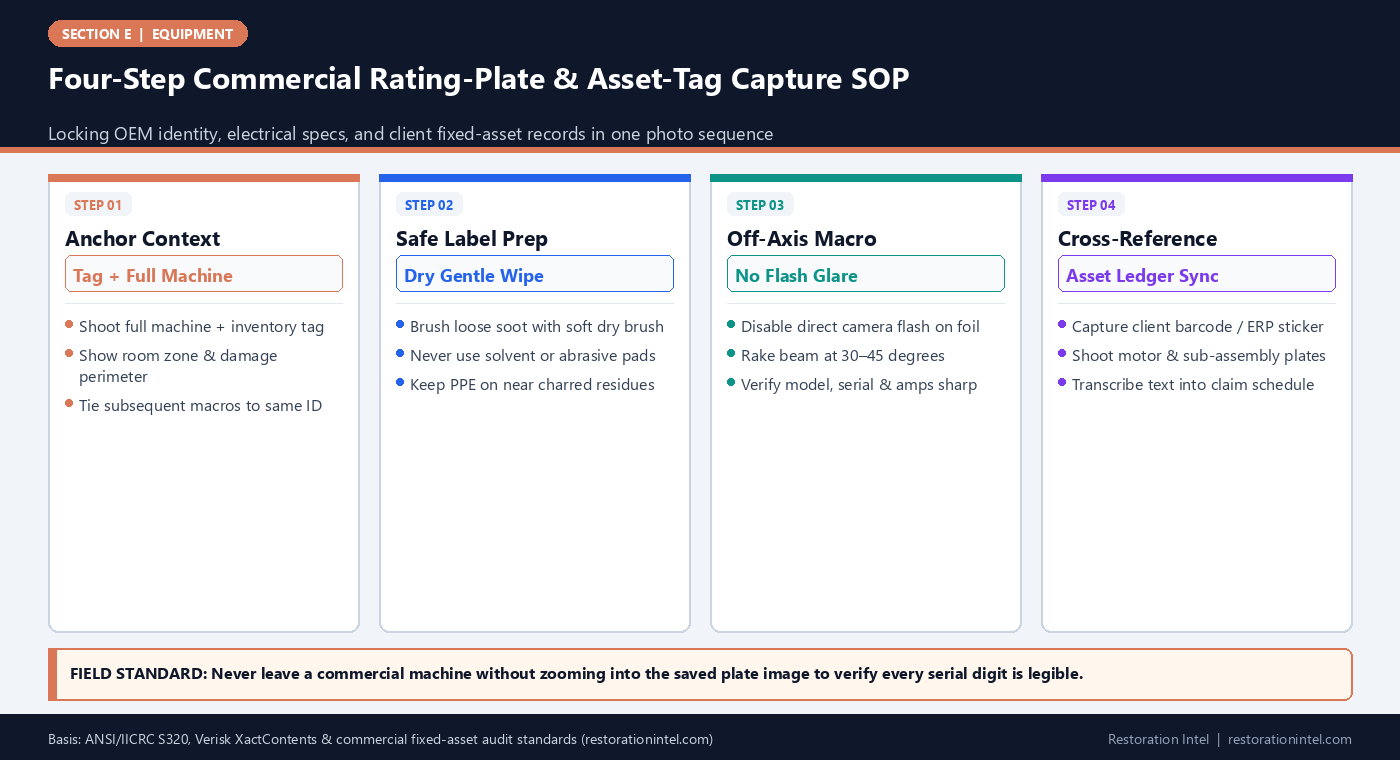
Four-Step Commercial Rating-Plate & Asset-Tag Capture SOP
Commercial Rating-Plate Capture Troubleshooting & Field Technique Matrix
Handling difficult surfaces, soot contamination, and hidden plate locations without damaging label data.
| Plate Type / Field Condition | Primary Capture Failure | Approved Field Technique | Secondary Verification Source | Prohibited Action |
|---|---|---|---|---|
| Brushed Aluminum or Foil Sticker (Soot-Coated) | Solvents dissolve thermal ink; dry rag smears soot into text | Use soft camel-hair brush or HEPA micro-vacuum nozzle; blot lightly with damp microfiber only if ink tested stable | Client purchase invoice, OEM warranty portal, or distributor pack slip | Spraying degreaser, acetone, or scrubbing with scouring pads |
| Stamped Brass or Embossed Steel Plate (Faded / Tarnished) | Direct flash washes out shallow stamped digits | Turn off camera flash; cast low-angle raking LED flashlight across stamping to create shadow relief | Pencil/graphite rubbing on paper photographed next to plate | Sanding or wire-brushing the metal plate |
| Glossy Mylar / Metallic Barcode Label | Specular flash reflection creates a white blind spot over serial | Angle lens 15–20 degrees off perpendicular; diffuse work light with white index card | Barcode scanner read + manual text transcription in photo notes | Submitting blurred shot without checking zoom on screen |
| Rear-Mounted Plate Against Tight Wall | Crew skips plate because 2,000-lb unit cannot be slid out safely | Use telescoping inspection mirror or articulated borescope/selfie-stick camera with LED tip | Matching sub-panel door spec sheet or electrical schedule | Blindly pulling heavy hardwired/plumbed unit without disconnect |
| Multi-Component Machine (Skid / Modular Line) | Only outer frame photographed; custom motor/VFD specs missing | Capture main frame plate PLUS drive motor, compressor, PLC, and burner plates | Equipment O&M binder and electrical schematic inside panel door | Assuming base model number covers custom OEM options |
| Heat-Melted or Charred Plastic Label | Paper/vinyl label melted into unreadable black crust | Photograph melted label in situ, then pull stamped chassis number, PCB silk-screen, or casting ID | Fixed asset ledger, lease schedule, or OEM service history | Peeling off charred remains without documenting chassis stamps |
Why Missing Serial Plates Turn Six-Figure Machinery Into Low-Tier Comps
Commercial machinery rarely has a single retail SKU. Take a commercial convection oven, a CNC vertical machining center, or a dental imaging unit: the exterior sheet metal may share one family name across multiple voltage configurations, gas versus electric manifolds, optional steam-injection kits, programmable touchscreens, and stainless-steel grade upgrades. Those options can double or triple replacement cost.
The OEM rating plate encodes the exact truth—manufacturer, full model string with option suffixes, serial number (which reveals manufacture year for depreciation math), electrical voltage, phase, amperage, BTU input, refrigerant type, and UL or NSF safety listings. When a field crew skips the plate or delivers an out-of-focus smudge, the desk estimator has no proof of capacity or vintage, and the carrier adjuster defaults to the lowest comparable configuration on file.
Serial numbers also protect the claim on two additional fronts: proving equipment age in depreciation disputes and tracing manufacturing lots during subrogation if an internal component started the fire.
- Option-code precision: Capture the entire model string including trailing dashes and option letters, not just the marketing badge on the front door.
- Age verification: Serial prefixes frequently encode build month and year, preventing arbitrary carrier assumptions that a five-year-old machine is fifteen years old.
- Safety listing proof: Keep UL, CSA, ETL, or NSF marks visible in the frame—missing certifications can dictate replacement rather than field modification.
Non-Destructive Cleaning, Lighting, and Macro Focus Technique
Before touching a soot-covered or grease-filmed rating plate, pause and inspect the label substrate under appropriate OSHA PPE. Stamped brass, etched stainless steel, and riveted aluminum plates handle gentle dry brushing well. Thermal-transfer paper stickers, inkjet foil labels, and clear-coated decals, by contrast, dissolve rapidly when sprayed with alkaline cleaners, alcohol, or soot-removal sponges.
Always start with a dry, soft-bristle brush or a HEPA vacuum brush held just off the surface to lift loose soot and drywall dust. If oily soot still obscures an etched plate, test a tiny corner gently with a barely damp microfiber cloth—never rub across printed barcodes until confirming the ink does not smear.
Once the surface is clean, kill the smartphone or tablet flash. Turn on a separate pocket LED light and hold it at a shallow 30-to-45-degree raking angle across the plate while tapping the screen to lock macro focus directly on the serial characters. Always pinch-zoom the captured image before moving to the next machine.
- No-solvent rule: Never spray degreaser, solvent, or heavy chem-sponge pressure onto thermal-printed OEM stickers.
- Raking side light: Oblique flashlight illumination throws crisp shadows inside stamped digits that flat overhead lighting erases.
- Two-shot safety net: Capture one tight macro filling the frame with text and one slightly wider shot showing the plate mounted on the machine housing.
Sub-Assemblies, Internal Panel Schematics, and Client Asset Tags
Capturing only the primary chassis plate misses half the value on modular industrial lines, custom skids, and upgraded machinery. A packaging conveyor, printing press, or fabrication cell often pairs a mechanical frame from one manufacturer with an upgraded servo drive, variable-frequency drive (VFD), chiller, laser head, or hydraulic power pack added later.
Inspect inside control-cabinet doors (only when verified de-energized and locked out by qualified personnel), motor housings, and bolted accessory skids for secondary rating plates and pasted wiring diagrams. Even when an exterior foil tag melted in a fire—consistent with NFPA 921 thermal evidence preservation—internal metal motor plates or PCB silk-screen revisions inside sealed enclosures frequently survive completely legible.
At the same time, capture the facility’s own property-control sticker or RFID/barcode tag. Matching the OEM serial number to the client’s internal asset tag bridges physical shop-floor reality directly to the accounting fixed-asset register described in Commercial BPP Schedules.
- Secondary plates count: Shoot drive motors, compressors, vacuum pumps, and VFD cabinets mounted onto main machinery.
- Panel-door schematics: Photograph laminated electrical schematics glued inside control cabinets before corrosion or moisture curls them.
- Client barcode pairing: Photograph the facility’s fixed-asset tag alongside the OEM plate so accounting ledgers reconcile one-for-one.
Hard-to-Reach Rear Plates and Confined Mechanical Bays
Equipment designers love putting rating plates on the rear panel of commercial refrigerators, dishwashers, and lab analyzers—two inches from a tiled wall, surrounded by rigid copper gas lines and 240-volt armored conduit. Inexperienced crews either skip the plate altogether or yank a heavy machine forward, risking kinked gas flexes, cracked drains, or spoliation of loss evidence.
Never force a hardwired or plumbed machine away from a wall solely for a photo. Equip every commercial capture kit with a compact articulated inspection borescope, a telescoping lighted mirror, and a slim selfie-extension arm with a Bluetooth shutter. Slipping a lighted borescope or mirror behind a bank of commercial fryers or lab freezers captures crisp serial plates in seconds with zero mechanical disturbance.
When heat damage or total obstruction makes rear access physically impossible during emergency stabilization, log the gap explicitly as “Plate Obstructed — Capture Pending Utility Disconnect” rather than leaving the field blank, and schedule capture the moment licensed trades pull the unit.
- Zero-disturbance reach tools: Use articulated borescopes or lighted telescoping mirrors behind plumbed or bolted gear.
- Never tug gas/electrical whips: Leave utility disconnects to licensed technicians before sliding heavy equipment out from walls.
- Explicit pending flags: Track temporarily inaccessible plates on a follow-up punch list so estimators never close a schedule with blind guesses.
Standardizing Transcription Into XactContents and Fixed-Asset Logs
A razor-sharp rating-plate photograph still fails if nobody transcribes its data accurately into the estimating schedule. Common character confusions—such as `0` vs `O`, `1` vs `I` vs `L`, `5` vs `S`, and `8` vs `B`—break OEM parts lookups and stall distributor quote requests for days.
When entering capture records into XactContents or the commercial claim ledger, transcribe four mandatory fields directly from the zoomed image: manufacturer, exact model/spec number, full serial number, and utility/capacity rating (voltage, phase, horsepower, or BTU). Pair that text record with the client’s internal asset tag number and room location.
As outlined in XactContents Field Mapping, consistent transcription at capture eliminates multi-day back-and-forth emails between desk estimators, OEM distributors, and carrier examiners.
- Four-field baseline: Record Brand, Exact Model/Option Code, Full Serial Number, and Electrical/Utility Spec on every serialized unit.
- Asset-tag column: Add a dedicated column for the insured’s ERP or fixed-asset tag ID to match depreciation ledgers cleanly.
- Zero memory entry: Type serial strings directly from the saved macro photo—never from handwritten scrap paper or spoken memory.
Practitioner Verification Checklist (E-03)
- Capture a paired wide shot (showing the numbered inventory tag on the full machine) before taking close-up rating-plate macros.
- Clean soot or dust from plates gently with a soft dry brush or HEPA micro-nozzle; never apply solvents or abrasive pads to printed labels.
- Disable direct camera flash and use a 30–45 degree raking flashlight to eliminate glare and expose stamped or faded characters.
- Capture secondary motor, VFD, compressor, and facility fixed-asset barcode tags alongside the primary chassis rating plate.
- Pinch-zoom every plate photo on site to verify full character legibility and transcribe brand, model, serial, and utility specs into the claim log.
Standards, Authority References & Related Reading
Primary standards, insurance definitions, and sibling Restoration Intel guides referenced in this brief:
- ANSI/IICRC S320 Standard for Professional Contents Restoration
- ANSI/IICRC S700 Fire & Smoke Restoration Standard
- Verisk XactContents Platform Overview
- OSHA 1910.132 Personal Protective Equipment Standard
- NFPA 921 Guide for Fire and Explosion Investigations
- IRMI Insurance Glossary: Subrogation
- Related Guide: Diagnostic Testing and OEM Teardown Protocols: Proving Internal Smoke, Moisture, or Surge Damage
- Related Guide: Leased, Financed, and Vendor-Consigned Equipment: Handling Third-Party Ownership on a Contents Inventory
- Related Guide: Field Guide: Rating-Plate Locations Cheat Sheet Across Appliances, HVAC, Shop Gear, and Electronics
- Related Guide: Macro Lighting & Focus Technique for Faded Serial Tags, Brass Nameplates, and Dark Utility Closets
- Related Guide: Commercial Business Personal Property (BPP) Pre-Loss Schedules: Aligning Fixed Asset Ledgers with Physical Reality
.md twin for desk QA and team training.Frequently Asked Questions
What should technicians do if soot covers a paper or foil OEM serial sticker?
Brush away loose soot gently using a soft dry brush or non-contact HEPA micro-nozzle first. Do not spray degreasers or solvents onto foil or thermal-printed labels, as chemical cleaners often erase the printed ink permanently.
How do you photograph a deeply stamped brass plate when flash washes out the numbers?
Turn off the camera flash completely and shine a pocket flashlight sideways across the metal plate at a low 30-to-45-degree angle. The raking light casts dark shadows inside the stamped impressions.
What if the rating plate is trapped behind a heavy bolted or hardwired machine?
Use an articulated lighted borescope or telescoping inspection mirror to capture the plate without disturbing gas lines or electrical conduits. If completely blocked, log it on a pending-disconnect punch list until licensed trades move the unit.
Why capture the client's asset-tag sticker in addition to the OEM serial plate?
Commercial clients track machinery in ERP and fixed-asset ledgers by internal asset tag ID. Capturing both tags links physical claim photos directly to historical purchase invoices and depreciation records.
What if fire completely destroyed the exterior rating plate?
Document the charred plate location, then inspect internal metal motor plates, compressor tags, chassis stampings, or circuit-board silk-screen revisions, and cross-reference the client’s pre-loss purchase orders or OEM service history.