Direct Answer: Capture full manufacturer brand, complete model suffix, and serial number plates before unplugging or crating major equipment — using angled LED illumination, inspection mirrors, and dry-brush cleaning only where permitted — because missing suffix characters collapse Like-Kind-and-Quality replacement pricing by 20 to 50 percent.
.md twin for estimator QA and carrier file documentation.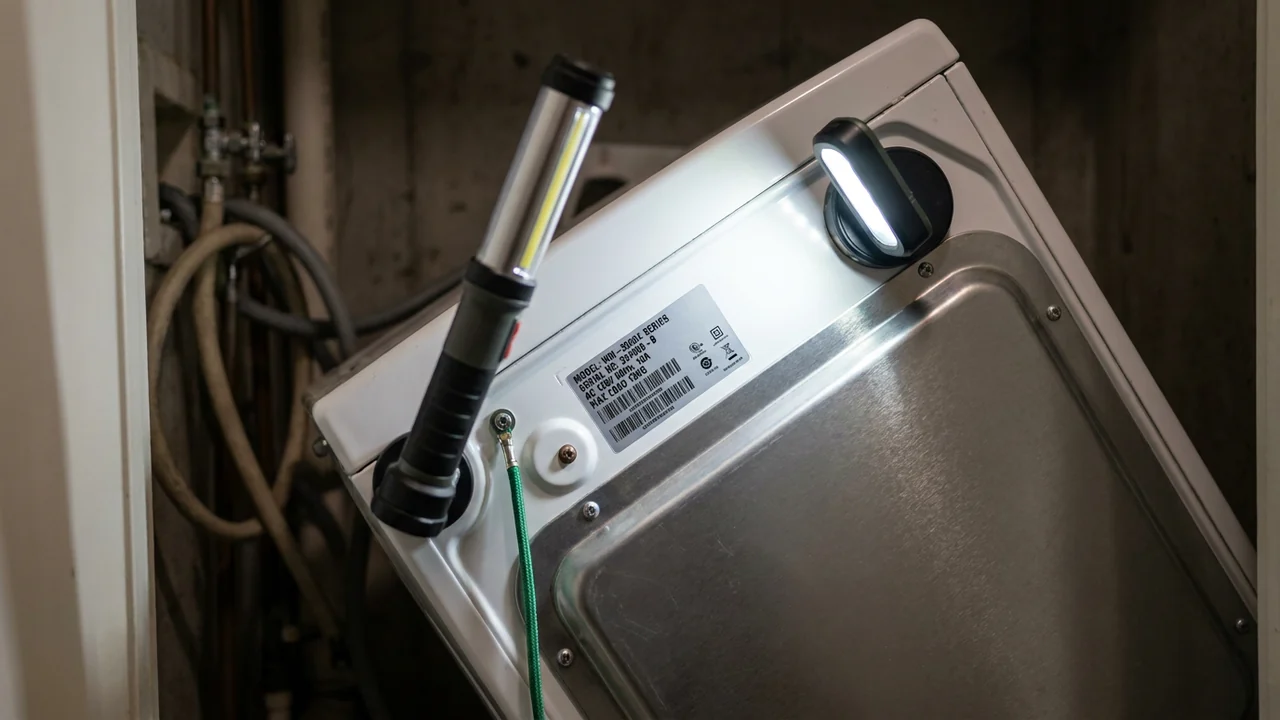
A photograph of the front of a stainless-steel refrigerator does not prove whether the unit is a $1,100 base model or a $4,400 counter-depth built-in with dual evaporators. When field crews skip rating plates—or shoot blurred frames washed out by camera flash—contents estimators are forced to guess specs or accept entry-level carrier comps that shortchange the claim.
This cheat sheet maps exact OEM data-plate locations across household appliances, HVAC assemblies, workshop machinery, and consumer electronics, alongside non-destructive field lighting techniques grounded in ANSI/IICRC S320 documentation practice and Verisk XactContents valuation standards.
OEM Rating-Plate Hunting & Macro Capture Protocol
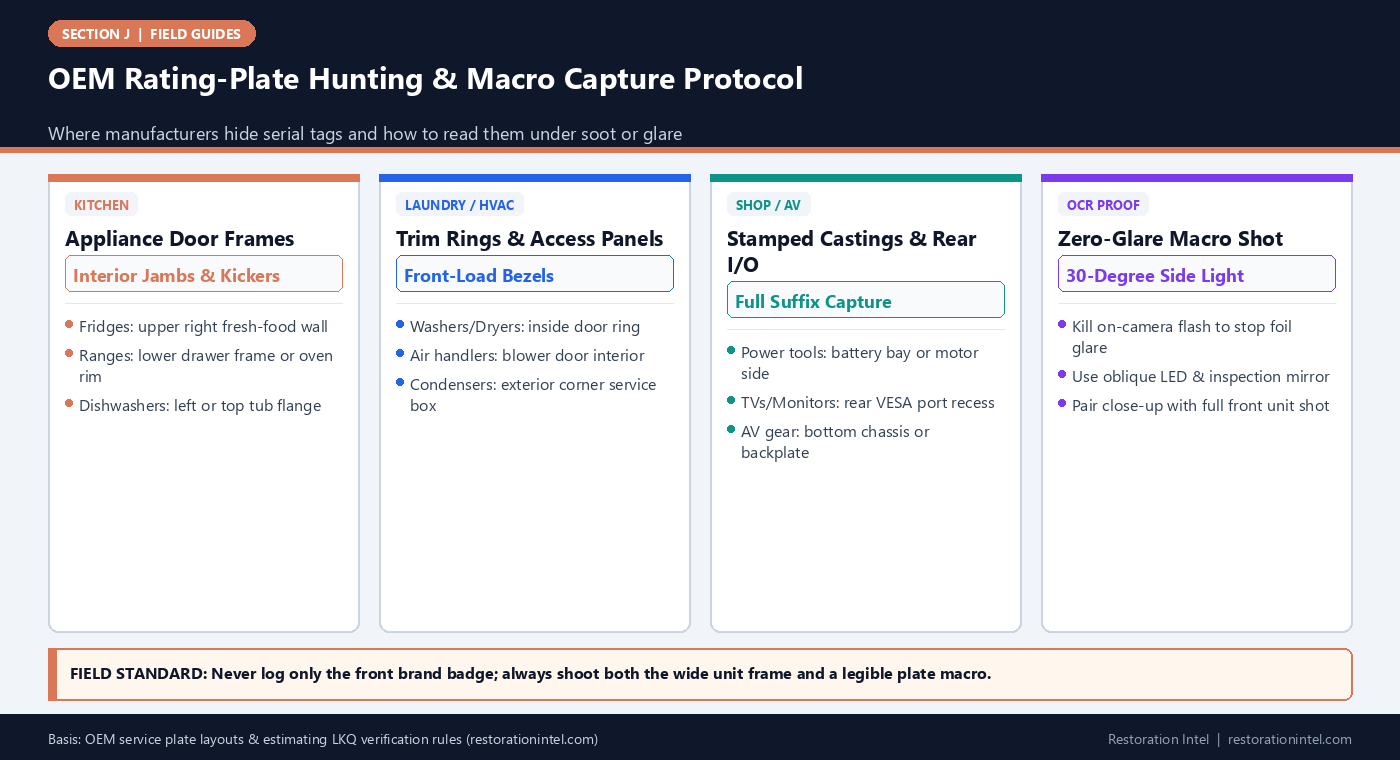
Rating-Plate Location Cheat Sheet Across 8 Equipment Categories
Check the primary location first; if soot, cabinetry trim, or wall clearance blocks access, move immediately to the secondary plate or mirror angle.
| Equipment Category | Primary Plate Location | Secondary / Hidden Location | Access & Lighting Tip | Critical Estimating Spec |
|---|---|---|---|---|
| Refrigerators & Freezers | Upper right or left interior wall of fresh-food compartment | Lower front kick-plate grille or rear compressor shroud | Pull top shelf bin forward; angle flashlight from side | Cubic feet, configuration, finish, ice/water tier |
| Ranges, Ovens & Cooktops | Inside oven door perimeter frame or storage-drawer side rail | Underside of cooktop chassis (open cabinet below) or rear panel | Use telescoping mirror on built-in wall ovens | Fuel type (gas/dual-fuel/induction), width, BTUs |
| Dishwashers & Built-In Microwaves | Left, right, or top stainless tub flange inside door opening | Lower toe-kick plate behind access panel (power off) | Wipe moisture condensation gently before macro shot | Decibel tier, tub material, panel-ready vs standard |
| Washers & Dryers | Inside door bezel (front-load) or under lid hinge (top-load) | Upper rear control console backplate or pedestal tag | Use 0.5x/1x macro inside tight top-load lid rims | Capacity cu. ft., steam/smart cycle, gas vs electric |
| HVAC Condensers & Air Handlers | Exterior corner panel near electrical service whip | Inside blower compartment door or evaporator coil casing | Never force rusted panels on active subro holds | Tonnage, SEER/AFUE rating, refrigerant type, Mfg date |
| Water Heaters & Boilers | Upper right side of outer jacket above gas valve or element cover | Top flue collar rim or underside of T&P spec decal | Keep camera perpendicular to curved tank face | Gallons/flow GPM, recovery rate, tankless vs tank |
| Shop Tools, Welders & Compressors | Side motor housing, battery slide bay, or tank weld saddle | Underneath baseplate casting or inside hinged belt guard | Cast aluminum tags need oblique raking light, no flash | Amps/volts, HP, tank gallons, brushless vs corded |
| TVs, Computers & AV Receivers | Rear chassis center beside HDMI/power ports | Side-edge serial bar, bottom laptop base, or battery well | Shoot wide rear + tight macro before unplugging cables | Exact screen size, panel tech (OLED/QLED), year/RAM |
Why Full Model Suffixes Drive Replacement Cost Defensibility
On modern appliances and electronics, the first six characters of a model number often describe only the family chassis, while the trailing two to five suffix characters specify finish, smart connectivity, decibel insulation, panel readiness, or regional energy tier. Logging a Samsung refrigerator or LG OLED television without its full trailing revision code allows desk reviewers to price the lowest-spec discontinued variant in the family.
Capturing both the alphanumeric model string and the manufacturing serial number also anchors age verification. Many OEM serial formats encode the year and month of manufacture directly in the first four characters, replacing vague homeowner age guesses with objective proof that anchors depreciation and Like-Kind-and-Quality matches. See A Price Tag on a Lost Item Is Worth Nothing for why identity proof precedes every pricing argument.
- Full-string rule: Record every character between slashes, hyphens, and revision codes, plus the UL/CSA date block if printed.
- Paired photo rule: Shoot one wide contextual shot of the unit in the room followed immediately by the macro plate frame.
- Manual transcription backup: When soot partially obscures embossed metal, type the verified string in the line notes while standing on site.
Finding Hidden Plates on Built-In Kitchen and Laundry Units
Freestanding appliances expose their tags within seconds, whereas built-in dishwashers, slide-in ranges, panel-ready columns, and stacked laundry towers bury stickers inside narrow trim clearances. Carrying a 2-inch telescoping inspection mirror and a low-profile headlamp prevents crews from pulling heavy built-in units out of cabinetry—avoiding scratched hardwood floors and broken water supply lines.
Before moving any plumbed or gas-connected appliance solely to read a rear plate, exhaust all interior door jambs, lower drawer rails, kick-plate fronts, and owner manual sleeves in nearby kitchen drawers. On built-in cooktops and wall ovens, the secondary UL label is almost always affixed to the underside pan visible from the cabinet directly below.
- Zero-pull rule: Never slide out an unstrapped refrigerator or gas range just for a rear plate before checking interior walls and lower drawer rails.
- Mirror text reversal: Note in the photo caption if shot via inspection mirror so estimating staff read reversed characters accurately.
- Laundry stack caution: Check top-load lid undersides and front-load rubber gasket rims with an angled light before dismantling stacked kits.
Capturing Mechanical, HVAC, and Shop Equipment Without Damaging Evidence
Garage workshops, mechanical rooms, and commercial back-of-house bays combine stamped aluminum castings, painted steel tags, and grease-coated decals. On standard losses where no subrogation hold applies, lightly brushing loose dust with a dry soft bristle brush reveals characters cleanly. However, if the unit sits near the suspected fire or water origin, do not wipe, scrape, or open sealed control covers—photograph the soot pattern as found and escalate to the forensic or subrogation lead.
For cordless power tools, extract the battery pack only if safe and dry to inspect the slide-rail voltage and serial plate, and log chargers and spare high-capacity packs as separate lines. Stationary air compressors and generators often carry two separate plates: one on the pressure vessel (ASME tank date) and one on the motor or engine block.
- Spoliation check first: Never wipe soot off a furnace, water heater, or breaker-adjacent appliance if origin/cause is under investigation.
- Dual-plate machinery: Shoot both the engine/motor serial plate and the pump/tank rating tag on compressors, washers, and welders.
- Cordless kit split: Log bare-tool model numbers separately from high-capacity lithium battery packs and multi-bay chargers.
Field Camera Settings That Prevent Foil Glare and Soot Blur
Most unreadable rating-plate photos fail for one reason: direct smartphone flash bouncing off metallic foil stickers or glossy varnish in dim closets. Foil labels reflect white light straight back into the lens, blowing out thin laser-etched serials into an unreadable white rectangle. Turning off automatic flash and holding a separate pocket LED at a 30-to-45-degree side angle eliminates glare while casting crisp micro-shadows across stamped metal digits.
Tap the phone screen directly on the center of the data plate to lock focus and lower exposure slightly before pressing the shutter. Wait half a second after snapping before pulling the camera away—motion blur in low-light basements ruins more OCR extractions than low sensor resolution.
- Flash-off rule: Disable on-camera flash on every metallic, Mylar, or laminated rating plate.
- Tap-to-focus & hold: Lock exposure on the plate text, brace your forearm against the cabinet frame, and verify legibility by zooming in before walking away.
- Dark-soot contrast trick: Sweep a high-CRI pocket light sideways across embossed steel or aluminum plates to illuminate raised digits without wet wiping.
Practitioner Verification Checklist (J-02)
- Disable smartphone flash and illuminate metallic or embossed rating plates with a 30-degree side-angle pocket light.
- Capture a paired photo sequence: full contextual unit frame followed immediately by a sharp, zoomed-verified plate macro.
- Record the complete model string including trailing finish/revision suffixes and the OEM serial number.
- Confirm no origin-zone or subrogation hold exists before touching, wiping, or opening panels on mechanical or HVAC equipment.
- Verify screen-size, fuel-type, capacity, or configuration attributes in notes whenever a rear sticker is permanently inaccessible.
Standards, Authority References & Related Reading
Primary standards, insurance definitions, and sibling Restoration Intel guides referenced in this brief:
- ANSI/IICRC S320 Standard for Professional Contents Restoration
- Verisk XactContents Platform Overview
- Restoration Industry Association (RIA)
- NFPA 921 Guide for Fire and Explosion Investigations
- Related Guide: Field Guide: The Universal Room-by-Room Contents Capture Order Checklist
- Related Guide: Field Guide: Photographic Proof Angles Required to Substantiate Odor, Corrosion, and Hidden Moisture
- Related Guide: Like Kind and Quality (LKQ) Replacement Matching: Rules for Discontinued Brands and Obsolete Models
- Related Guide: Electronics and Rapid-Obsolescence Depreciation: Handling Computers, TVs, and Smart Devices Fairly
- Related Guide: A Price Tag on a Lost Item Is Worth Nothing
.md twin for desk QA and team training.Frequently Asked Questions
What should a crew do if a built-in appliance's rating plate is completely unreachable without uninstallation?
Photograph the front panel controls, brand badge, finish, width measurement with a tape measure in frame, and any owner manual or cabinet sticker, and flag the line as requiring estimator LKQ verification rather than forcing cabinetry loose.
Can technicians wipe soot off an appliance plate to read the serial number?
Only on routine non-origin units after taking an untouched as-found photo first. Never wipe soot or disturb labels on appliances, cords, or mechanical systems located in a suspected fire or water origin area.
Why do estimators ask for serial numbers in addition to model numbers?
Serial numbers frequently encode the exact manufacturing month and year, giving adjusters objective age proof for ACV depreciation instead of rough homeowner estimates, and proving the unit was distinct on multi-unit commercial losses.
Why does direct phone flash ruin metallic rating plates?
Mylar and brushed-aluminum plates act like mirrors under coaxial camera flash, overexposing thin laser-printed ink. Oblique side lighting reveals ink and embossed characters cleanly without glare.