Direct Answer: Cleaning or relocating precision commercial equipment only restores half the asset; contents schedules must separately capture OEM recalibration, NIST-traceable certification, regulatory safety testing, and factory warranty-preservation inspections whenever a loss or pack-out disturbs precision tolerances.
.md twin for estimator QA and carrier file documentation.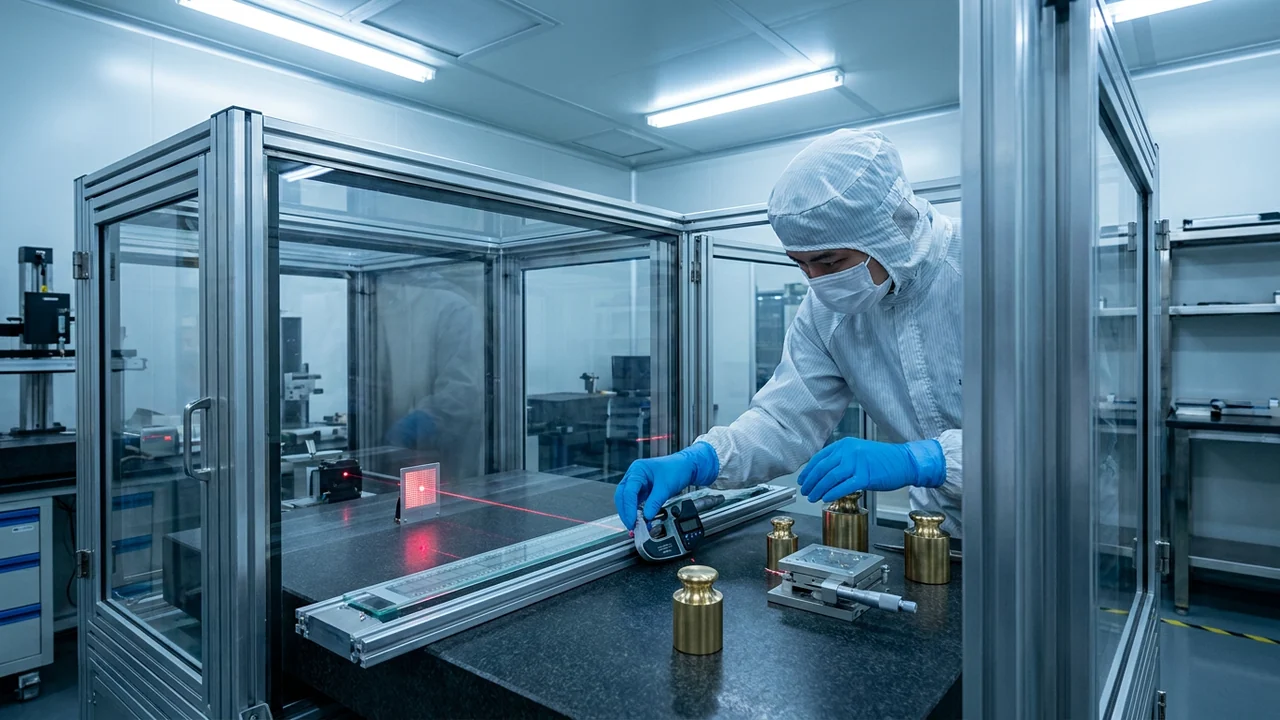
On routine household or office contents jobs, once a stainless-steel table or espresso grinder is decontaminated, dried, verified odor-free, and reset in place, the restoration team’s job is finished. On commercial, medical, dental, laboratory, food-processing, and precision manufacturing losses, finishing the cleaning step leaves the policyholder with a machine that still cannot legally or safely operate.
Moving a coordinate measuring machine (CMM), decontaminating a pharmacy laminar-flow hood, unbolting a CNC vertical mill, or cleaning soot off a clinical blood analyzer breaks factory geometric alignment, invalidates ISO/NIST-traceable calibration certificates, or interrupts regulated quality-control chains. Without formal factory recalibration and recertification, the insured cannot bill patients, ship aerospace tolerances, or pass health-department inspections.
Estimators who omit these downstream technical charges—or bury them inside generic cleaning labor—shortchange restoration margins and force policyholders to fight out-of-pocket for mandatory recommissioning costs. Grounding calibration scopes in ANSI/IICRC S320, RIA commercial restoration standards, and IRMI RCV repair principles ensures equipment returns to pre-loss operational and regulatory condition. Compliance disclaimer: Restoration contractors do not self-certify OEM warranties or regulated medical, food-safety, or metrology compliance; always verify return-to-service requirements directly with the equipment manufacturer, accredited calibration lab, and governing regulatory body.
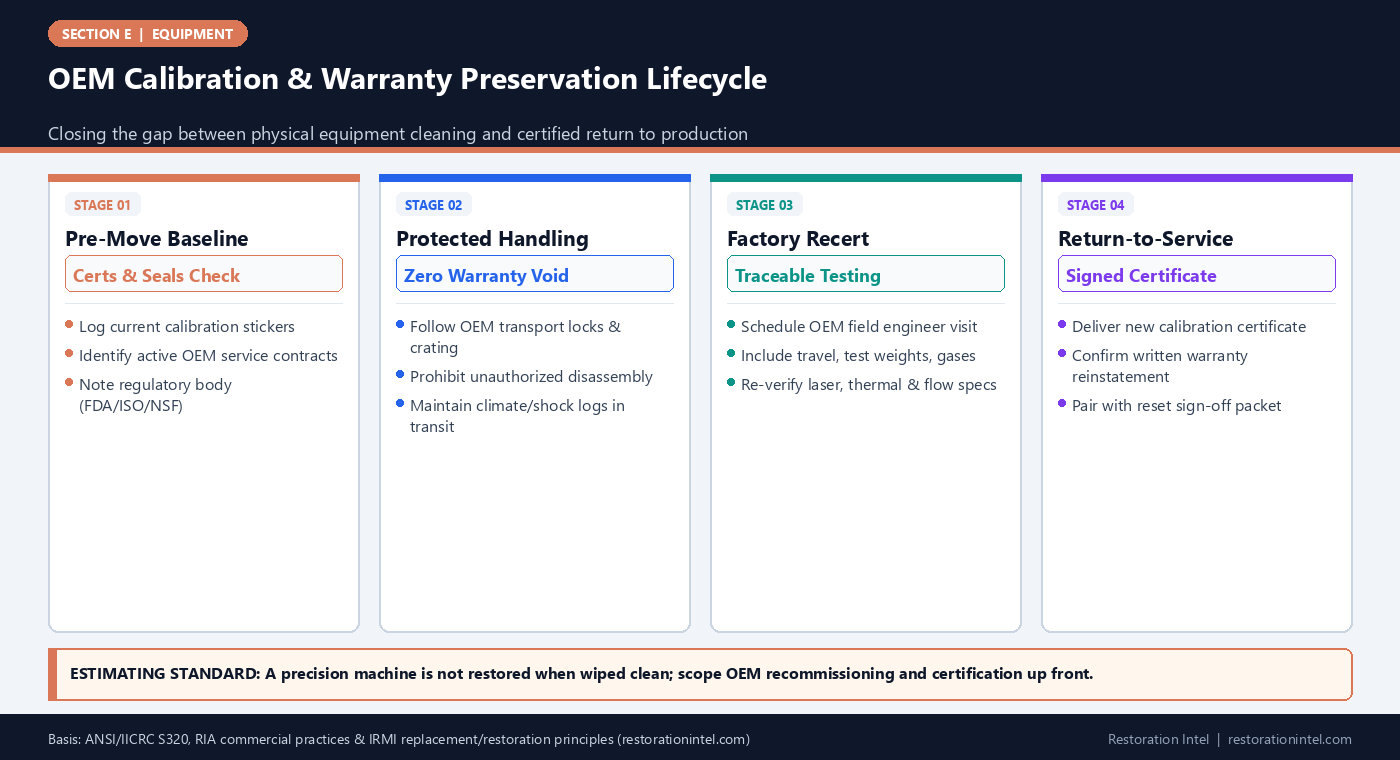
OEM Calibration & Warranty Preservation Lifecycle
Calibration, Recertification & Warranty Preservation Matrix by Sector
Common post-loss certification triggers that standard cleaning line items exclude.
| Commercial Sector & Equipment | Trigger Event During Loss / Pack-Out | Mandatory Recertification Step | Typical Ancillary Costs Omitted | Warranty / Compliance Impact |
|---|---|---|---|---|
| Precision Manufacturing (CNC Mills, CMMs, Laser Cutters) | Vibration shock, thermal soot exposure, unbolting & rig reset | Ballbar / laser interferometry alignment & spindle runout check | OEM field engineer travel, per diem, calibration artifacts | Out-of-tolerance parts scrap entire production runs if uncalibrated |
| Healthcare & Dental (Autoclaves, Imaging, Patient Monitors) | Smoke/water ingress, disconnect & re-install, electrical interruption | Biomedical safety test, spore/pressure cycle validation, leakage test | Authorized OEM service-only requirement; temporary loaner logistics | Unauthorized handling voids FDA/OEM clearance and clinic malpractice compliance |
| Laboratories & Pharmacies (Fume Hoods, Analytical Balances, HPLC) | Airflow contamination, relocation, power loss, chemical exposure | ASHRAE/NSF airflow face-velocity certification & NIST weight cert | HEPA filter recert, reference standard gases/weights, cleanroom test | Cannot legally process patient diagnostics or regulated samples until recertified |
| Food Processing & Commercial Kitchens (Scales, Pasteurizers, Ovens) | Water/soot cleaning, thermostat reset, plumbing disconnect | State Weights & Measures seal check, thermal probe calibration, NSF clean check | Certified test weights, replacement food-grade gaskets/seals | Health inspector shutdown or failed HACCP audit without current seal |
| Automotive & Calibration Bays (ADAS Rigs, Frame Racks, Wheel Balancers) | Floor flooding, shop fire soot, concrete anchor reset | Laser target alignment & floor-level plane certification | Shop downtime during OEM visit, specialized leveling shims | ADAS/safety liability prevents billing OEM-compliant vehicle repairs |
| IT Server Racks, Cleanrooms & Telecom Gear | Particulate smoke exposure, static risk during pack-out/reset | Particulate count verification, grounding continuity & burn-in load test | OEM hardware inspection fee to preserve enterprise support SLA | Enterprise support contracts lapse without documented OEM recertification |
Why 'Cleaned and Powered On' Is Not Ready for Regulated Production
A restoration crew’s definition of finished—clean, dry, odor-free, and powering on without tripping a breaker—differs sharply from a commercial operator’s definition of operational. Consider a compounding pharmacy’s laminar-airflow hood or a dental practice’s digital panoramic X-ray column. Even if neither machine suffered direct fire contact, extinguishing water and ambient soot forced the unit to be powered down, unbolted, wrapped, transported off site during drywall reconstruction, and re-installed six weeks later.
That move alone alters laser alignment, shifts mechanical leveling tolerances by millimeters, and breaches the facility’s continuous certification record. Under healthcare accreditation, ISO 9001/17025 manufacturing quality systems, and municipal health codes, putting that machine back into service without formal recertification exposes the policyholder to failed audits, invalidated patient diagnostics, or scrapped customer batches.
Treating calibration and recertification as separate, explicit contents-restoration costs—rather than hoping the insured absorbs them—honors the core indemnity promise of returning property to pre-loss utility.
- Capture existing stickers early: Photograph calibration due dates, NSF/ISO tags, and state weights-and-measures seals during initial walkthrough before cleaning.
- Ask the quality-assurance question: Ask the facility manager which machines require external third-party or OEM sign-off before staff can touch them.
- Distinguish routine PM from loss-triggered recert: Document clearly that the move, decontamination, or peril event—not an overdue annual schedule—triggered the recertification requirement.
Breaking Down Calibration and Field-Engineer Cost Drivers
Estimators familiar only with hourly restoration labor routinely underestimate what OEM factory calibration actually costs. Unlike local handymen, factory-certified field engineers for CNC equipment, medical sterilizers, or laboratory chromatography systems often fly in from regional hubs and bill structured charges that desk examiners question if presented as a lump sum.
An accurate calibration scope breaks those charges into transparent lines: round-trip travel and mobilization, minimum on-site diagnostic/calibration hours, specialized test artifacts (certified NIST weights, laser interferometers, reference calibration gases, biological indicator strips), single-use seals or HEPA filters replaced during certification, and the official certificate issuance fee.
Reviewing D-05 labor and freight mechanics also reminds estimators to protect non-physical service fees from improper physical wear-and-tear depreciation when negotiating Replacement Cost settlements.
- Itemize travel separately: Regional OEM travel time, mileage, and lodging should appear explicitly on the OEM quote rather than inflated hourly rates.
- Capture consumables used in testing: Calibration gases, sterile test kits, and sacrificial filters required to pass certification are direct loss costs.
- Coordinate schedule sequencing: Align the OEM engineer’s visit immediately after E-06 rigging reset to avoid double-mobilization fees.
Protecting Manufacturer Warranties During Pack-Out and Vault Storage
On newer commercial equipment still under factory warranty—or covered by paid enterprise maintenance agreements—the restoration team’s own pack-out and cleaning choices can accidentally void coverage worth tens of thousands of dollars. Many manufacturers require specific shipping brackets, spindle locks, ink-head capping routines, refrigerant recovery procedures, or vertical-only orientation during transit.
If a general pack-out crew unbolts a commercial printer or lab centrifuge without installing OEM transit bolts, internal bearings brinell or optical rails warp on the truck. When the machine fails later, the OEM inspects the shock sensor or missing shipping locks and refuses warranty repair. Similarly, using unauthorized chemical cleaners on medical plastics or coated optics can void both warranty and UL/FDA safety compliance.
Before packing high-value commercial or clinical equipment, obtain the OEM’s transport and environmental storage specification, incorporate those steps into the pack-out work order, and keep environmental telemetry logs inside the climate-controlled vault.
- Transport-lock verification: Require OEM shipping brackets, drum locks, and anti-static crating on sensitive precision hardware.
- Written warranty-preservation check: Ask the manufacturer’s technical support desk in writing what inspection is required post-fire/water to keep existing service coverage active.
- Chemistry approval: Never apply unapproved deodorizers, ozone, or alkaline cleaners to OEM electronics or medical surfaces without vendor clearance.
Separating OEM Recertification From Restoration Cleaning Scope
Clear demarcation between the restoration contractor’s decontamination work and the OEM’s recertification role protects both parties legally and financially. Under ANSI/IICRC S320 and vendor evaluation protocols, the restoration team or specialty electronics restorer documents physical removal of soot, odor, and moisture residues—backed by cleaning logs and cleanliness swabs.
The OEM or accredited calibration laboratory then performs functional performance testing, geometric alignment, and regulatory certification. Restoration estimators should never bundle OEM calibration into a vague “restoration cleaning” line item, nor sign certificates implying the restoration company guarantees FDA, ISO, or metrology compliance.
Presenting the cleaning invoice and the OEM recertification quote side by side inside the same equipment packet shows the desk examiner exactly how the two scopes complement each other—and why total restoration plus recertification remains economically favorable versus full replacement.
- Two-part packet structure: Present physical cleaning/pack-out costs in one section and OEM/accredited recertification quotes in an adjacent schedule.
- Economic feasibility ceiling: Always add diagnostic + cleaning + rigging + recertification together before comparing against LKQ replacement cost.
- Clear liability boundary: Restoration sign-off covers cleanliness and custody; OEM sign-off covers functional calibration and warranty status.
Substantiating Recertification Line Items for Carrier Sign-Off
Desk adjusters unfamiliar with industrial or clinical compliance sometimes challenge recertification lines as unnecessary “preventive maintenance.” Overcoming that objection requires documentation connecting the loss directly to the certification loss.
Attach three pieces of proof to every calibration request: (1) photo of the pre-loss calibration sticker or active service contract showing the asset was maintained in certified status before the loss; (2) written OEM manual excerpt, service bulletin, or regulatory code stating that relocation, thermal/smoke exposure, or electrical interruption requires re-verification; and (3) an itemized third-party quote detailing test standards, labor, and certificate delivery.
Finally, confirm certificate delivery during reset reconciliation so the claim file closes only when the policyholder holds both the physical machine and its restored operational credentials.
- Pre-loss compliance proof: Capture existing calibration tags and annual PM logs to refute claims that the machine was already out of calibration.
- OEM bulletin citations: Quote the exact manufacturer manual passage requiring recalibration after unbolting, shock, or power/smoke events.
- Close-out packet check: File the post-loss calibration certificate alongside the final reset sign-off before releasing holdback or closing the job.
Practitioner Verification Checklist (E-05)
- Photograph existing calibration stickers, weights-and-measures seals, and OEM warranty tags on Day 1 before moving or cleaning any precision equipment.
- Verify OEM transit locks, climate limits, and approved cleaning chemistry before packing sensitive medical, lab, or CNC assets.
- Obtain written OEM or accredited-lab quotes itemizing field-engineer travel, calibration labor, test artifacts, and certificate fees.
- Include diagnostic, rigging, cleaning, and recertification totals together when testing repair-vs-replacement economic feasibility.
- Attach pre-loss maintenance proof and OEM manual requirements to justify recertification lines as direct loss costs rather than routine PM.
Standards, Authority References & Related Reading
Primary standards, insurance definitions, and sibling Restoration Intel guides referenced in this brief:
- ANSI/IICRC S320 Standard for Professional Contents Restoration
- ANSI/IICRC S700 Fire & Smoke Restoration Standard
- Restoration Industry Association (RIA)
- Verisk XactContents Platform Overview
- IRMI Insurance Glossary: Replacement Cost Value (RCV)
- Related Guide: Diagnostic Testing and OEM Teardown Protocols: Proving Internal Smoke, Moisture, or Surge Damage
- Related Guide: De-Installation, Rigging, Crane Access, and Re-Installation Labor on Heavy Contents Equipment
- Related Guide: Evaluating Equipment Restoration Vendors: Reading Lab Reports, Megohm Testing, and Cleanliness Swabs
- Related Guide: Depreciation of Labor, Freight, and Installation on Contents and Scheduled Equipment
- Related Guide: Field Guide: Homeowner Reset, Unpack Verification, and Missing/Damaged Item Reconciliation Protocol
.md twin for desk QA and team training.Frequently Asked Questions
Why isn't standard equipment cleaning enough to return commercial lab or CNC gear to service?
Moving, unbolting, or exposing precision equipment to heat, soot, or water breaks geometric alignment, invalidates ISO/NIST-traceable calibration certificates, and can void OEM safety clearances until factory recertification is completed.
Will insurance carriers pay for OEM calibration after a pack-out and reset?
Yes, when documented properly. Pairing pre-loss calibration proof with OEM manual requirements showing that relocation or peril exposure mandates re-testing establishes calibration as a direct loss-restoration expense rather than routine maintenance.
Can a restoration contractor issue its own calibration or safety certificate?
No. Restoration contractors document physical cleaning, decontamination, and custody. Functional calibration, safety compliance, and warranty reinstatement must come from the OEM or an appropriately accredited calibration/testing body.
How do you protect active factory warranties during a pack-out?
Consult the OEM manual or technical support desk prior to disconnect, install required factory shipping brackets or spindle locks, use approved non-corrosive chemistry, and maintain climate logs during transport and storage.
What if cleaning plus OEM recertification exceeds replacement cost?
When combined diagnostic, rigging, cleaning, vault storage, reset, and OEM recertification costs approach or exceed Like-Kind-and-Quality replacement value, estimators should present both totals to the adjuster to support economic total-loss replacement.