Direct Answer: Standard Business Personal Property (BPP) contents coverage pays to restore or replace damaged equipment with Like Kind and Quality (LKQ)—it does not automatically fund building electrical, exhaust, fire-suppression, or safety code upgrades triggered by replacement unless specific Ordinance or Law or Equipment Breakdown endorsements apply and costs are cleanly split by code citation.
.md twin for estimator QA and carrier file documentation.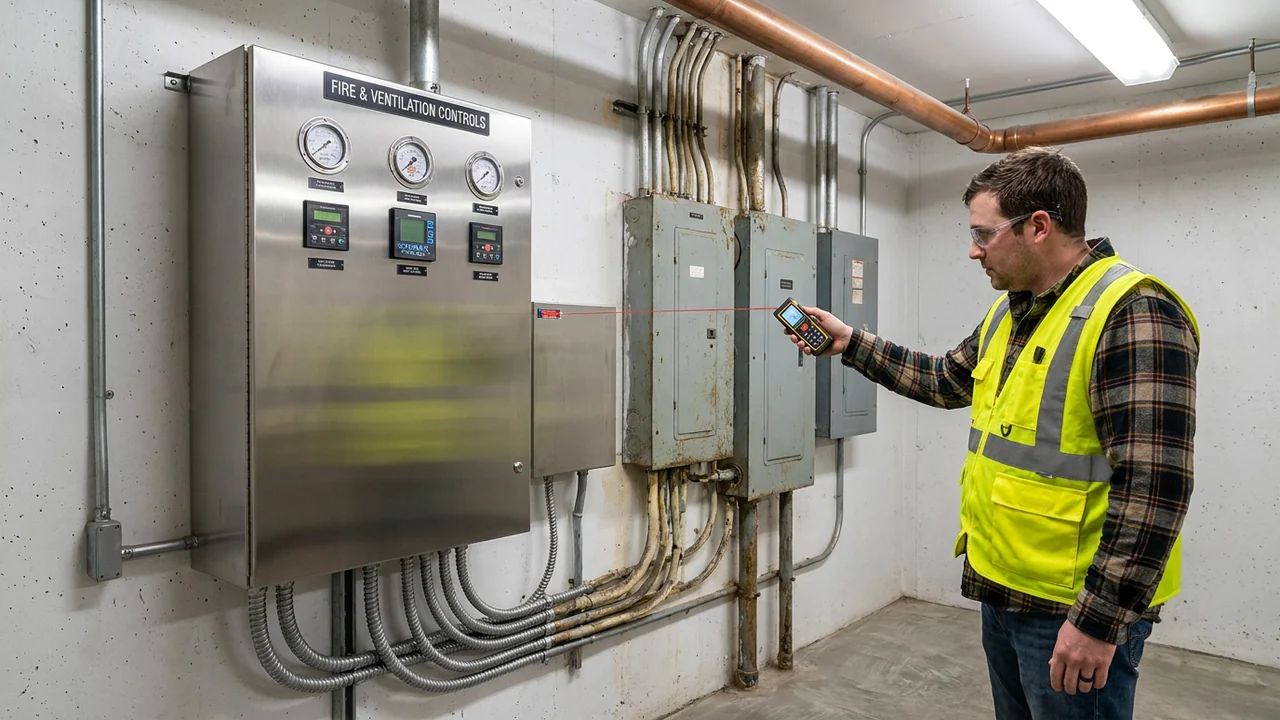
Replacing a twenty-year-old commercial fryer bank, spray booth, walk-in refrigerant condenser, or mechanical stamping press rarely stops at buying a new machine. The moment a replacement unit rolls onto the slab, the local Authority Having Jurisdiction (AHJ)—a building official, fire marshal, health inspector, or state boiler/OSHA compliance officer—may prohibit reconnecting it unless the premises also upgrades to current electrical, exhaust-hood, fire-suppression, seismic-anchoring, or machine-guarding codes.
That collision creates one of the sharpest coverage disputes in commercial claims. Under standard Replacement Cost Value (RCV) and Like-Kind-and-Quality (LKQ) principles, base property forms replace what existed prior to loss with current equivalent functionality, excluding increased costs driven by the enforcement of any ordinance or law unless specific Ordinance or Law coverage applies—and traditional Ordinance or Law endorsements frequently tie to building structures rather than movable BPP contents unless specially endorsed or routed through Equipment Breakdown.
Non-UPL & policy boundary disclaimer: whether a mandatory upgrade falls under BPP LKQ obsolescence, Building Ordinance or Law (Coverages A, B, or C), Equipment Breakdown, or remains uninsured depends strictly on exact policy language, endorsements, and governing law. This operational brief guides field documentation and estimate separation only; it is not legal advice or coverage interpretation.
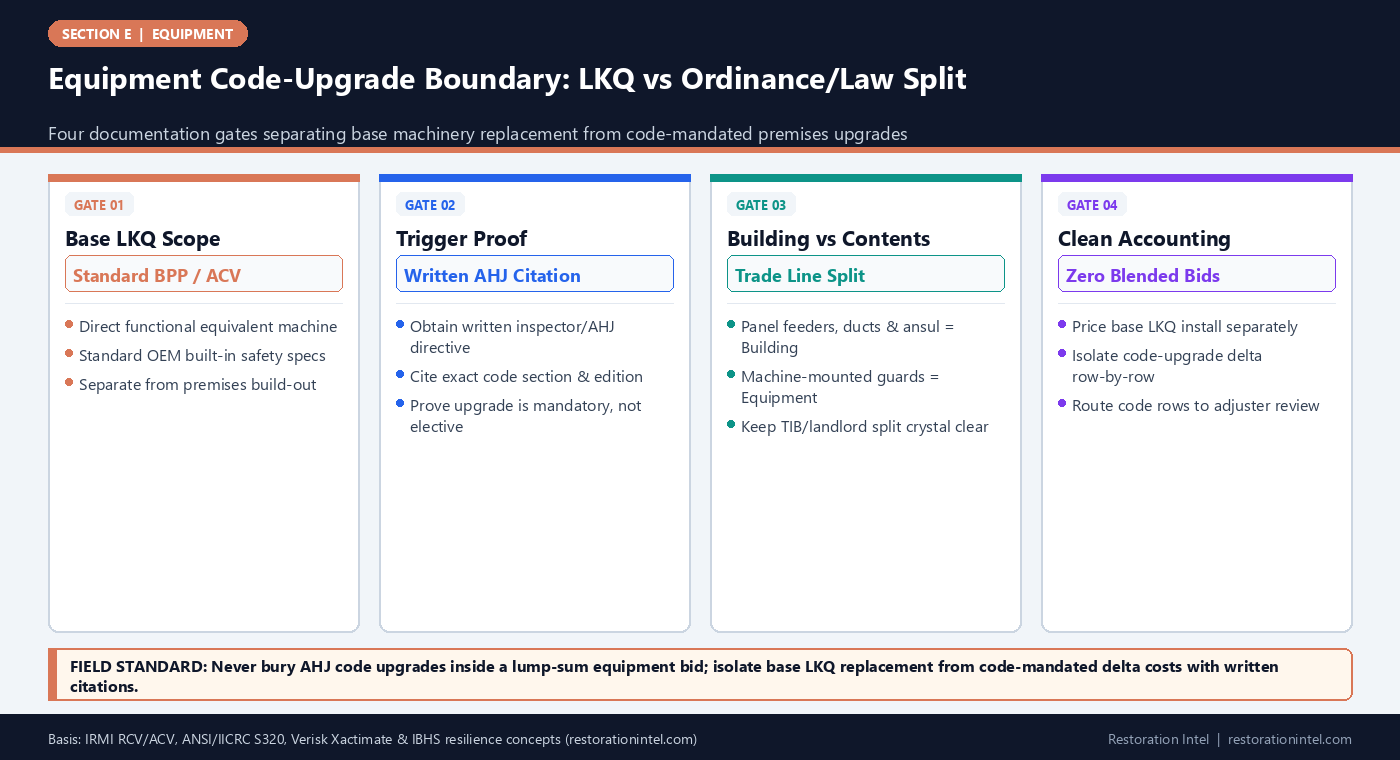
Equipment Code-Upgrade Boundary: LKQ vs Ordinance/Law Split
Common Equipment-Triggered Code Upgrades & Estimate Separation Matrix
How estimators document frequent code triggers and separate base LKQ equipment costs from premises Ordinance/Law scope.
| Code-Triggered Upgrade Scenario | Typical Enforcing Authority | Base LKQ Equipment Component | Code-Driven Upgrade Delta | Required Claim File Proof |
|---|---|---|---|---|
| Commercial Cooking Line Triggers UL-300 / Type I Hood & Ansul Upgrade | Fire Marshal & Health Dept | Replacement fryer, range, or charbroiler LKQ unit | Gas shutoff interlocks, Ansul nozzle re-pipe, Type I hood/makeup air | Fire marshal correction notice + base kitchen bid vs hood/Ansul quote |
| New Machine Requires Upgraded 3-Phase Feeder, GFCI, or Arc-Flash Disconnect | Municipal Electrical Inspector | Machine-equivalent OEM motor & internal starter | Larger breaker panel, shunt-trip, NEMA-4X disconnect, conduit run | NEC citation from electrical inspector + split electrician proposal |
| Refrigerant Phase-Out Forces Newer Condenser / Evaporator System | EPA / Mechanical Code | Direct cooling capacity equivalent unit | New refrigerant-compatible line sets, controls, or rack modifications | OEM discontinuation letter + HVAC mechanical code compliance memo |
| Seismic Anchoring, Floor Bolting, or Spill-Containment Curbing | Building Dept / Environmental | Base equipment delivery and standard floor placement | Engineered seismic anchor bolts, PE stamp, or secondary containment curb | Structural/seismic code citation + PE engineering & anchoring quote |
| Replacement Shop Press or Saw Includes Modern Light Curtains / Guarding | OSHA / State Safety Compliance | Current production OEM model (built with standard modern guards) | Plant-wide perimeter fencing, E-stop relays, or external dust collector | OEM spec sheet distinguishing built-in standard vs facility upgrades |
Built-In OEM Modernization vs External Premises Code Upgrades
A crucial distinction separates technological modernization built into a replacement machine from external code upgrades forced onto the surrounding facility. If a 2004 commercial slicer or CNC mill is totaled and the manufacturer no longer builds that exact model without modern factory finger guards, digital touch controls, or compliant refrigerants, buying today’s nearest functional equivalent is generally standard Like-Kind-and-Quality (LKQ) replacement—even though the new machine carries updated factory safety features.
By contrast, when installing that replacement fryer, autoclave, or compressor forces the owner to tear out an undamaged concrete pad for seismic curbing, upgrade a 200-amp building service panel to 400 amps, install fire-rated duct enclosures, or retrofit a wet-chemical Ansul system to current UL-300 standards, those external modifications cross out of movable contents and into building and Ordinance or Law territory.
Reviewing Like Kind and Quality (LKQ) Replacement Matching Rules alongside Fixed Building Machinery vs Scheduled Business Equipment helps estimators draw this exact boundary cleanly on paper before submitting estimates.
- Factory-standard rule: Document when safety or emissions updates are embedded in the base OEM model because legacy versions are legally barred or discontinued.
- Premises boundary: Separate anything touching walls, panels, roofs, exhaust ducts, drains, or floor slabs onto a distinct building/code schedule.
- Elective vs mandatory test: Never mix owner-desired capacity expansion (e.g., upgrading from a 20-quart to a 60-quart mixer) with mandatory code compliance.
Securing Written AHJ Citations Before Starting Upgrade Work
Verbal remarks from a contractor—’the city is going to make us upgrade the hood and electric’—carry zero weight on an Ordinance or Law claim file. Property adjusters require objective proof that a specific governmental ordinance or code in force at the time of loss legally compels the upgrade, rather than a contractor upsell or owner preference.
Before executing code-driven modifications around damaged equipment, request a written correction notice, red-tag inspection report, or plan-review letter from the municipal building official, fire marshal, or health inspector. That document should cite the exact adopted code edition and section number (for example, local NFPA fire-code adoption, NEC article, or mechanical fuel-gas requirement) and state clearly why the pre-loss configuration cannot be re-permitted.
Similarly, when resilience improvements encouraged by groups like the Insurance Institute for Business & Home Safety (IBHS)—such as elevated equipment pads in flood zones or seismic bracing—are mandated by local floodplain or building ordinances rather than voluntary upgrades, attach the municipal ordinance text directly to the estimate packet.
- Citation packet minimum: Attach (1) AHJ letter/red-tag, (2) exact code section text, and (3) comparative base-vs-upgrade trade bids.
- Pre-loss grandfathering proof: Document that the prior installation was legally operating before the loss and lost grandfathered status solely due to the covered peril.
- Incurred-cost trigger: Remember that Ordinance or Law increased-cost-of-construction benefits typically pay only when upgrades are actually performed and incurred.
Tenant vs Landlord and Equipment Breakdown Coordination
In leased commercial suites—restaurants, medical clinics, dry cleaners, and light-industrial bays—equipment-triggered code upgrades frequently fall into a gap between the tenant’s BPP policy and the landlord’s building policy. A restaurant tenant may own the fryer and Ansul system under a Tenants’ Improvements and Betterments (TIB) clause while the landlord insures the Type I roof exhaust shaft and main electrical service.
Additionally, when a mechanical or electrical failure triggers Boiler & Machinery / Equipment Breakdown coverage rather than an all-risk fire peril, separate Ordinance or Law sublimits inside the Equipment Breakdown endorsement may respond differently than the standard property Ordinance or Law form. Estimators should never guess which policy pocket pays—instead, structure the estimate so every stakeholder can map each dollar cleanly.
Present three distinct subtotals: (1) Base LKQ Equipment Replacement/Repair, (2) Premises Trade / TIB Restoration (matching pre-loss configuration), and (3) Code-Required Upgrade Delta supported by AHJ citations. That modular breakdown lets the tenant’s adjuster, landlord’s adjuster, and Equipment Breakdown specialist apply their exact policy limits without re-auditing the entire job.
- Three-bucket subtotaling: Never blend Base LKQ, Pre-Loss TIB Restoration, and Code-Upgrade Delta into a single lump-sum contractor bid.
- Lease-clause flagging: Attach the commercial lease repair/compliance addendum when requesting tenant-vs-landlord code allocation.
- Xactimate coding clarity: Label code-upgrade line items explicitly in Xactimate so Ordinance/Law sublimits track cleanly.
Avoiding Unauthorized Practice of Law and Coverage Overreach
Because Ordinance or Law disputes hinge directly on policy exclusions, anti-concurrent causation clauses, and statutory municipal authority, restoration contractors and contents estimators must stay strictly inside their lane of technical pricing and factual documentation. Telling a commercial client ‘your policy has to pay for the new electrical service under Ordinance or Law’ risks both professional liability and the unauthorized practice of public adjusting or law.
Instead, follow the disciplined communication framework outlined in The Adjuster Desk and RIA practitioner standards: document the pre-loss physical installation, obtain the written AHJ code requirement, obtain itemized contractor pricing showing the exact cost delta between pre-loss hookup and code-compliant installation, and submit the factual packet for the carrier and insured’s broker or counsel to evaluate under the policy.
Clean separation ensures that even if an Ordinance or Law sublimit caps out—or does not apply to a specific movable BPP item—the base LKQ equipment settlement proceeds smoothly without contaminating the entire claim.
- Fact-only narrative: State what the code requires and what the delta costs; leave policy coverage interpretation to the adjuster, broker, or legal counsel.
- Protect base payout: Keep undisputed base LKQ machine quotes completely separate so code disputes never freeze core equipment funding.
- Permit close-out archive: Retain final signed municipal inspection sign-offs and paid contractor invoices for recoverable Ordinance/Law release.
Practitioner Verification Checklist (E-21)
- Separate built-in OEM model modernization (standard LKQ replacement) from external building, electrical, exhaust, or anchoring code upgrades.
- Obtain a written inspection notice or plan-review letter from the AHJ citing exact adopted code editions and sections before performing upgrade work.
- Split contractor bids into three isolated buckets: Base LKQ Equipment, Pre-Loss Premises Hookup, and Code-Required Upgrade Delta.
- Coordinate commercial lease TIB schedules so landlord-owned building infrastructure and tenant-owned equipment code upgrades do not collide.
- Present code citations and delta costs strictly as factual documentation without offering legal or policy coverage interpretations.
Standards, Authority References & Related Reading
Primary standards, insurance definitions, and sibling Restoration Intel guides referenced in this brief:
- IRMI Insurance Glossary: Replacement Cost Value (RCV)
- IRMI Insurance Glossary: Actual Cash Value (ACV)
- ANSI/IICRC S320 Standard for Professional Contents Restoration
- Verisk Xactimate Estimating Platform
- Restoration Industry Association (RIA)
- Insurance Institute for Business & Home Safety (IBHS)
- Related Guide: Fixed Building Machinery vs Scheduled Business Equipment vs Loose Tools: Policy Classification Matrix
- Related Guide: OEM Calibration, Recertification, and Warranty Preservation Costs on Contents Schedules
- Related Guide: Point-of-Sale, Security, and Low-Voltage Smart Systems: Contents vs Building Fixture Triage
- Related Guide: Structuring Multi-Quote Equipment Packets for Large Commercial Contents Adjusters
- Related Guide: Tenant Improvements and Betterments vs Contents: Pre-Loss Lease Boundary Mapping for Commercial Tenants
.md twin for desk QA and team training.Frequently Asked Questions
Does standard BPP contents coverage automatically pay to upgrade building electrical panels for a replacement machine?
Usually no. Standard replacement cost covers restoring or replacing the damaged property with Like Kind and Quality (LKQ); increased costs to upgrade building panels, ducts, or fire suppression to meet current codes typically require applicable Ordinance or Law or Equipment Breakdown coverage.
What if an older machine is discontinued and the only available replacement includes modern factory safety guards?
Replacing an obsolete machine with the closest current OEM functional equivalent generally falls under standard Like-Kind-and-Quality replacement, as distinct from external premises upgrades forced onto building systems.
What proof do adjusters require before considering an Ordinance or Law upgrade claim?
Adjusters typically require a written directive from the Authority Having Jurisdiction (building official, fire marshal, or health inspector) citing the specific code section, proof the pre-loss setup was compliant when built, and itemized pricing separating base LKQ work from the code delta.
Does this brief determine whether my commercial policy covers code-required equipment upgrades?
No. Coverage depends on exact policy forms, Ordinance or Law endorsements, Equipment Breakdown provisions, and lease terms. This guide covers factual documentation and estimate separation only and is not legal or coverage advice.