Direct Answer: Like Kind and Quality (LKQ) matching requires pricing a replacement that equals the damaged item in functional performance, material grade, dimensions, and market tier—never defaulting to the cheapest lookalike when an original brand or model has been discontinued or superseded.
.md twin for estimator QA and carrier file documentation.
Almost every major contents loss includes items that can no longer be bought off a store shelf: an eight-year-old JennAir range, a discontinued mid-century walnut credenza line, a retired Nikon DSLR body, or specialty architectural audio gear. When the exact SKU no longer exists, estimating shifts from simple price lookup to Like Kind and Quality (LKQ) matching.
LKQ is where millions of claim dollars are quietly won or lost. A hurried desk search often substitutes an entry-level big-box SKU that shares only a generic noun (’30-inch gas range’), dropping RCV by 50 percent while ignoring stainless gauge, dual-fuel burners, or commercial warranty class. Conversely, an estimator who jumps to an ultra-luxury flagship without spec justification invites instant rejection. Applying structured feature-by-feature matching—parallel to the structural matching discipline in Reconstruction Materials Matching & Like-Kind Quality Standards—protects valuation accuracy under IRMI RCV standards.
Five-Point LKQ Matching Rubric for Discontinued & Obsolete Goods
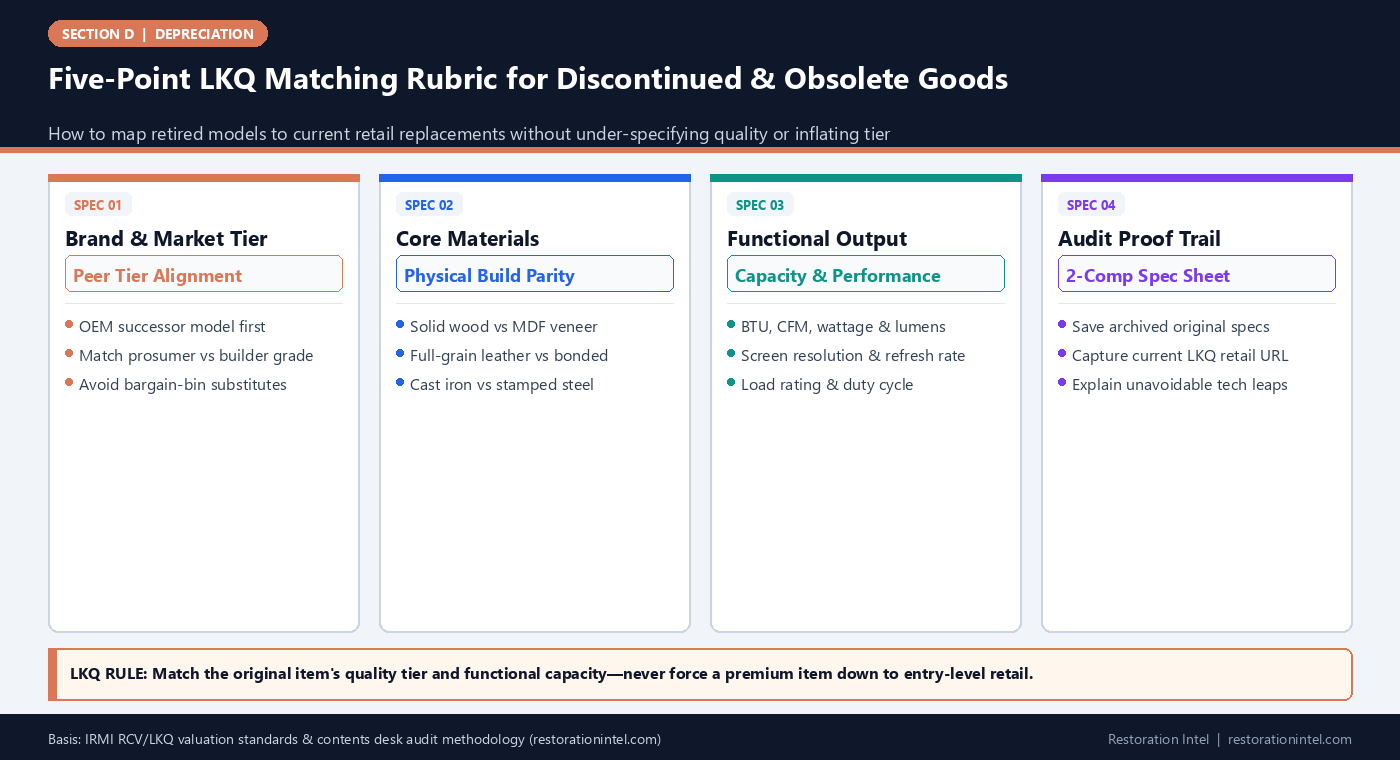
Defensible LKQ Substitution Hierarchy for Discontinued Contents
Step-by-step matching order and red-flag traps across common discontinued or obsolete categories.
| LKQ Match Tier | When to Use It | Verification Standard | Common Desk Error | Example Application |
|---|---|---|---|---|
| 1. Direct OEM Successor Model | Original brand still operates and released a next-gen replacement | OEM spec sheet cross-reference showing direct series replacement | Adjuster searches generic brand name and picks budget base model | Discontinued LG French-door fridge -> current same-series cubic-ft & ice spec |
| 2. Peer Brand Functional Equivalent | Original manufacturer exited market or discontinued entire product line | Match at least 4 of 5 specs: size, material, power, finish, warranty | Substituting mass-market discount brand for specialty prosumer brand | Retired boutique audio amp -> peer audiophile brand with matching watts/THD |
| 3. Material & Craftsmanship Equivalent | Discontinued furniture, cabinetry, or custom soft goods without model SKUs | Match joinery (dovetail/mortise), wood species, fabric rub count, origin | Pricing solid kiln-dried hardwood at flat-pack particleboard retail | Discontinued Restoration Hardware sofa -> peer grade kiln-dried down-wrapped frame |
| 4. Modern Baseline Tech Floor | Obsolete electronics (CRT, legacy 1080p, older Gen CPU) no longer sold new | Lowest current production unit delivering equal or next-step utility, adjusted via depreciation | Pricing obsolete tech at phantom $4,000 third-party NOS collector listings | 2014 flagship 1080p plasma -> current quality mid-tier 4K OLED/QLED with proper age depreciation |
| 5. Custom Fabricator / Millwork Quote | Bespoke sizes, commercial fittings, or discontinued specialty equipment | Written bid from comparable shop or specialty dealer | Forcing custom piece into standard retail box-store catalog SKU | Discontinued commercial bakery rack -> local stainless fabricator build quote |
What 'Like Kind and Quality' Actually Requires Under Policy Language
Standard homeowners and commercial property policies obligate the insurer to pay the cost to repair or replace damaged property with materials or goods of ‘like kind and quality’—not identical museum replicas, and certainly not inferior knockoffs. In practical contents estimating, LKQ balances two anchors: functional equivalence (does it perform the same job at the same capacity?) and quality-tier equivalence (does it use comparable materials, construction methods, and durability?).
Crucially, LKQ does not require an exact brand match when a brand has folded or discontinued a line, nor does it guarantee the exact historical feature set if technology has moved on. What it prohibits is cross-tier downgrading—such as replacing a solid brass fixture with plated plastic, a commercial-duty stand mixer with a light residential model, or full-grain aniline leather with bonded polyurethane.
- Never match by noun alone: ’65-inch TV’ or ‘leather recliner’ is not an LKQ specification; panel technology, leather grade, and frame construction set the tier.
- Ignore phantom marketplace listings: Unverified third-party reseller listings pricing a discontinued 2016 toaster at 3x original MSRP fail desk review immediately.
- Anchor quality before price: Document the original item’s build specs first, then search current retail for matches meeting those specs.
Handling Discontinued Appliances, Tools, and Brand Exits
Appliance and power-tool manufacturers refresh SKU numbers every 12 to 24 months, often changing only a suffix digit while keeping core chassis and performance identical—or occasionally retiring an entire flagship line. When a technician captures a legible rating plate, an estimator can pull archived manufacturer specification sheets to verify capacity, motor amperage, BTU output, finish, and original MSRP tier.
If the same manufacturer offers a direct successor series, that successor is the cleanest LKQ anchor. When the brand has vanished or moved downmarket into a licensing shell, document the shift explicitly and step across to a peer brand occupying the same engineering and price tier, noting the spec-by-spec match in the line description.
- Archive the old spec sheet: Attach a PDF or snippet of the discontinued model’s original features (CFM, amps, cubic feet, finish) to prove tier.
- Watch brand dilution: Legacy heritage tool or audio names bought by discount conglomerates may no longer represent the original item’s quality.
- Match commercial vs residential duty: NSF certification, duty cycle, and serviceability separate commercial units from consumer lookalikes.
Technology Leapfrogging: When Modern Baseline Exceeds the Old Item
Obsolete technology creates the reverse LKQ problem: sometimes today’s entry-level or mid-tier product performs faster or sharper than a 10-year-old flagship. A 2015 high-end desktop monitor or smartphone carried specs that even budget devices surpass today. Conversely, certain legacy features—built-in optical drives, physical ports, or repairable modular chassis—have disappeared from consumer shelves and now exist only in niche prosumer lines.
The proper indemnity approach is not to punish the insured by refusing replacement, nor to inflate RCV with collector ‘new old stock’ listings. Establish RCV using the lowest reputable current retail equivalent that matches the original’s market position and functional role, and let realistic depreciation adjust ACV for the item’s age and obsolescence.
- Separate RCV tier from ACV age: Use current LKQ for RCV, then apply fair obsolescence/age depreciation to reach ACV.
- Preserve specialized ports or ergonomics: If a user relied on workstation ECC memory, physical keyboard travel, or calibrated color gamut, match those functional requirements.
- Document obsolete media ecosystems: When an obsolete player cannot be replaced directly, note whether replacement requires format migration or compatible hardware.
Building Spec-Comparison Notes Adjusters Approve on First Pass
Desk examiners reject LKQ substitutions most often when the schedule shows a higher-priced link with zero explanation connecting it to the damaged item. A concise two-line comparison note eliminates guesswork: state the original brand/model, list three matching specs (size, material/power, tier), and paste the active retailer URL.
For high-dollar disputed items, keep a backup second comparable ready in your workfile. Showing two independent current retailers offering the same peer tier proves the LKQ price is market reality rather than a single-store anomaly, reinforcing practices shared with Reconstruction Materials Matching & Like-Kind Quality Standards and A Price Tag on a Lost Item Is Worth Nothing.
- Three-spec proof rule: Every non-exact LKQ comp over $300 should list at least three matched attributes alongside the URL.
- Avoid promotional flash-sale traps: Do not force RCV to a 48-hour clearance price that is out of stock when the insured actually shops.
- Distinguish true upgrades: Note clearly if an insured chooses a higher-tier replacement out of pocket while keeping claim RCV anchored to LKQ.
Practitioner Verification Checklist (D-07)
- Capture full brand, model, sub-model suffix, and physical spec measurements before declaring any item discontinued.
- Pull archived manufacturer spec sheets on discontinued models to document original material, capacity, and market tier.
- Select the direct OEM successor model first; step to a peer brand only when the original series or maker no longer exists.
- Verify that LKQ comps match construction material and duty grade (e.g., solid hardwood vs veneer, commercial vs consumer).
- Reject unverified third-party marketplace ‘new old stock’ inflation listings and attach active, in-stock retail URLs with spec notes.
Standards, Authority References & Related Reading
Primary standards, insurance definitions, and sibling Restoration Intel guides referenced in this brief:
- IRMI Insurance Glossary: Replacement Cost Value (RCV)
- Verisk XactContents Platform Overview
- ANSI/IICRC S320 Standard for Professional Contents Restoration
- Restoration Industry Association (RIA)
- Related Guide: Electronics and Rapid-Obsolescence Depreciation: Handling Computers, TVs, and Smart Devices Fairly
- Related Guide: Furniture Valuation and Depreciation: Solid Wood vs Veneer, Upholstery Grade, and Custom Joinery
- Related Guide: Estimating Software Price Lists vs Live Retail Links: Audit Rules for Verifying Contents Line Pricing
- Related Guide: Reconstruction Materials Matching & Like-Kind Quality Standards
- Related Guide: A Price Tag on a Lost Item Is Worth Nothing
.md twin for desk QA and team training.Frequently Asked Questions
What does Like Kind and Quality (LKQ) mean for discontinued products?
LKQ means replacing a discontinued item with a current model of comparable functional capability, material quality, durability, and market tier—not necessarily the exact brand, and never an inferior budget substitute.
Should an estimator price discontinued electronics using inflated third-party reseller listings?
No. Phantom or scalper ‘new old stock’ prices on third-party marketplaces do not reflect legitimate replacement cost and are routinely rejected by desk examiners. Use a current peer-tier production equivalent and apply appropriate depreciation.
What happens when technology improves so a modern unit has higher specs than the old one?
Price the lowest current reputable model that fulfills the same functional role and market tier as the original item’s RCV, and let age/obsolescence depreciation reflect the used pre-loss value in ACV.
How can contractors keep adjusters from downgrading LKQ comps?
Document the original item’s rating plate, materials, dimensions, and archived spec sheet, and include a concise three-spec comparison linking the original item to the proposed current retail SKU.