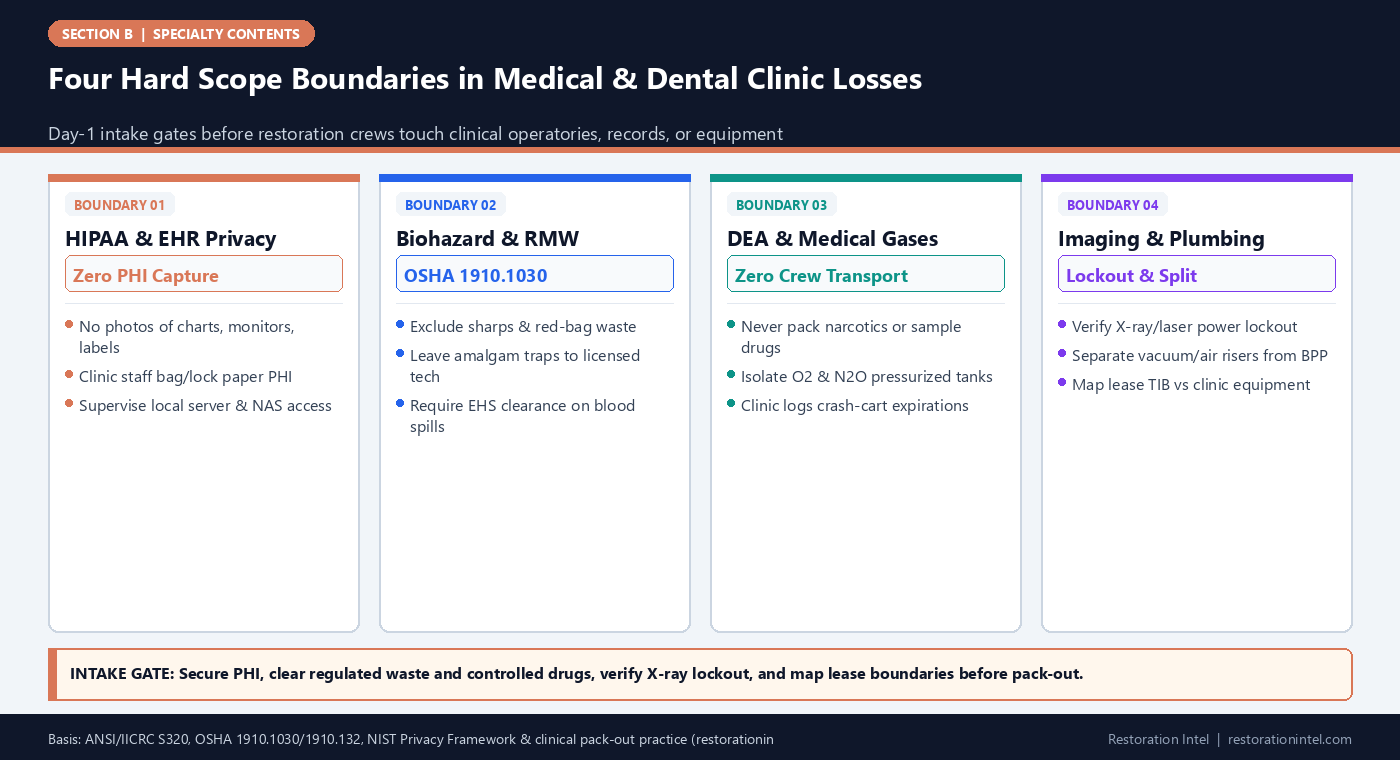
Direct Answer: Before a restoration crew inventories or moves a single item inside a medical or dental clinic, project leads must enforce four hard boundaries: HIPAA protected health information (PHI) containment, OSHA 1910.1030 bloodborne-pathogen and regulated medical waste exclusion, DEA-controlled pharmaceutical and medical-gas lockouts, and radiation/laser de-energization clearance.
.md twin for estimator QA and carrier file documentation.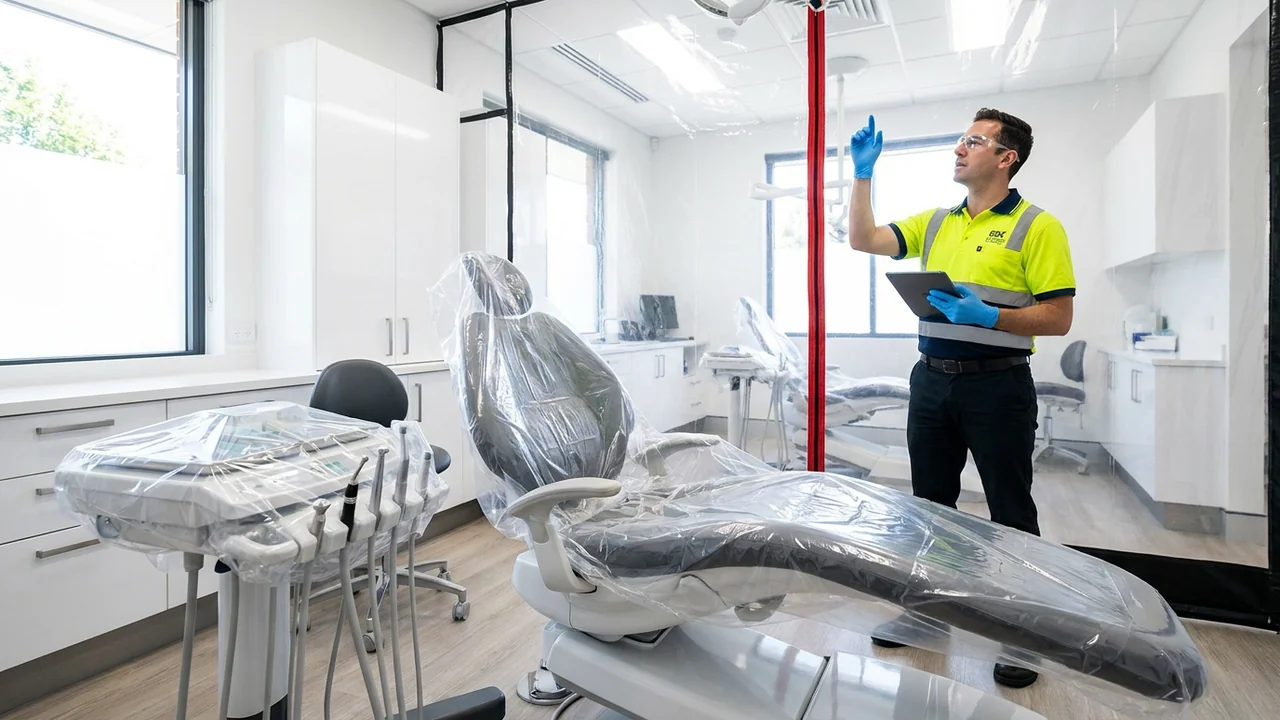
Walking into a water-damaged family medical practice or smoke-affected dental clinic feels familiar at first glance—reception chairs, workstations, cabinetry, and examination rooms—until a crew crosses an unseen regulatory tripwire. Within five feet of a reception desk sits an open schedule binder containing patient names and diagnoses. Behind an operatory partition sit red biohazard sharps containers, suction traps holding dental amalgam, compressed nitrous oxide cylinders, and an active CBCT X-ray unit wired into lead-lined framing.
Standard residential pack-out habits fail immediately in clinical environments. Under ANSI/IICRC S320, contents specialists must identify regulated hazards, privacy-protected records, and specialist-only assemblies before touching contents. Capturing an unredacted patient chart in a pack-out photo creates a reportable privacy breach, while tossing a partially full sharps box into a standard debris bin violates federal bloodborne and medical waste rules.
Setting clear Day-1 boundaries protects clinic staff, restoration technicians, and claim validity alike. Pair this intake framework with Field Guide: HIPAA, FERPA & Trade-Secret Privacy Rules and Healthcare & Dental Leasehold vs Equipment Splits. Clinical & Regulatory Disclaimer: This brief provides restoration workflow and insurance documentation guidance only; it does not constitute legal advice, HIPAA privacy counsel, OSHA compliance certification, or clinical infection-control authorization. Always defer to the clinic’s Privacy Officer, licensed biohazard/medical-gas vendors, and state radiation/health regulators.
Four Hard Scope Boundaries in Medical & Dental Clinic Losses
Medical & Dental Clinic Hazard & Scope Boundary Matrix
Operational split between standard contents restoration crews, clinic privacy/clinical officers, and licensed specialty vendors.
| Clinic Zone / Asset Class | Primary Regulatory or Safety Risk | Contents Crew Boundary | Required Specialist / Clinic Owner Action | Primary Claim Bucket |
|---|---|---|---|---|
| Paper Charts, Intake Clipboards & EHR Terminals | HIPAA Privacy & Security Rules (PHI exposure in photos/vaults) | Do not open drawers, read charts, or photograph readable screens/labels | Practice Privacy Officer bags, seals, or relocates PHI; IT secures backup drives | Valuable Papers / Electronic Media Sublimit |
| Sharps Containers, Red Biohazard Bags & Suction Traps | OSHA 1910.1030 bloodborne pathogens & state RMW statutes | Do not handle, uncap, compress, or pack open sharps or biohazard waste | Licensed medical waste hauler removes RMW before restoration staging | Mitigation / Biohazard Subcontract |
| DEA Narcotics Safes, Vaccines & Sample Closets | DEA diversion liability & cold-chain adulteration | Zero physical custody or transport of scheduled drugs or injectables | Licensed clinician/pharmacist inventories, quarantines, or destroys per DEA rules | Stock / Pharmaceuticals (BPP Sublimit) |
| Medical Oxygen, Nitrous Oxide & Vacuum Manifolds | Pressurized oxidizer/asphyxiant & NFPA 99 medical-gas rules | Do not disconnect brazed copper risers or transport filled gas cylinders | Certified medical-gas vendor bleeds lines and caps cylinders prior to work | Building / TIB vs Scheduled Equipment |
| CBCT, Panoramic X-Ray & Class 3B/4 Dental Lasers | Ionizing radiation interlocks, lead shielding & high-voltage capacitors | Verify breaker lockout/tagout; never cut lead drywall or move unlatched heads | Authorized OEM imaging engineer decommissions and tests radiation safety | BPP / Scheduled Equipment Floater |
| Waiting Room, Reception Furniture & Admin Office Gear | Cross-contamination from operatory soot or Cat 2/3 tracking | Standard S320 pack-out after zone clearance and containment zipper install | PM verifies clean-zone pathway separate from clinical biohazard corridors | Business Personal Property (BPP) |
HIPAA Protected Health Information and Electronic Record Containment
Every medical and dental practice operates as a HIPAA-covered entity, meaning patient names, appointment boards, insurance EOBs, referral faxes, lab slips, and unencrypted radiology workstations carry federal privacy rules even during an active fire or water emergency. When a crew sweeps an office with wide-angle tablets and voice narration, an open patient sign-in sheet at reception or an unlocked chart rack can enter cloud photo storage shared with carriers, TPAs, and subcontractors.
Aligned with the NIST Privacy Framework and J-07’s clinical privacy pack-out controls, crews must enforce a strict “PHI-free lens” rule before capture begins. Have the practice manager or Privacy Officer walk the suite first to pull chart binders, close monitors, clear prescription pads, and lock paper files inside tamper-evident totes under clinic custody or Business Associate protocols.
If water or soot has damaged paper patient charts and archival freeze-drying is required, never route those boxes to a general contents warehouse. Send them through a document-recovery vendor willing to execute a HIPAA Business Associate Agreement (BAA) with restricted-access vaulting and return manifests.
- Pre-camera privacy sweep: Cover open chart racks with opaque poly, close workstation monitors, and remove whiteboard patient schedules before taking overview photos.
- No patient identifiers in audio logs: Instruct technicians to log room numbers (e.g., “Operatory 3”) and equipment tags—never patient names or procedure notes visible on trays.
- Server and DICOM media handoff: Leave local EHR servers, intraoral scan databases, and NAS units powered down or supervised with the clinic’s IT provider.
OSHA 1910.1030 Bloodborne Pathogens and Regulated Medical Waste Boundaries
Operatories, triage bays, sterilization alcoves, and phlebotomy rooms routinely contain potentially infectious materials: used needle sharps containers, blood-tinged gauze, extracted teeth, biohazard specimen refrigerators, soiled lab coats, and dental vacuum amalgam separators. Under the OSHA 1910.1030 Bloodborne Pathogens Standard and OSHA 1910.132 PPE Standard, ordinary contents technicians who lack written exposure-control plans, HBV vaccination access, and biohazard waste manifesting authority must never handle regulated medical waste (RMW).
In a Category 2 or Category 3 water loss—or a sprinkler discharge that topples operatory supply carts onto used instrument cassettes—contaminated standing water can mix bloodborne residues with structural debris. Restoration leads must establish hard containment zippers separating affected clinical zones from administrative waiting areas, as detailed in clean-zone hygiene protocols.
Before any contents technician enters an operatory for inventory or pack-out, require the practice or a licensed medical waste contractor to remove red-bag waste, seal and manifest sharps containers, and evacuate soiled instrument ultrasonic baths. Document that handoff in writing so adjusters understand why pre-pack clearance delayed Day-1 box production.
- Mandatory pre-pack RMW clear: Never pack, bag, or haul red biohazard liners, wall-mounted sharps bins, or pathology specimen jars.
- Amalgam and heavy-metal traps: Dental chair cuspidors and central vacuum amalgam separators fall under EPA dental effluent rules; leave servicing to licensed dental technicians.
- PPE escalation gate: Where biological fluids or Category 3 sewage overlap in clinical suites, require documented biohazard remediation clearance before contents capture.
Controlled Pharmaceuticals, Medical Gases, and Crash-Cart Exclusions
Even outpatient clinics without an attached retail pharmacy store regulated medications: local anesthetic carpules, emergency epinephrine and crash-cart kits, corticosteroid vials, sedation agents, and temperature-sensitive vaccines. Under federal and state pharmacy/DEA controls, restoration contractors cannot take physical custody of DEA-scheduled substances or transport prescription inventory inside general pack-out vans.
As outlined in J-06’s legal exclusions handoff protocol and J-16’s hazmat stabilization rules, pressurized medical gases—specifically portable E-cylinders of oxygen, nitrogen, and nitrous oxide—also trigger Department of Transportation and warehouse storage hazards. Oxygen supports rapid combustion in fire-damaged structures, while nitrous oxide cylinders exposed to elevated heat require pressure-relief inspection before transport.
Have the practice’s prescribing clinician or medical director inventory all controlled medications, lock surviving pharmaceuticals in an on-site safe or transfer them to an authorized reverse distributor, and photograph exterior locked cabinet tags for the claim file without handling individual vials. Coordinate cylinder shutoff and vendor pickup before rigging nearby operatory equipment.
- Vaccine and biologic cold-chain check: Record refrigerator min/max digital logger temperatures immediately on arrival if power failed; thermal excursions often render vaccines non-salvageable.
- No narcotics in vault manifests: Require written exclusion sign-off confirming all DEA-controlled drugs and prescription pads remain with clinic personnel.
- Cylinder isolation: Verify main valves are closed on portable O2 and N2O tanks and store upright away from heat or electrical drying gear.
Radiation, Laser, and Central Utility Boundaries
Dental and medical imaging rooms introduce energy hazards that general contents crews are not licensed to disarm. Panoramic X-ray columns, cone-beam CT (CBCT) gantries, wall-mounted intraoral X-ray arms, and Class 3B/4 surgical or soft-tissue lasers contain high-voltage capacitors, fragile tube heads, and precise optical alignments. Wall framing around these rooms frequently contains lead-lined gypsum board or lead glass viewing windows tied to state radiation-control registrations.
Restoration crews must verify electrical breaker lockout/tagout before wiping or tenting around imaging columns and must never unbolt wall-mounted X-ray tube arms or ceiling-suspended surgical lights. One dropped tube head or bumped laser mirror converts a cleanable external housing into a five-figure mechanical total loss—and creates potential contractor liability.
Equally important on Day 1 is separating utility-room mechanicals from movable clinical contents. Central oil-less air compressors, wet/dry dental vacuum pumps, water-filtration manifolds, and medical-gas alarm panels sit in mechanical closets hard-plumbed through slabs and walls. Map these against E-02’s building-versus-BPP classification matrix and J-14’s tenant-landlord split reference before estimating removal or replacement.
- Imaging lockout verification: Confirm imaging consoles are powered down at the dedicated subpanel before wet extraction or HEPA wiping begins.
- Lead-shielding preservation: Flag lead-lined walls and doors for the structural mitigation team so drywall flood-cuts do not mishandle lead waste under EPA hazardous waste rules.
- Central mechanical mapping: Photograph wall disconnects, copper medical-gas risers, and floor drains on compressors and vacuum turbines to settle Building vs. BPP ownership early.
Establishing Clean-Zone Staging and Multi-Stakeholder Sign-Off
Once privacy, biohazard, pharmaceutical, and imaging boundaries are locked down, establish a physical staging plan that protects surviving clinical spaces from cross-contamination. Never stage soot-laden lobby chairs inside a clean sterilization alcove, and never run negative-air exhaust through an active waiting room where patients or staff are retrieving records.
Build a one-page Day-1 Clinic Scope Boundary Addendum signed by the restoration project manager and the clinic’s practice administrator. That single document lists which rooms are released for contents capture, which cabinets remain locked under clinic custody, which regulated waste or medical-gas vendors are scheduled, and which OEM engineers hold decommissioning authority for imaging and sterilization hardware.
When adjusters review the file weeks later, that signed boundary log explains every split invoice, every specialist mobilization charge, and why certain clinical areas required sequential clearance rather than rapid residential-style pack-out.
- Room-status door placards: Post color-coded status sheets on every operatory door showing Biohazard Clear, PHI Clear, Lockout Verified, and Ready for Capture.
- Separate containment zones: Isolate soot- or Category 3-affected operatories with zipper barriers and dedicated HEPA scrubbers under ANSI/IICRC S500 and S700.
- Advance to structured capture: Hand released rooms directly into B-03’s capture and serial-logging workflow.
Practitioner Verification Checklist (B-02)
- Conduct a pre-camera HIPAA privacy sweep with the Practice Privacy Officer to bag paper charts, hide schedule boards, and secure EHR screens.
- Obtain written confirmation that sharps containers, red biohazard bags, amalgam traps, and soiled clinical waste are cleared by licensed haulers before pack-out.
- Exclude all DEA-scheduled drugs, anesthetic carpules, vaccine coolers, and pressurized O2/N2O cylinders from restoration crew custody and transport.
- Verify breaker lockout/tagout and OEM decommissioning schedules before touching CBCT/X-ray units, surgical lasers, or plumbed dental chairs.
- Document utility tie-ins on central vacuum pumps, oil-less compressors, and lead-lined imaging walls to separate Building/TIB from BPP equipment.
- Execute a signed Day-1 Clinic Scope Boundary Addendum with the practice administrator and attach room-clearance placards prior to capture.
Standards, Authority References & Related Reading
Primary standards, insurance definitions, and sibling Restoration Intel guides referenced in this brief:
- ANSI/IICRC S320 Standard for Professional Contents Restoration
- ANSI/IICRC S500 Water Damage Standard
- ANSI/IICRC S700 Fire & Smoke Restoration Standard
- OSHA 1910.1030 Bloodborne Pathogens Standard
- OSHA 1910.132 Personal Protective Equipment Standard
- NIST Privacy Framework
- US EPA Hazardous Waste Framework
- Related Guide: Medical & Dental Clinics: Capture, Serial & Provenance Logging
- Related Guide: Medical & Dental Clinics: Cleanability vs Total-Loss Triage
- Related Guide: Pre-Loss Readiness for Healthcare and Dental Practices: Separating Leasehold Build-Out from Scheduled Equipment
- Related Guide: Field Guide: High-Sensitivity Legal Exclusions — Firearms, Medications, Cash, Jewelry, and Passports
- Related Guide: Field Guide: HIPAA, FERPA, and Trade-Secret Privacy Rules During Commercial & Clinic Pack-Outs
- Related Guide: Fixed Building Machinery vs Scheduled Business Equipment vs Loose Tools: Policy Classification Matrix
.md twin for desk QA and team training.Frequently Asked Questions
Can restoration technicians move or pack paper patient charts during an emergency clinic pack-out?
Only under strict privacy controls. Standard crews should never photograph open chart pages or remove PHI without the clinic Privacy Officer present; if wet charts require archival freeze-drying, route them through a vendor executing a HIPAA Business Associate Agreement.
Who is responsible for emptying dental chair suction traps and sharps boxes before restoration?
The clinic or its licensed medical/dental waste vendor. Under OSHA 1910.1030 and EPA dental amalgam rules, standard contents technicians do not open, unhook, or haul regulated medical waste or amalgam separators.
Why should portable oxygen and nitrous oxide cylinders never ride in a contents pack-out truck?
Compressed oxidizers and anesthetic gases pose DOT transport hazards, warehouse fire-code violations, and heat-damage rupture risks. Certified medical-gas suppliers must inspect, bleed, or retrieve cylinders.
Are central dental air compressors and vacuum pumps covered as Building or BPP?
Classification varies by lease and policy form. Hard-plumbed utility risers and landlord-installed mechanicals often fall under Building or Tenant Improvements and Betterments (TIB), whereas tenant-installed trade machines may fall under BPP—document every tie-in on Day 1.
Can a contents crew wipe down a smoke-exposed CBCT X-ray unit on site without an OEM tech?
No. Crews should verify power lockout and photograph external conditions only until an authorized OEM imaging engineer inspects internal boards, cooling fans, and radiation safety interlocks.