Direct Answer: Laboratory cleanability turns on internal optical, microfluidic, and circuit-board tolerance plus regulatory recertification viability: non-porous stainless gear and simple enclosures may be decontaminated, whereas soot- or moisture-infiltrated analytical optics, HEPA plenums, and temperature-excursioned reagents generally require total-loss condemnation.
.md twin for estimator QA and carrier file documentation.
The fastest way to derail a laboratory contents claim is to apply residential or general-office cleaning assumptions to scientific and clinical instrumentation. On a standard office desk, wiping light soot off a steel filing cabinet or cleaning a monitor casing returns the item to pre-loss utility. Inside a research or clinical laboratory, wiping the painted sheet-metal shell of a mass spectrometer, flow cytometer, or automated hematology analyzer accomplishes nothing if conductive chloride soot, fine gypsum dust, or fire-suppression residue entered the air-cooled optical bench or high-voltage electronics.
Under ANSI/IICRC S320 and ANSI/IICRC S700, restoration viability requires returning an item to its pre-loss functional, hygienic, and regulatory condition—not merely improving cosmetic appearance. In laboratories, instruments operate at parts-per-billion analytical sensitivity or under strict FDA/CLIA diagnostic tolerances where trace residue invalidates assays, triggers baseline drift, or voids OEM service warranties.
Triage teams must separate cleanable mechanical fixtures from sensitive optics, microfluidic manifolds, and compromised chemical or biological consumables before packing a single box. Clinical, Regulatory & EHS Disclaimer: Final cleanability and return-to-service determinations for regulated diagnostic, GLP, GMP, or biosafety equipment must be made by the OEM, qualified biomedical engineers, or certified certifiers; hazardous waste disposition must follow US EPA RCRA and applicable state biohazard regulations.
Laboratory Cleanability vs Total-Loss Triage Spectrum
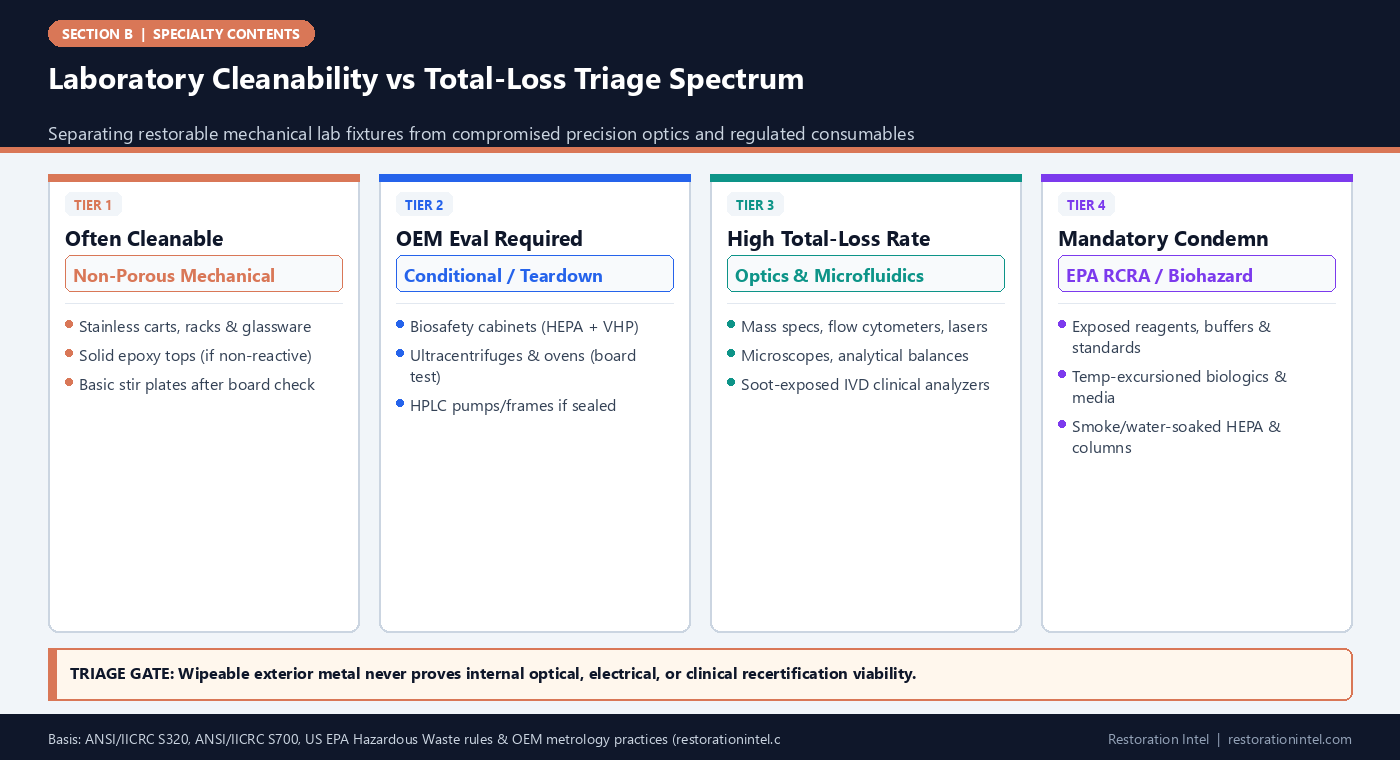
Laboratory Equipment & Stock Cleanability Decision Matrix
Practical triage thresholds separating restorable assets, OEM-teardown candidates, and total-loss condemnations across lab categories.
| Asset / Material Category | Primary Peril Failure Mechanism | Typical Triage Disposition | Required Verification / Proof | Hazmat / Disposal Caveat |
|---|---|---|---|---|
| Stainless Carts, Non-Volumetric Glassware & Metal Racks | Surface soot, smoke odor, Category 1–2 water contact | Cleanable / Decontaminable (unless etched or warped) | Visual/swab cleanliness check & autoclave/sanitize log by lab staff | Verify no radioactive/biohazard history before entering general wash bay |
| Class II Biosafety Cabinets (BSCs) | Drywall dust or soot loading HEPA plenums; water on blower boards | Conditional (Decontaminate, replace HEPA, recertify) or Total Loss | Certified VHP/gas decon + NSF/ANSI 49 airflow & integrity cert | Contaminated HEPA filters require bagged biohazard/hazmat handling |
| Mass Specs, Flow Cytometers & Confocal Optics | Acidic soot on ion optics, mirrors, PMTs, lasers & HV PCBs | Usually Total Loss (or costly OEM module rebuild) | OEM field service inspection letter stating tolerance/warranty loss | Vacuum pump oil and calibration sources may require RCRA disposal |
| Analytical Balances & Precision Spectrophotometers | Particulate fouling of load cells, draft knives & optical gratings | Usually Total Loss if dust/soot breached housing | OEM teardown quote + ISO 17025 calibration failure report | Verify mercury/lamp or battery disposal before scrap |
| PCR Thermal Cyclers, Microplate Readers & Incubators | Moisture corrosion on Peltier blocks, optics & control boards | OEM Diagnostic Eval; Total Loss if Cat 3 or acidic soot | Megohm/board corrosion photos + OEM repair-vs-replace letter | Incubator chambers with biological spills require EHS bio-clearance |
| Reagents, Media, HPLC Columns & Reference Standards | Thermal excursion, smoke permeation, water dilution, broken seals | Mandatory Total Loss (zero restoration viability) | Itemized lot/catalog manifest + excursion/exposure photos | Must be profiled & manifested via licensed EPA RCRA hazmat vendor |
Why External Wipe-Down Fails on Optical, Vacuum, and Microfluidic Hardware
Most laboratory instrumentation relies on active internal cooling fans, ultra-clean optical paths, or sub-millimeter fluidic channels. During a structure fire or even a minor electrical smoke event in an adjacent mechanical room, combustion produces sub-micron carbonaceous particles and acidic chloride gases that travel effortlessly through HVAC ducts and chassis intake vents. Once inside, those residues deposit onto first-surface mirrors, diffraction gratings, photomultiplier tubes, laser diodes, and gold-plated mass-spectrometer ion guides.
Even without direct flame or heavy black soot, fine alkaline dust from wet drywall demolition or acoustic ceiling-tile collapse creates severe mechanical and optical failures. Silica and gypsum dust settles onto analytical balance electromagnetic force restoration cells, linear guideways inside liquid-handling robots, and precision pipette pistons. As explained in Electronic Circuit Boards and Corrosion Creep, hygroscopic salts absorbed onto multi-layer control PCBs slowly attract ambient humidity and cause delayed dendritic shorting weeks after the initial incident.
Because restoration contractors cannot ethically or technically spray solvent across a confocal microscope prism or ultrasonic-wash a quadrupole mass filter, cleanability triage must focus on whether the internal environment remained sealed or whether OEM-authorized decontamination and calibration can restore factory signal-to-noise specifications.
- Intake-to-exhaust trace: Check cooling fans, internal shrouds, and power-supply louvers; soot at the exhaust grille proves full-chassis airflow contamination.
- Optical & load-cell sensitivity: Treat unsealed laser optics, spectrometers, and microgram balances exposed to smoke or gypsum dust as presumptive OEM-eval or total-loss candidates.
- Delayed corrosion risk: Reject quick surface wipe-and-run proposals on powered lab boards exposed to sprinkler water or acidic smoke.
Clinical IVD, GLP, and Biosafety Recertification Thresholds
In commercial offices, a cleaned computer monitor that powers on is restored. In a CLIA-certified clinical laboratory or a FDA-regulated GLP/GMP facility, powering on is meaningless if the instrument can no longer legally produce reportable patient or regulatory data. Many diagnostic OEMs expressly prohibit field cleaning of internal fluidics or optical blocks after fire, smoke, or Category 2/3 water exposure, and will void maintenance agreements and 510(k)-validated support upon inspection.
Biosafety cabinets (Class II Type A2/B2) and laminar-flow clean benches illustrate the boundary between repairable and condemned hardware. A stainless-steel BSC cabinet exposed to clean sprinkler water on its exterior or light ambient smoke may be salvageable if a certified technician performs formal gas/vapor decontamination, replaces loaded HEPA supply and exhaust filters, tests blower windings, and passes ANSI/IICRC S320 cleanliness plus NSF/ANSI 49 airflow recertification. Conversely, Category 3 sewage flooding inside the lower drain pan or warped plenum welds typically push repair and certification costs past replacement.
Follow the structured verification mindset in Diagnostic Testing and OEM Teardown Protocols: secure written OEM or qualified biomedical engineering reports stating specifically whether the unit can be recertified to original accuracy and warranty status.
- OEM warranty & cert gate: Ask the OEM directly in writing whether post-cleaning IQ/OQ/PQ and service-contract eligibility remain intact.
- HEPA plenum reality: Never attempt to vacuum or clean smoke/water-exposed BSC HEPA filters—filter replacement and certified cabinet decon are mandatory.
- Cost-vs-recert math: Include teardown, filter/module replacement, metrology, and validation labor when comparing cleaning against replacement.
Triaging Glassware, Casegoods, Cold Storage, and Passive Lab Fixtures
Not every item inside a damaged lab belongs in the total-loss pile. Solid stainless-steel carts, heavy epoxy or phenolic-resin benchtops, anodized instrument stands, wire shelving, and non-volumetric borosilicate glassware frequently survive smoke or Category 1–2 water incidents with full cleanability—provided EHS clears them of residual hazardous chemicals or biohazards first. Cleaning and sanitizing those durable fixtures saves substantial claim budget and reduces lead-time disruption.
However, subtle traps exist even in glassware and cold storage. Class A volumetric flasks, burettes, and precision quartz cuvettes can suffer thermal shock etching or optical micro-scratching from aggressive abrasive cleaning, destroying calibration tolerances. Ultra-low-temperature (-80°C) cascade freezers exposed to heat or heavy soot often suffer condenser fin fouling and compressor oil degradation; even if the exterior cleans up, compromised thermal hold-down threatens irreplaceable future sample runs.
Porous laboratory items—cardboard cryogenic storage boxes, paper protocol binders, acoustic ceiling tiles, fabric task chairs, and open consumable cardboard cases—exposed to Category 2/3 water or persistent smoke odor follow standard porous-material condemnation rules under ANSI/IICRC S500 and ANSI/IICRC S520.
- Durable salvage wins: Prioritize stainless steel racks, chemical-resistant epoxy work surfaces, and solid anodized stands for controlled decontamination.
- Precision glassware split: Separate general flasks/beakers from optical quartz cuvettes and Class A volumetric ware when testing cleanability.
- Porous & paper triage: Condemn soaked cardboard cryo-boxes and smoke-saturated lab manuals; digitize vital paper logs under controlled containment if needed.
Reagents, Biologics, and EPA RCRA Total-Loss Disposal Boundaries
Consumable stocks inside research and clinical labs—monoclonal antibodies, PCR master mixes, cell-culture media, HPLC-grade solvents, diagnostic test cartridges, and NIST-traceable chemical standards—almost always represent a 100 percent total loss when exposed to power-loss temperature excursions, smoke infiltration, or water intrusion. Unlike consumer pantry cans, a lab reagent bottle cannot simply be washed off and reused if thermal history, sterility, or lot purity is in doubt.
Crucially, total-loss condemnation in a laboratory does not mean tossing bottles into a contractor roll-off dumpster. Opened or compromised acids, bases, flammables, oxidizers, heavy-metal salts, ethidium bromide, and biohazardous reagents are regulated under the US EPA Hazardous Waste Framework (RCRA) and state medical-waste statutes. Mixing incompatible lab chemicals in a trash bag or municipal bin creates severe exothermic fire, toxic gas, and regulatory enforcement hazards.
Restorers must inventory, photograph, and verify expiration/temperature logs for adjuster sign-off while leaving physical chemical segregation, lab-packing, and manifest disposal strictly to the facility’s EHS office or a licensed RCRA hazardous-waste contractor.
- Zero dumpster rule: Never place condemned lab chemicals, biological kits, sharps, or mercury thermometers into general construction debris bins.
- Excursion proof: Export continuous temperature-monitoring logs (or photograph max-min digital displays) to prove cold-chain failure on unburnt reagents.
- Licensed lab-pack routing: Scope chemical disposal as a separate licensed EHS/RCRA line item rather than generic debris haul-off.
Building an Adjuster-Proof Non-Salvageable Technical Packet
Because laboratory instruments carry five- and six-figure unit values, carrier examiners rarely approve a total-loss line item based solely on a restoration technician’s note saying “smells like smoke.” Every condemned instrument should be backed by a concise technical dossier linking physical peril exposure to functional or regulatory failure.
Pair macro exposure photos (soot at cooling vents, moisture corrosion on boards, debris inside optical bays) with an independent written evaluation from the OEM field service engineer or an accredited third-party biomedical/metrology lab. That report should document diagnostic error codes, failed calibration checks, repair parts plus IQ/OQ/PQ cost, and any explicit OEM refusal to recertify or honor warranties.
Finally, verify salvage/scrap and decommissioning steps before disposal. Never crush or haul away a condemned LC-MS or spectrometer before the adjuster confirms whether the carrier waives physical salvage or requests OEM part-out credit—and ensure all internal sample residues, radioactive check sources, and hard drives are cleared prior to release.
- Three-part proof bundle: Combine exposure macro photos, OEM/biomed teardown report, and repair-vs-replacement cost comparison on every high-value total loss.
- Check salvage hold first: Confirm adjuster written disposal release before scrapping condemned chassis, titanium rotors, or precious-metal labware.
- Pre-disposal purge: Document removal of internal hard drives (HIPAA/IP), radioactive sources, and hazardous fluids before salvage or scrap handoff.
Practitioner Verification Checklist (B-09)
- Evaluate laboratory cleanability by internal optical, microfluidic, and PCB tolerance rather than exterior sheet-metal appearance.
- Obtain written OEM or certified biomedical engineering teardowns confirming whether post-cleaning calibration and warranty recertification remain valid.
- Separate non-porous stainless/epoxy fixtures that can be safely decontaminated from porous consumables and exposed precision optics.
- Pull temperature-logger exports and photograph broken seals to substantiate total loss on temperature-excursioned reagents and biologics.
- Route all condemned lab chemicals, biohazards, and contaminated HEPA filters through licensed EPA RCRA / medical-waste handlers—never general dumpsters.
- Secure written carrier disposal/salvage authorization and strip hard drives, check sources, and residual fluids before removing condemned instruments.
Standards, Authority References & Related Reading
Primary standards, insurance definitions, and sibling Restoration Intel guides referenced in this brief:
- ANSI/IICRC S320 Standard for Professional Contents Restoration
- ANSI/IICRC S700 Fire & Smoke Restoration Standard
- ANSI/IICRC S500 Water Damage Standard
- US EPA Hazardous Waste Framework
- OSHA Hazard Communication Standard (HazCom)
- IRMI Insurance Glossary: Salvage
- Related Guide: Research & Clinical Laboratories: Capture, Serial & Provenance Logging
- Related Guide: Research & Clinical Laboratories: Valuation, LKQ Sourcing & Policy Traps
- Related Guide: Diagnostic Testing and OEM Teardown Protocols: Proving Internal Smoke, Moisture, or Surge Damage
- Related Guide: Electronic Circuit Boards and Corrosion Creep: Why Wet or Soot-Exposed Machinery Fails Weeks After Loss
- Related Guide: Field Guide: Non-Salvageable Disposal Authorization & Witness-Log Template
- Related Guide: Salvage Is a Window, Not a Service
.md twin for desk QA and team training.Frequently Asked Questions
Can a soot-exposed mass spectrometer or flow cytometer be restored by ultrasonic cleaning?
Generally no. Mass analyzers, vacuum optics, lasers, and microfluidic blocks cannot tolerate trace ionic or detergent residues, and third-party disassembly typically voids OEM service contracts and regulatory validation. OEM inspection or replacement is standard.
When is a Class II biosafety cabinet restorable vs total loss?
A BSC may be restorable if structural welds and blower housing are intact, allowing certified vapor/gas decontamination, HEPA filter replacement, and NSF/ANSI 49 airflow recertification. Heavy corrosion, Category 3 flooding in lower plenums, or repair costs exceeding replacement push it to total loss.
Why are unopened reagents in a refrigerator often condemned after a brief fire power outage?
Clinical diagnostics and GLP research require strict cold-chain continuity. Once power loss pushes reagent or media storage outside validated tolerances—or introduces smoke odor into permeable packaging—lot integrity cannot be guaranteed for patient or research results.
Who is responsible for disposing of condemned laboratory chemicals after a fire or flood?
Condemned laboratory reagents and solvents are regulated under EPA RCRA and state hazardous-waste rules. A licensed hazardous-waste lab-pack vendor coordinated with the facility’s EHS officer—not general restoration haul-off crews—must manifest and dispose of them.
What documentation persuades a carrier desk examiner to approve a high-dollar lab instrument total loss?
Combine macro photos of soot or moisture inside intake vents/boards, the asset’s pre-loss NIST calibration record, a formal OEM/biomedical inspection stating non-recertifiability or repair-exceeds-ACV math, and clear RCV/LKQ quotes.