Direct Answer: Veterinary hospital scoping requires strict containment around zoonotic and hardy animal pathogens (such as parvovirus and ringworm), radiation and anesthetic-gas zones, DEA-controlled euthanasia and sedation drugs, and live-animal respiratory sensitivities to deodorizers and containment chemicals.
.md twin for estimator QA and carrier file documentation.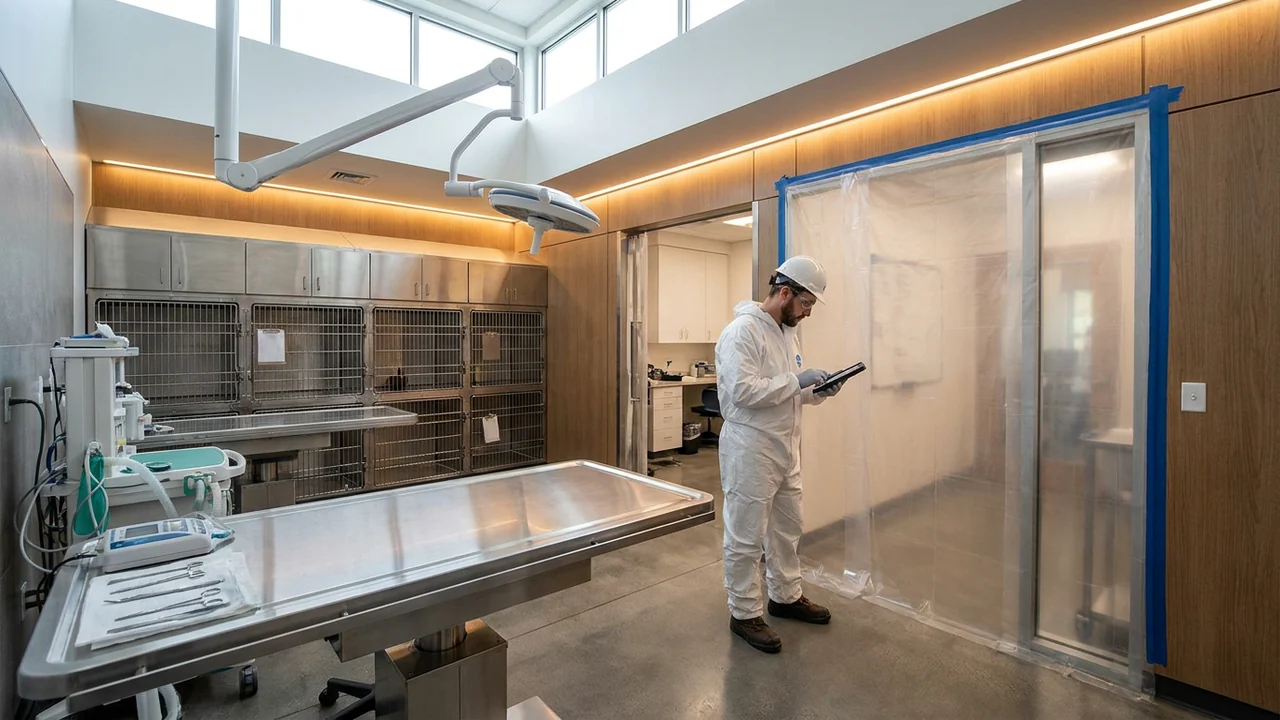
At first glance, a veterinary hospital or animal care facility looks similar to an outpatient human medical clinic—exam rooms, diagnostic imaging, surgical suites, and pharmacy bays—combined with commercial kennels. In practice, veterinary facilities introduce distinct biological, chemical, radiological, and live-patient hazards that standard B-02 medical clinic boundaries do not fully cover.
Restoration crews scoping a water, fire, or mold loss inside an animal hospital, emergency vet ER, or boarding kennel must account for non-enveloped animal pathogens like canine parvovirus (resistant to many routine hospital disinfectants), dermatophyte fungal spores (ringworm) hiding inside kennel HVAC returns, isoflurane and sevoflurane anesthetic gas lines, oncology chemotherapy prep areas, veterinary X-ray and Cone Beam CT (CBCT) radiation rooms, and DEA-controlled sedation or euthanasia drugs. Just as critically, many clinics shelter hospitalized or boarding animals in an unaffected wing during mitigation—meaning odor-control chemistry, ozone, and airborne dust pose immediate toxicity risks to veterinary patients.
Compliance & Safety Disclaimer: This field brief outlines property-restoration scoping boundaries and does not replace OSHA regulations, state veterinary medical board rules, radiation-control laws, or DEA controlled-substance compliance. Coordinate all zone entries, biohazard clearances, and animal-safety protocols with the Medical Director or Practice Manager.
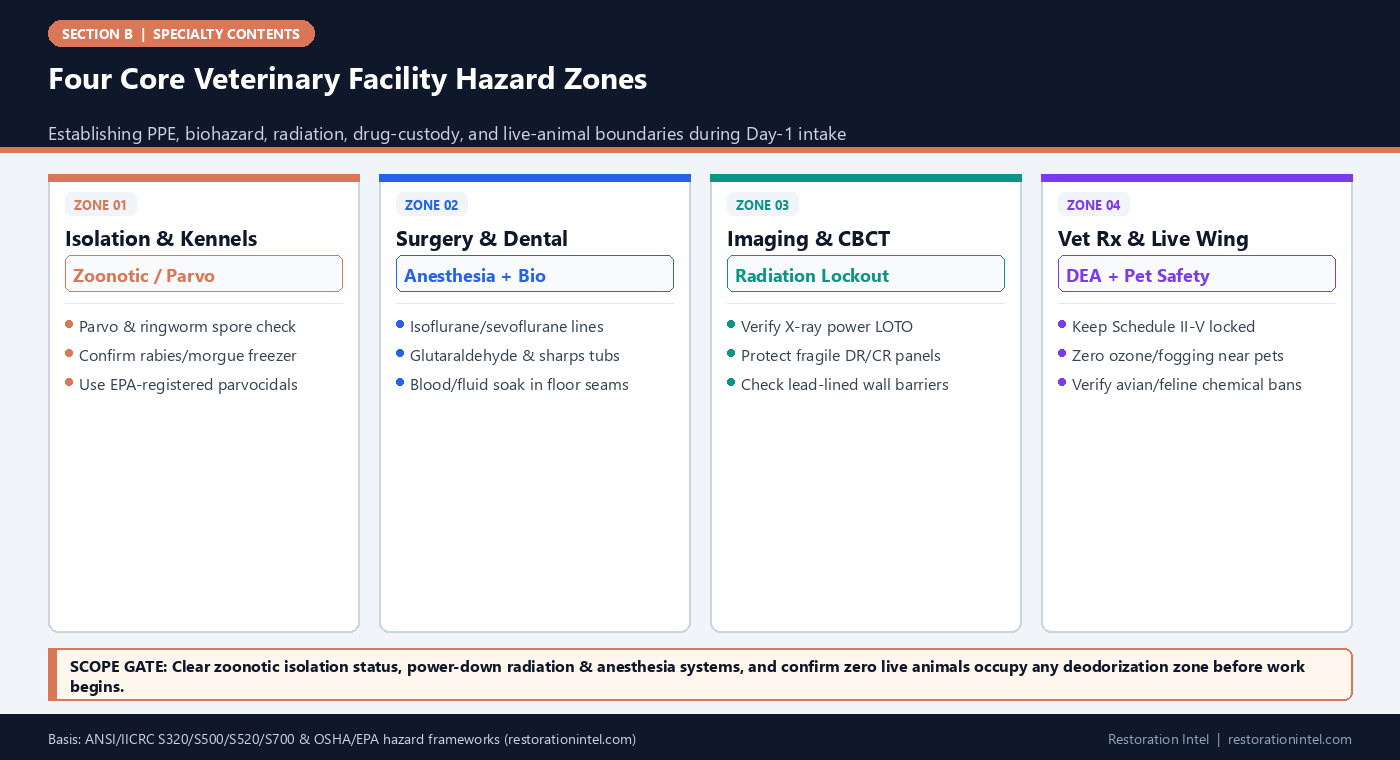
Four Core Veterinary Facility Hazard Zones
Veterinary Hospital & Animal Care Zone Hazard Boundary Matrix
Mandatory pre-entry checks, hazard controls, and crew exclusions across clinical, imaging, and kennel spaces.
| Facility Zone | Primary Biological or Chemical Hazards | Regulatory / Operational Boundary | Minimum Crew PPE & Containment | Immediate Hard Stop / Exclusion |
|---|---|---|---|---|
| Isolation Ward & Morgue / Cremation Prep | Parvovirus, feline panleukopenia, ringworm, Leptospira, rabies-suspect tissue | OSHA PPE/HazCom & clinic infection-control officer sign-off | Tyvek suit, double nitrile gloves, N95/P100 per S520/S320, boot covers | Never enter active isolation rooms or open euthanasia/necropsy freezers without DVM clearance |
| Kennels, Runs, Grooming & Boarding Wings | Animal urine/feces ammonia, Bordetella aerosols, flea/tick sprays, hair mats | Cat 3 biohazard protocol for flooded floor drains & trench runs | Full eye protection, chemical gloves, negative air containment | Zero ozone, thermal fog, or phenolic cleaners anywhere animals remain boarded |
| Surgical Suites & Dental Wet-Table Bays | Isoflurane/sevoflurane gas, oxygen cylinders, blood/tissue, cold-sterilants | Lock out O2/N2O manifolds; follow bloodborne/zoonotic hygiene | OSHA 1910.132 PPE, sharps awareness, HEPA air scrubbing | Never disconnect pressurized anesthesia manifolds or touch open sharps containers |
| Radiology, Ultrasound & CBCT Suites | High-voltage X-ray generators, lead aprons/shields, fragile DR detectors | Confirm breaker lockout; no lead-shielding demolition without survey | Standard dry/clean PPE; padded ESD handling for DR panels | Never energize water-exposed X-ray consoles or drop wireless DR plates |
| In-House Lab & Oncology Prep | Formalin specimen jars, analyzer reagents, cytotoxic chemo residues | EPA Hazardous Waste & OSHA HazCom SDS review | Nitrile chemo-rated gloves, P100/OV respirator if chemical spill | Quarantine broken formalin jars or oncology hoods for specialty hazmat |
| Veterinary Pharmacy & DEA Lockbox | Schedule II–V pentobarbital, ketamine, hydromorphone, buprenorphine | DEA registrant custody; strictly off-limits to restoration crews | Exterior documentation only under Practice Manager escort | Zero crew contact with controlled drug safes or open narcotics logs |
Animal-Zoonotic Pathogens That Defeat Standard Restoration Disinfectants
General restoration crews are trained to apply standard quaternary ammonium disinfectants after Category 2 or Category 3 water losses under ANSI/IICRC S500 and OSHA 1910.1030 Bloodborne Pathogens principles. Inside a veterinary hospital, however, routine residential disinfectants fail completely against several core veterinary pathogens. Canine parvovirus and feline panleukopenia are rugged, non-enveloped viruses that survive in porous grout, kennel seams, and wet drywall for months unless treated with verified, label-approved parvocidal oxidizers (such as accelerated hydrogen peroxide or properly diluted sodium hypochlorite after gross soil removal).
Equally persistent are dermatophyte spores (ringworm), Leptospira in urine-soaked run drains, and aerosolized kennel cough agents. Before crews pull baseboards in an isolation ward or pack out stainless kennel doors, ask the Medical Director which wards housed infectious cases within the past 30 days—and verify whether the clinic’s walk-in or chest morgue freezer holds biological remains or rabies-quarantine specimens requiring immediate veterinary transfer before power cutoff.
- Match disinfectant to pathogen: Verify EPA registration claims for parvovirus and dermatophytes with the clinic’s Medical Director.
- Treat kennel drains as Cat 3: Floor-trough backups carrying animal waste require full Category 3 containment and PPE.
- Clear morgue freezers early: Coordinate transfer of deceased patient remains or diagnostic specimens before shutting down power.
Anesthetic Gases, Oxygen Manifolds, and Oncology Chemical Boundaries
Every veterinary surgical and dental suite contains compressed oxygen cylinders, central oxygen-concentrator lines, and volatile inhalation anesthetics—most commonly isoflurane or sevoflurane—paired with activated-charcoal scavenging canisters (F/air) or active waste-anesthetic-gas exhaust lines. During fire suppression or structural tear-out, punctured anesthetic vaporizer bottles, leaking medical-gas manifolds, or heat-exposed pressurized O2 tanks create acute inhalation and combustion hazards.
Under OSHA HazCom and OSHA 1910.134 Respiratory Protection, collect Safety Data Sheets (SDS) for glutaraldehyde cold-sterile trays, 10% neutral buffered formalin biopsy jars, and any chemotherapy agents used in specialty practices. Never pack pressurized gas bottles, spilled liquid isoflurane, or cracked formalin jars into standard contents boxes.
- Close O2 & manifold valves: Confirm veterinary staff have shut down oxygen tanks and central concentrators before electrical work.
- Quarantine formalin & chemo spills: Treat broken biopsy jars and oncology prep hoods as EPA hazardous waste scopes.
- Leave vaporizers upright: Tilting an isoflurane precision vaporizer spills liquid anesthetic and ruins internal calibration wicks.
Live-Animal Safety: Why Deodorizers, Dust, and Ozone Threaten Adjacent Wings
Unlike a retail store that closes completely after a pipe burst, emergency veterinary hospitals and multi-ward boarding facilities frequently keep critical ICU patients, post-op dogs, hospitalized cats, or boarded exotics in an unaffected wing while restoration proceeds in another zone. Standard restoration deodorization tools become acute veterinary toxins in that scenario.
Birds and exotic pets possess extraordinarily sensitive respiratory tracts that suffer fatal injury from thermal fogging, solvent deodorizers, and even trace ozone leakage. Cats lack specific liver glucuronidation pathways to metabolize phenolic disinfectants and many essential-oil-based odor counteractants. Whenever live animals remain anywhere on the premises, establish airtight negative-pressure HEPA containment under ANSI/IICRC S520 isolation logic, prohibit ozone and strong fragrance fogging completely, and coordinate all loud demolition or dust-generating activity with veterinary staff.
- Absolute ban on ozone near animals: Never operate ozone generators or high-output hydroxyl units in buildings housing live patients.
- No phenols or essential oils: Exclude phenolic disinfectants and pine/terpene odor agents anywhere cats or birds may breathe return air.
- Isolate HVAC return paths: Seal shared ductwork between damaged zones and occupied treatment or kennel wings immediately.
Radiation Suites, Veterinary DEA Lockboxes, and Pet-Food Retail Splits
Three additional hard boundaries govern veterinary scoping. First, radiology suites house high-voltage X-ray generators, ceiling- or table-mounted tube heads, fragile digital radiography (DR) flat panels, and lead-lined drywall or glass observation windows. Never cut into lead-lined radiology walls or move heavy imaging gantries without electrical lockout and veterinary radiation-safety clearance. Second, veterinary narcotics safes—containing Schedule II–V euthanasia solutions (pentobarbital), ketamine, and opioids—must remain strictly untouched under DVM/DEA registrant control per J-06 High-Sensitivity Legal Exclusions.
Third, separate clinical medical spaces cleanly from lobby retail zones holding prescription therapeutic pet diets and over-the-counter supplements, and verify lease fixture splits between landlord plumbing/trench drains and tenant surgical gear before estimating under E-02 Equipment Classification Rules.
- Protect DR panels & lead barriers: Lock out imaging breakers and flag lead-lined partition walls for structural adjusters.
- Exclude DEA narcotics vaults: Document exterior safe condition only; DVM registrant handles all controlled inventory.
- Separate lobby retail diets: Track therapeutic pet-food bags and OTC preventives in a clean retail sub-zone apart from biohazard kennels.
Emergency Patient Transfers, Biomedical Vendors, and Corridor Containment
During the first hours after a fire or pipe burst at a 24-hour veterinary emergency clinic, staff focus simultaneously on stabilizing hospitalized animals, transferring critical ICU patients to partner clinics, and shutting down medical-gas lines. Restoration project managers must establish clean, unobstructed evacuation corridors for rolling gurneys and oxygen carts before erecting zipper barriers or stringing power cords across hallways.
Just as important is separating structural mitigation from specialized veterinary biomedical servicing. While restoration crews extract water, deploy HEPA negative air scrubbers under ANSI/IICRC S500, and sanitize non-porous kennel shells, factory biomedical technicians—not general contents packers—must unhook piped anesthesia scavenging lines, discharge radiology capacitors, and inspect sensitive monitoring electronics.
- Keep ICU transfer paths clear: Stage drying cords and containment airlocks away from active ambulance and client exits.
- Coordinate biomedical disconnects: Wait for OEM service engineers before unplugging hardwired imaging or surgical booms.
- Align with capture protocols: Transition cleared rooms cleanly into B-38 Veterinary Capture & Provenance Logging.
Practitioner Verification Checklist (B-37)
- Review active infectious-disease status (parvovirus, ringworm, leptospirosis, rabies quarantine) with the Medical Director before room entry.
- Confirm zero live animals remain in or share HVAC air with any zone slated for demolition, containment breach, or deodorization.
- Ban ozone generators, thermal fogging, phenolic disinfectants, and essential-oil odor agents whenever pets occupy adjacent wings.
- Verify oxygen manifolds, anesthesia scavenging systems, formalin jars, and X-ray high-voltage breakers are safely shut down and locked out.
- Exclude DEA-controlled veterinary narcotics safes (pentobarbital, ketamine, opioids) from restoration handling under DVM custody.
- Treat flooded kennel drains as Category 3 biohazard and coordinate transfer of morgue/necropsy freezer contents before power loss.
Standards, Authority References & Related Reading
Primary standards, insurance definitions, and sibling Restoration Intel guides referenced in this brief:
- ANSI/IICRC S320 Standard for Professional Contents Restoration
- ANSI/IICRC S500 Water Damage Standard
- ANSI/IICRC S520 Mold Remediation Standard
- ANSI/IICRC S700 Fire & Smoke Restoration Standard
- OSHA 1910.1030 Bloodborne Pathogens Standard
- OSHA 1910.134 Respiratory Protection Standard
- OSHA 1910.132 Personal Protective Equipment Standard
- OSHA Hazard Communication Standard (HazCom)
- US EPA Hazardous Waste Framework
- Related Guide: Veterinary Hospitals & Animal Care Facilities: Capture, Serial & Provenance Logging
- Related Guide: Medical & Dental Clinics: Scope & Hazard Boundaries
- Related Guide: Research & Clinical Laboratories: Scope & Hazard Boundaries
- Related Guide: Field Guide: High-Sensitivity Legal Exclusions — Firearms, Medications, Cash, Jewelry, and Passports
- Related Guide: Field Guide: HIPAA, FERPA, and Trade-Secret Privacy Rules During Commercial & Clinic Pack-Outs
- Related Guide: Fixed Building Machinery vs Scheduled Business Equipment vs Loose Tools: Policy Classification Matrix
.md twin for desk QA and team training.Frequently Asked Questions
Why do standard restoration disinfectants fail in veterinary isolation wards?
Non-enveloped animal viruses like canine parvovirus and fungal spores like ringworm resist standard quaternary ammonium disinfectants, requiring EPA-registered parvocidal oxidizers or validated chlorine protocols after gross soil removal.
Can restoration crews run ozone or hydroxyl machines in a partially occupied veterinary clinic?
No ozone should ever be run in a building with live animals, and strong chemical/essential-oil deodorizers can be fatal to birds, exotics, and cats. Even hydroxyl deployment requires verifying zero adverse sensitivity and strict air-barrier isolation.
Who handles veterinary controlled substances like ketamine or euthanasia solutions after a loss?
Only the DEA-registered veterinarian or authorized clinic staff. Restoration crews must never touch, count, or transport Schedule II–V veterinary drugs.
Are veterinary X-ray rooms safe to enter after a sprinkler discharge?
Only after imaging breakers are locked out by qualified personnel so wet high-voltage generators and power supplies pose no shock hazard, and crews must avoid damaging lead-lined walls or fragile DR panels.
How should kennel floor-trough water losses be classified?
Because kennel runs and trench drains accumulate animal feces, urine, and biological debris, water backups or flooding across kennel floors should be scoped as Category 3 biohazard losses.