Direct Answer: Veterinary capture requires logging detached serials on anesthesia precision vaporizers, ultrasound probes, and DR flat-panel detectors separately from carts and tables, flagging reagent-rental lab analyzers for third-party ownership, and indexing stainless kennel banks, surgical suites, and clinic inventory without touching DEA narcotics.
.md twin for estimator QA and carrier file documentation.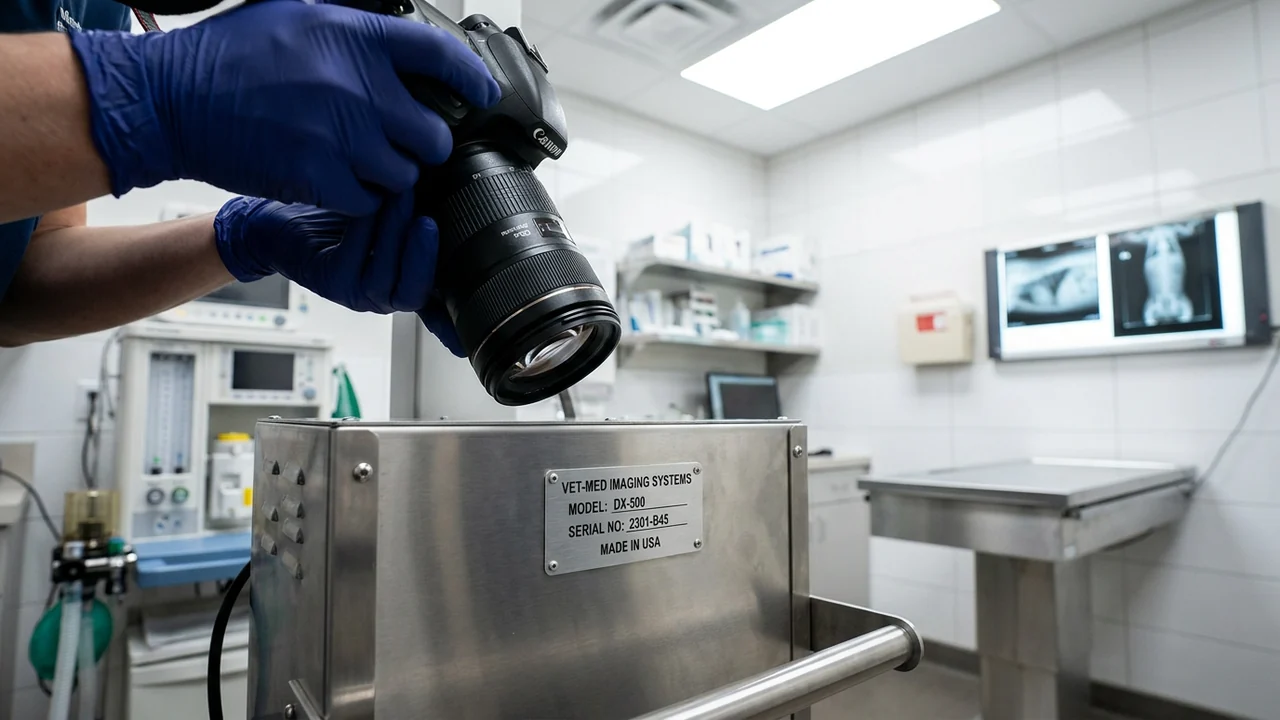
Once zoonotic, radiological, and live-animal boundaries are locked down under B-37 Scope & Hazard Boundaries, field documentation shifts into precision asset capture. A general or specialty veterinary hospital packs intense capital density into compact treatment rooms: a rolling anesthesia cart carries a standalone calibrated isoflurane vaporizer worth thousands on its own; an ultrasound system relies on three or four individually serialized transducers; and an in-house diagnostics bench often blends clinic-owned centrifuges with manufacturer-owned analyzers placed under reagent-purchase agreements.
Treating those systems like generic office equipment—photographing only the front of a cart or grouping “exam room medical gear” as a single line in XactContents—virtually guarantees undervaluation or carrier rejection. Following ANSI/IICRC S320 and E-03 Rating-Plate Capture Standards, crews must capture every sub-assembly serial number, annual calibration sticker, state radiation registration tag, and lease/ownership contract on Day 1.
Compliance Disclaimer: Veterinary narcotics logs, state radiation-machine registrations, and patient medical records remain under the control of the licensed veterinarian and Practice Manager. Do not handle DEA Schedule II–V stock or expose identifiable client/patient billing files in claim photo packets.
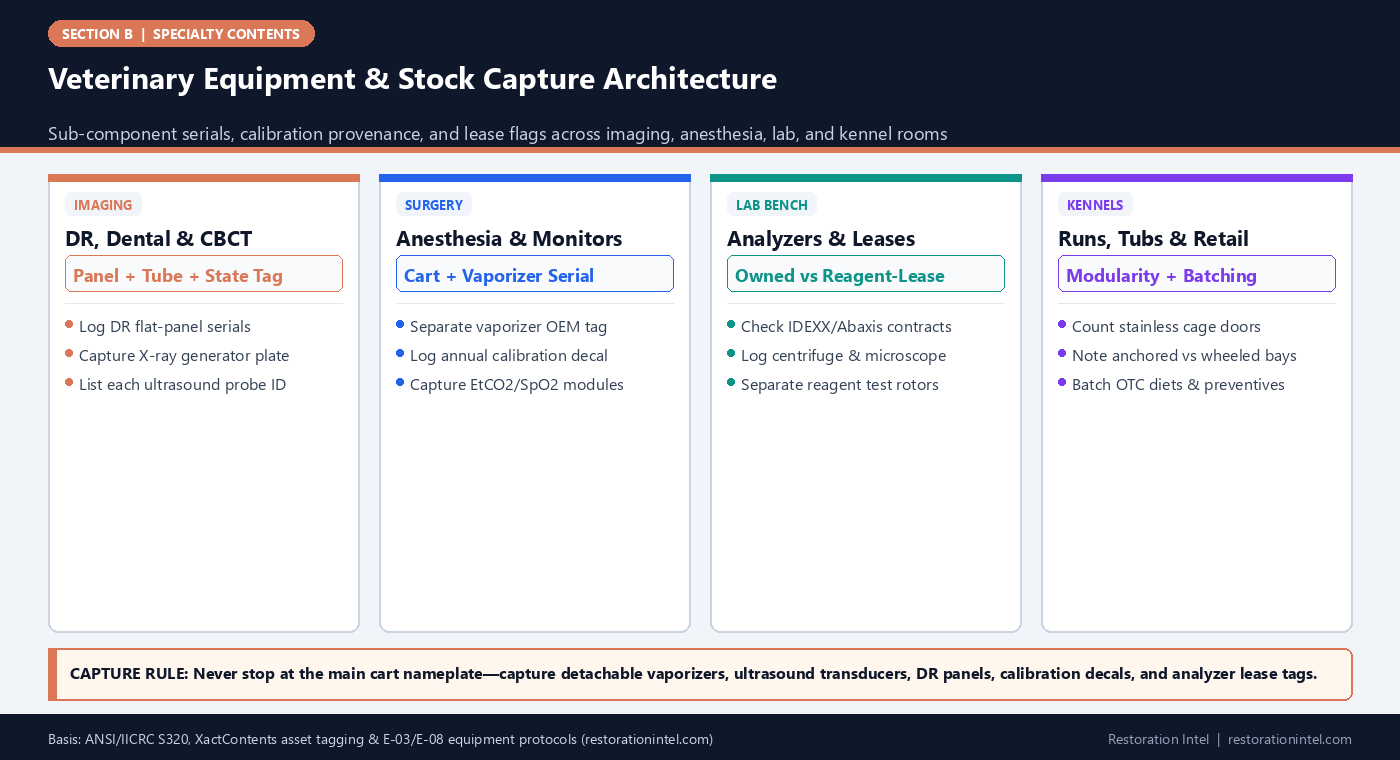
Veterinary Equipment & Stock Capture Architecture
Veterinary Hospital Room-by-Room Capture & Provenance Matrix
Critical sub-components, serial locations, and ownership provenance checks across veterinary clinical and boarding rooms.
| Veterinary Asset Group | Sub-Components Requiring Separate Capture | Primary Serial / Tag Locations | Essential Provenance Records | Most Common Field Capture Omission |
|---|---|---|---|---|
| Anesthesia Machines & Ventilators | Chassis/frame, precision vaporizer(s), scavenging unit, ventilator bellows | Rear frame plate + front/side vaporizer barrel + calibration sticker | Annual vaporizer calibration certificate & OEM service invoice | Logging only the cart chassis and missing the $1,500+ detachable vaporizer serial |
| Diagnostic Ultrasound Systems | Main console, linear/microconvex/phased-array probes, thermal printer | Console rear plate + strain-relief collar or connector block on each probe | Probes purchase invoices & extended transducer service plan | Counting '1 ultrasound' without capturing 3–4 individually serialized probes |
| Digital Radiography (DR/CR) & Dental X-Ray | Wireless/wired DR flat panel, tube head, high-voltage generator, dental sensor | Panel back/edge barcode, generator cabinet, tube housing, state rad decal | State radiation-control registration & acquisition workstation specs | Overlooking fragile intraoral dental X-ray sensors stored in wall cradles |
| In-House Blood Chemistry & Hematology Analyzers | Chemistry analyzer, hematology unit, sediment analyzer, UPS battery | Rear/underside rating plate + vendor asset/placement barcode sticker | Owned CapEx invoice vs reagent-rental / placement contract | Listing vendor-owned placement analyzers as clinic-owned BPP without lease check |
| Surgical Suites & Sterilization | Ceiling/wall surgical LED booms, autoclave, electrocautery, fluid pumps | Boom hub (check building tie-in), autoclave door jamb, pump rear | Autoclave spore-test logs & installation invoices (Building vs BPP) | Failing to photograph ceiling mount flanges to separate Building vs BPP |
| Stainless Kennels, Lift Tables & Grooming | Modular cage banks, latch hardware, hydraulic lift tables, wet/tub stations | Cage bank side frame, table actuator column, tub faucet manifold | Layout blueprint showing anchored runs vs rolling stainless stacks | Lumping custom stainless cage suites into generic 'metal shelving' |
Imaging Systems: Separating DR Panels, Tube Generators, and Ultrasound Probes
Veterinary diagnostic imaging equipment routinely represents the highest single-room value on a clinic claim, yet it is packed with modular sub-components that carry independent serial numbers and fragility profiles. On a digital radiography (DR) suite, capture four separate identifiers: (1) the wireless or tethered Cesium Iodide (CsI) flat-panel detector resting inside the bucky tray or protective sleeve, (2) the X-ray tube housing and collimator, (3) the high-voltage generator and floating table base, and (4) the dedicated acquisition workstation PC and DICOM viewing monitors.
Check wall-mounted veterinary dental X-ray arms and tiny intraoral digital sensors—which are easily knocked loose or dropped during ceiling tear-out. For Cone Beam CT (CBCT) or mobile C-arms, photograph state radiation-control registration decals alongside shielded door interlock switches. On diagnostic ultrasound carts, carefully pull each transducer cable from its holder without kinking the fiber sheath to photograph the probe model and serial engraved on the connector block or strain relief; specialty cardiac and abdominal probes frequently cost almost as much as a mid-range cart.
- Never stack heavy items on DR panels: Wireless DR detectors contain fragile amorphous silicon/CsI matrices sensitive to shock and moisture.
- Log every probe separately: Record frequency range and serial number for every ultrasound transducer on the cart.
- Capture acquisition software keys: Photograph imaging workstation dongles and PACS license labels before IT teardown.
Anesthesia Carts, Precision Vaporizers, and Monitoring Provenance
A veterinary anesthesia machine is never a single serialized item. The rolling frame, flowmeter block, oxygen flush assembly, ventilator module, and active/passive waste-gas scavenger sit on one base, while one or two detachable isoflurane or sevoflurane precision vaporizers lock onto the backbar. Each vaporizer has its own manufacturer serial plate and an annual factory calibration/verification sticker showing when output concentration accuracy was last tested.
Photograph the vaporizer dial, fill-port type (keyed-fill vs funnel), serial tag, and calibration date sticker upright without tilting the unit. Next to the anesthesia cart, capture multiparameter patient monitors (logging attached ECG leads, SpO2 lingual clips, oscillometric blood-pressure cuffs, and sidestream/mainstream capnography modules), IV syringe/infusion pumps, and heated surgical forced-air warming blowers.
- Separate vaporizers on XactContents: Create distinct line items for each precision vaporizer with its exact serial and calibration date.
- Log accessories & sensors: EtCO2 water-trap modules, arterial cuffs, and fiber-optic laryngoscopes add thousands per surgical suite.
- Record oxygen concentrators: Capture mobile O2 concentrator hour-meters and oxygen purity indicator status.
Reagent-Rental Lab Analyzers vs Clinic-Owned Diagnostics
Inside the treatment room lab alcove, veterinary clinics operate automated dry-slide chemistry analyzers, laser flow-cytometry hematology units, urine sediment analyzers, centrifuges, binocular microscopes, and refractometers. Here lies a major commercial claim pitfall addressed in E-08 Leased & Vendor-Consigned Equipment: many veterinary reference labs place high-end benchtop analyzers inside hospitals under multi-year ‘reagent-rental’ or commitment contracts where the diagnostic manufacturer retains legal title.
Always photograph both the OEM serial plate and any vendor asset-ownership tag on the rear or side of diagnostic analyzers, then ask the Practice Manager for the placement agreement or CapEx invoice. Separately, log unopened boxes of single-use test slides, hematology reagent packs, and SNAP ELISA rapid-test kits by lot number, quantity, and refrigeration status.
- Flag placement contracts early: Distinguish clinic-owned analyzers from vendor-owned reagent-rental hardware on Day 1.
- Capture rapid-test & rotor stock: Log refrigerated ELISA test kits and chemistry slide cartons with expiration dates.
- Photograph optical objectives: On laboratory microscopes, note brand and magnification objectives (e.g., 40x, 100x oil).
Stainless Kennel Banks, Surgical Booms, and Veterinary Pharmacy Counts
Kennel and boarding bays contain high-value modular stainless-steel cage banks (often Shor-Line or Mason-style systems), tempered-glass ICU oxygen cages, hydraulic lift exam tables, and stainless wet/grooming tubs. Capture total bank dimensions, compartment counts, latch styles, mobile casters versus masonry-curb anchoring, and wall-mounted fluid-drain connections so estimators can separate removable BPP cages from permanently plumbed run partitions. For ceiling-mounted surgical LED lights and booms, photograph upper ceiling junction plates to establish Building versus BPP classification.
Finally, follow strict room-sweep discipline per J-01 Capture Order Checklist and J-02 Rating-Plate Locations when logging clinic consumables: count general surgical suture boxes, sterile drape packs, non-controlled injectables, and lobby therapeutic pet diets by bay, while leaving DEA-controlled narcotics safely locked for Practice Manager/DVM reconciliation.
- Count stainless cage compartments: Record exact widths, heights, and door-latch counts across modular kennel walls.
- Photograph ceiling boom flanges: Give building and contents adjusters clear visual proof of structural attachment.
- Log sterile pack integrity: Note autoclave chemical-indicator strips and water-stained peel-pack pouches in central sterile.
Ambulatory Vet Trucks, Grooming Gear, and Fixed-Asset Ledger Reconciliation
Mixed-animal, equine, and full-service animal care facilities frequently operate equipment outside the main treatment rooms—including heated veterinary box inserts on ambulatory practice trucks, portable digital X-ray cases, mobile dental units, commercial high-velocity cage dryers, hydraulic grooming tubs, and heavy-duty laundry washers/dryers running kennel bedding cycles. Always verify whether ambulatory truck inserts and mobile imaging cases sit under commercial auto, Inland Marine floaters, or premises BPP.
Before closing Day-1 capture, ask the Practice Manager for the clinic’s fixed-asset depreciation ledger and equipment service-contract roster. Reconciling room-by-room field serials against the accounting ledger catches hidden basement storage spares, discontinued dental handpiece turbines, and shared cloud-telemetry gateways that adjusters would otherwise miss.
- Check mobile & equine cases: Separate portable field-imaging units insured on Inland Marine schedules from stationary clinic BPP.
- Log grooming & laundry gear: Capture commercial cage-dryer timers, hydraulic tub actuators, and washer extractor rating plates.
- Match the fixed-asset ledger: Cross-check captured serials against accounting depreciation lists before estimating begins.
Practitioner Verification Checklist (B-38)
- Capture separate serial plates and calibration stickers for detachable anesthesia vaporizers, ultrasound transducers, and DR flat panels.
- Identify state radiation-control registration tags and high-voltage generator specs in X-ray, dental X-ray, and CBCT suites.
- Check vendor asset tags and placement contracts on benchtop blood chemistry and hematology analyzers to flag reagent-rental ownership.
- Photograph ceiling mounting flanges on surgical lights and plumbing/curb anchors on stainless kennel runs for Building vs BPP sorting.
- Log sterile surgical packs, non-controlled pharmacy vials, diagnostic test kits, and retail therapeutic pet foods by room and lot.
- Leave DEA-controlled veterinary narcotics safes untouched by crew; pair exterior safe photos with DVM/Practice Manager inventory logs.
Standards, Authority References & Related Reading
Primary standards, insurance definitions, and sibling Restoration Intel guides referenced in this brief:
- ANSI/IICRC S320 Standard for Professional Contents Restoration
- Verisk XactContents Platform Overview
- OSHA 1910.132 Personal Protective Equipment Standard
- OSHA 1910.1030 Bloodborne Pathogens Standard
- Restoration Industry Association (RIA)
- Related Guide: Veterinary Hospitals & Animal Care Facilities: Scope & Hazard Boundaries
- Related Guide: Medical & Dental Clinics: Capture, Serial & Provenance Logging
- Related Guide: Rating-Plate, Serial Number, and Asset-Tag Capture Standards for Commercial Equipment Claims
- Related Guide: Leased, Financed, and Vendor-Consigned Equipment: Handling Third-Party Ownership on a Contents Inventory
- Related Guide: Field Guide: The Universal Room-by-Room Contents Capture Order Checklist
- Related Guide: Field Guide: Rating-Plate Locations Cheat Sheet Across Appliances, HVAC, Shop Gear, and Electronics
.md twin for desk QA and team training.Frequently Asked Questions
Why must precision anesthesia vaporizers be logged separately from the anesthesia machine?
Isoflurane and sevoflurane vaporizers detach from the backbar, carry independent OEM serial numbers and annual factory calibration records, and represent a substantial share of the machine’s replacement value.
How should diagnostic ultrasound machines be documented on a veterinary loss?
Capture the main console rating plate plus the individual model and serial number on every attached or stored transducer probe, along with thermal printer and cart accessories.
Why do veterinary benchtop blood analyzers often trigger ownership disputes?
Many clinics obtain chemistry and hematology analyzers under reagent-rental or placement agreements where the diagnostic vendor retains ownership and carries specific insurance terms.
Are stainless-steel veterinary kennel banks classified as Building or BPP contents?
Freestanding or wheeled modular stainless cage banks typically route to Business Personal Property (BPP), whereas permanently plumbed runs built into masonry curbs and floor drains may route to Building or Tenant Improvements depending on the lease and policy.
Should restoration crews open and inventory veterinary narcotics lockboxes?
No. Schedule II–V sedation and euthanasia drugs remain strictly under the DEA-registered veterinarian’s custody; crews photograph exterior lockbox condition and attach the clinic’s controlled-substance reconciliation.