Direct Answer: Recovering vital records requires spine-down packing into lined crates, rapid sub-zero blast freezing to halt mold and coated-paper blocking, routing between vacuum freeze-drying (lyophilization) and controlled desiccant air-drying by substrate, and dual-signed sterilization, biohazard, and HIPAA/FERPA recertification.
.md twin for estimator QA and carrier file documentation.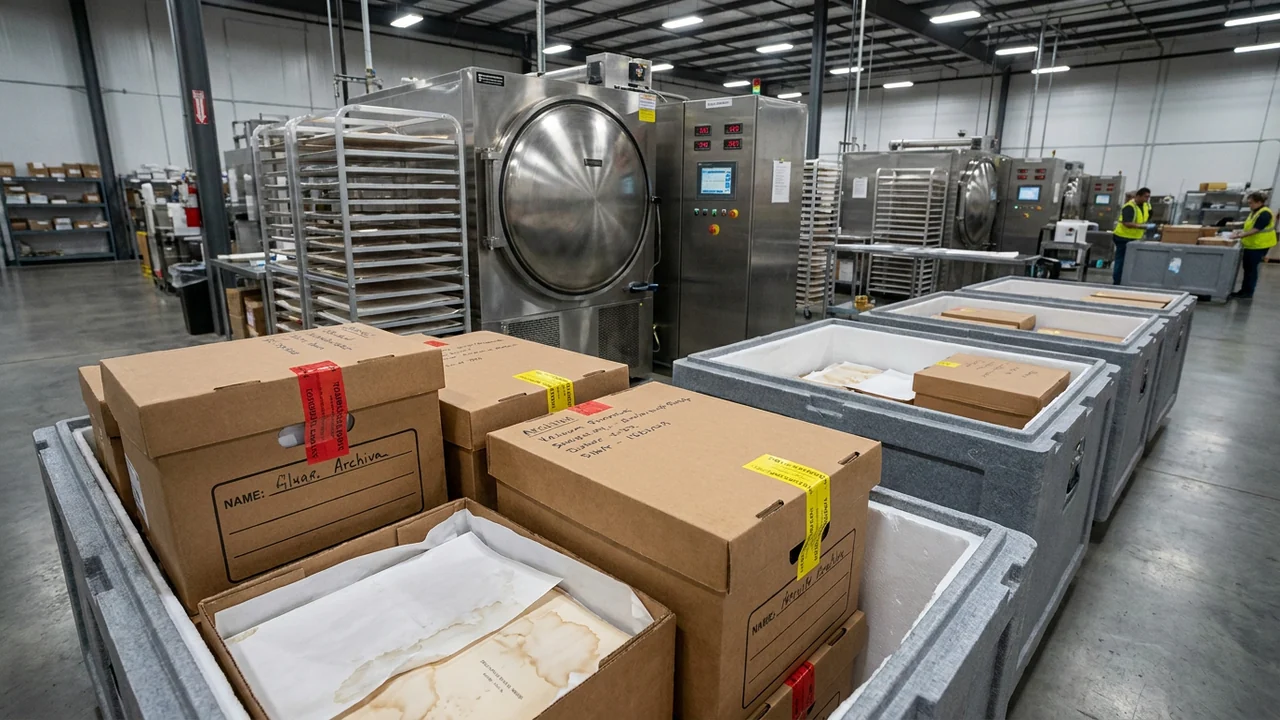
Once scope boundaries and provenance logs are locked in, execution success hinges on the physical handoff from wet shelf to stabilization freezer, drying chamber, and clean return bay. Unlike furniture or glassware, wet paper continues deteriorating every hour it sits unfrozen: mold colonizes cellulose sizing, water-soluble inks feather across pages, leather book covers curl and delaminate, and coated clay pages weld into solid blocks.
Selecting the wrong drying technology compounds the loss. Blast-heating wet books in a conventional dehumidification room shrinks vellum bindings and cements glossy pages shut. Conversely, tossing delicate silver-halide microfilm reels or magnetic backup tapes into a standard paper freeze-drying batch can ruin emulsion layers or binder coatings. Every substrate requires the exact mechanical route matched to its chemistry—while maintaining tamper-evident chain of custody across HIPAA, FERPA, and legal-hold barriers.
Following field and plant protocols anchored in ANSI/IICRC S320, ANSI/IICRC S520, and SPC-DOC-FREEZE gives crews, specialty drying vendors, and compliance officers an auditable end-to-end recovery workflow. Compliance disclaimer: Sterilization, biohazard clearance, and statutory record-retention acceptance must be verified with qualified industrial hygienists, vendor lab directors, and the client’s legal or compliance officers before returning formerly contaminated records to active service.
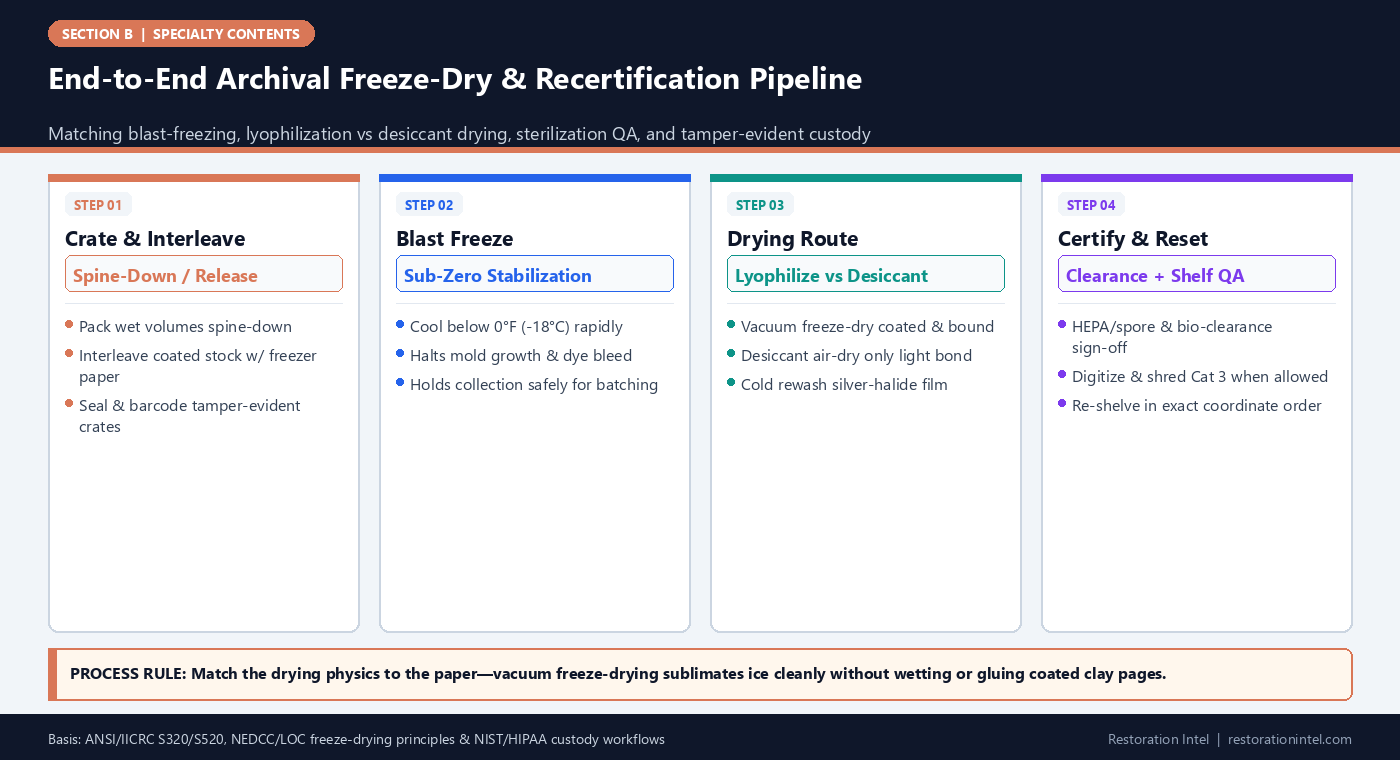
End-to-End Archival Freeze-Dry & Recertification Pipeline
Document Drying Methods, Media Compatibility & Recertification Gates
Comparative operational matrix for stabilizing, drying, sanitizing, and recertifying damaged archival materials.
| Recovery Method | Physical Mechanism | Best-Fit Substrates | Contraindicated Media (Do Not Use) | Required Clearance / Sign-Off |
|---|---|---|---|---|
| Vacuum Freeze-Drying (Lyophilization) | Sublimates ice directly from solid to vapor under deep vacuum | Coated clay paper, bound books, large wet archives, water-sensitive inks | Magnetic tape (LTO/VHS), delicate sealed electronics, certain vellum unless guided | Moisture equilibrium log, page separation check, post-dry HEPA mold-spore clean |
| Controlled Desiccant Air-Drying | Low-temp, low-RH dehumidified air circulation (never high heat) | Lightly damp uncoated bond paper, loose unglued file folders (<24 hrs wet) | Coated clay stock (causes blocking), heavy saturated books, active Cat 3 sewage | Moisture <8-10% paper equivalent, zero musty odor, flat press finish |
| Vacuum Thermal Drying | Elevated gentle heat + vacuum pulls liquid water out as vapor | Bulk non-archival bond files, disposable print runs needing OCR scan | Thermal receipt paper (turns black), coated stock, rare books, leather/vellum | Dry weight verification + confirmation no thermal/legibility loss occurred |
| Specialist Film Re-Wash & Cleanroom Dry | Controlled cold filtered water rinse + photographic drying cabinet | Wet/muddy silver-halide microfilm, microfiche, aperture cards, X-rays | Do not leave wet silver-halide reels stuck together warm or blast-heat dry | Optical legibility check, emulsion integrity, clean canister re-spooling |
| Contained Digitization + Certified Destruction | HEPA/negative-air thaw -> high-speed OCR/PDF-A scan -> secure shred/incinerate | Category 3 sewage-soaked files & smoke-charred records where copies suffice | Original wet-ink deeds/wills under strict physical statutory retention | SHA-256 digital checksum log + Certificate of Destruction + BAA closeout |
| Dry Particulate Cleaning (No Wetting) | HEPA micro-vacuuming + dry vulcanized rubber chemical sponges | Dry soot/ash on file edges, rare bindings, uncoated charters | Wet/tacky paper (smears soot into fibers) or fragile flaking media | Clean white-glove wipe check, residual smoke-odor clearance |
Crate Packing, Interleaving & Sub-Zero Blast-Freezing Staging
Field execution during a vital-records pack-out determines how many pages survive vacuum freeze-drying intact. Never pack wet folders or bound books flat in tall cardboard boxes: cardboard softens and collapses in moisture, while heavy top stacks crush wet lower spines into permanent deformation. Instead, use vented, rigid plastic milk crates or heavy polyethylene-lined archive totes, packing wet books spine-down in a single layer and standing wet file folders vertically with rigid corrugated dividers.
Where damp coated clay paper volumes or glossy art folios are not yet fused solid, gently interleave sections or separate individual wet books with waxed freezer paper or silicone release paper so adjacent covers and glossy pages do not weld into an inseparable ice block inside the freezer.
Move loaded crates rapidly into refrigerated transport and sub-zero blast freezers (0°F / -18°C or colder, ideally -20°F for thick wet volumes). Rapid freezing forms smaller ice crystals that cause less microscopic fiber disruption than slow household freezers, immediately arresting mold growth and halting ink feathering until chamber capacity opens.
- Pack wet books spine-down: Standing volumes upright or spine-down prevents text-block sag inside swollen bindings.
- Interleave with freezer or silicone paper: Separate wet books and glossy sleeves before freezing so they lift cleanly out of the crate.
- Use rigid vented plastic crates: Wet corrugated cardboard disintegrates under stacked freezer pallets and invites secondary collapse.
Vacuum Freeze-Drying (Lyophilization) vs Desiccant Air-Drying
Choosing between vacuum freeze-drying (lyophilization) and desiccant air-drying is a materials-science decision, not a convenience preference. During ordinary air-drying or even low-temperature desiccant drying, liquid water remains present inside paper fibers as it evaporates. That liquid phase swells cellulose, bleeds water-soluble inks, warps heavy book boards, and activates the clay-starch binder on coated stock so pages weld together permanently.
In vacuum freeze-drying, frozen records stay below freezing inside a high-vacuum chamber while controlled thermal shelves drive sublimation—converting solid ice directly into water vapor without ever passing through a liquid phase. As confirmed by Library of Congress and NEDCC disaster-recovery protocols, lyophilization dramatically reduces cockling, stops ink bleed, and allows coated clay pages to separate cleanly once dry.
Reserve desiccant air-drying strictly for lightly damp, uncoated bond paper caught within hours of a clean-water leak where small batches can be interleaved with blotters in a climate-controlled room. Never put coated stock, actively moldy stacks, or soaked bound books through warm vacuum thermal drying—a separate process that uses liquid-phase heating and blackens thermal receipts.
- Lyophilize coated paper and bound volumes: Sublimation avoids the liquid phase that glues glossy stock and warps book covers.
- Keep thermal receipts out of thermal-vacuum chambers: Heat turns thermal POS/expense receipts completely black; freeze-dry or pre-digitize instead.
- Press after drying if needed: Expect mild residual edge waviness even after freeze-drying; controlled book-press flattening finishes restoration cleanly.
Microfiche, Silver-Halide Film & Magnetic Media Recovery Custody
Archival vaults rarely hold paper alone. Microfilm reels, microfiche jackets, aperture cards, medical X-rays, and magnetic LTO or VHS backup tapes frequently share the same flooded basement or smoke-filled credenza. Each requires isolated custody away from general paper freeze chambers.
Wet silver-halide microfilm and X-rays suffer severe gelatin emulsion swelling; if allowed to dry stuck together in rolls or jackets, the emulsion rips off the polyester or acetate base when unspooled. Keep wet microfilm cold and submerged in clean distilled water only for short emergency windows (typically under 48–72 hours per lab instructions) while dispatching directly to a specialist photographic film lab for cleanroom re-washing, squeegeeing, and filtered-air cabinet drying.
Meanwhile, keep magnetic tapes and optical media out of high-heat rooms and paper blast-freeze stacks; route them under tamper-evident ESD-safe custody straight to a data-recovery cleanroom (SPC-DATA-REC) where technicians clean particulates and image data onto fresh redundant storage.
- Do not let wet microfilm dry in reels: Ship wet film canisters to a specialist re-wash lab before swollen gelatin glues adjacent windings.
- Separate acetate vs polyester film: Flag any brittle or vinegar-smelling acetate canisters for priority cold digitization.
- Use ESD-safe custody for magnetic/optical media: Keep LTO tapes and drives out of wet paper crates and log serial numbers at data-lab handoff.
Tamper-Evident Chain of Custody, BAA & Cleanroom Digitization Handoffs
Regulated records demand unbroken physical security from the moment a crate leaves the client’s door until it returns. Apply serialized tamper-evident security seals to every lidded crate holding HIPAA patient charts, FERPA academic files, or litigation-hold boxes. Record every seal number alongside the crate barcode on dual-signature custody transfer sheets covering: (1) site pack-out, (2) cold-storage/freezer intake, (3) lyophilization chamber batching, (4) post-dry cleaning/digitization bench, and (5) final return delivery.
When records were exposed to Category 3 sewage or heavy active mold, freezing and freeze-drying alone do not sterilize pathogens or remove dead allergenic spore fragments. After drying under negative-air HEPA containment, technicians perform HEPA micro-vacuuming and dry-sponge surface remediation—or execute the contained digitization + certified destruction workflow: thawing/drying strictly to make pages scannable inside an isolated cleanroom, generating indexed OCR PDF/A files with verified checksums, and issuing notarized Certificates of Destruction once counsel/compliance approves.
For physical originals that must legally survive Category 3 or mold exposure, coordinate third-party sterilization (such as validated gamma irradiation or approved antimicrobial treatment where substrate-safe) and independent industrial-hygiene clearance testing before unsealing boxes inside an occupied office.
- Serialize tamper-evident crate seals: Log broken/re-applied seal numbers whenever crates open for drying, cleaning, or scanning.
- Maintain BAA coverage across subcontractors: Confirm any third-party lyophilization or scanning vendor holds a downstream HIPAA Business Associate Agreement.
- Separate dry cleaning from sterilization claims: Document HEPA spore removal vs validated microbial sterilization separately for liability protection.
Post-Recovery Recertification, Odor Clearance & Return-to-Shelf Audit
Recertification closes the custody loop. Before returning dried boxes to the client’s active vault, verify four quality gates in a clean staging zone: (1) Moisture Equilibrium (paper moisture content returned to ambient ~6–8% equilibrium with zero damp core pockets); (2) Mold & Biohazard Clearance (HEPA-cleaned exteriors/interiors and third-party IEP/hygiene clearance on prior Category 3 or heavy-mold jobs); (3) Odor Neutrality (zero persistent smoky/musty off-gassing inside closed cartons); and (4) Sequence & Legibility Integrity (confirming folder dividers match the original Room-Rack-Shelf-Drawer coordinate map).
Re-house dried records into fresh acid-free archival cartons and folders rather than returning them in soot-stained or previously damp boxes. Deliver a complete Closeout Dossier containing the custody transfer log, chamber drying telemetry, any IEP/sterilization certificates, digitization checksum manifests (if scanned), and signed return acceptance by the client’s records officer—mirroring the rigor of J-22 Reset Reconciliation.
- Re-box into fresh acid-free cartons: Discard soot-damaged or water-stained original bankers boxes after transferring coordinate labels.
- Deliver chamber & hygiene certificates: Include lyophilization cycle logs and any third-party spore/biohazard clearance reports in the final dossier.
- Verify exact shelf re-indexing: Walk each restored bay with the records custodian to sign off alphabetical/chronological sequence restoration.
Practitioner Verification Checklist (B-76)
- Pack wet books spine-down and wet folders vertically in rigid vented plastic crates; interleave coated stock with waxed freezer or silicone release paper before blast freezing below 0°F.
- Route coated clay paper and bound volumes strictly to vacuum freeze-drying (lyophilization), reserving desiccant air-drying for lightly damp uncoated bond paper only.
- Segregate wet silver-halide microfilm/X-rays for specialist film-lab re-washing and magnetic/optical media for ESD-safe data-recovery cleanrooms.
- Seal all HIPAA, FERPA, and legal-hold crates with serialized tamper-evident seals and maintain dual-signature custody logs through every vendor handoff.
- Complete moisture equilibrium, HEPA/biohazard clearance, odor checks, and acid-free re-boxing before obtaining records-custodian shelf-sequence sign-off.
Standards, Authority References & Related Reading
Primary standards, insurance definitions, and sibling Restoration Intel guides referenced in this brief:
- ANSI/IICRC S320 Standard for Professional Contents Restoration
- ANSI/IICRC S520 Mold Remediation Standard
- OSHA 1910.1030 Bloodborne Pathogens Standard
- NIST Privacy Framework
- US Department of Education FERPA Student Privacy Guidance
- Related Guide: Vital Records, Archival Media & Paper Documents: Scope & Hazard Boundaries
- Related Guide: Vital Records, Archival Media & Paper Documents: Capture, Serial & Provenance Logging
- Related Guide: SPC-DOC-FREEZE: When the Boxes Hold Paper
- Related Guide: Vital Records, Archival Media & Paper Documents: Valuation, LKQ Sourcing & Policy Traps
- Related Guide: Field Guide: Chain-of-Custody Form Elements & Pack-Out Sign-Off Template
- Related Guide: Field Guide: HIPAA, FERPA, and Trade-Secret Privacy Rules During Commercial & Clinic Pack-Outs
- Related Guide: Field Guide: Homeowner Reset, Unpack Verification, and Missing/Damaged Item Reconciliation Protocol
- Related Guide: SPC-DATA-REC: The Value Is the Data, Not the Drive
.md twin for desk QA and team training.Frequently Asked Questions
How does vacuum freeze-drying save coated clay paper when air-drying ruins it?
Vacuum freeze-drying keeps water frozen inside the paper and removes it via sublimation—turning ice directly into vapor under deep vacuum without passing through a liquid phase. This prevents the wet clay coating from liquefying and gluing pages together.
What temperature is used to stabilize wet vital records before lyophilization?
Standard preservation guidance calls for rapid freezing at 0°F (-18°C) or colder—and commercial blast freezers often hold -20°F (-29°C)—to halt mold growth, ink bleed, and coated-paper blocking quickly until chamber drying begins.
When is controlled digitization plus certified destruction better than returning physical Category 3 paper?
When sewage or heavy microbial contamination hits working business records that lack strict wet-ink original mandates, thawing under containment to scan high-resolution OCR/PDF-A copies followed by certified destruction eliminates lingering health liability at lower cost than full sterilization.
Should thermal POS or credit-card receipts inside tax boxes go through vacuum thermal drying?
No. Vacuum thermal drying applies heat that turns heat-sensitive thermal paper solid black, erasing the text. Thermal receipts should be freeze-dried at sub-zero temperatures or carefully digitized before thermal exposure.
What proves chain of custody for HIPAA or litigation-hold boxes sent to an off-site freeze-drying plant?
Serialized tamper-evident crate seals, dual-signature custody transfer sheets at every handoff, executed Business Associate Agreements (BAAs) covering downstream subcontractors, and matching Room-Rack-Shelf-Drawer coordinate manifests.