Direct Answer: Capture and provenance logging for vital records protects privacy and retrieval order simultaneously: photograph file-cabinet coordinates, box spines, and folder-range headers without fanning open PHI or privileged pages, while logging substrate class, moisture state, retention holds, and exact shelf order.
.md twin for estimator QA and carrier file documentation.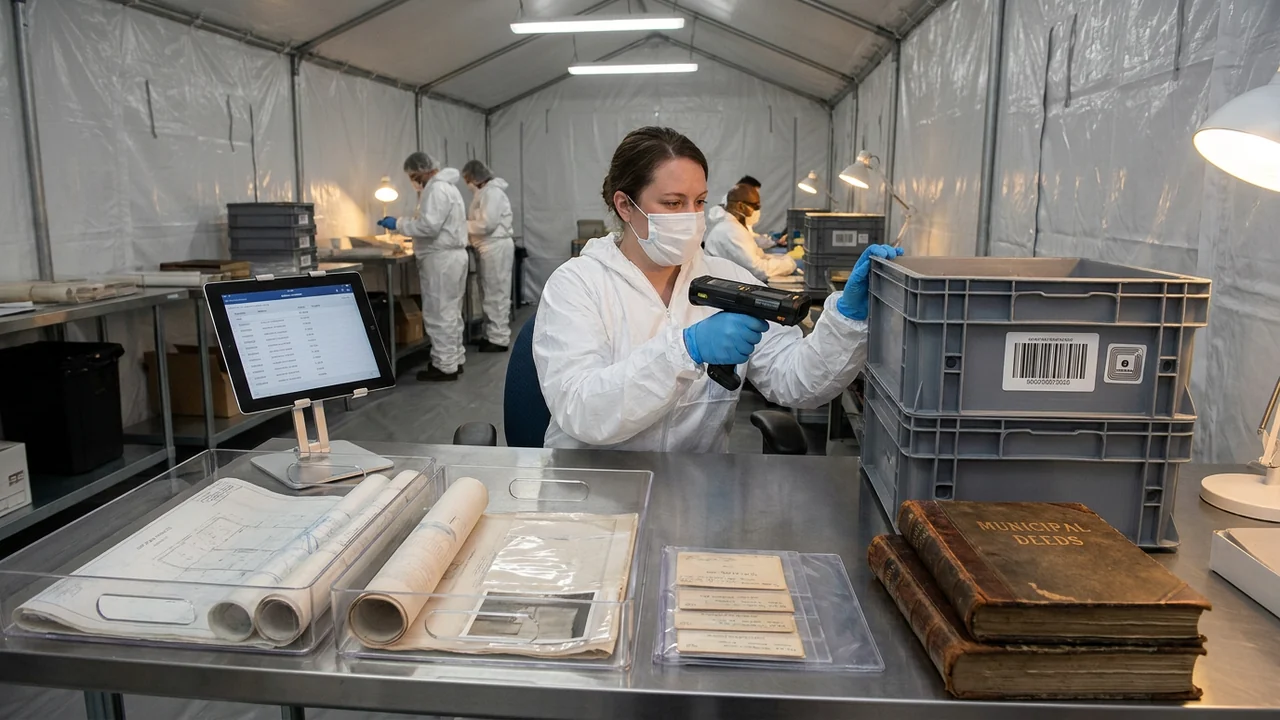
In ordinary contents pack-outs, technicians open every drawer, fan items onto a table, and snap bright close-up photos of everything inside. Applying that habit inside a medical clinic’s chart room, a law firm’s litigation archive, or a university registrar’s vault creates an immediate privacy breach and destroys decades of filing sequence in ten minutes.
At the same time, vital-records adjusters, compliance officers, and document-drying plants still need precision logging. A vague entry reading “42 Wet Boxes of Office Files” gives the lyophilization vendor zero warning that six boxes hold glossy coated medical atlases fusing by the hour, two drawers contain silver-halide microfiche reels, and one steel cabinet holds active litigation files under a court preservation hold.
Grounded in ANSI/IICRC S320, NIST Privacy Framework data-minimization principles, and C-26 privacy access controls, proper archival capture balances forensic traceability with strict zero-read-through discipline.
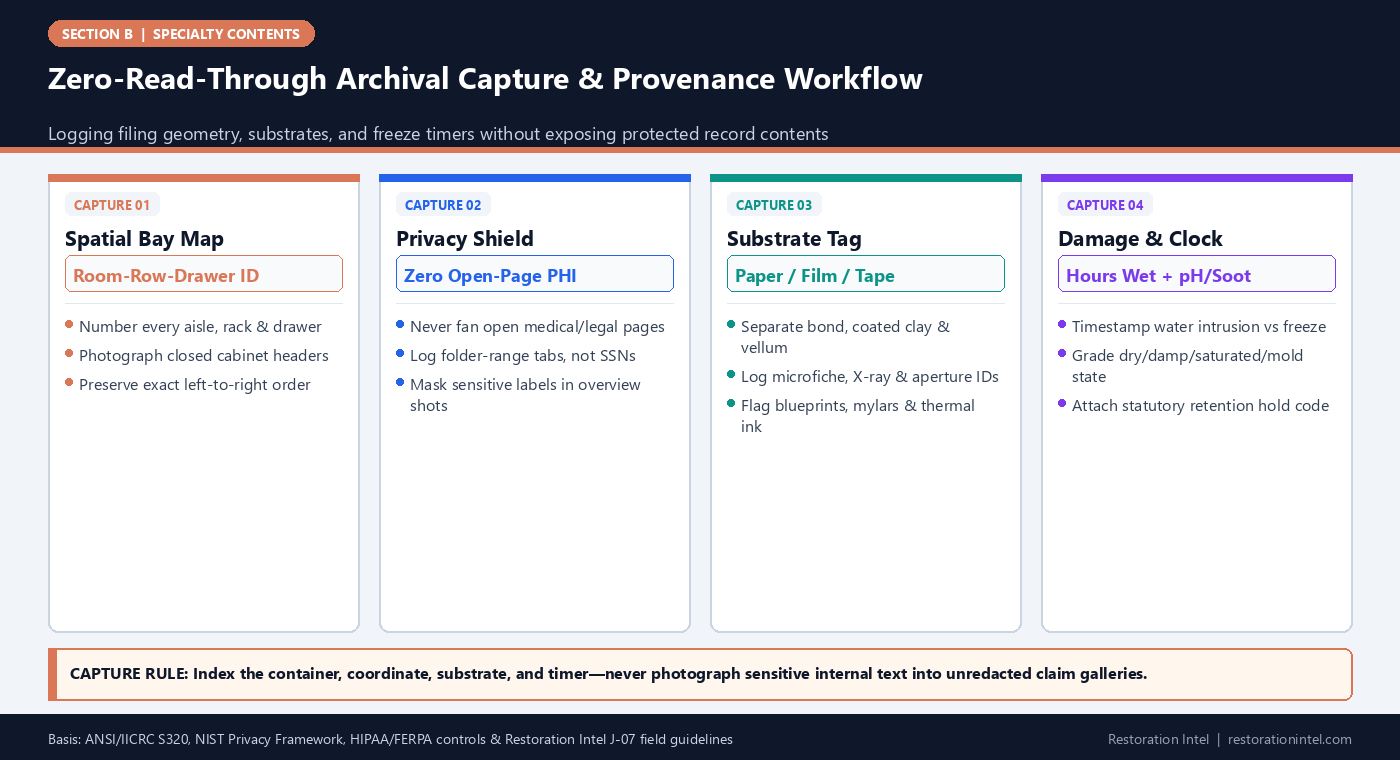
Zero-Read-Through Archival Capture & Provenance Workflow
Archival Capture, Substrate Coding & Provenance Logging Standards
Required metadata fields and privacy-safe capture methods across regulated document and archival media types.
| Archive / Media Type | Permitted Photo / Video Capture | Prohibited Exposure Action | Mandatory Provenance Fields | Telemetry & Condition Tags |
|---|---|---|---|---|
| Legal Case Files & Corporate Minute Books | Aisle/cabinet map + folder spine range (e.g., 'Matter 2019-A to 2019-F') | Photographing open contracts, settlement terms, or client names | Cabinet ID, drawer #, folder count, counsel hold flag, linear feet | Dry smoke / soot pH / damp edge / saturated / freeze timestamp |
| HIPAA Patient Charts & X-Ray Jackets | Closed file-shelf range markers + tamper-evident carton barcode only | Shooting patient names, DOB, diagnosis, or unredacted X-ray labels | BAA reference ID, shelf sequence range, estimated chart count | Cat 1-3 water class, elapsed wet hours, visible mold flag |
| FERPA Academic & Registrar Vaults | Locked drawer tag + carton barcode + alpha-range index sheet | Capturing student transcripts, SSNs, or disciplinary headers | Vault bay, graduating-year/alpha range, registrar sign-off ID | Moisture % gradient, binder warp, soot particulate level |
| Coated Clay Books, Manuals & Portfolios | Book spine, ISBN/edition stamp, water-line tide mark on fore-edge | Prying apart damp glossy pages for title-page photos (tears clay) | Title/ISBN if visible externally, volume count, coated-stock flag | Urgent freeze priority, incipient blocking risk, elapsed hours |
| Architectural Blueprints, Mylars & Maps | Flat-file drawer label, project index strip, edge moisture shot | Unrolling brittle wet diazo/linen sheets onto dirty floors | Drawer/tube ID, project/parcel code if authorized, sheet count | Substrate (bond/vellum/mylar/linen), edge curl, ammonia-print fade |
| Microfilm, Microfiche & Magnetic Media | Canister/tray label, emulsion reel count, sleeve barcode ID | Pulling wet silver-halide film strips from reels in bright room | Format (16mm/35mm/fiche/LTO), canister serial, encrypted flag | Water submersion depth, vinegar-syndrome odor, soot ingress |
Spatial Coordinate Mapping & Preserving Exact Retrieval Order
For an active medical practice, engineering office, or law firm, a box of clean dry files returned out of alphabetical or chronological sequence can be almost as disruptive as losing the box entirely. High-density file rooms rely on exact row, bay, shelf, and drawer coordinates—and often use color-coded end-tab filing systems where a single misplaced folder breaks billing or court deadlines.
Before moving a single folder, draw and photograph a rapid Vault Coordinate Grid: label every room (VAULT-A), shelving bank (RACK-01), shelf tier (SH-B), and lateral drawer (DR-03). Assign sequential carton IDs (DOC-001, DOC-002) that explicitly encode source coordinates and pack-direction (for example, top-to-bottom, left-to-right within drawer DR-03).
When packing wet folders vertically spine-down into milk crates or lined archive cartons, insert rigid Tyvek or corrugated dividers labeled with the exact start and end folder markers so the freeze-drying plant and return crew keep every folder in lockstep sequence from intake through re-shelving.
- Encode coordinates on every carton: Print both the unique barcode/QR ID and human-readable source coordinates (
R2-B4-DR3-Part1of2) on waterproof labels. - Pack spine-down, never flat-stacked high: Vertical spine-down packing in shallow crates prevents wet lower folders from crushing under upper weight.
- Log linear feet, not guesses: Measure occupied shelf inches/linear feet per substrate class so drying plants and estimators share verifiable volume metrics.
Zero-Read-Through Privacy Capture for HIPAA, FERPA & Privileged Files
Standard cloud-based contents inventory platforms sync field photos automatically to estimators, carrier adjusters, TPAs, and third-party pricing desks. If a technician photographs an open medical chart, a payroll tax return, or a confidential M&A folder, that Protected Health Information (PHI) or Personally Identifiable Information (PII) propagates across uncontrolled servers in seconds.
Enforce a strict zero-read-through capture rule aligned with J-07 Privacy Pack-Out Protocols and Pre-Loss Privacy Access Controls. Technicians photograph only exterior cabinet tags, closed box spines, alpha/numeric divider tabs (when individual names/SSNs are not exposed), and sealed tamper-evident carton labels. Where an insurer needs visual proof of damage inside a confidential box, shoot a controlled edge-only moisture or soot-line shot with a clean opaque cover sheet masking all text.
Record client-provided summary ranges (e.g., “Active Patient Charts A–C, ~140 folders, 2.5 linear ft, wet lower 3 inches”) rather than transcribing individual patient or client names into XactContents descriptions.
- Mask text in damage-proof shots: Place a blank kraft card over open page text so photos prove water tide lines or mold bloom without exposing data.
- Separate privacy-restricted photo folders: Store any compliance-sensitive condition photos inside encrypted, access-controlled client workspaces rather than open carrier portals.
- Log BAA and NDA numbers on header: Attach the executed Business Associate Agreement or NDA reference to the master lot manifest.
Substrate Identification: Bond, Coated Clay, Vellum, Thermal & Microforms
Estimators and drying engineers cannot select safe recovery protocols from a label that just says “Paper.” Capture logs must tag the physical substrate inside each carton or drawer because drying physics vary dramatically across media types.
Uncoated wood-free bond paper tolerates either vacuum freeze-drying or controlled desiccant air-drying if caught early. Coated clay paper (glossy brochures, medical journals, architectural render books) requires urgent freezing and vacuum freeze-drying to prevent permanent page welding. Thermal receipt paper (often stapled inside IRS expense folders) turns solid black if exposed to heat—making thermal vacuum drying fatal unless digitized or kept cold. Diazo blueprints and engineering mylars fade under UV light and delaminate if scrubbed wet.
For archival film and magnetic records—16mm/35mm silver-halide microfilm, microfiche, aperture cards, medical X-rays, and LTO or VHS tapes—log canister counts, emulsion side condition, any pungent acetic “vinegar syndrome” odor (indicating degrading cellulose acetate film base), and exact submersion depth without unspooling wet film in dusty air.
- Flag coated stock in bright orange: Apply high-visibility
COATED-FREEZE-URGENTstickers on cartons containing glossy books or laser-printed manuals. - Identify thermal receipts inside tax boxes: Note thermal-paper presence so drying plants avoid elevated-temperature vacuum thermal cycles.
- Log vinegar-syndrome odor on film: Acetated microfilm emitting vinegar odor is actively off-gassing acid and requires isolated cold storage away from paper.
Moisture State, Soot pH & Elapsed-Time Telemetry at Intake
Because biological degradation accelerates by the hour, every archival capture record needs timestamped damage telemetry, not static checkboxes. Log the documented date/time of water intrusion (or fire suppression sprinkler activation) alongside the exact timestamp each carton enters cold storage or blast-freeze staging—proving how cleanly the crew beat or encountered the 24–48 hour mold window.
Use calibrated non-invasive moisture meters (pinless RF readings against container edges and book blocks, never driving sharp pins through historic pages!) and categorize every lot into standardized moisture bands: Dry Smoke-Exposed, High-RH Damp (edge curl, no free water), Saturated Wet, or Actively Mold-Colonized. On fire jobs, document soot character (dry cellulosic char vs oily petroleum/plastic protein soot) and note any visible yellowing or surface embrittlement.
Capturing pre-freeze tide lines and microbial status protects the restoration contractor if an insurer later questions why already-blocked glossy volumes or mold-stained folders discovered 72 hours post-loss required freeze-drying or specialized digitization.
- No pin meters in archival pages: Use pinless capacitance meters or visual/weight checks rather than puncturing vital documents with moisture pins.
- Record intrusion-to-freeze delta: Log exact hours elapsed from loss notification to freezer door closure for carrier SLA audits.
- Photograph water tide lines on box exteriors: External box saturation marks corroborate which bottom shelf tiers absorbed standing water.
Linking Retention Schedules, Litigation Holds & Pre-Loss Indexes
The most useful capture log ties physical boxes directly to the client’s governance framework. During intake, reconcile physical shelf ranges against the organization’s existing pre-loss file index, records-retention schedule (e.g., IRS multi-year tax retention, state medical-record retention statutes, corporate permanent charter files), and active legal hold roster.
Adding a structured Hold_Status and Retention_Class column to the intake CSV allows counsel, adjusters, and estimators to filter immediately between boxes eligible for economic digitization-and-shredding versus boxes where statutory law or litigation demands physical freeze-drying and original paper preservation.
Pair every lot record with dual-verified custody signatures following J-04 Chain-of-Custody standards so no auditor or opposing counsel can challenge whether an original deed or medical chart remained accounted for throughout recovery.
- Add governance columns to the log: Track
Retention_Rule,Litigation_Hold_ID,Duplicate_Exists (Y/N), andBAA_Requiredper lot. - Cross-reference client box numbers: Preserve the organization’s legacy off-site archive barcodes (e.g., Iron Mountain/internal IDs) alongside new restoration tags.
- Generate daily exception summaries: Deliver a daily redacted carton-count and priority-freeze manifest to the client’s records officer and adjuster.
Practitioner Verification Checklist (B-73)
- Build a Room-Rack-Shelf-Drawer coordinate map before removing any vital records so cartons return in exact alphabetical or chronological order.
- Enforce zero-read-through photo discipline: shoot exterior cabinet labels, masked edge damage, and barcode carton IDs without exposing PHI, FERPA, or privileged text.
- Tag every carton by exact substrate (uncoated bond, coated clay, vellum, thermal, blueprint/mylar, silver-halide film, or magnetic tape) and linear feet.
- Log intrusion-to-freeze timestamps, moisture/soot state, and visible mold indicators using non-invasive inspection methods (no pin holes in archival paper).
- Record client legacy archive IDs, statutory retention tiers, and active litigation/spoliation hold flags on every manifest line prior to transport.
Standards, Authority References & Related Reading
Primary standards, insurance definitions, and sibling Restoration Intel guides referenced in this brief:
- ANSI/IICRC S320 Standard for Professional Contents Restoration
- NIST Privacy Framework
- US Department of Education FERPA Student Privacy Guidance
- IRS Publication 547: Casualties, Disasters, and Thefts
- Restoration Industry Association (RIA)
- Related Guide: Vital Records, Archival Media & Paper Documents: Scope & Hazard Boundaries
- Related Guide: SPC-DOC-FREEZE: When the Boxes Hold Paper
- Related Guide: Vital Records, Archival Media & Paper Documents: Valuation, LKQ Sourcing & Policy Traps
- Related Guide: Vital Records, Archival Media & Paper Documents: Pack-Out, Chain of Custody & Recertification
- Related Guide: Field Guide: Chain-of-Custody Form Elements & Pack-Out Sign-Off Template
- Related Guide: Field Guide: HIPAA, FERPA, and Trade-Secret Privacy Rules During Commercial & Clinic Pack-Outs
- Related Guide: Field Guide: Evidence Preservation & Spoliation-Hold Rules on Subrogation and Arson Investigations
- Related Guide: Pre-Loss Privacy & Access Controls: Protecting Sensitive Financial, Medical, and Security Information Inside Baselines
.md twin for desk QA and team training.Frequently Asked Questions
How do crews prove water or soot damage inside confidential HIPAA or legal boxes without violating privacy?
Technicians photograph exterior box tide lines, cabinet bay labels, and sealed carton barcodes—or place a clean opaque mask sheet over any page text when capturing moisture or soot-edge proof—never uploading readable PHI, SSNs, or legal text to open photo feeds.
Why should vital records be measured in linear feet as well as box counts?
Standardizing volume in linear feet (shelf inches divided by 12) aligns field logs directly with commercial lyophilization chamber capacity, restoration pricing tiers, and the client’s internal records-retention schedules.
What does 'vinegar syndrome' mean when logging microfilm or motion-picture reels?
A sharp vinegar odor indicates acetic-acid degradation of cellulose acetate film base. Those reels are actively off-gassing corrosive acid and must be logged and isolated in cold storage away from paper records and healthy polyester film.
Should technicians use pin-type moisture meters on soaked archival books or vellum?
No. Driving steel pins into wet paper or parchment permanently punctures historic pages and creates rust-staining entry points. Rely on pinless non-contact meters, visual saturation grading, and weight checks.
How do you preserve exact file order when packing wet folders into freeze crates?
Number drawers and pack folders vertically spine-down in left-to-right sequence, inserting waterproof dividers marked with start/end folder range codes and matching coordinate tags on each crate.