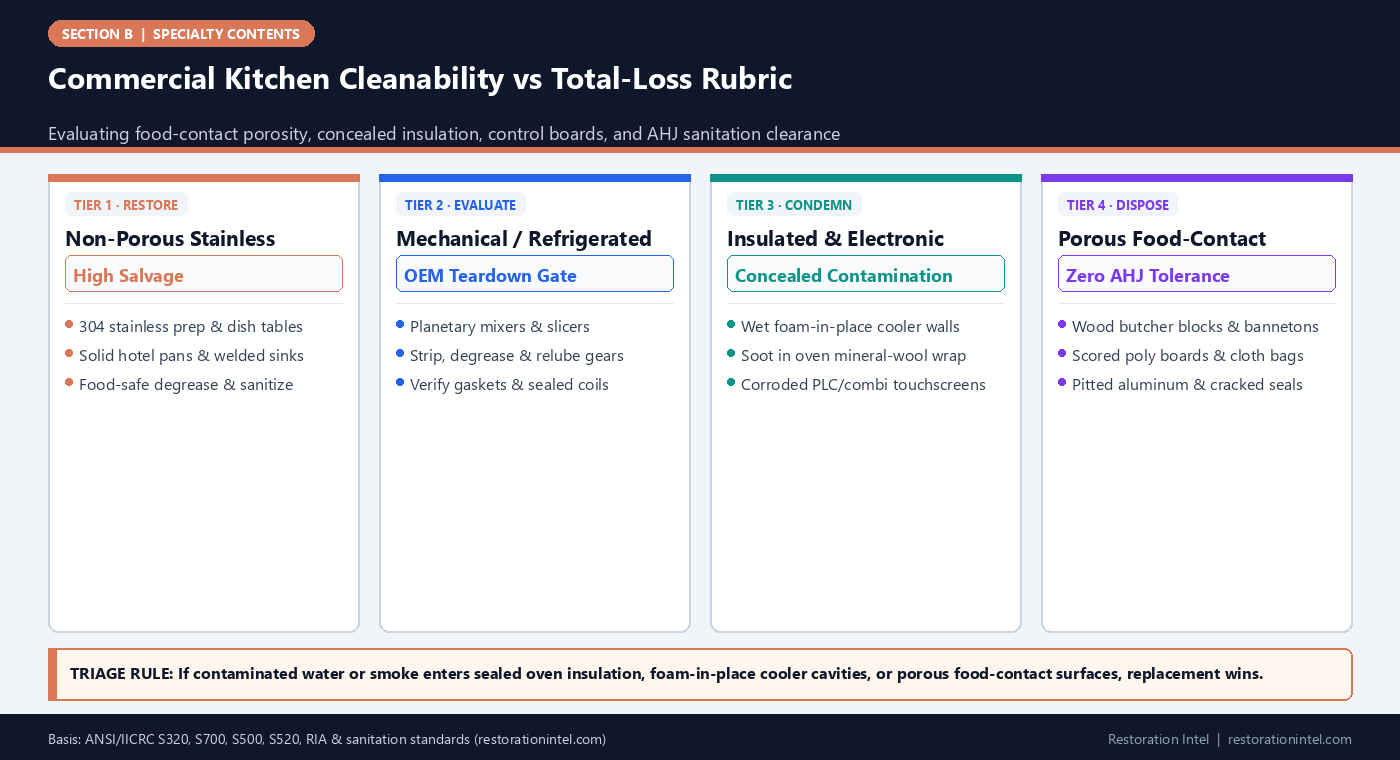
Direct Answer: Commercial kitchen cleanability turns on NSF/ANSI food-contact surface integrity, concealed insulation exposure, electronics corrosion, and health-department acceptance: solid welded stainless tables often restore cleanly, while porous wood/poly boards, flooded foam-insulated coolers, and soot-contaminated oven controls generally require replacement.
.md twin for estimator QA and carrier file documentation.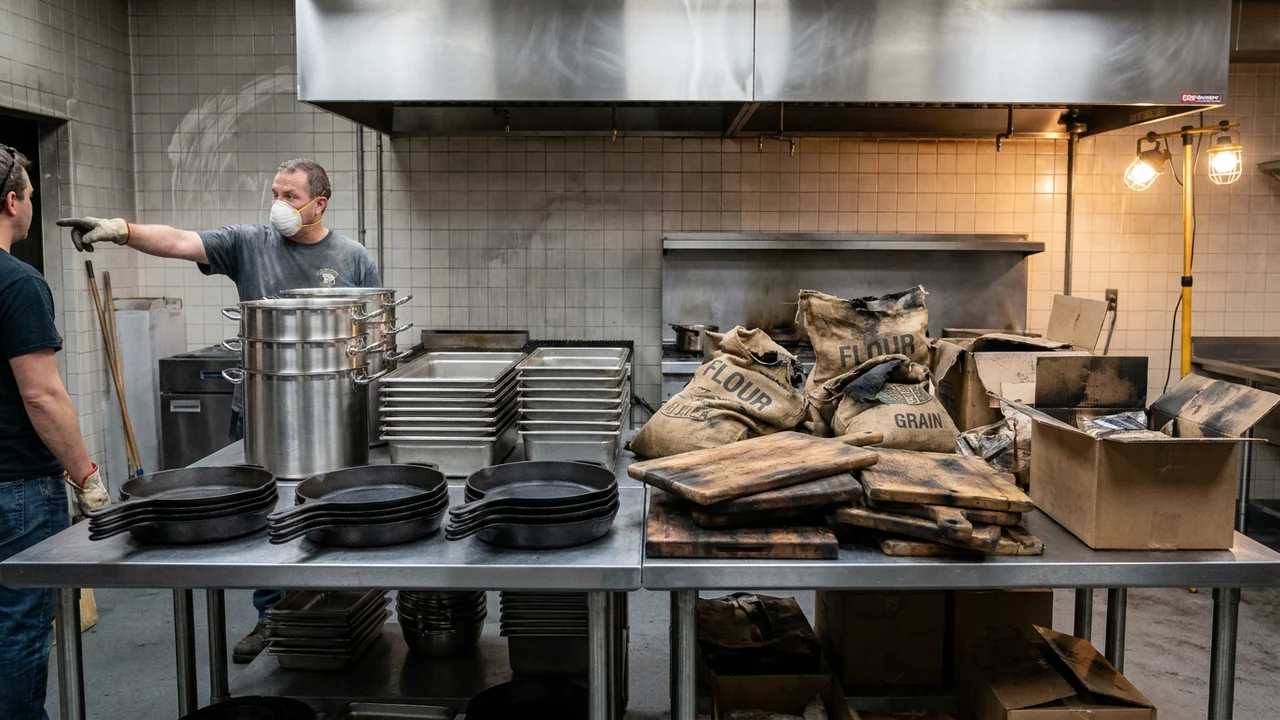
Unlike an office conference table or a warehouse steel shelf, restored commercial kitchen equipment does not just have to look clean—it has to prepare food for the public under the eyes of an environmental health inspector. A hairline crack in a scored cutting board, smoke-saturated fiberglass insulation wrapped around a baking chamber, or alkaline Ansul residue pitted into an aluminum dough-divider hopper can turn a seemingly minor restoration shortcut into a failed health inspection.
On the flip side, declaring an entire stainless steel commercial kitchen a blanket total loss ignores real engineering durability. Heavy 14- and 16-gauge 304 stainless steel prep tables, solid-welded three-compartment sinks, and cast-iron planetary mixer frames can often undergo food-safe degreasing, alkaline neutralization, mechanical polishing, and OEM mechanical servicing under ANSI/IICRC S320 and E-18 food-grade stainless restoration standards.
Defensible triage separates equipment by material porosity, sealed vs. unsealed thermal insulation, electronic control sensitivity, and UL/NSF listing preservation. Health-code & OEM safety disclaimer: Local health authorities (AHJs) govern whether fire-, smoke-, or flood-exposed food-contact equipment may return to commercial service, and licensed appliance/gas/electrical technicians must certify safety controls and thermostats before re-commissioning.
Commercial Kitchen Cleanability vs Total-Loss Rubric
Kitchen & Bakery Equipment Cleanability Decision Matrix
Practical restorable vs total-loss benchmarks across commercial food-service equipment and smallwares categories.
| Equipment / Item Group | Smoke / UL-300 Exposure | Cat 2 / Cat 3 Water Exposure | Primary Failure or Refusal Driver | Recommended Triage Action |
|---|---|---|---|---|
| Stainless Prep Tables, Shelving & Welded Sinks | Restorable via food-grade degrease & neutralize | Restorable with Cat 3 disinfect & rinse | Deep pitting from UL-300 left un-neutralized | Restore & verify sanitation wipe/swab |
| Combi Ovens, Convection & Bakery Deck Ovens | Condemn if soot enters insulation or PLC boards | Condemn if floodwater reaches burner/insulation | Fiberglass/mineral-wool odor + voided UL listing | OEM teardown or condemn insulated cavities |
| Reach-In Coolers & Undercounter Prep Fridges | Restorable if exterior only; replace gaskets | Condemn if water breaches foamed cabinet base | Wet polyurethane foam breeds mold & corrosion | Inspect base seams + compressor test |
| Heavy Planetary Mixers & Dough Sheeters | Restorable if gears/wiring pass OEM strip-down | Condemn motors/bearings if submerged | Flour + soot paste in gearbox; electrical safety | OEM mechanical service quote vs ACV |
| Butcher Blocks, Bannetons & Scored Poly Boards | Non-salvageable (absorbs toxic smoke odor) | Non-salvageable (porous bacterial harborage) | Cannot sanitize porous wood or knife grooves | Document & dispose under witness log |
| Pitted Aluminum Sheet Pans & Cracked Cambros | Replace if etched by UL-300 or warped by heat | Replace cracked plastics; wash intact steel | NSF cleanability failure on pitted metal | Sort batch: salvage stainless, condemn etched |
NSF/ANSI Surface Integrity, Porous Materials, and Concealed Insulation
Commercial food-safety codes require food-contact surfaces to remain smooth, non-absorbent, corrosion-resistant, and free of pits, seams, or deep scratches that harbor bacteria. In fire and smoke restorations, those physical requirements draw sharp lines across the kitchen. Unfinished maple butcher blocks, wicker bakery proofing baskets (bannetons), canvas couche cloths, wooden pizza peels, and heavily knife-scored polyethylene cutting boards absorb smoke particulates, alkaline suppression salts, or sewage pathogens into microscopic crevices where surface sanitizers cannot reach.
Even solid metal equipment hides porous traps inside its outer stainless shell. Commercial deck ovens, convection ovens, fryers, and heated holding cabinets wrap their cooking chambers in thick blankets of fiberglass or mineral-wool thermal insulation. Once heavy smoke drafts through intake louvers—or floodwater wicks up from a wet tile floor—that concealed insulation holds acrid combustion odor or bacterial contamination that off-gasses every time the oven heats to 400 degrees.
Similarly, modern reach-in coolers and prep tables inject polyurethane foam directly between inner and outer stainless walls. When Category 2 or Category 3 water under ANSI/IICRC S500 submerges bottom cabinet seams or drainage channels, moisture saturates the closed-cell/open-seam cavity, creating chronic mold odor under ANSI/IICRC S520 that cannot be dried without destroying the box.
- Condemn porous food-contact tools: Wood blocks, wicker baskets, scarred poly boards, and cracked silicone spatulas fail food-safety triage automatically.
- Inspect concealed oven cavities: Pull rear or side access panels on ovens and fryers to photograph soot or water lines inside insulation blankets.
- Measure flood height on refrigeration: Compare water-line marks against lower compressor bays, door gaskets, and cabinet bottom seams.
UL-300 Chemical Etching and Digital Control-Board Corrosion
Older commercial ranges with purely mechanical thermostatic dials and cast-iron burners tolerate smoke and mild moisture far better than modern computerized cooklines—provided cast burners are disassembled, ultrasonically cleaned, dried, and re-seasoned promptly. Modern kitchens and bakeries, however, run on microprocessor-driven combi ovens, programmable proofers, digital batch scales, and touchscreen fryers.
When ANSI/IICRC S700 fire smoke or alkaline Ansul UL-300 wet-chemical mist enters membrane keypads, relay boards, and cooling fans, potassium salts and acidic combustion chlorides initiate progressive PCB corrosion creep. Additionally, high-pH UL-300 solutions visibly pit bare aluminum sheet pans, slicer housings, and range-hood grease baffles within 24 to 48 hours if not properly neutralized and rinsed.
Never approve a cosmetic wipe-down on a computerized oven or digital mixer without a written OEM technician inspection verifying board cleanliness, gas ignition safety, high-limit thermostat calibration, and intact UL safety listing.
- Act fast on aluminum surfaces: Document UL-300 alkaline etching on cast-aluminum slicer bodies, grinder heads, and sheet pans immediately.
- Require OEM board sign-off: Digital combi ovens and programmable bakery controllers need authorized OEM safety and calibration clearance.
- Protect safety interlocks: Never bypass or clean corroded gas thermopiles, solenoid valves, or high-limit switches without licensed testing.
Restoring Heavy Stainless Fabrication and Mechanical Bakery Gear
Where equipment lacks sealed foam cavities or exposed digital boards, commercial kitchen restoration delivers genuine savings and faster reopening timelines. Heavy-gauge 304 stainless steel prep tables, equipment stands, wall shelves, speed racks, and solid stainless hotel pans respond exceptionally well to controlled plant processing: ultrasonic immersion for removable parts, food-grade alkaline/neutralizing washes, passivating polish, and NSF-approved quaternary or peracetic sanitation.
Heavy mechanical bakery and butcher equipment—such as 60-quart Hobart planetary mixers, commercial bone saws, and dough rounders—sit in the middle evaluation tier. If floodwater did not submerge the sealed transmission or motor windings, an authorized food-equipment service house can strip outer shrouds, degrease soot-caked flour paste, flush and relubricate gearboxes with food-grade grease, and test electrical insulation resistance (megohmmeter testing).
Compare that full refurbishment quote (including teardown, gaskets, food-grade sanitation swabs, and OEM safety check) against the unit’s depreciated Actual Cash Value (ACV) using D-13 economic feasibility rules before committing labor.
- Use food-safe chemistry only: Never apply industrial fragrance deodorizers, ozone-damaged rubber cleaners, or toxic solvent films to food-contact metal.
- Replace all rubber & silicone seals: Door gaskets on surviving reach-ins and mixer splash rings absorb smoke odor and must be replaced, not wiped.
- Verify flour-paste cleanup: In bakeries, dry smoke bonds tightly with airborne flour; document the extra labor required for safe mechanical teardown.
The Health-Inspector Clearance Gate and Hazardous Disposal
The ultimate arbiter in commercial kitchen triage is the local environmental health inspector (AHJ). Even if a restoration plant certifies a restored ice machine or sandwich prep table as mechanically operational, the restaurant cannot legally reopen if the health department rejects smoke-exposed refrigeration seals, pitted food-contact alloy, or unverified electrical repairs. Invite or consult the local inspector’s written requirements early when high-dollar appliances sit on the borderline.
For condemned appliances—especially refrigeration units containing HFC/HFO refrigerants, commercial fryers with residual oil, or mercury/PCB ballasts in older warmers—route decommissioning through EPA-compliant refrigerant recovery and licensed haulers aligned with US EPA waste regulations and RIA disposal standards, keeping signed non-salvageable witness records in the claim file.
Avoid sending condemned food-service gear to general liquidation auctions unless the carrier explicitly assumes decommissioning liability and local regulations permit non-food scrap recovery. Documenting why a unit’s UL safety listing or NSF cleanability has been permanently compromised closes out salvage-deduction disputes cleanly and protects the restoration contractor and business owner from downstream food-safety liability.
- Get AHJ rules in writing: Request the local health department’s written fire/flood re-opening checklist at claim intake.
- Recover refrigerants legally: Condemned reach-ins and walk-in condensers require certified refrigerant evacuation before scrap haul-off.
- Document zero-salvage food risk: Note health-code prohibitions when carriers ask about secondary resale salvage on condemned food gear.
Practitioner Verification Checklist (B-19)
- Inspect concealed thermal insulation (ovens, fryers, warmers) and foamed cooler cabinet bases for smoke or water intrusion before recommending cleaning.
- Condemn porous food-contact items (wood butcher blocks, wicker bannetons, scored poly boards, cloth pastry bags) and pitted aluminum.
- Require authorized OEM safety and calibration sign-off on digital combi ovens, proofers, and UL-300-exposed gas controls.
- Clean solid 304 stainless tables, sinks, and pans using food-safe chemistry only, replacing all rubber door gaskets and hoses.
- Compare full mechanical refurbishment + sanitation verification costs against ACV before tearing down heavy mixers or slicers.
- Coordinate EPA-compliant refrigerant evacuation and signed health-code condemnation documentation prior to haul-off.
Standards, Authority References & Related Reading
Primary standards, insurance definitions, and sibling Restoration Intel guides referenced in this brief:
- ANSI/IICRC S320 Standard for Professional Contents Restoration
- ANSI/IICRC S700 Fire & Smoke Restoration Standard
- ANSI/IICRC S500 Water Damage Standard
- ANSI/IICRC S520 Mold Remediation Standard
- US EPA Hazardous Waste Framework
- Restoration Industry Association (RIA)
- Related Guide: Commercial Kitchens, Bakeries & Food Service: Scope & Hazard Boundaries
- Related Guide: Commercial Kitchens, Bakeries & Food Service: Capture, Serial & Provenance Logging
- Related Guide: Commercial Kitchens, Bakeries & Food Service: Valuation, LKQ Sourcing & Policy Traps
- Related Guide: Commercial Kitchens, Bakeries & Food Service: Pack-Out, Chain of Custody & Recertification
- Related Guide: Preventive Cleaning vs Full Refurbishment for Stainless Steel and Food-Grade Processing Gear
- Related Guide: Cleaning Cost vs Depreciated ACV: Navigating the Economic Feasibility Trap on Restorable Contents
.md twin for desk QA and team training.Frequently Asked Questions
Can a stainless steel commercial oven be cleaned if smoke entered its insulation cavity?
Generally no. Commercial ovens wrap baking chambers in thick fiberglass or mineral-wool insulation that traps acrid smoke odor and moisture. Once contaminated, the insulation releases odor whenever heated, usually requiring replacement unless an OEM-approved complete rebuild is economically feasible.
Why are solid stainless prep tables restorable when wooden butcher blocks are condemned?
Non-porous 304 stainless steel can be degreased, passivated, and sanitized to NSF food-contact standards, whereas porous wood, wicker proofing baskets, and knife-scored plastic boards retain smoke toxins and bacteria inside microscopic crevices.
What makes floodwater so destructive to reach-in coolers and prep refrigerators?
If Category 2 or Category 3 water reaches the lower cabinet seams, moisture wicks into the foam-in-place polyurethane insulation between the inner and outer metal skins, creating trapped mold and structural corrosion that cannot be sanitized.
Can an Ansul-coated planetary mixer still be restored?
Often yes, if alkaline UL-300 chemical residue is neutralized quickly, electrical windings pass megohmmeter testing, and an authorized food-equipment tech disassembles, degreases, and relubricates the gearbox with food-grade lubricant—provided repair cost stays below ACV.
Does a clean cosmetic wipe-down satisfy health inspectors after a kitchen fire?
No. Local health authorities require intact NSF/ANSI cleanable surfaces, replacement of smoke-tainted gaskets, verified holding temperatures on refrigeration, and intact UL/gas safety operation before issuing a re-opening permit.