Direct Answer: During active loss execution, the Contents Estimator and Claim Packet Specialist converts raw field photos, box logs, and voice notes into structured line items with complete object attributes, isolates observed facts from owner-reported claims, and triggers same-day field recaptures before crews leave the site.
.md twin for estimator QA and carrier file documentation.
Waiting until a five-day pack-out finishes before opening the field photos guarantees missing specifications and expensive return trips. In a mature contents workflow, the Contents Estimator and Claim Packet Specialist runs a concurrent capture-and-enrichment loop alongside the field crew, ingesting daily photo batches and container manifests into XactContents or Symbility while rooms are still accessible.
This execution discipline bridges the structural gap between physical handling and claim evidence. Field technicians capture rapid custody sequences under ANSI/IICRC S320 workflow pressure, often naming lines by container (‘Master Closet Box 14’) rather than claimable attributes. The estimator translates that raw capture into unambiguous item nouns, verified quantities, material and quality tiers, and visible damage states.
Just as important, the specialist enforces strict evidentiary hygiene across every line created. Attributes observed directly in photographs are kept separate from details reported by the property owner, and items lacking sufficient visual proof are flagged immediately rather than padded with guesses.
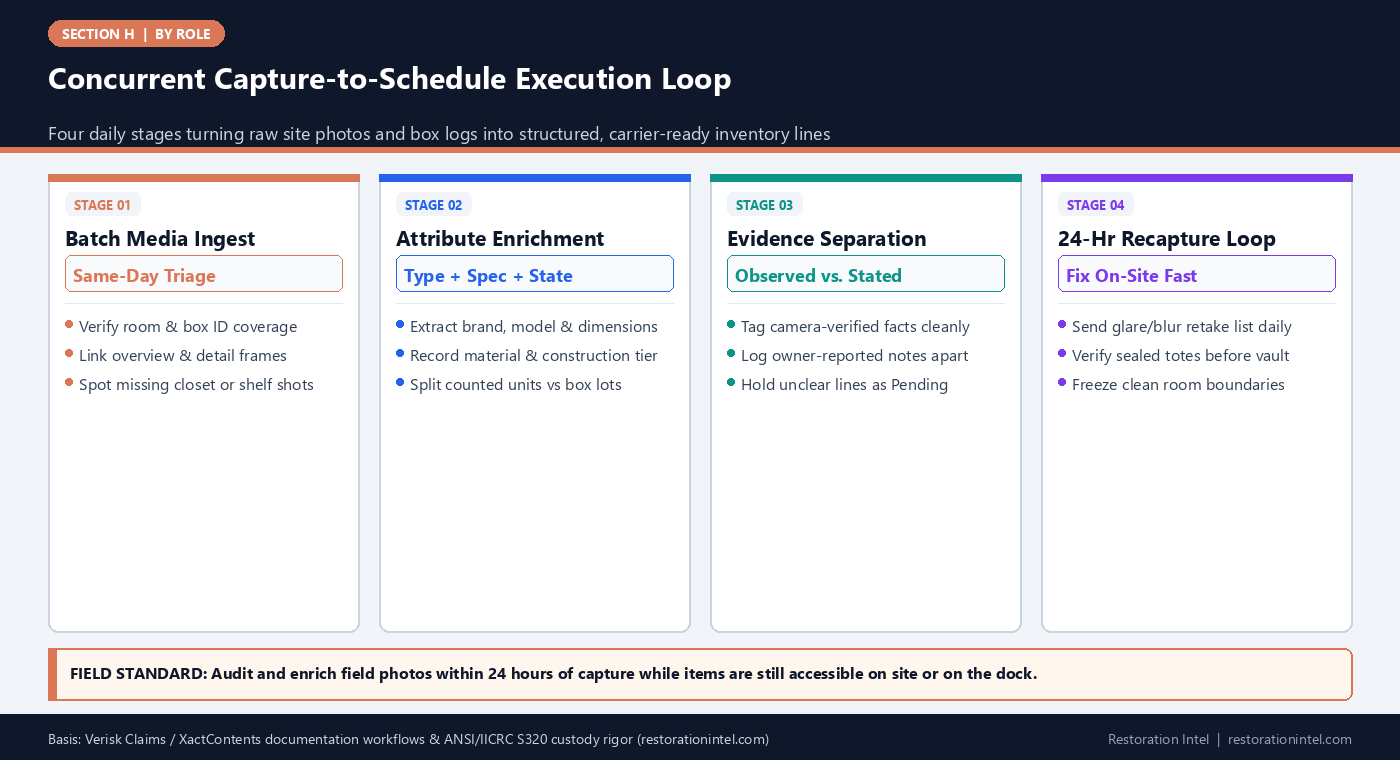
Concurrent Capture-to-Schedule Execution Loop
Field Capture Defect vs. Estimator Desk Resolution Protocol
How the Contents Estimator & Claim Packet Specialist resolves recurring documentation gaps during active loss execution.
| Capture Defect | Why It Breaks Downstream Pricing | Estimator Detection Trigger | Immediate Desk Action | Field Correction Request |
|---|---|---|---|---|
| 1. Generic Box Labels ('Kitchen Misc') | Adjuster cannot verify contents, quantities, or LKQ values inside closed cartons | Box line shows container number without itemized sub-rows or open-top photo | Hold line as Unverified Container Lot; do not guess internal items | Request open-box bench photo or spread sheet count during warehouse receiving |
| 2. Glare / Soot Over Rating Plate | Prevents exact OEM model lookup on appliances, TVs, and power equipment | Model/serial frame is blurred, overexposed, or blocked by soot film | Log visible brand/size only; tag exact model as Pending Clarification | Send same-day retake request with angled lighting or light dry wipe around tag |
| 3. Multi-Angle Duplicate Risk | Same sofa or tool chest appears in overview, detail, and carry-out shots | Two adjacent rows share identical upholstery, room, and wear marks | Compare photo timestamps and background landmarks before finalizing count | Confirm physical unit count with Crew Lead and merge redundant frame IDs |
| 4. Uncounted Dense Storage | Eyeballed counts in pantries, closets, or bookcases invite adjuster haircuts | Single row claims '50 shirts' or 'assorted hardware' from one closed-door shot | Flag quantity as Unverified Estimate; keep out of final RCV sum until counted | Have crew lay items in countable rows or log exact hanger/shelf tallies |
| 5. Unopened Homeowner Totes | Sealed pre-loss storage bins cannot be attested without physical inspection | Crew logs sealed plastic totes moved to vault without opening lids | Record container count and external condition only; mark contents unknown | Schedule supervised tote opening or record signed owner-inventory protocol |
| 6. Missing Pre-Loss Condition Proof | Without wear/age clues, adjusters apply steep default depreciation rates | Detail shot shows soot/water only with no intact finish, fabric, or age cue | Record observable construction tier and flag age for owner input | Capture intact underside, joinery, or manufacturer date stamp where visible |
Translating Raw Field Photos Into Structured Platform Schemas
Raw field media rarely arrives in clean estimating order. A pack-out crew moves through a home physically—clearing walkways first, boxing fragile breakables second, and staging heavy furniture last—so photo rolls mix rooms, overview panoramas, and close-up tags. The Contents Estimator’s execution workflow begins by organizing incoming images into the locked room tree and establishing a strict one-to-one or parent-child link between every line item and its supporting photo IDs.
Once indexed, each entry is enriched to carry the attributes required by Verisk Claims estimating tools and Symbility item trees: precise object type, primary material, key dimensions or capacity, brand and model where proven, counted quantity, pre-loss quality tier, and observable damage mechanism. Replacing ‘chair’ with ‘upholstered wingback accent chair, solid wood legs, mid-grade linen blend’ gives any reviewer immediate clarity.
Where crews work across both platforms depending on carrier assignment, maintaining platform-agnostic source notes in the working workbook ensures no attribute is lost when exporting to the final claim format, a workflow tradeoff explored in Xactimate vs. Symbility.
- Three-part item naming: Write every line description as Primary Noun + Material/Spec + Size/Capacity.
- Photo-ID binding: Store exact image filenames or URLs in each row so audit spot-checks take seconds rather than minutes.
- Condition vs. damage split: Describe pre-loss wear (scratches, fading, age tier) separately from loss-caused damage (char, sewage wicking, delamination).
Enforcing the Three-Pile Rule: Observed, Owner-Reported, and Unresolved
The most dangerous habit in contents estimating is silent gap-filling—typing a popular brand name, guessing a 10-piece cookware count, or assuming ‘like new’ condition just to clear a spreadsheet validation error. When an adjuster zooms into the backing photo and sees an off-brand label or three pans instead of ten, the entire schedule loses credibility.
To prevent this, the estimator enforces a strict three-pile discipline across every line item as detailed in A Pack-Out Record Is Not a Priced Inventory. Pile one holds facts directly visible in site photography or verified physical inspection. Pile two holds attributes supplied by the homeowner or business manager—such as purchase year, custom upgrades, or contents of a melted cabinet—clearly tagged as ‘Owner-Reported’.
Pile three holds unresolved questions: blurry model tags, unverified duplicate candidates, or inaccessible locked cabinets. Treating unresolved lines as explicit, visible findings rather than inventing answers keeps the file honest and directs targeted follow-up.
- Zero hallucinated brands: If a photo cannot confirm OEM branding, enter ‘Unbranded / Manufacturer Not Visible’ and classify by visible build quality.
- Explicit attribution tags: Mark owner-supplied ages, original prices, or concealed-item lists in a dedicated source column.
- Visible pending queue: Keep unverified rows in a clearly labeled Pending section until resolved rather than burying them in totals.
Managing Dense Storage, Pairs, Sets, and Multi-Tech Deduplication
Dense storage spaces—walk-in closets, kitchen pantries, garage pegboards, and commercial stockrooms—break naive item-by-item workflows. When multiple technicians photograph opposite sides of a garage or split shifts across a three-day pack-out, overlapping shots easily create duplicate lines for the same tool chest, miter saw, or shelving unit.
During daily desk execution, the estimator reviews room panoramas alongside detail frames to catch cross-shift duplicates before lines enter valuation. Checking timestamp sequences, background floor markings, and unique scuff marks resolves most overlap questions within minutes while the crew still remembers the room layout.
For dense smalls, the estimator verifies that technicians applied consistent sub-lot grouping—counting garments by category and quality tier, grouping standard pantry dry goods by shelf lot with clear overview photos, and keeping high-value individual tools or specialty appliances broken out as standalone lines that pass adjuster line-item scrutiny.
- Anchor-object deduplication: Cross-check big-ticket items against wide room overviews so three angles never become three units.
- Sub-lot granularity rules: Separate specialty cookware, power tools, and designer apparel from bulk everyday equivalents.
- Set-integrity tagging: Link matching dinnerware, bedroom suites, and modular shelving rows with a shared Set ID during capture.
Running the 24-Hour Recapture Feedback Loop With Field Crews
A documentation workflow only improves if errors are caught before the truck leaves the driveway or before vault boxes are stacked three pallets deep. Every afternoon, the Contents Estimator issues a concise recapture punch list to the Crew Lead covering only the specific defects that block pricing or custody verification.
Keeping that punch list focused—five unreadable model plates, two unopened basement totes, and one unphotographed hall closet—respects field crew time and builds rapid skill transfer. Technicians quickly learn what angles avoid flash glare on stainless appliances and why spreading dense drawers flat saves everyone a second handling cycle.
Once every room passes capture completeness and every recapture item clears, the estimator marks the room ‘Capture Locked’ in the tracking log, signaling that the desk can proceed cleanly into pricing and LKQ sourcing.
- Targeted punch lists: Send exact photo numbers and room names for retakes rather than vague ‘need better pictures’ complaints.
- Dockside recovery window: Catch missing box-level specs during warehouse receiving intake before items enter long-term vaulting.
- Room lock milestone: Record a clear sign-off timestamp when a room transitions from active field capture to desk valuation.
Practitioner Verification Checklist (H-18)
- Ingest and index field photos against the canonical room tree within 24 hours of capture so gaps are caught before crew demobilization.
- Enrich every line item with unambiguous object type, material/specification, dimensions, counted quantity, pre-loss quality tier, and photo ID link.
- Separate camera-observed facts, owner-reported details, and unresolved/pending items into explicit columns without inventing missing brands or models.
- Audit room overviews against detail shots across shifts to eliminate multi-angle duplicate entries on furniture, tools, and electronics.
- Issue targeted same-day recapture requests for glare-obscured rating plates, unverified box lots, and unphotographed closets before locking a room.
Standards, Authority References & Related Reading
Primary standards, insurance definitions, and sibling Restoration Intel guides referenced in this brief:
- Verisk XactContents Platform Overview
- Symbility Claims Support Portal
- ANSI/IICRC S320 Standard for Professional Contents Restoration
- Verisk Property Claims Solutions
- Related Guide: Contents Estimator & Claim Packet Specialist: Initial Scope & Loss-Walkthrough Intake
- Related Guide: A Pack-Out Record Is Not a Priced Inventory
- Related Guide: Contents Estimator & Claim Packet Specialist: Pricing, LKQ Sourcing & Valuation Defensibility
- Related Guide: Xactimate vs. Symbility
- Related Guide: Which Xactimate Line Items Do Adjusters Actually Approve?
.md twin for desk QA and team training.Frequently Asked Questions
How quickly should field capture photos reach the Contents Estimator?
Ideally at the end of every shift or within 24 hours of capture. Same-day desk review catches blurry rating plates, missed closets, and duplicate shots while technicians are still on site or items are accessible on the receiving dock.
What should an estimator do when a photo does not show an item's brand or model?
Never guess or invent a brand. Record the item generically with its observable type, dimensions, material, and construction tier, and flag missing OEM specifics as Pending Clarification or Owner-Reported if the insured later supplies documentation.
How can estimators prevent duplicate entries when multiple technicians photograph the same room?
Cross-reference detail photos against room overview panoramas using background landmarks, timestamps, and unique wear marks, and reconcile furniture and major assets against the physical pack-out container manifest.
Why separate observed evidence from owner-reported information in the working file?
Because carrier reviewers treat photographic proof and policyholder assertions differently. Keeping them clearly labeled preserves estimator credibility and allows disputed assumptions to be verified without undermining the rest of the inventory.