Direct Answer: Mitigation equipment billing covers the restoration contractor's temporary drying, filtration, and containment fleet billed under emergency mitigation, whereas contents equipment claims value or restore the insured's own damaged machinery, appliances, and shop assets on a separate property schedule.
.md twin for estimator QA and carrier file documentation.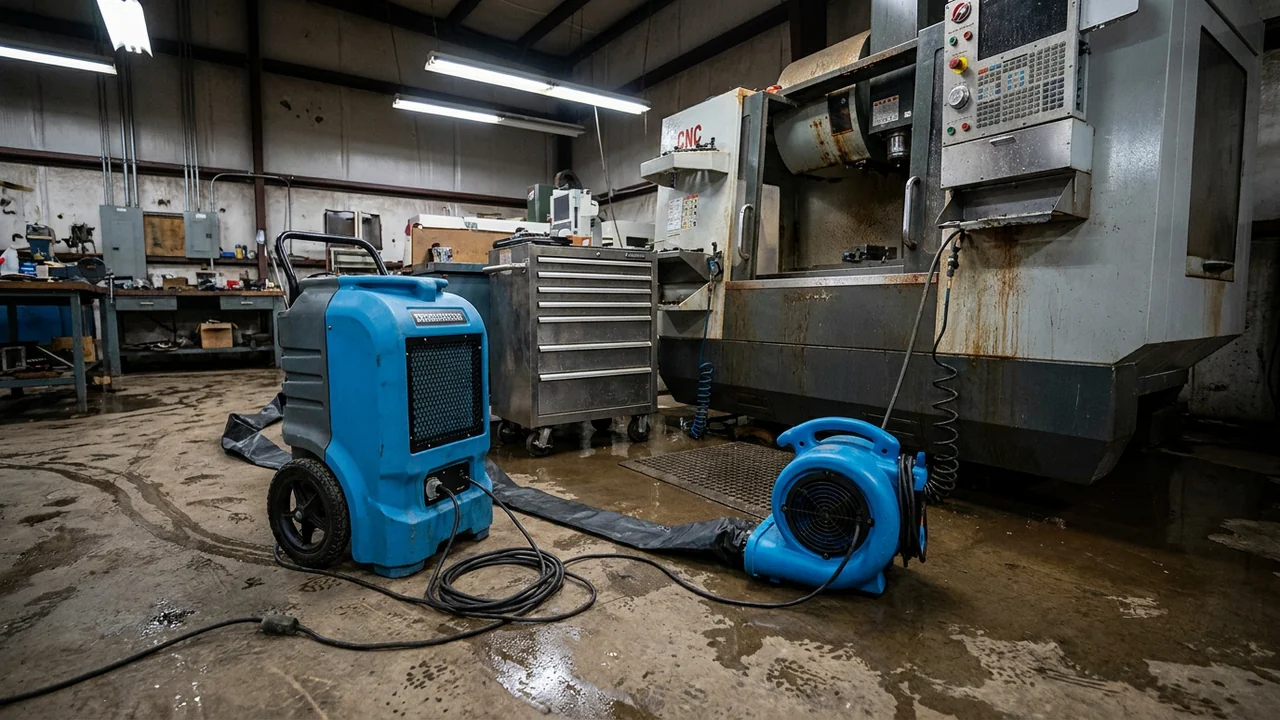
Few words trigger more avoidable friction inside an insurance claim file than the single word “equipment.” To a mitigation project manager, equipment means low-grain refrigerant (LGR) dehumidifiers, high-velocity air movers, HEPA negative air machines, and desiccant trailers deployed to dry a wet building under ANSI/IICRC S500. To a contents estimator or commercial adjuster, equipment means the insured restaurant’s walk-in compressor, a dental clinic’s autoclave, a machine shop’s CNC lathe, or a homeowner’s basement woodworking tools documented under ANSI/IICRC S320.
When a restoration contractor operates both a structural mitigation division and a contents pack-out division on the same loss, sloppy file naming blurs those worlds immediately. Estimators drop a hydroxyl generator rental into the same spreadsheet tab as a soot-damaged commercial mixer, or label an ultrasonic cleaning tank’s daily processing rate simply as “equipment charge” without specifying whether the machine belongs to the restoration plant or the policyholder.
Desk examiners and third-party administrators (TPAs) audit mitigation invoices and contents schedules under different policy coverages, different price-list structures, and often different review teams. As emphasized in Which Xactimate Line Items Do Adjusters Actually Approve?, separating contractor fleet rentals, plant cleaning machinery, and claimant-owned property before submission eliminates duplicate-billing flags and keeps both invoices moving toward settlement.
Three Distinct Equipment Buckets on a Single Restoration Claim
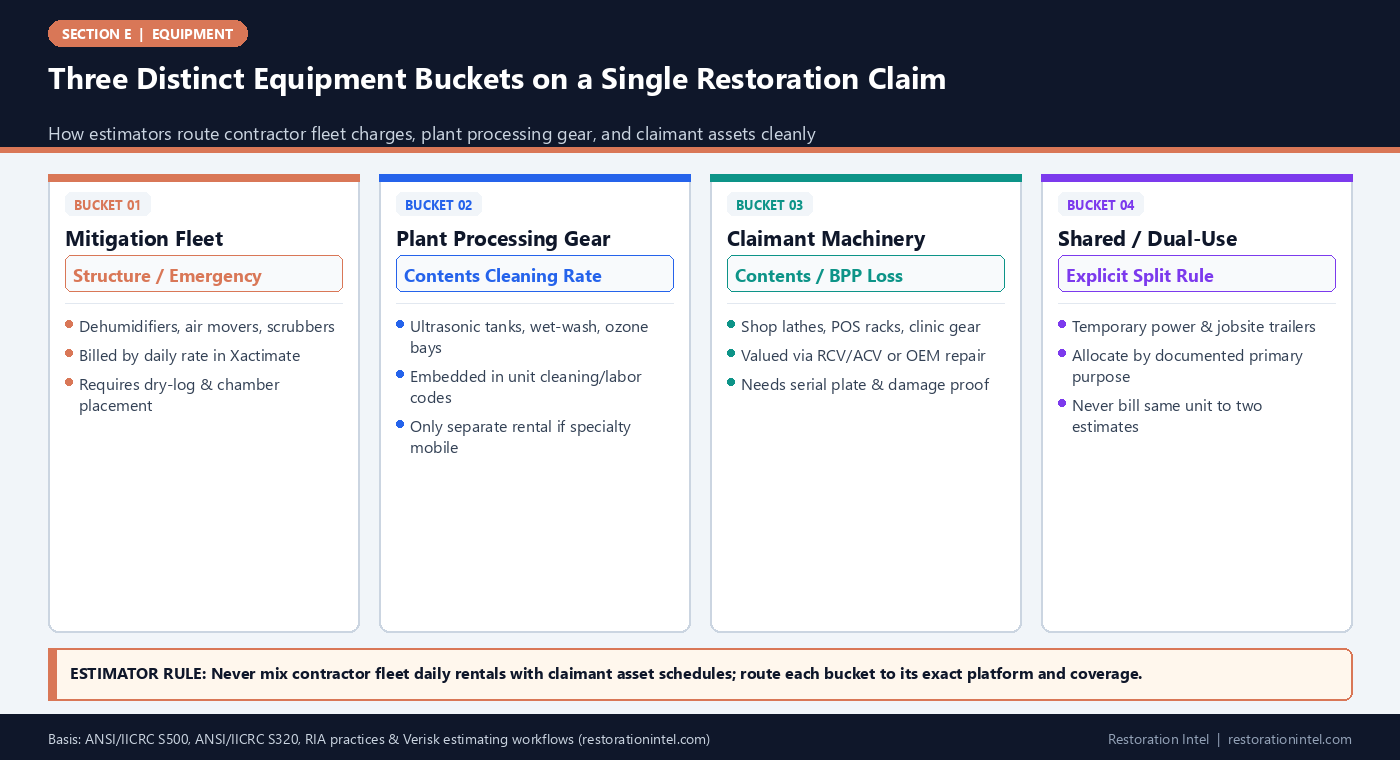
Equipment Billing vs Claimant Equipment Schedule Routing Matrix
Practical separation rules across restoration divisions, estimating platforms, and carrier coverage buckets.
| Equipment Category | Who Owns the Asset | Primary Coverage / Estimate | Preferred Estimating Structure | Primary Audit Rejection Trigger |
|---|---|---|---|---|
| Drying & Air-Filtration Fleet (LGRs, Air Movers, AFDs) | Restoration Contractor / Rental House | Coverage A / Mitigation Emergency | Xactimate WTR/HMR daily equipment line items + psychrometric logs | Missing chamber calculations, unlogged run days, or billing inside contents packet |
| Vault Processing Gear (Ultrasonic Baths, Esporta, Chambers) | Restoration Contractor Plant | Contents Cleaning / Processing | Embedded per-item, per-box, or per-pound contents cleaning codes | Double-dipping by adding separate machine rental atop full unit cleaning rates |
| Mobile Specialty Decontamination Units (Dry-Ice Blasters, Desiccant Trailers) | Contractor / Specialty Subcontractor | Mitigation or Specialty Contents Clean | Line-item mobilization + documented production hours with job logs | Vague 'specialty equipment' lump sums without square-footage or unit throughput |
| Claimant Commercial Machinery (CNC, Ovens, Compressors) | Insured Business / Landlord | BPP / Coverage A Fixed / Scheduled | XactContents or multi-quote commercial packet with OEM repair/LKQ bid | Mixing claimant replacement quotes into the contractor's mitigation invoice |
| Claimant Residential Equipment (Shop Tools, Mowers, AV Racks) | Insured Homeowner | Coverage C (Personal Property) | Itemized XactContents schedule with brand, model, age, condition | Grouping high-value shop equipment into generic 'garage tools' allowances |
| Temporary Replacement Rental for Insured Operations | Third-Party Rental Vendor | Business Interruption / Extra Expense | Separate Extra Expense / ALE packet tied to repair lead time | Billing insured's operational rental inside contractor pack-out mitigation |
Why Generic 'Equipment' Labels Trigger Immediate Desk Examiner Flags
Insurance claim software and carrier TPA audit rules are built to catch unsubstantiated hardware charges. On the structural mitigation side, daily equipment billing routinely represents a major portion of emergency invoice dollars, so carrier desk examiners scrutinize every dehumidifier, air scrubber, and temporary power distribution box against ANSI/IICRC S500 psychrometric ratios. On the contents side, adjusters look for proof of ownership, pre-loss specifications, and physical peril damage to the insured’s own property.
Trouble begins when field notes or accounting exports carry ambiguous descriptions such as “Equipment Setup — $3,400” or “Commercial Equipment Cleaning & Containment — 4 Days.” An examiner reviewing the mitigation file assumes the contractor is trying to bill undocumented drying gear; an examiner reviewing the contents file cannot tell whether the line covers restoring the policyholder’s bakery deck oven or renting an ozone chamber in the restoration warehouse.
Every estimate line must identify ownership, function, and location on its face. When the contractor’s temporary climate control is cleanly separated from the insured’s damaged machinery schedule, each reviewer sees familiar, auditable evidence without cross-file confusion.
- Explicit ownership tags: Prefix contractor rentals with the mitigation chamber or containment zone and claimant assets with the room, serial number, and asset ID.
- Zero orphan lump sums: Break apart combined invoices where a mitigation crew also moved, powered, or cleaned the insured’s commercial equipment.
- Separate invoice numbers: Issue distinct estimate and invoice numbers for emergency mitigation versus contents pack-out and machinery restoration.
Separating Contractor Drying Fleets From Claimant Machinery in the Field
Confusion starts on site when mitigation and contents crews work the same commercial floor simultaneously. Suppose a sprinkler head bursts over a print shop, wetting drywall, carpet tiles, and two wide-format digital presses. The mitigation crew deploys two desiccant-assisted LGR dehumidifiers, ten air movers, and poly containment to dry the structure. Meanwhile, the contents crew installs a dedicated portable dehumidifier and localized tent around the electronics cabinet of a press to halt moisture creep while an OEM technician evaluates the boards.
Both actions use drying machines, yet their billing paths differ depending on scope authorization. Structural drying fleet units belong in the building mitigation estimate backed by moisture maps and daily grain-depression readings. If a localized micro-drying tent is built specifically to stabilize a high-value piece of claimant machinery before transport—preventing total loss of a $45,000 press—document that tent as targeted contents stabilization with adjuster pre-approval so it is neither rejected as redundant structural equipment nor conflated with the press’s own repair estimate.
Conversely, never list the insured’s surviving shop fans, portable heaters, or wet/dry vacuums as mitigation equipment unless a documented emergency agreement covers their consumption, and never let field crews accidentally pack a contractor’s rented HEPA scrubber onto the claimant’s vault manifest.
- Color-coded fleet tagging: Apply bright contractor asset stickers and QR barcodes to every company dehumidifier and scrubber so vault crews never log them as claimant goods.
- Dedicated stabilization logs: When tenting claimant machinery on site, log target RH and temperature separately from the building’s structural drying chamber.
- Crew boundary briefing: Review the separation rule during Day-1 huddles as outlined in Project Manager Initial Scope Intake.
Processing Plant Equipment vs Line-Item Contents Cleaning Rates
A subtler billing error happens inside the restoration warehouse. Modern contents plants run substantial capital machinery: automated ultrasonic immersion tanks, hydraulic soft-goods wash systems, HEPA-filtered dry-cleaning booths, and thermal or hydroxyl deodorization rooms. Estimators new to contents billing sometimes try to charge a daily “ultrasonic tank rental” or “hydroxyl chamber equipment day” on top of standard per-item cleaning line items.
Under standard Verisk Xactimate and XactContents pricing conventions, unit cleaning prices already bake in normal shop overhead and plant equipment amortization. Adding a separate daily equipment fee on top of an already-burdened per-item cleaning rate creates an instant double-billing rejection from carrier reviewers.
Separate equipment billing on the contents side is generally defensible only when specialized portable machinery—such as dry-ice blasting rigs, vacuum freeze-drying chambers for archival media, or portable cleanroom benches—is mobilized specifically for an unusual on-site or batch-salvage scope that standard unit price lists do not contemplate, and even then only with clear scope notes and pre-authorization.
- Overhead-included check: Verify whether the estimating price list’s cleaning line item already includes shop machinery depreciation and consumables before adding equipment lines.
- Bid-item clarity: When billing specialty decontamination machinery (e.g., cryogenic blasting on fixed CNC beds), state hours, crew count, and media consumed rather than generic day rates.
- Chamber justification: If billing an on-site odor-control chamber for packed contents, show why standard vault deodorization could not be used.
Routing Estimates Between Xactimate, XactContents, and Commercial Packets
Software architecture reinforces the boundary between contractor fleet charges and claimant equipment claims. Structural mitigation equipment—LGRs, air scrubbers, containment airlocks, and temporary power—lives cleanly inside Xactimate (or Symbility) using standardized category/selector codes tied to room dimensions and drying days. As detailed in Field Guide: XactContents & Symbility Field-Mapping Reference, the insured’s personal property and commercial contents schedules belong in XactContents or a structured commercial asset ledger.
Where estimators get tripped up is on heavy commercial machinery that sits on the borderline between contents and structure, or on de-installation labor required to move claimant equipment out of a wet room so structural drying can proceed. Moving a 400-pound refrigerated prep table onto blocks for floor drying is contents manipulation billed on the mitigation or pack-out scope; replacing the table’s water-shorted compressor belongs on the claimant equipment valuation packet.
By keeping manipulation, mitigation fleet, and asset valuation in clearly titled sections—and cross-referencing the claimant item’s unique tag ID across both files—estimators prevent duplicate entries while preserving full cost recovery across divisions.
- Manipulation vs repair split: Log moving or elevating equipment to access wet floors as manipulation labor, distinct from cleaning or OEM repair of the machine itself.
- Cross-reference tag IDs: Use the same asset tag number on any stabilization log and on the XactContents valuation line so adjusters see a unified story.
- Review the classification boundary: Pair this separation workflow with E-02’s Policy Classification Matrix before finalizing building versus BPP totals.
Pre-Submission QA Gate for Dual-Division Commercial Losses
Before either the mitigation invoice or the contents claim packet leaves the office, a senior estimator or project manager should run a cross-file reconciliation check following RIA documentation best practices. The goal is to confirm that no contractor drying machine appears on a contents schedule, no claimant equipment replacement bid is buried inside an emergency services invoice, and every mobilization or rigging line ties clearly to an authorized scope.
A five-minute side-by-side comparison of the mitigation equipment summary report and the contents asset schedule routinely catches misrouted generator fuel, shared temporary electrical spider-boxes, and overlapping labor hours for disconnecting shop machinery. Catching those overlaps internally builds long-term credibility with commercial adjusters and accelerates undisputed partial payments.
- Cross-file keyword sweep: Search both estimates for “equipment,” “generator,” “rental,” and “disconnect” to confirm each charge sits in the right coverage bucket.
- Temporary power audit: Allocate portable generator and spider-box charges transparently between structure drying and temporary refrigeration/business continuity.
- Pre-send sign-off: Require PM and contents estimator sign-off on any shared commercial loss exceeding five pieces of claimant machinery.
Practitioner Verification Checklist (E-01)
- Separate contractor drying/filtration fleet logs (Xactimate mitigation) from claimant-owned machinery schedules (XactContents/BPP) on Day 1.
- Label every contractor asset physically with barcode/QR fleet tags so pack-out crews never inventory company scrubbers or dehumidifiers as client contents.
- Eliminate redundant daily equipment charges for standard warehouse cleaning machinery already amortized into unit contents cleaning prices.
- Document targeted micro-drying tents around high-value claimant machines separately from general structural drying chambers with adjuster pre-approval.
- Run a pre-submission cross-file sweep for shared terms (‘equipment,’ ‘generator,’ ‘disconnect,’ ‘rental’) before releasing either invoice.
Standards, Authority References & Related Reading
Primary standards, insurance definitions, and sibling Restoration Intel guides referenced in this brief:
- ANSI/IICRC S500 Water Damage Standard
- ANSI/IICRC S320 Standard for Professional Contents Restoration
- Verisk Xactimate Estimating Platform
- Verisk XactContents Platform Overview
- Restoration Industry Association (RIA)
- Related Guide: Fixed Building Machinery vs Scheduled Business Equipment vs Loose Tools: Policy Classification Matrix
- Related Guide: De-Installation, Rigging, Crane Access, and Re-Installation Labor on Heavy Contents Equipment
- Related Guide: Field Guide: Verisk XactContents & Symbility Field-Mapping Reference Sheet
- Related Guide: Which Xactimate Line Items Do Adjusters Actually Approve?
- Related Guide: A Pack-Out Record Is Not a Priced Inventory
.md twin for desk QA and team training.Frequently Asked Questions
Can a restoration contractor bill daily ultrasonic tank rental on top of per-item contents cleaning?
Usually no. Standard Xactimate and XactContents cleaning rates already incorporate shop overhead and normal plant machinery amortization. Separate equipment charges are generally defensible only for extraordinary, pre-approved specialty rigs not covered by unit pricing.
Where do temporary generators used during a commercial loss get billed?
It depends on primary purpose. If the generator powers structural dehumidifiers and air scrubbers during an outage, it belongs on the mitigation estimate; if it keeps the insured’s undamaged walk-in coolers running to prevent stock spoilage, coordinate it under Extra Expense or loss-mitigation sub-coverage with the adjuster.
Why do adjusters reject 'equipment manipulation' lines on contents claims?
Rejection usually happens when estimators use vague labels instead of specifying whether labor covered moving claimant machinery onto blocks for floor drying, disconnecting utilities for pack-out, or transporting units to a cleaning facility.
Should claimant machinery repair quotes ever be attached to a mitigation invoice?
No. Contractor mitigation invoices cover emergency stabilization, drying, and containment. Claimant machinery repair, calibration, or replacement quotes belong in the contents or building equipment claim packet.
How do we keep rented air scrubbers from getting mixed into a commercial pack-out manifest?
Apply high-contrast contractor fleet stickers and barcodes to every drying and filtration unit before deployment, and exclude tagged fleet units during the pack-out capture sweep.