Direct Answer: Overflow CAT subcontractor oversight requires pre-deployment custody and OSHA PPE verification, prime-owned barcode and manifest control, curbside photo-gate sign-offs before third-party trucks roll, and breakage holdbacks tied to vault intake reconciliation.
.md twin for estimator QA and carrier file documentation.
Regional hurricanes, deep freezes, and urban wildfire complexes overwhelm local staffing overnight. When forty pack-out requests land in seventy-two hours, prime restoration contractors have little choice but to supplement internal crews with traveling contents teams or third-party moving-and-pack-out subcontractors.
That surge capacity solves headcount—yet unsupervised subcontractors routinely create the worst liability storms in the industry. Traveling movers unfamiliar with ANSI/IICRC S320 pack damp textiles into sealed cartons, skip rating-plate photos, ignore OSHA 1910.134 respirator rules inside soot-filled houses, and haul boxes back to unindexed overflow trailers with no chain of custody.
When the carrier TPA scorecard drops or an heirloom disappears, the prime contractor’s brand takes the hit, as warned in Two Standards, One Truck and The 2026 TPA Survival Guide. Keeping CAT overflow profitable requires non-negotiable onboarding gates, prime-controlled manifests, and curbside release checks.
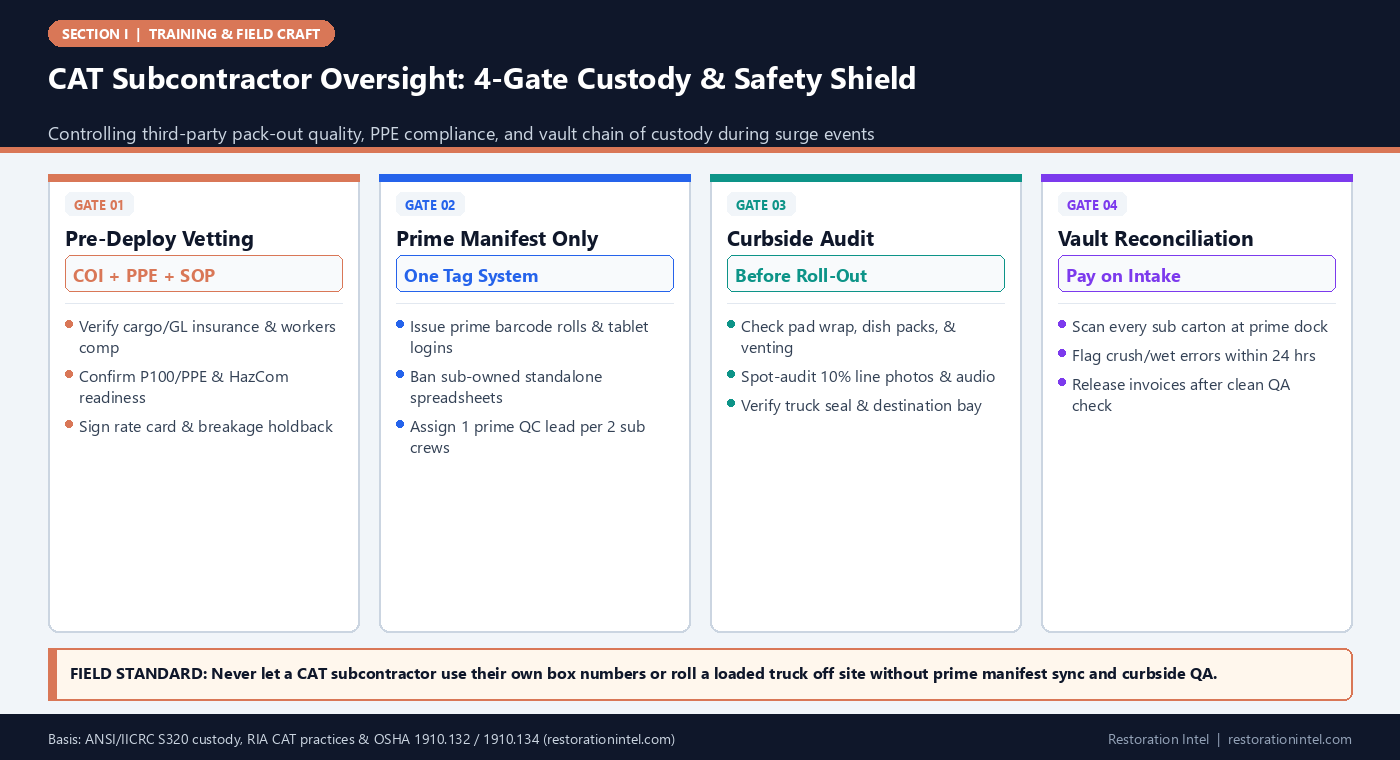
CAT Subcontractor Oversight: 4-Gate Custody & Safety Shield
CAT Overflow Subcontractor Control Matrix: Contract, Field & Vault Gates
Closing the specific custody, safety, and billing gaps that turn third-party CAT pack-out labor into post-storm liabilities.
| CAT Failure Mode | Why Third-Party Labor Causes It | Pre-Dispatch Contract Control | Active On-Site Supervision Gate | Vault & Payment Holdback |
|---|---|---|---|---|
| Broken Chain of Custody | Sub uses paper tally sheets or proprietary moving software | Mandate exclusive use of prime inventory app & barcodes | Sync tablet uploads at lunch and shift end on site | Withhold progress draw until digital manifest matches truck count |
| PPE & Respiratory Violations | Traveling helpers enter soot or Cat 3 sites without fit-tested gear | Require documented OSHA 1910.132/134 & HazCom compliance | Prime site lead verifies respirators & containment before entry | Immediate site stop-work right for safety non-compliance |
| Transit Breakage & Mold | Moving crews skip dish-pack cells or seal wet items in plastic | Attach S320 packing & breathable-wrap spec sheet to MSA | Curbside inspection of wrapped furniture and open test carton | Deduct verified handling breakage & re-pack labor via holdback |
| Missing Rating Plates & Photos | Sub paid flat per-box rate rushes packing without camera proof | Pay balanced line/quality rate, not unverified raw box bonus | Spot-audit 10% of daily items before truck doors close | Require unpaid return to vault to photograph unverified items |
| Sub-Leased Unvetted Drivers | Sub brings unscreened day labor into occupied client homes | Prohibit unauthorized sub-tier labor & require background badge | Daily morning roster & ID check at job driveway | Remove unauthorized personnel immediately; breach penalty |
| Unbilled / Inflated Scope Creep | Sub adds unapproved pack-out hours or extra trucks on site | Require prime PM written work order for scope expansions | Daily sign-off on crew headcount and hours at 4:30 p.m. | Audit timecards against GPS/gate logs prior to payout |
Pre-Deployment Vetting, Insurance, and OSHA Safety Verification
Emergency urgency is never an excuse to wave an unvetted box truck into a policyholder’s driveway. Even during a major CAT mobilization, prime contractors remain contractually and reputationally responsible to the property owner, the carrier TPA, and state regulators for who enters the residence and how hazards are controlled.
Maintain a pre-qualified CAT bench packet updated before storm season hits: verified Certificates of Insurance covering general liability, commercial auto, and bailee’s/cargo coverage for contents in transit; workers’ compensation certificates; background-check attestations for crew members entering occupied homes; and signed ANSI/IICRC S320 packing standards.
Do not assume out-of-state movers understand hazardous environments. Under OSHA 1910.132, OSHA 1910.134, and OSHA HazCom, verify respiratory protection, glove/Tyvek discipline, and containment hygiene—matching the clean-zone habits in Contaminated PPE and Clean-Zone Hygiene—before a subcontractor crosses a soot or Category 3 threshold.
- Cargo & bailee check: Standard moving-company liability ($0.60/lb) is fatal on insurance claims; require real restoration cargo coverage.
- No unapproved fourth-party labor: Prohibit subcontractors from hiring unbadged day laborers off street corners onto your client losses.
- 30-minute CAT onboarding: Walk every arriving sub crew lead through your exact photo rules, room tags, and PPE kit before Day 1 dispatch.
One Inventory System, One Barcode Sequence, Zero Parallel Spreadsheets
The fastest way to lose track of contents during a 20-house CAT surge is letting three subcontractors track boxes in three different formats—one using paper bingo sheets, another snapping photos on personal iPhones, and a third printing their own sequential sticker numbers that collide with your vault’s existing barcodes.
Enforce one ironclad rule: subcontractors work exclusively inside the prime contractor’s inventory system using prime-issued tablet logins and prime-printed barcode rolls. If a sub does not have compatible hardware, issue rugged loaner kits from your CAT staging cache—requiring a signed equipment deposit—so every photo, audio clip, and box barcode lands in one unified database in real time.
Pair every one or two subcontractor crews with an embedded prime Quality Control (QC) lead—especially during initial triage and high-value room sweeps—so witness bins, heirloom exceptions, and electronic cable maps follow the exact house standard.
- Central barcode issuance: Control all tag number blocks centrally so two trucks never stick Box #104 on different homes.
- Mandatory lunch sync: Check cellular/cloud upload status at midday rather than discovering 300 un-synced photos at 8:00 p.m.
- Embedded QC lead: One seasoned company tech overseeing two sub crews pays for itself on Day 1 by preventing unbillable capture gaps.
Curbside Gate Audits Before Any Third-Party Truck Leaves the Driveway
Once a subcontractor truck rolls out of the neighborhood and blends into highway traffic, your leverage drops sharply. Inspecting load quality and documentation completeness at the curb takes ten minutes and catches 90 percent of avoidable CAT disasters.
Before signing the subcontractor’s daily trip sheet, the prime QC lead opens the rear roll-up door and performs three checks: (1) inspect furniture padding, load straps, and breathable wrapping on damp upholstery; (2) pull one random dish pack or medium carton open to confirm cell dividers, clean paper cushioning, and zero crushed tops; and (3) spot-audit ten percent of the crew’s tablet entries from that afternoon for legible serial plates and clear counts.
When the truck heads to the prime contractor’s climate-controlled warehouse—or an approved temporary CAT overflow facility—apply a numbered tamper-evident truck seal and log the seal ID on the departure sheet, reinforcing the rack-mapping controls in Truck Loading and Vault Mapping.
- Open-one-box check: Knowing the prime lead will open one random sealed carton at 4:30 p.m. keeps sub packing geometry honest all day.
- Dry vs wet segregation: Reject mixed loads that stack wet storm-damaged goods directly against dry upstairs bedroom cartons.
- Tamper-seal truck logs: Seal loaded third-party trailers with numbered tags verified again upon warehouse dock arrival.
Vault Intake Reconciliation, Rate Cards, and Breakage Holdbacks
Subcontractor payment structures shape subcontractor behavior. Paying a flat rate per box without quality gates guarantees half-empty cartons and zero rating-plate photos. Paying straight hourly rates without production benchmarks invites slow walking.
Structure CAT Master Service Agreements around transparent hybrid rates—combining verified labor or weighted room deliverables with a standard 10-to-15-percent quality holdback released only after two milestones clear: physical barcode scan-in at the prime warehouse dock with zero missing cartons, and a clean estimator intake audit confirming photos and counts match.
Whenever vault intake uncovers crushed cartons, soaked cardboard, or undocumented items, notify the subcontractor in writing within 24 hours with timestamped dock photos—aligning with Post-Job Crew Debriefs and RIA contractor governance—and give the subcontractor crew lead an opportunity to inspect or cure missing photo tags on site at the warehouse before rework labor and replacement costs are back-charged against final invoice settlement.
- Dock scan-in parity: Every box scanned off the house must scan into a numbered vault pallet within the agreed transit window.
- 24-hour defect notice: Document crushed boxes, missing pads, or unlogged pieces at the dock immediately to preserve contractual recovery.
- Holdback release gate: Tie final sub invoice release to zero unresolved missing-item flags and verified documentation completeness.
Practitioner Verification Checklist (I-26)
- Maintain a pre-vetted CAT subcontractor file verifying bailee/cargo insurance, workers’ comp, background clearances, and signed S320 packing specs.
- Confirm OSHA 1910.132/134 PPE, respirator fit/cartridges, and HazCom readiness before allowing third-party crews into soot or Category 3 structures.
- Issue prime-owned tablet logins and central barcode rolls exclusively—banning parallel paper tallies or subcontractor-owned tag numbers.
- Embed one prime QC lead per two sub crews and execute a curbside open-box, pad-wrap, and 10% photo audit before sealing departing trucks.
- Reconcile every carton barcode at warehouse intake and hold a 10–15% quality reserve until documentation QA passes cleanly.
Standards, Authority References & Related Reading
Primary standards, insurance definitions, and sibling Restoration Intel guides referenced in this brief:
- ANSI/IICRC S320 Standard for Professional Contents Restoration
- Restoration Industry Association (RIA)
- OSHA 1910.132 Personal Protective Equipment Standard
- OSHA 1910.134 Respiratory Protection Standard
- OSHA Hazard Communication Standard (HazCom)
- Related Guide: Two Standards, One Truck: Documentation When the Brand and the Scorecard Disagree
- Related Guide: The 2026 TPA Survival Guide
- Related Guide: Truck Loading, Vault Mapping, and Climate-Controlled Rack Indexing for Multi-Month Claims
- Related Guide: Contaminated PPE, Containment Zippers, and Clean-Zone Hygiene on Soot and Category-3 Contents Jobs
- Related Guide: Post-Job Crew Debriefs and Audit Error Feedback Loops: Turning Estimator Flags Into 10-Minute Morning Huddles
.md twin for desk QA and team training.Frequently Asked Questions
Why should prime contractors ban CAT subcontractors from using their own barcode tags?
Subcontractor tag numbers frequently collide with existing warehouse ranges and trap photos inside third-party apps. Issuing prime barcodes and logins keeps every item unified in one vault manifest.
Who is liable for OSHA PPE violations if a subcontractor enters a soot or sewage house unprotected?
Under multi-employer worksite principles and carrier TPA agreements, the prime contractor faces severe regulatory, contract, and reputational exposure if it fails to verify and enforce site PPE compliance.
What should a curbside audit check before a third-party pack-out truck leaves the job?
Verify furniture pad coverage, dry-vs-wet load separation, one randomly opened carton for proper cushioning geometry, a 10% tablet photo/audio check, and a numbered tamper seal on the rear door.
How do breakage holdbacks work cleanly with overflow subcontractors?
Hold 10 to 15 percent of each CAT invoice until warehouse intake confirms zero missing barcodes, clean physical condition, and an estimator documentation pass—issuing written photo notice within 24 hours for any defects.