Published November 14, 2026. By Will Tygart · Restoration Intel Editorial Desk.
Direct answer. First-Pass Adjuster Acceptance Rate tracks the percentage of contents schedules approved for payment without revision kicks, price-proof challenges, or custody disputes — making it the clearest leading indicator of pack-out cash velocity and unbilled rework drag.

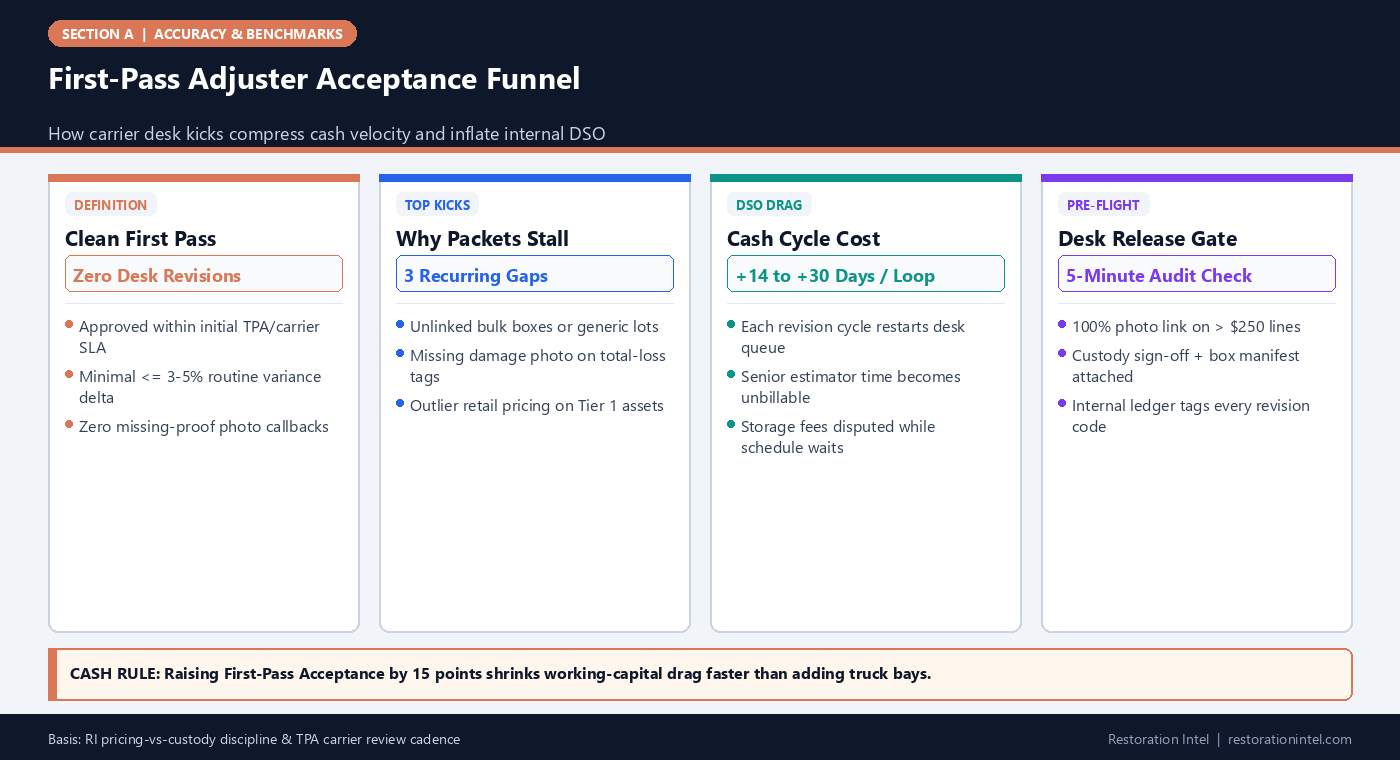
Contents divisions obsess over gross billed revenue while overlooking the metric that controls working capital: how many schedules clear carrier desk review on the first submission. Every time an adjuster kicks a 300-line packet back for missing brand proofs, vague box lots, or unverified non-salvageable documentation, cash collection stalls 14 to 30 days while senior estimators burn unbillable hours defending prior work.
Notice how closely cash flow ties back to physical proof discipline emphasized in both A Price Tag on a Lost Item Is Worth Nothing and The $7,986 Hiding in Your Xactimate: a high-priced schedule that lacks clear photo linkage or chain-of-custody accountability simply generates rework friction instead of cleared checks.
First-Pass Acceptance Scoring Rubric & Revision Taxonomy
| Outcome Tier | Carrier Desk Behavior | Cycle-Time Impact | Common Contributing Defect | Recommended Ledger Action |
|---|---|---|---|---|
| Pass — Clean First Submission | Approved as submitted or minor <= 3% unit/tax rounding tweak | Baseline payout velocity | 100% photo linkage, verified Tier-1 serials, clean LKQ dealer proofs | Log Pass; archive template as training benchmark |
| Conditional Pass — Minor Clarification | 1–2 targeted questions answered inside 24 hrs via email | +3–7 days DSO | Single unclear garage lot photo or missing warranty/manual backup | Track minor tag; refine field intake rule |
| Kick — Documentation Deficiency | Schedule held pending site return photos or teardown proof | +14–30 days DSO | Condemned items lacked pre-disposal macro damage evidence | Hard QA stop; audit crew pre-disposal gate |
| Kick — Pricing / Scope Challenge | Wholesale hair-cuts on Tier 1 assets or category disallowance | +21–45 days DSO | Inflated 3rd-party SKU comps or generic box dumps without breakdown | Retrain estimator on LKQ & tree rules |
Custody and Pricing Must Move Together
A desk examiner looking at an unfamiliar line item asks two questions simultaneously: can the policyholder or restoration team prove this exact item was damaged at the loss location, and is the clean/replace number anchored in reality? As highlighted in A Price Tag on a Lost Item Is Worth Nothing, perfect retail pricing means zero if vault custody or pre-cleaning proof is missing — and conversely, pristine barcode custody stalls if the attached estimate reads like inflated guesswork.
Tracking First-Pass Acceptance bridges operations and accounting. Instead of measuring estimating speed in isolation, managers track the share of submitted packets clearing carrier review desks without formal revision requests.
- Separate partial approvals from clean approvals: Holding back 40 percent of a packet over questioned lines is still a first-pass miss.
- Log carrier vs TPA patterns: Specific carrier programs flag specific documentation triggers; ledger tracking reveals those rules within 10 files.
Five Pre-Submission Checks That Eliminate Routine Desk Kicks
Teams raising first-pass acceptance above 85 percent rarely hire extra lawyers — they enforce a rigid five-minute pre-flight check before exporting any ESX or PDF packet. Before an estimator hits upload, QA reviews a targeted risk slice rather than scrolling passively through low-value lines.
Every Tier 1 asset (>$500) must carry a readable model tag or fallback measurements; every condemned non-salvageable item must show visible peril damage in pre-disposal photos; every bulk box lot must link to an open-top overview shot; no retail link may rely on obvious third-party resellers; and room totals must match intake walkthrough notes. Packet organization counts nearly as much as technical accuracy: ordering schedules cleanly room-by-room with clickable thumbnail sheets lets busy desk examiners clear dozens of lines in minutes.
- Separate structural fixtures cleanly from tenant/homeowner contents before export so carrier desks do not hold the whole schedule over one disputed light sconce.
- Attach an explicit Executive Summary cover note detailing peril scope, box counts, and total-loss non-salvage protocols at the front of large commercial packets.
Turning Acceptance Tracking Into Estimator Coaching
Track First-Pass Acceptance per estimator and per field crew lead inside a simple monthly ledger alongside average Days Sales Outstanding. Cross-referencing acceptance rates with TPA SLA compliance turns subjective adjuster complaints into concrete SOP upgrades — showing owners precisely which checklists eliminate payment stalls without sacrificing legitimate billable scope.
Field Execution Checklist
- Log every submitted contents packet in an acceptance ledger recording submission date, first carrier response, and any revision kick reasons.
- Treat zero-revision approval (or <= 3 percent minor clerical reconciliation) as the only true First-Pass Acceptance win.
- Enforce a mandatory pre-submission QA audit covering Tier-1 model photos, non-salvageable peril proof, and box-lot overview shots.
- Audit third-party pricing outlier flags before uploading XactContents or Symbility files.
- Feed recurring carrier adjustment patterns straight back into field crew pre-pack checklists weekly.
Related Restoration Intel Guides & Reference Standards
- Internal Guide: A Price Tag on a Lost Item Is Worth Nothing
- Internal Guide: The $7,986 Hiding in Your Xactimate
- Companion Brief (A-14): The True Cost of Inventory Rework: Quantifying Field Return Trips, Missing-Item Disputes, and Supplement Delays
- Companion Brief (A-16): Setting Realistic Internal SLAs for Contents Turnaround: From Field Walkthrough to Final Schedule
- Internal Guide: The 2026 TPA Survival Guide
- Primary Authority: Verisk Property Claims Solutions
- Primary Authority: Verisk XactContents Platform Overview
- Primary Authority: Restoration Industry Association (RIA)
- Primary Authority: ANSI/IICRC S320 Standard for Professional Contents Restoration
Frequently Asked Questions
What counts as a First-Pass Acceptance failure?
Any carrier desk response that pauses settlement or requests supplemental photos, line breakdowns, pricing documentation, or category reclassification before issuing approval.
Why track First-Pass Acceptance if supplements eventually get paid?
Because unbilled estimating rework, follow-up emails, and 20-to-40-day cash delays quietly consume net operating margin even when gross invoice dollars eventually clear.
What is a strong benchmark rate for mature contents teams?
Mature shops enforcing pre-submission QA checklists typically see 80 to 90+ percent clean or near-clean first-pass acceptance on standard residential claims.
Do TPA programs penalize low first-pass acceptance?
Yes — repeat documentation kicks hurt contractor scorecard metrics on turnaround SLA, revision frequency, and carrier audit scores.
.md twin (first-pass-adjuster-acceptance-rate-contents-claims.md).