Published November 14, 2026. By Will Tygart · Restoration Intel Editorial Desk.
Direct answer. Restoration teams can audit 300-to-1,500-box pack-outs defensibly by applying lot-acceptance statistical sampling — inspecting roughly the square root of total containers plus high-value outliers — rather than burning labor opening every sealed carton.
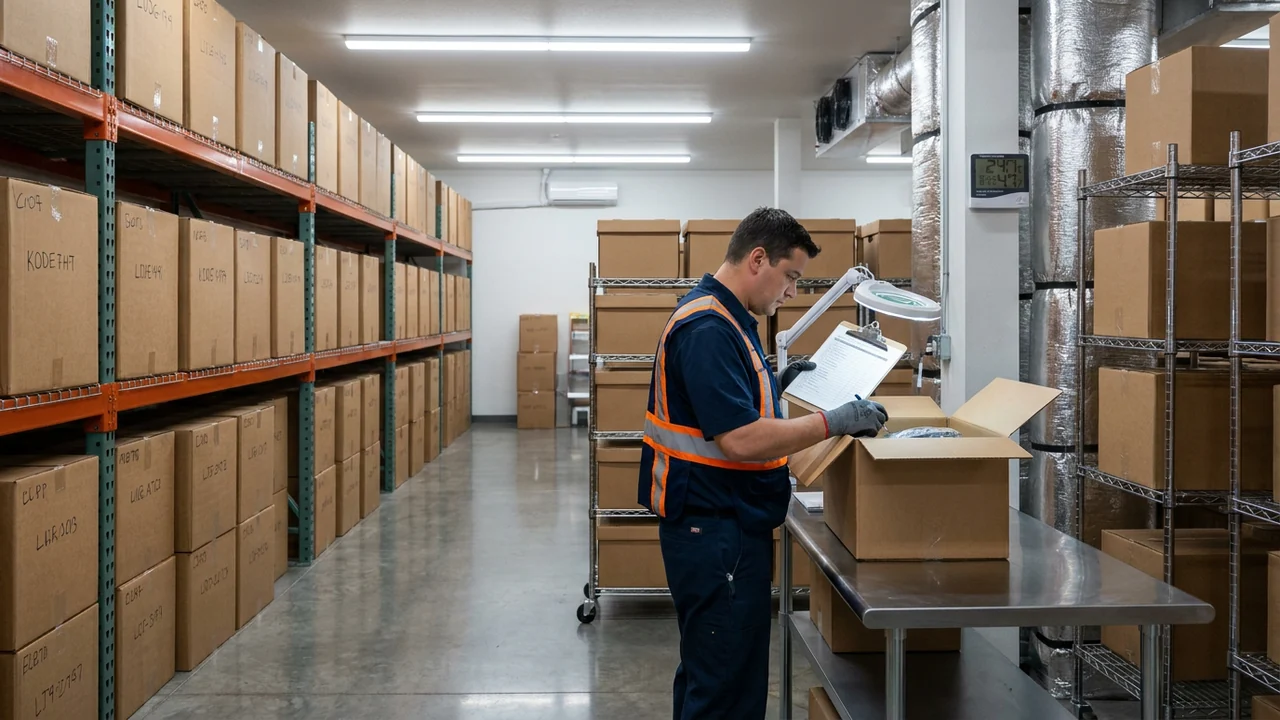
On a 60-box kitchen pack-out, opening every fifth carton during warehouse intake takes twenty minutes. On a 650-box estate fire or commercial clinic move, 100 percent re-inspection wrecks vault throughput, breaks fragile wrapping, and still misses systemic errors buried in identical technician habits.
Statistical lot-acceptance sampling solves this exact scale problem. Borrowing practical principles from industrial quality control (matching public ANSI/ASQ acceptance-sampling logic), contents managers audit a structured sample stratified across rooms, pack-out crews, and high-dollar tiers — catching systemic tagging, counting, or condition-grading drift before the invoice or ESX hits the carrier.
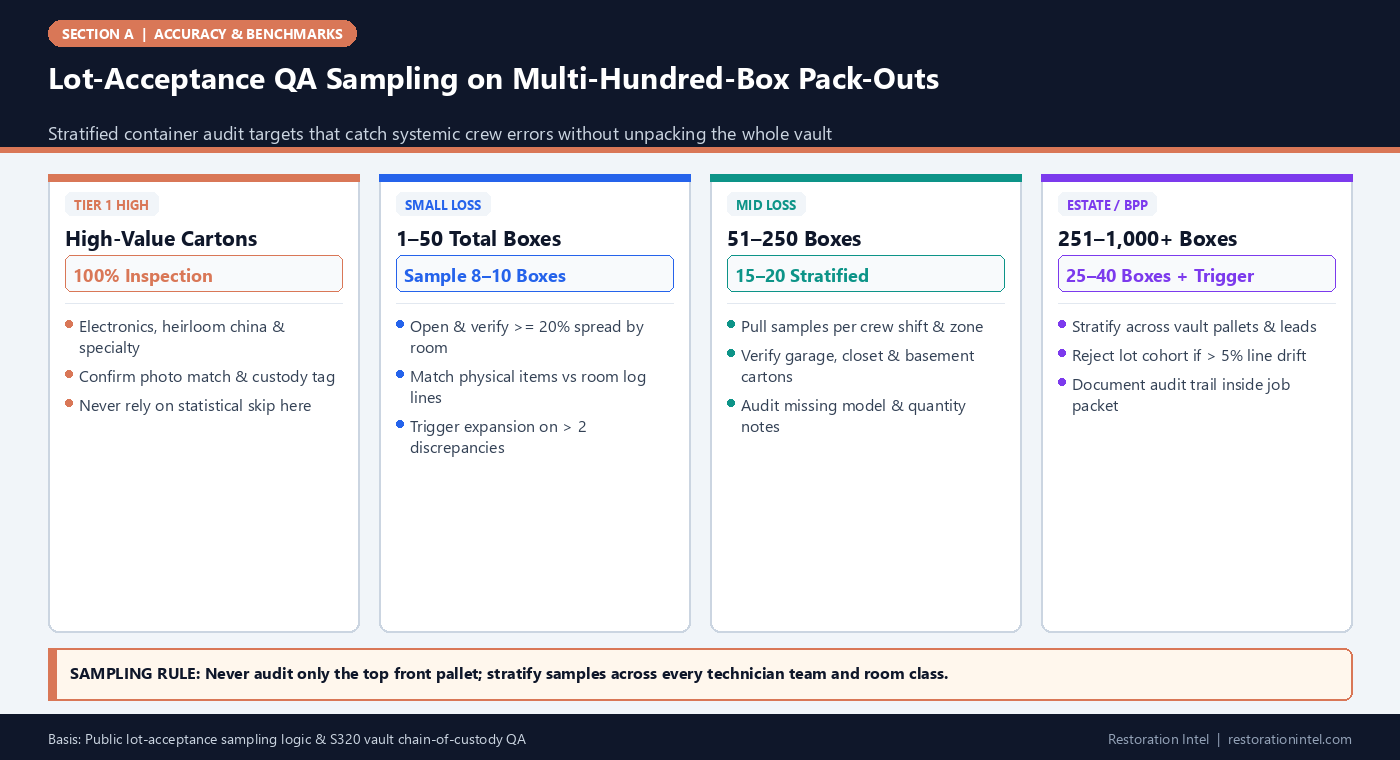
Warehouse Pack-Out Sampling Table by Container Volume
Apply standard stratified sampling to general household boxes while holding 100 percent verification on designated Tier-1 cartons.
| Total Pack-Out Size | Recommended QA Sample | Stratification Rule | Acceptance Threshold | Escalation Trigger |
|---|---|---|---|---|
| 10–50 Boxes | 8–10 Cartons | Cover every packed room + every shift crew | 0 high-value misses; <= 1 minor count mismatch | Inspect 100% of questionable crew’s boxes |
| 51–150 Boxes | 15–20 Cartons | Weight toward dense closets, pantry & garage | <= 3% aggregate item/category error | Double sample size for offending shift or room |
| 151–400 Boxes | 24–32 Cartons | Proportionally pull from all truck loads & tech pairs | <= 3% aggregate error; 0 missing custody IDs | Hold carrier export; run full crew re-audit on flagged zone |
| 401–1,000+ Boxes | 35–50 Cartons | Stratify by vault rack, floor, and specialty tag | <= 2.5% aggregate error; zero orphan pallets | Quarantine unverified pallet batch before billing |
Why Convenience Sampling Creates False Confidence
Most improvised warehouse audits suffer from convenience bias: leads crack open two boxes closest to the bay door, both packed by their most experienced technician from the clean master bedroom, find crisp dishware wrapping and clean barcode lists, and check off the entire vault.
Meanwhile, the back three pallets packed by temporary helpers during hour nine of a soot job contain unlabeled mixed garage totes, unlogged cord bundles, and duplicate box numbers. Stratifying the QA draw by pack-out technician, shift day, and room density ensures the sample surfaces weak links instead of rehearsing strengths.
- Tag box origin metadata: Every pack-out carton label should record Room Code, Packer Initials, and Date so stratification takes thirty seconds.
- Pull blind before unloading: Pick QA box IDs straight from the digital manifest before walking onto the vault floor.
Integrating Physical Box Audits With Photo-Log Reconciliation
A high-leverage QA inspection does not always require unwrapping bubble paper from delicate glassware. Pair physical opening of sealed general cartons with a rapid digital audit of box-open photos against scheduled line descriptions. If the open-box intake frame clearly displays four small kitchen appliances yet the exported room log shows only two toaster entries, you spotted an error without lifting a roll of packing tape.
Where unwrapping is required due to missing pre-pack frames or fragile claims, log repack seals with QA inspector initials and date so chain of custody per ANSI/IICRC S320 remains unbroken.
When a Sample Fails: Containment Instead of Panic
Statistical sampling only saves time if teams obey reject triggers cleanly. When a stratified audit sample exceeds three percent item/category discrepancies — say three out of twenty boxes show omitted tools or wrong barcode links — do not silently patch just those three boxes and ship the schedule.
Trace the defect back to its cohort (same technician team, same afternoon, or same room zone), run targeted 100 percent reconciliation on that cohort alone, and leave passing cohorts untouched. That pinpoints rework cost where errors actually occurred. Logging every QA draw ID, box condition finding, and cohort clearance signature directly inside the job folder also provides crisp third-party audit proof if an insurer later challenges vault completeness across multi-pallet commercial moves.
- Record sampled box numbers inside an immutable intake QA sheet before resealing pallets so adjusters can verify impartial inspection.
- Track per-lead sample pass rates across closed months to spot crews needing focused wrapping or room-boundary coaching.
Field Execution Checklist
- Audit 100 percent of high-value, fragile, or sublimit-tagged cartons independently of general household lot sampling.
- Draw general carton QA samples stratified across every crew lead, shift day, and dense storage room.
- Require Packer Initials and Room Source on every box label so error cohorts can be isolated rapidly.
- Set explicit reject thresholds (e.g., > 3% variance or any lost custody ID) that automatically widen the audit to that crew’s batch.
- Reseal opened QA cartons with inspector initials and date stamp to preserve clean warehouse chain of custody.
Related Restoration Intel Guides & Reference Standards
- Companion Brief (A-01): How Restoration Teams Should Define and Measure Contents Inventory Accuracy
- Companion Brief (A-13): How Duplicate Detection Fails During Multi-Tech Re-Uploads and Split-Shift Pack-Outs
- Companion Brief (A-11): Photo-to-Line-Item Traceability Standards for Carrier Audit Readiness
- Internal Guide: A Pack-Out Record Is Not a Priced Inventory
- Internal Guide: The Specialty Codes
- Primary Authority: ANSI/IICRC S320 Standard for Professional Contents Restoration
- Primary Authority: Restoration Industry Association (RIA)
- Primary Authority: Verisk XactContents Platform Overview
Frequently Asked Questions
Do we have to unwrap every fragile item inside a QA sampled box?
No. If pre-pack open-top photos match exterior box weight/contents notes cleanly, inspect down just far enough to verify representative layer fidelity and reseal carefully.
What if a crew argues sampling slows down warehouse receiving?
Inspecting 25 stratified cartons takes 45 minutes — dramatically less than the days of lost margin caused by an unverified 400-box lost-item claim or carrier audit dispute.
Should total-loss items left on site use statistical sampling?
Yes, at the photo-room level: audit a stratified sample of rooms (especially closets and garages) comparing raw walkthrough frames to final line schedules before leaving the property.
Can barcode logs substitute for physical box spot-checks?
Barcodes verify that a carton moved from truck to bay, not that everything inside was described, counted, and condition-graded accurately.
.md twin (statistical-qa-sampling-large-pack-outs-box-verification.md).