Published November 14, 2026. By Will Tygart · Restoration Intel Editorial Desk.
Direct answer. Accurate total-loss triage compares realistic all-in restoration cost — pack-out, cleaning, deodorization, vault handling, and pack-back — against verifiable replacement value (typically flagging total loss when all-in cleaning hits 65 to 80 percent of RCV), supported by in-place peril evidence.
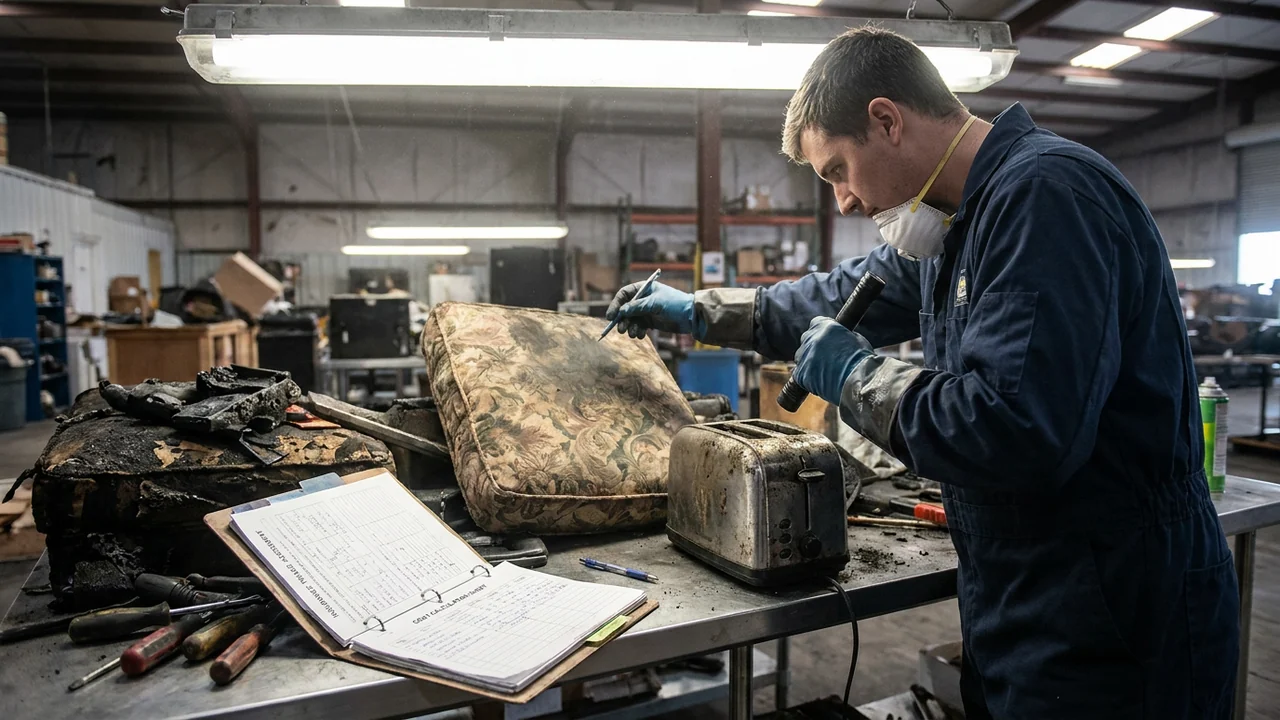
Every experienced contents estimator has seen two embarrassing extremes on submitted claims: crews hauling $40 laminated bookshelves across town to charge $140 in cleaning and vault storage, and conversely, technicians condemning a $2,800 commercial espresso machine over mild exterior soot when a two-hour authorized bench clean would save it cleanly. Both mistakes burn trust — the first with carriers auditing economic sense, the second with policyholders attached to specialty property.
Accurate total-loss triage prevents needless handling waste before items ever leave the driveway. It marries S320 technical salvageability criteria (material porosity, pathogen hazard, irreversible structural distortion) with disciplined all-in unit economics.
Total-Loss Decision Thresholds by Asset Class & Failure Mode
| Asset / Material Class | Primary Non-Salvage Trigger | Typical Economic Breakpoint | Carrier Audit Verification Requirement |
|---|---|---|---|
| Particleboard / MDF Furniture | Liquid swelling, veneer bubble, edge delamination | Often instant total loss once wet | Close-up macro of swollen seam + wide room context before demo |
| Standard Low-Cost Smalls (<$75 RCV) | Heavy protein grease, char odor, multi-step ultrasonic/pack cost | Pack + clean + return exceeds 75% RCV | Show side-by-side clean line total vs retail LKQ snapshot |
| Cat 3 Porous Soft Goods / Mattresses | Sewage / overland flood pathogen saturation | Mandatory health/safety condemnation | Waterline height stick + sewer backup origin proof in place |
| High-End Electronics & Appliances | Acidic soot PCB corrosion, tripped safety circuits | Refurb/OEM bench recert > 70% RCV (or voided safety listing) | Authorized OEM/electronics vendor diagnostic + rating plate |
| Heirlooms, Art & Unique Documents | Economic RCV caps yield to sentimental/irreplaceable value | Exceeds 100% market value when authorized | Written policyholder/adjuster written cleaning authorization |
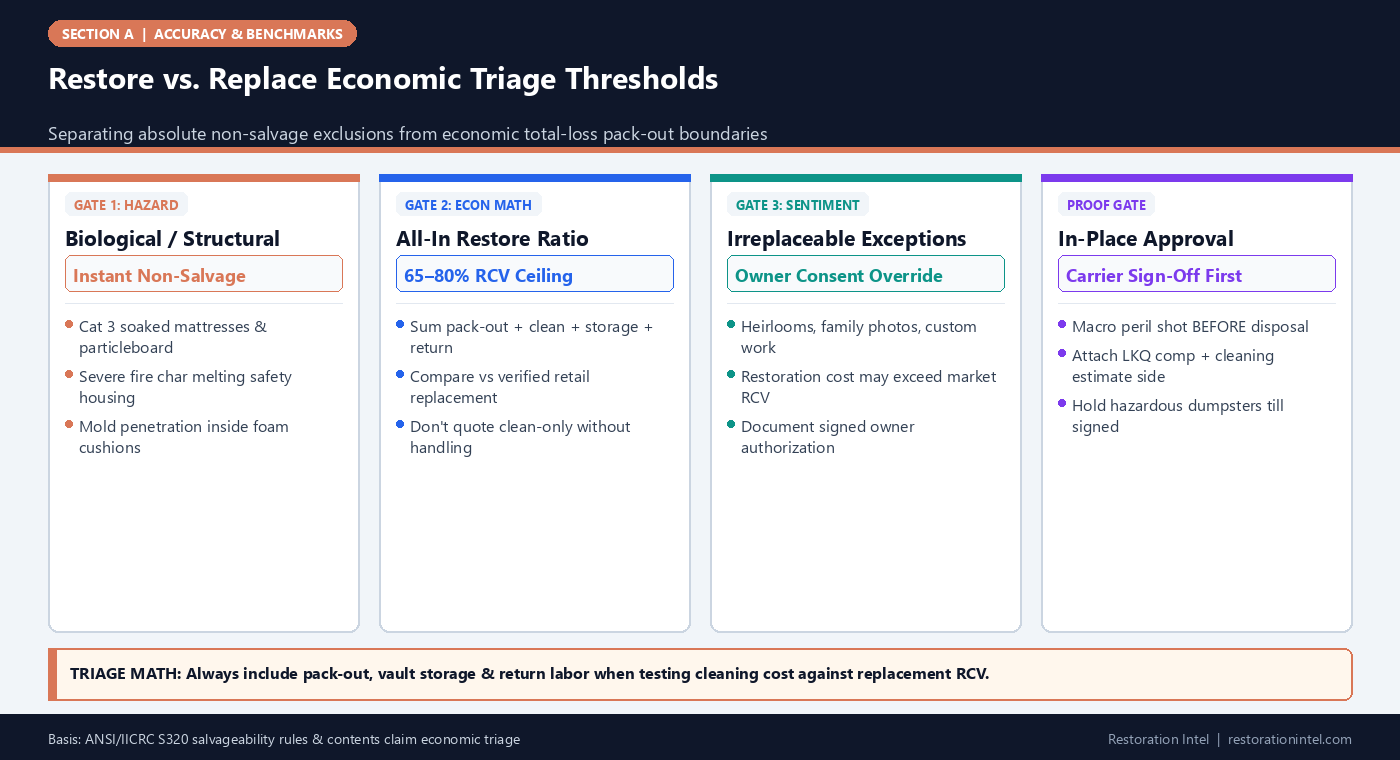
Why Leaving Out Handling & Storage Breaks Clean-vs-Replace Math
The #1 error in early triage happens when field leads glance at a kitchen blender worth $65, estimate $25 in shop wiping labor, and load it onto the truck. They forget the real cost stack attached to any packed box: initial wrapping materials, pack-out technician time, transport mileage, climate-controlled vault storage, ozone/hydroxyl chamber allocation, QA logging, and pack-back delivery.
Once all-in pack-out + clean + storage + pack-back reaches roughly 65 to 80 percent of current retail replacement cost on non-sentimental commodities, carriers almost universally prefer clean total-loss settlement — saving contractor handling overhead and returning cash to the insured immediately.
- Run pre-pack triage sweeps: Walk rooms with an estimator or digital pricing reference BEFORE wrapping team enters.
- Never dispose unilaterally: Even obviously ruined property belongs on an approved non-salvage schedule with adjuster sign-off prior to dumpster haul-away.
Documenting Safety and Regulatory Total-Loss Condemnations
Some items fail triage at zero percent economic debate because returning them into service poses health or fire liability. Category 3 flood-soaked mattresses, infant car seats exposed to structural heat or smoke chemicals, open food/pharmaceuticals, and soot-contaminated circuit breakers typically require mandatory condemnation regardless of surface wiping feasibility — aligned with S500 and S700 risk boundaries.
Document exact code, safety recall, or manufacturer void-of-warranty clauses alongside clear model numbers so adjusters never classify safety replacements as ‘cosmetic upgrades’.
Tracking Early Triage Accuracy on Closed Jobs
Audit what percentage of packed warehouse items end up condemned post-arrival because cleaning crews uncover hidden delamination or unbearable odor inside vaults. If more than 8 to 10 percent of packed cartons get reclassified to total loss in your warehouse, field pre-pack triage rules need tighter on-site screening. Comparing Day-1 triage assumptions against final settled claims keeps crews from wasting labor boxing marginal cheap goods while safeguarding recoverable specialty property.
- Separate structural non-salvage decisions clearly from contents items using in-place damage photos dated before demolition starts.
- Present side-by-side clean-vs-replace cost summaries proactively on any borderline appliance or upholstered chair over $400.
Field Execution Checklist
- Evaluate ALL-IN restoration cost (wrap + pack-out + clean + storage + return) against verified LKQ replacement value.
- Condemn safety/pathogen exposures (Cat 3 porous mattresses, infant safety seats, blistered circuit boards) under written policy/manufacturer criteria.
- Obtain adjuster/insured authorization BEFORE moving non-salvageable inventory to roll-off dumpsters.
- Capture crisp in-place macro damage photos AND rating plates on every total-loss item before disposal.
- Audit warehouse post-pack total-loss reclassification rates monthly to tighten Day-1 site triage.
Related Restoration Intel Guides & Reference Standards
- Companion Brief (A-10): Inter-Rater Reliability Between Contents Estimators and Field Technicians
- Companion Brief (A-11): Photo-to-Line-Item Traceability Standards for Carrier Audit Readiness
- Companion Brief (A-14): The True Cost of Inventory Rework: Quantifying Field Return Trips, Missing-Item Disputes, and Supplement Delays
- Internal Guide: IICRC Cat 3 Contents Pack-Out Cleaning Protocol
- Internal Guide: Which Xactimate Line Items Do Adjusters Actually Approve?
- Primary Authority: ANSI/IICRC S320 Standard for Professional Contents Restoration
- Primary Authority: ANSI/IICRC S500 Water Damage Standard
- Primary Authority: ANSI/IICRC S700 Fire & Smoke Restoration Standard
- Primary Authority: Verisk XactContents Platform Overview
Frequently Asked Questions
Is there an exact universal percentage rule for total-loss contents?
No fixed statute exists across all carriers, though 65 to 80 percent all-in restoration-to-RCV cost is a widespread practical benchmark before carriers opt to cash out replacement.
What if the homeowner wants a low-value sentimental quilt or photo album cleaned despite high cost?
Flag sentimental items explicitly as Policyholder Priority Exceptions and secure written adjuster or owner authorization before incurring specialty conservation costs exceeding market replacement value.
Who makes the final call on throwing away ruined property?
The policyholder owns the property and the insurance adjuster validates claim settlement; restoration contractors recommend salvage/condemnation with documented proof and wait for authorization before disposal.
Why do adjusters challenge post-pack-out total-loss switches?
When contractors bill pack-out labor first and later declare the exact same cartons unsalvageable in the warehouse, carriers question why that triage wasn’t spotted on site.
.md twin (total-loss-threshold-accuracy-cleaning-cost-vs-replacement.md).