Published November 14, 2026. By Will Tygart · Restoration Intel Editorial Desk.
Direct answer. Raw computer vision labels like ‘silver pot’ or ‘wooden seat’ fail insurance review because carrier systems run rigid multi-level category trees, unit-of-measure rules, and age/depreciation tables — making taxonomy normalization one of the most consequential engineering layers in contents AI.

Open a general-purpose vision model trained on consumer web photos and point it at a kitchen counter: it sees `cup`, `knife`, `pot`, `chair`, `box`. Drop those raw nouns straight into an insurance contents submission and desk review breaks immediately.
Insurance estimating platforms such as Verisk XactContents and Symbility do not price informal labels; they classify assets inside hierarchical carrier trees (Category -> Subcategory -> Item Spec -> Quality Grade -> Age/Condition -> Unit of Measure) where each branch links directly to useful-life depreciation schedules and special policy limits.
Raw Vision Label -> Carrier Estimating Tree Normalization Examples
| Raw AI Visual Tag | Critical Disambiguating Question | Normalized Carrier Category Branch | Required Quality & Unit Fields |
|---|---|---|---|
| ‘Leather Bag’ | Everyday backpack/tote vs designer luxury handbag vs laptop briefcase? | Apparel / Accessories vs Scheduled Valuables Check | Unit = EA; Maker/Material tier; Sublimit screen if designer |
| ‘Brown Table’ | Foyer console, kitchen laminate dinette, or solid walnut dining table? | Furniture -> Dining vs Entryway Tables | Construction material + Quality Tier + Dimensions |
| ‘Sneakers’ | Single left shoe photographed twice vs complete pair? | Footwear -> Athletic Shoes | Unit = PAIR (PR); Brand/Performance tier |
| ‘Metal Box w/ Wires’ | Personal desktop PC, medical clinic autoclave, or building HVAC relay? | Electronics / Computers vs Commercial Medical vs Building MEP | Policy boundary check (Contents vs Structure) + Serial/OEM |
| ‘Box of Plates’ | Single melamine plate vs 12-piece fine bone china place setting? | Dinnerware / Kitchen -> Fine China vs Everyday Dishware | Unit = Place Setting / Set vs EA; Material (Porcelain/Stoneware) |
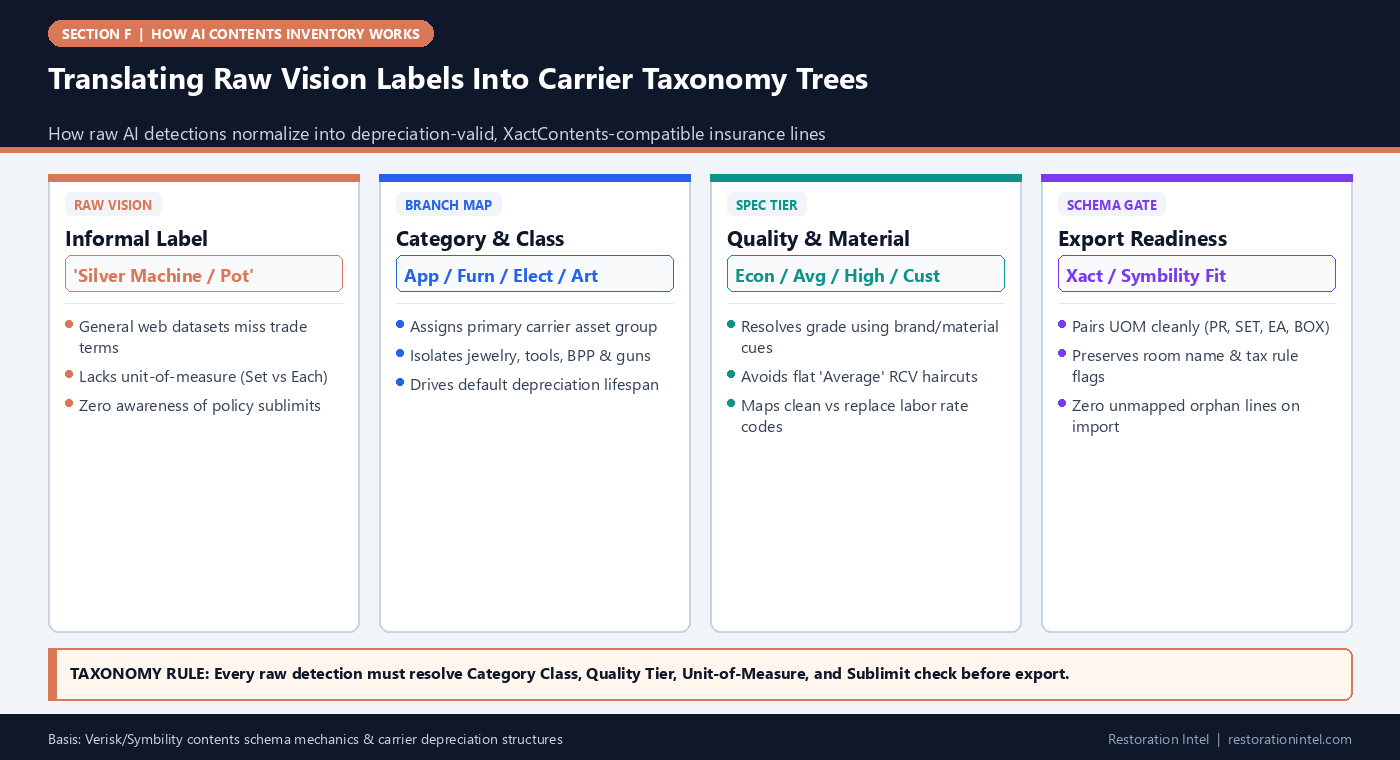
Why Depreciation Tables Punish Sloppy Category Mapping
Suppose a restoration crew logs a $1,600 custom wool dining rug inside generic `Home Decor / Accessories` instead of `Rugs / Fine Wool`. In common insurance depreciation schedules, short-lived decor wears faster annual depreciation percentages than woven wool rugs or solid hardwood heirloom furnishings — quietly cutting initial ACV holdback checks to policyholders even when total RCV looks identical.
Similarly, dumping commercial photography lights inside `Home Lighting` risks triggering improper residential caps or obscuring true business personal property (BPP) sublimits.
- Protect policy boundaries at mapping time: Separate attached building fixtures (mounted lighting, bolted cabinetry, built-in dishwasher plumbing) cleanly from contents schedules.
- Audit Units of Measure (UOM) explicitly: Confirm shoes, curtains, earrings, and boxed dishware sets carry `PR` / `SET` consistently so quantities don’t double-bill or halve inadvertently.
Resolving Quality Grade (Economy vs. Average vs. High vs. Custom)
Every estimating catalog relies on quality tiers to anchor pricing bands. Leaving 100 percent of lines locked on `Average` cheats estates furnished with custom millwork and prosumer appliances, while blindly pushing `High/Custom` across student apartments triggers immediate adjuster kicks. Combining OCR brand lookups with clear material/construction tags produces clean, consistent tier mapping matching estimator calibration rules. Document exact visual evidence supporting any `High` or `Custom` classification (dovetail drawers, solid oak underside, commercial stainless gauge) directly in linked thumbnail notes.
- Validate default quality presets per loss property profile (builder apartment vs custom single-family estate vs medical/commercial suite) before importing room schedules.
- Keep specialty BPP items segregated strictly from homeowner residential furnishings even inside mixed home-office setups.
Verifying Clean Schema Round-Trips into Estimating Platforms
Before buying or deploying any capture workflow, push a realistic 50-line test file containing footwear pairs, fine china sets, appliances, and garage tool lots through its taxonomy mapper straight into your live XactContents or Symbility workspace — verifying zero unmapped generic rows or broken unit multipliers on arrival so estimator desk cleanup stays near zero. Checking actual import fidelity early protects estimating teams from weeks of tedious post-export spreadsheet cleanup.
Field Execution Checklist
- Map every raw visual label into a validated estimating tree category with verified Policy Boundary (Contents vs Structure).
- Enforce explicit Unit-of-Measure governance (`EA`, `PR`, `SET`, `LOT`) on shoes, curtains, dishware, and grouped hardware.
- Tie Quality Tier assignments directly to OCR brand evidence, material joinery, or field voice tags — avoid blanket defaults.
- Flag sublimit-sensitive branches (jewelry, watches, furs, firearms, silver, commercial BPP) automatically during mapping.
- Test 50-item real exports straight inside XactContents/Symbility to confirm zero dropped fields or category rejections.
Related Restoration Intel Guides & Reference Standards
- Companion Brief (F-01): How AI Contents Inventory Works End-to-End: From Field Capture to Carrier-Ready Schedule
- Companion Brief (F-09): Automated Pricing Lookup & LKQ Matching: Static Price Lists vs Live Retail Catalog Retrieval
- Companion Brief (F-13): Verisk XactContents, CoreLogic Symbility, and Spreadsheet Export Mechanics: Where AI Integrations Actually Break
- Companion Brief (A-02): Item Count Recall Vs Category Precision Contents Audits
- Internal Guide: Xactimate vs. Symbility
- Primary Authority: Verisk XactContents Platform Overview
- Primary Authority: Symbility Claims Support Portal
- Primary Authority: Verisk Property Claims Solutions
- Primary Authority: NIST AI Risk Management Framework
Frequently Asked Questions
Why don't standard AI object names work directly in XactContents?
Consumer object detectors output broad labels (`chair`, `pot`) lacking insurance hierarchy, depreciation class, quality tier, and unit-of-measure conventions.
What is the single most dangerous unit-of-measure bug in mapping?
Inconsistently labeling paired objects like shoes, drapes, or speakers as `EA` instead of `PR`, which can double or halve line replacement pricing cleanly under automated export.
Does mapping differ between homeowner contents and commercial BPP?
Yes — commercial schedules demand strict separation of leased vendor assets, specialized regulated gear, and fixed building improvements vs tenant contents.
How can teams verify taxonomy accuracy quickly?
Filter any drafted export by generic ‘Miscellaneous’ categories and inspect all >$250 lines to verify brand tier and depreciation class alignment.
.md twin (taxonomy-mapping-ai-object-labels-xactcontents-carrier-trees.md).