Direct Answer: Fair contents production tracking weights boxes per tech hour and line items per hour by room density while pairing speed metrics against breakage incidents and documentation audit pass rates so fast, sloppy packing never outscores careful work.
.md twin for estimator QA and carrier file documentation.
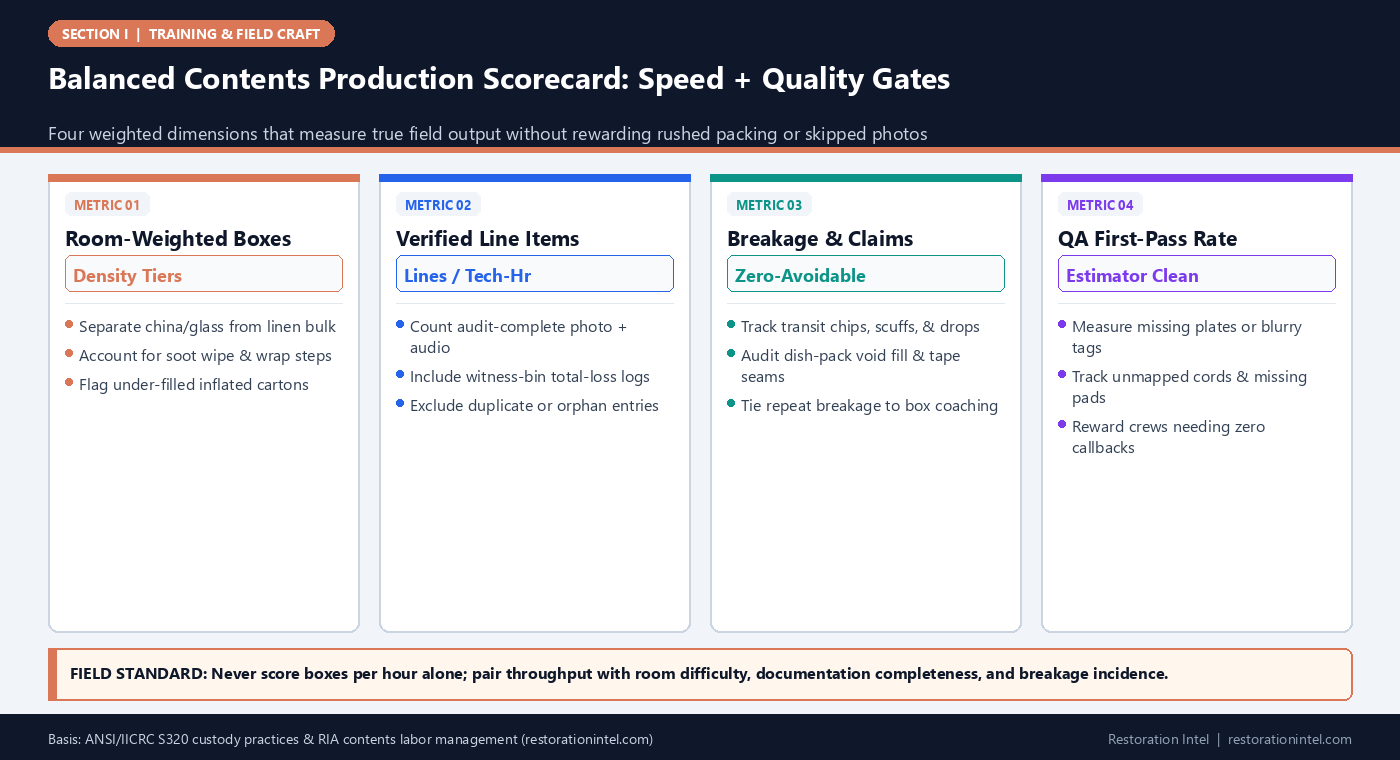
Nothing distorts field behavior faster than measuring a contents crew solely on raw boxes packed per technician hour. Give a crew a flat daily box quota without room-complexity weighting or quality gates, and experienced leads immediately see what happens: technicians chase easy linen closets, under-pack cartons to inflate box counts, skip rating-plate photos on appliances, and rush fragile china wrapping.
On the other side of the ledger, shops that abandon production tracking altogether lose visibility into labor burn before an estimate even hits XactContents. As discussed in The Hands Were Always the Bottleneck, contents profitability depends on how cleanly field hours convert into verified, billable line items and damage-free vault custody under ANSI/IICRC S320.
A fair measurement system separates room type, packing phase, and documentation completeness. By pairing throughput metrics with breakage logs and estimator rework flags, managers can compare a three-tech crew clearing a butler’s pantry against a crew clearing a three-car garage without penalizing the harder room.
Balanced Contents Production Scorecard: Speed + Quality Gates
Room-Complexity Weighting Framework for Fair Daily Crew Metrics
Adjusting production expectations by room contents density, fragility, and pre-pack soot or moisture handling requirements.
| Room or Zone Profile | Dominant Labor Driver | Why Raw Box Counts Mislead | Fair Primary Output Metric | Required Quality Gate |
|---|---|---|---|---|
| Kitchen & Butler's Pantry | Multi-layer paper wrap, dish-pack cells, small appliance plates | One dish pack takes far longer than four wardrobe boxes | Weighted dish-pack units + appliances logged per tech-hr | Zero transit chips; legible rating plates on small electrics |
| Primary Bedroom & Closets | Garment hanging, bundled shoes, dresser drawer organization | Wardrobe cartons fill fast while jewelry/heirlooms slow capture | Line items + wardrobe/carton count per tech-hr | Clean bundle counts; zero crushed footwear or mixed dirty/clean |
| Living Room & AV Media Wall | Heavy furniture padding, cable mapping, fragile decor & art | Zero cardboard boxes used for padded sofas and wrapped TVs | Vault pieces + cable-mapped electronics per tech-hr | Four-corner pad coverage; labeled AV harnesses and remotes |
| Garage, Basement & Utility | Heavy bulk sorting, tool bundles, hazmat segregation | Mixed junk vs high-value power tools distorts item counts | Sorted tote/pallet volume + tool serials per tech-hr | Flammables isolated; non-salvageable witness bins photographed |
| Home Office & Records | Paper file sequence, IT peripherals, sensitive client media | File cartons require strict shelf order and privacy custody | Sequential banker boxes + IT assets per tech-hr | Folder order preserved; hard drives and routers paired with tags |
| Total-Loss Witness Staging | Triage sorting, scale photos, non-salvageable listing | Crew produces zero vault boxes while logging heavy line items | Verified non-salvageable line items per tech-hr | Paired wide/macro proof + brand tier on every condemned lot |
Why Raw Boxes per Tech Hour Punishes Careful Technicians
When restoration managers post a single shop average of boxes packed per technician hour, they accidentally create a two-tier incentive problem. The technician assigned to wrap crystal stemware, oil paintings, and porcelain figurines inside a formal dining room looks slow on paper compared with a teammate tossing folded guest towels and stuffed animals into medium cartons upstairs.
Worse, raw box targets quietly punish technicians who follow ANSI/IICRC S320 custody rules. Shooting a clean establishing photo, lifting an espresso machine to read a dark underside serial plate, wrapping a brass lamp harp in clean acid-free tissue, and sealing a double-walled dish pack properly takes real minutes. A technician who skips those steps beats the clock at 4:00 p.m. and leaves the company exposed to a breakage claim or carrier short-pay three weeks later.
Fair operations leaders also account for non-box labor that never shows up in a carton tally. On occupied or tight-access losses, hauling wrapped sectional sofas down two flights of stairs, building protective Masonite floor runners, and staging witness bins for non-salvageable debris consume hours of productive crew time with zero cardboard boxes taped.
- Separate padded pieces from cartons: Track large wrapped furniture, rugs, and crated art as vault piece units alongside boxed cartons.
- Credit witness-bin documentation: Non-salvageable sorting requires the same photo and line-item rigor as salvageable pack-out and must count toward daily output.
- Exclude setup and teardown bottlenecks: Log floor protection, elevator padding, and truck-ramp rigging as mobilization time rather than diluting packing speed.
Pairing Line Items per Hour With Documentation Completeness
Line items captured per technician hour offers a sharper lens than carton volume alone because estimating revenue and carrier reimbursement follow documented scope, not cardboard count. However, line-item velocity still breaks down if crews split a pantry shelf into forty individual soup-can photos just to juice their daily count, or rush through entries with vague labels like ‘misc box of stuff.’
As detailed in A Pack-Out Record Is Not a Priced Inventory, an incomplete field entry forces an estimator back into the vault to open sealed cartons—erasing every minute saved on site. Measuring ‘audit-ready line items per hour’ solves that trap by counting only lines that include room zone, clear category or material description, legible count, and required photo angles.
Crew leads can spot-check five random cartons and five large-item records per technician at the end of each shift. If a technician logged forty lines an hour but ten require estimator callbacks for blurry serial tags or missing counts, their net usable production drops behind a steady peer hitting thirty clean lines an hour with zero rework.
- Anti-padding bundle rule: Teach techs to group homogeneous pantry, linen, and closet lots consistently rather than splitting pennies to inflate counts.
- First-pass audit score: Sample at least one carton or five line items per tech daily for tag legibility, audio clarity, and damage angle proof.
- Estimator callback log: Feed post-job vault re-inspection hours back to the job scorecard so hidden rework becomes visible.
Tracking Breakage Incidents and Near-Misses Without Hiding Errors
If a company penalizes crew members punitively for every single accidental chip, technicians stop reporting hairline cracks, conceal wobbly furniture legs inside stretch wrap, and hope nobody notices until pack-back. Once a concealed break surfaces months later in front of the homeowner, the restoration firm absorbs both the replacement cost and the reputation hit.
Instead, high-performing contents divisions run a transparent breakage-and-incident ledger tied to coaching rather than fear. Technicians distinguish pre-existing cracks photographed during room sweep from acute handling incidents during pack-out, loading, or vault stacking. Every handling incident gets logged immediately on the shift exception sheet with a photo so the project manager can repair, notify, or resolve it proactively.
Reviewing breakage patterns across jobs reveals systemic fixable causes—such as single-wall boxes failing under heavy hardcover books, dish packs stacked three high without corner boards, or crews skipping RIA-aligned wrapping buffers on stoneware edges.
- Pre-existing vs handling split: Reward techs who photograph pre-existing chips and loose glue joints before touching an item.
- Amnesty for immediate reporting: Never punish honest same-shift breakage reports; reserve accountability for concealed damage or repeated SOP skips.
- Root-cause tagging: Classify every incident by cause—void fill, box crush, wrap abrasion, or carry drop—so training targets real failure modes.
Running Weekly Crew Reviews That Build Trust Instead of Gaming
Production dashboards only improve retention and margin when technicians trust the math behind them. Sharing a simple weekly scorecard in a ten-minute shop review—broken down by job complexity, total crew hours, audit pass rate, and breakage-free days—gives veterans and new hires alike a clear picture of what good looks like.
Pair raw metrics with context from the job file: a fire pack-out in a cramped 1920s rowhouse with narrow spiral stairs and heavy grease soot should never be benchmarked against a clean single-story suburban water pack-out. Documenting access constraints, contamination level, and homeowner presence right on the shift summary prevents unfair comparisons across crews.
When bonuses or promotions tie to balanced scorecards—requiring both strong weighted throughput and high documentation/breakage standards—crews police their own box geometry and photo discipline because rushing no longer pays.
- Context tags on every shift: Record stairs, elevator wait times, heavy soot, and occupied-home interruptions alongside daily output.
- Team + individual balance: Score shared loading/staging tasks at the crew level while coaching individual capture and wrapping habits privately.
- Quarterly baseline calibration: Revisit room-hour targets using completed job actuals rather than static guesses.
Practitioner Verification Checklist (I-20)
- Weight daily production targets by room type (kitchen/fragile vs bedroom/linen vs garage/bulk) and separate wrapped furniture pieces from carton counts.
- Track audit-ready line items per tech-hour by discounting entries that lack clear room tags, counts, material notes, or legible rating-plate photos.
- Log mobilization, floor protection, stair carries, and witness-bin total-loss staging separately from clean-carton packing hours.
- Maintain a non-punitive same-shift breakage log that separates pre-existing defects photographed pre-touch from transit or wrapping incidents.
- Review crew scorecards weekly with job-context notes (stairs, soot level, occupied status) before coaching or adjusting labor targets.
Standards, Authority References & Related Reading
Primary standards, insurance definitions, and sibling Restoration Intel guides referenced in this brief:
- ANSI/IICRC S320 Standard for Professional Contents Restoration
- Restoration Industry Association (RIA)
- Verisk XactContents Platform Overview
- IRMI Insurance Glossary: Subrogation
- Related Guide: The Hands Were Always the Bottleneck
- Related Guide: A Pack-Out Record Is Not a Priced Inventory
- Related Guide: Box Packing Geometry & Dish-Pack Engineering: Preventing Transit Breakage Claims During Vault Storage
- Related Guide: Fragile Glassware, Stemware, and Crystal Wrapping SOPs for Fire and Water Pack-Outs
- Related Guide: Post-Job Crew Debriefs and Audit Error Feedback Loops: Turning Estimator Flags Into 10-Minute Morning Huddles
.md twin for desk QA and team training.Frequently Asked Questions
Why is boxes per tech hour misleading on a contents pack-out?
A single heavy dish pack full of wrapped crystal and plates takes several times longer to pack safely than multiple wardrobe or linen cartons, while padded sofas, rugs, and non-salvageable witness-bin documentation produce zero cartons despite heavy labor.
How do you stop technicians from padding line-item counts with single-can photos?
Enforce standardized closet and pantry bundling rules and measure audit-ready line items rather than raw photo count. Discount duplicate or improperly split entries during daily crew-lead spot checks.
Should breakage incidents reduce a technician's production bonus?
Yes, as a quality gate rather than a punitive fine for honest reporting. Tie incentives to balanced metrics where strong throughput only qualifies when breakage rates and estimator rework flags stay below threshold.
How can a crew compare production fairly between fire jobs and clean-water jobs?
Tag each shift by contamination class and access difficulty. Heavy soot pre-cleaning, PPE decontamination steps, and multi-flight stair carries require separate labor multipliers from ground-floor clean-water pack-outs.