Direct Answer: Choosing between on-site content manipulation and full off-site vault pack-out determines whether a restoration job finishes on margin or collapses into triple-handled chaos. Crew leads make the right call using a four-factor gate—structural repair duration, dust and drying clearance, item sensitivity, and trade footprint—while billing manipulation and pack-out cleanly without overlap.
.md twin for estimator QA and carrier file documentation.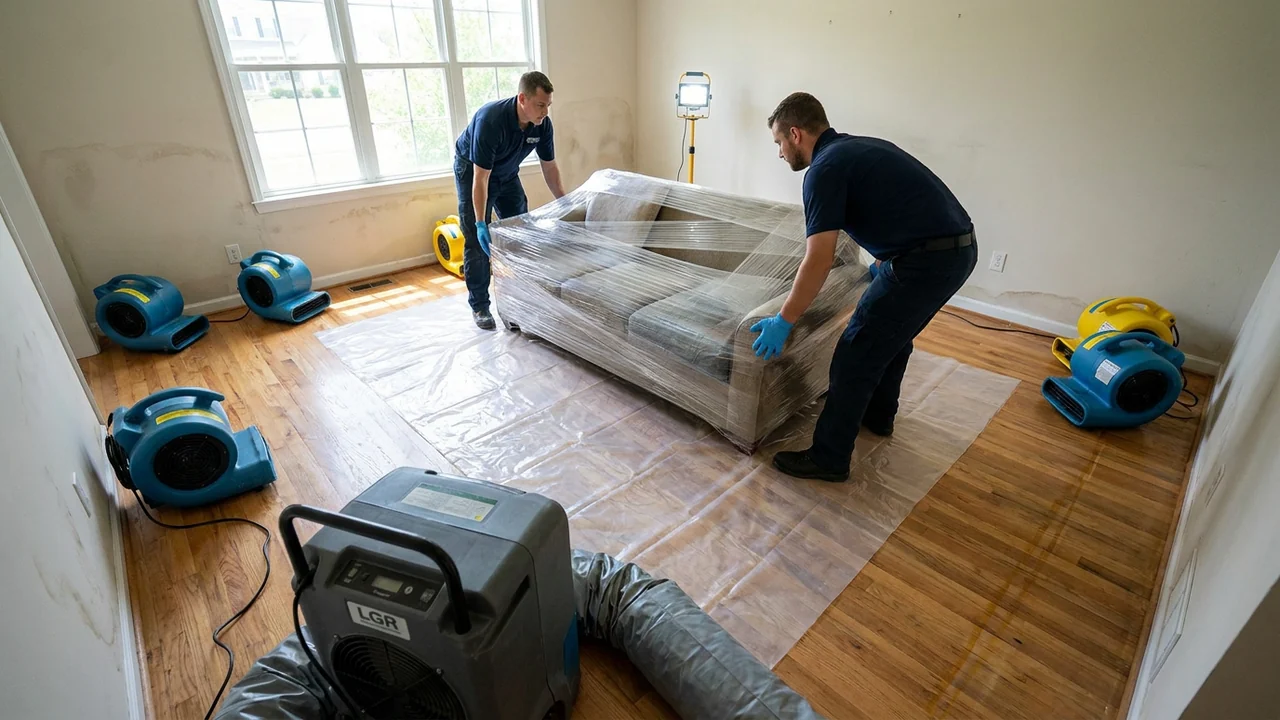
Not every water loss or localized remodel needs a six-person box truck hauling three hundred boxes to a climate-controlled warehouse. Equally, not every ‘simple kitchen and hallway flooring repair’ can survive by sliding oak dining tables back and forth across rooms while drywallers sand ceilings and structural air movers run at 100 degrees. One of the hardest leadership calls in contents operations is deciding—before mobilization—whether to execute on-site content manipulation or commit to a partial or full vault pack-out.
When project leads pick manipulation on a job that actually needs vault storage, crews end up moving the same sofa four times across dusty hallways, scratching hardwood thresholds, soaking upholstery in drywall mud, and eating unbilled labor hours. Conversely, pulling an entire household into off-site storage for a two-day localized floor patch burns carrier goodwill and triggers unnecessary estimating pushback under ANSI/IICRC S320 and ANSI/IICRC S500.
Coaching crew leads on a clear decision rubric—and teaching disciplined center-room staging and room-flipping execution—protects furniture integrity, keeps repair trades moving cleanly, and produces transparent line-item justification in Xactimate and XactContents.
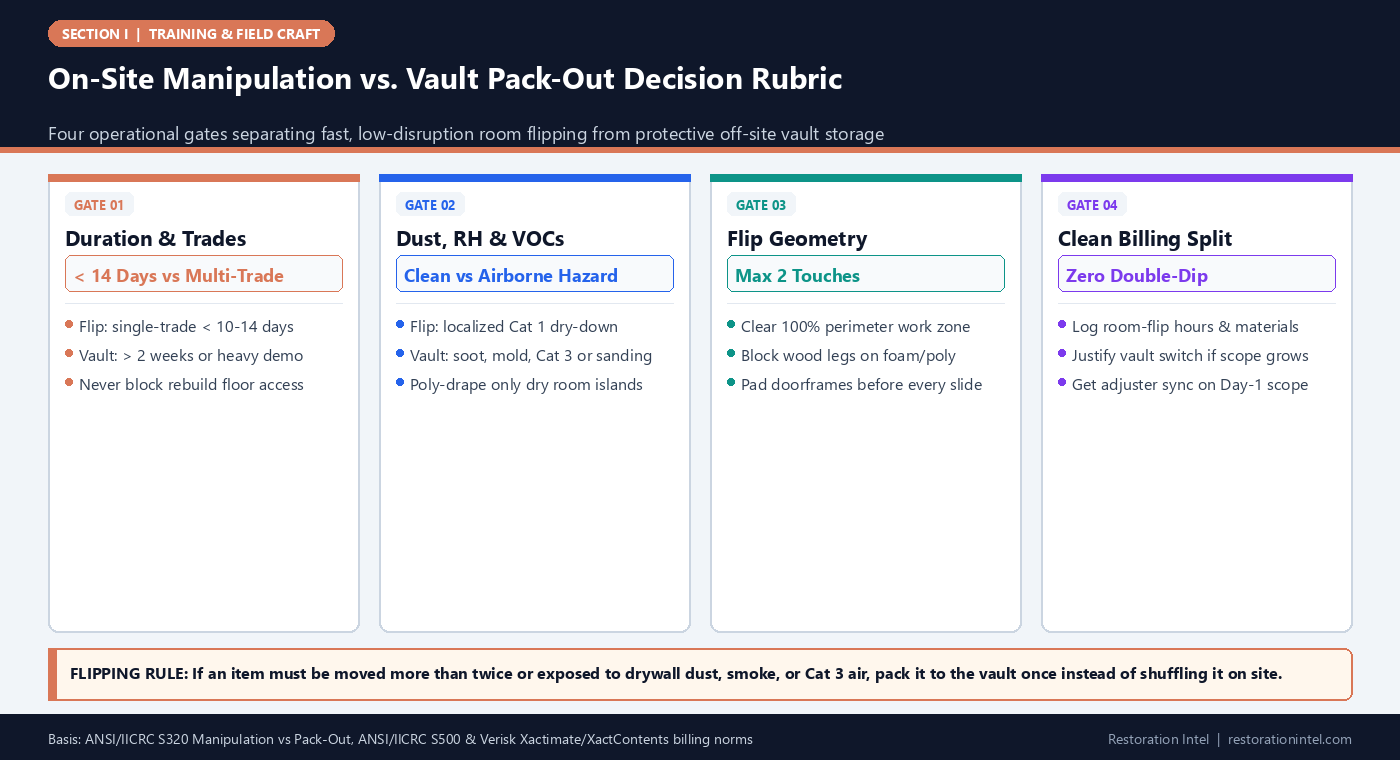
On-Site Manipulation vs. Vault Pack-Out Decision Rubric
On-Site Content Manipulation vs. Partial / Full Vault Pack-Out Matrix
Decision framework guiding contents leads and project managers between room flipping, hybrid clean-room staging, and full off-site vault custody.
| Job Condition / Factor | On-Site Manipulation (Room Flipping) | Hybrid (Clean-Room Staging / Partial Pack) | Full Off-Site Vault Pack-Out | Claim & Billing Documentation |
|---|---|---|---|---|
| Affected Footprint & Repair Scope | 1-2 rooms; fast mitigation or single-trade floor/paint refresh under 10-14 days | 2-4 rooms affected while spare bedrooms/garage stay unaffected and secure | Whole-house rebuild, multi-trade demo (cabinets, drywall, MEP), or > 2-3 weeks | Attach floorplan sketch marking affected rooms vs clean staging footprint |
| Airborne Hazard & Peril Class | Cat 1 clean water; zero heavy soot, mold amplification, or fine drywall sanding dust | Localized Cat 1/2 with zipped poly separation protecting clean staging room | Fire/smoke soot, Category 3 sewage, mold remediation, or asbestos/lead abatement | Cite peril class and airborne dust/VOC risk to justify off-site protection |
| Furniture Protection & Touch Count | Center-room island or flip to adjacent room; max 2 touches (move + return) | Pack smalls into labeled bins in clean room; leave heavy case goods padded in garage | Full wrap, barcode scan, dock intake, and climate-controlled rack indexing | Log touch count and hours; zero duplicate manipulation + full pack-out fees |
| Drying & Contractor Clearance | Must leave 100% perimeter walls, baseboards, and subfloor open for air movers/tools | Ensure dehumidifier exhaust and electrical cords never choke staging doorways | Gives rebuild crews completely clear empty shell, cutting structure timeline 20-35% | Document structure schedule acceleration and reduced trade obstruction |
| Security & Occupant Access | Homeowner remains on site or locks unaffected interior doors securely | Keep high-value electronics/jewelry with owner; lock clean staging wing | Vacant rebuild with open sub-contractor foot traffic or broken doors/windows | Note open-site security exposure when recommending vault custody to adjuster |
The Four-Gate Decision Rubric: When Room Flipping Wins vs. When It Backfires
On-site content manipulation—moving furniture into the center of a room or flipping belongings between unaffected rooms so mitigation or flooring crews can work—is a legitimate cost-saving tool on small, clean losses. When a kitchen supply line dampens one dining area and adjacent hallway for a five-day dry-down, hauling the entire house into a warehouse wastes carrier money and needlessly disrupts the family.
However, leads frequently fall into the ‘false-economy flip’ trap when a scope looks small on Day 1 and expands on Day 3. If flooring subcontractors need to sand and finish continuous hardwood across three adjoining rooms, if drywall crews are scraping popcorn ceilings, or if open exterior doors during reconstruction leave unsecured property exposed to a dozen rotating subcontractors, on-site furniture ends up draped in torn plastic, dusted with gypsum, and dinged across three separate shuffles.
Coach crew leads to evaluate four gates before choosing manipulation: (1) Touch Count—will any piece be moved more than twice? (2) Airborne Exposure—is drywall sanding, soot, mold, or Cat 3 air present? (3) Trade Clearance—can subcontractors work without climbing over draped furniture? (4) Duration & Security—will the disruption exceed 10 to 14 days or leave the structure unsecured? Failing any two gates points straight to partial or full off-site pack-out.
- The Two-Touch Ceiling: On-site manipulation works only if furniture moves out once and moves back once—three or four shuffles destroy margin and finish.
- Never trap mitigation airflow: Center-room furniture islands must never block wet baseboards, cabinet toe-kicks, or dehumidifier intake paths.
- Escalate Day-1 scope creep early: If floor removal reveals mold or subfloor rot requiring multi-week rebuild, convert to vault pack-out immediately instead of burying furniture under rebuild dust.
Productive Room-Flipping Craft: Block-and-Pad, Center Islands, and Floor Protection
When on-site manipulation passes all four gates, execution quality separates professional contents crews from sloppy movers. Before sliding a single dresser, inspect floor surfaces and lay clean Masonite, Ram Board, or taped floor runners along the flip path so grit beneath furniture glides never scores hardwood planks. Use felt sliders or lift-carry straps on heavy case goods—never drag weighted wood legs across thresholds or carpet tack strips.
If contents stay inside a drying room on a center-room island, elevate every wood leg on non-staining foam blocks or rigid poly tabs above damp subfloors so oak or mahogany stain never bleeds onto carpet or absorbs capillary moisture. Drape breathable dust sheeting lightly over dry furniture only after moisture readings confirm items are dry; wrapping damp upholstery tightly under sealed plastic traps humidity and invites mold colonization inside 48 hours.
Just as important is small-item discipline during a flip. Loose table lamps, framed photos, and silverware trays should never sit unboxed on top of a draped sofa where a drywaller’s ladder can sweep them off. Pack fragile tabletop smalls into labeled, closed cartons stacked neatly along the non-work wall or inside a locked clean closet so zero breakage occurs between flips.
- Empty drawers before lifting heavy chests: Removing heavy clothes or hardware stops racking stress on joints and protects tech backs.
- Pad door casings first: Clip quilted jamb protectors onto narrow hallway turns before moving wide sectionals between rooms.
- Clear labels on flipped stacks: Tape ‘DO NOT STACK / CLEAN CONTENTS — RESTORATION HOLD’ placards on draped islands so rebuild trades never use dining tables as tool benches.
Hybrid Pack-Outs: Pairing Clean-Room Staging with Targeted Vault Custody
The smartest option on mid-sized claims is often neither ‘move everything to the warehouse’ nor ‘leave everything in the way’—it is a targeted hybrid plan. On a two-bedroom water loss where the attached two-car garage or bonus room is completely dry and unimpacted, crews can safely stage dense hard goods and boxed closet items in the dry garage behind a sealed zipper while packing only sensitive electronics, heirloom textiles, and wet/soot-affected items off site to the climate vault.
Hybrid staging succeeds only when leads guard three boundaries: security, climate, and access. An uninsulated metal garage door in July heat or winter freeze will warp acoustic pianos, crack oil paintings, and ruin flat-screen panels—those sensitive tiers always go to climate-controlled vaults. Likewise, if the homeowner needs daily garage parking or repair crews need the garage to stage drywall sheets and tile saws, garage manipulation quickly collapses into a turf war.
Document the exact room split on Day 1: send the adjuster a simple one-page room map showing which rooms stay on site behind poly protection and which high-sensitivity items require vault custody. Adjusters appreciate contractors who propose disciplined partial pack-outs instead of reflexive all-or-nothing warehouse bills.
- Climate-sensitive items never sit in garages: Route electronics, fine art, leather, and wood heirlooms to climate vaults even on partial jobs.
- Lock clean staging zones: Coordinate with the owner on interior keyed locks or zipped dust barriers so rebuild traffic stays out.
- Respect repair-trade staging needs: Ask the general contractor where tile saws, cabinets, and drywall stacks go before claiming a room for contents.
Preventing Billing Overlap Between Manipulation Hours and Pack-Out Scopes
One of the fastest triggers for a carrier desk audit in Xactimate claim review is seeing billed hours for ‘on-site content manipulation’ on the same room that also carries full ‘pack-out, wrap, transport, and storage’ line items without explanation. Without clear timestamps and notes, the examiner assumes the contractor double-billed the same physical labor.
Train leads and estimators to separate the two scopes cleanly in field logs. On pure manipulation days, capture before-and-after room photos showing cleared perimeter walls, blocked furniture islands, protected doorways, and crew start/stop headcounts tied to CPS LAB / manipulation line items. If structural scope later expands (for example, hidden asbestos or subfloor rot discovered during demo) forcing a transition from manipulation to vault pack-out, record a written change-order note explaining the new peril trigger before mobilizing the box truck.
Clean alignment between field leads, rebuild project managers, and estimators turns manipulation versus pack-out from a guessing game into a transparent margin-protecting discipline.
- Before/after manipulation photos: Shoot the cluttered room at arrival and the cleared perimeter / protected island at exit to prove hours billed.
- Separate emergency block-and-move from pack-out: If mitigation techs flipped a room on Night 1 before contents arrived for pack-out on Day 3, label the Night-1 emergency stabilization step explicitly.
- Written PM sync before room flip #2: Require project-manager sign-off before scheduling a second on-site shuffle instead of converting to off-site storage.
Practitioner Verification Checklist (I-18)
- Evaluate every job before dispatch against the four manipulation gates: Touch Count (<= 2), Airborne Hazard (zero dust/soot/Cat 3), Trade Clearance, and Duration/Security.
- Protect hardwood and tile paths with rigid Masonite/Ram Board runners and jamb pads before moving heavy case goods.
- Elevate center-room furniture legs on non-staining foam blocks or poly tabs and box fragile tabletop smalls instead of leaving them loose under plastic.
- Use dry breathable sheeting on dry islands only—never seal damp upholstery under airtight poly during structural drying.
- Propose hybrid partial pack-outs when unaffected dry rooms exist, while always routing climate-sensitive art, leather, and electronics to vaults.
- Capture before/after cleared-perimeter photos for all manipulation hours and document written PM/adjuster change orders if scope expands to full pack-out.
Standards, Authority References & Related Reading
Primary standards, insurance definitions, and sibling Restoration Intel guides referenced in this brief:
- ANSI/IICRC S320 Standard for Professional Contents Restoration
- ANSI/IICRC S500 Water Damage Standard
- Verisk Xactimate Estimating Platform
- Verisk XactContents Platform Overview
- Related Guide: Multi-Tech Split-Room Protocols: Assigning Clear Zone Boundaries So Two Crew Members Never Double-Log
- Related Guide: Truck Loading, Vault Mapping, and Climate-Controlled Rack Indexing for Multi-Month Claims
- Related Guide: Handling High-Emotion Occupied Homes: Empathy, Boundary Language, and De-Escalation for Pack-Out Crews
- Related Guide: Handling Partial Pack-Backs and Phased Returns When Structure Repairs Finish Early in Select Rooms
- Related Guide: Which Xactimate Line Items Do Adjusters Actually Approve?
- Related Guide: Salvage Is a Window, Not a Service
.md twin for desk QA and team training.Frequently Asked Questions
When is on-site content manipulation better than a full off-site vault pack-out?
On-site manipulation works best on localized, clean-water or minor repair claims lasting under 10 to 14 days where items only move once out and once back, airborne dust or soot is absent, and cleared room perimeters still give mitigation or repair trades unobstructed access.
Why is sliding damp furniture onto a plastic-wrapped center island risky during water drying?
Leaving wood legs directly on damp flooring causes capillary wicking and stain bleed, while sealing damp upholstery tightly under plastic traps moisture and triggers mold growth within 48 hours. Always block legs on foam/poly tabs and drape dry breathable sheeting only on dry items.
Can an adjuster reject billing that shows both content manipulation and full pack-out on the same room?
Yes, unless the claim file documents why they did not overlap—such as emergency Night-1 mitigation block-and-move followed by a later written change order when hidden demo damage or mold forced full off-site vault pack-out.
What items should go to a climate-controlled vault even on a partial or hybrid pack-out?
High-value electronics, fine art, acoustic instruments, genuine leather upholstery, family heirlooms, and solid-wood antiques should never sit in unconditioned garages or behind active drywall/flooring dust zones.