Direct Answer: Packing out instruments and pro A/V rigs demands controlled climate buffering (45%–50% RH), proper string-tension and tube isolation, rack cable mapping, tamper-evident serial custody logs, and mandatory third-party luthier, piano-technician, or electronics-bench recertification before pack-back sign-off.
.md twin for estimator QA and carrier file documentation.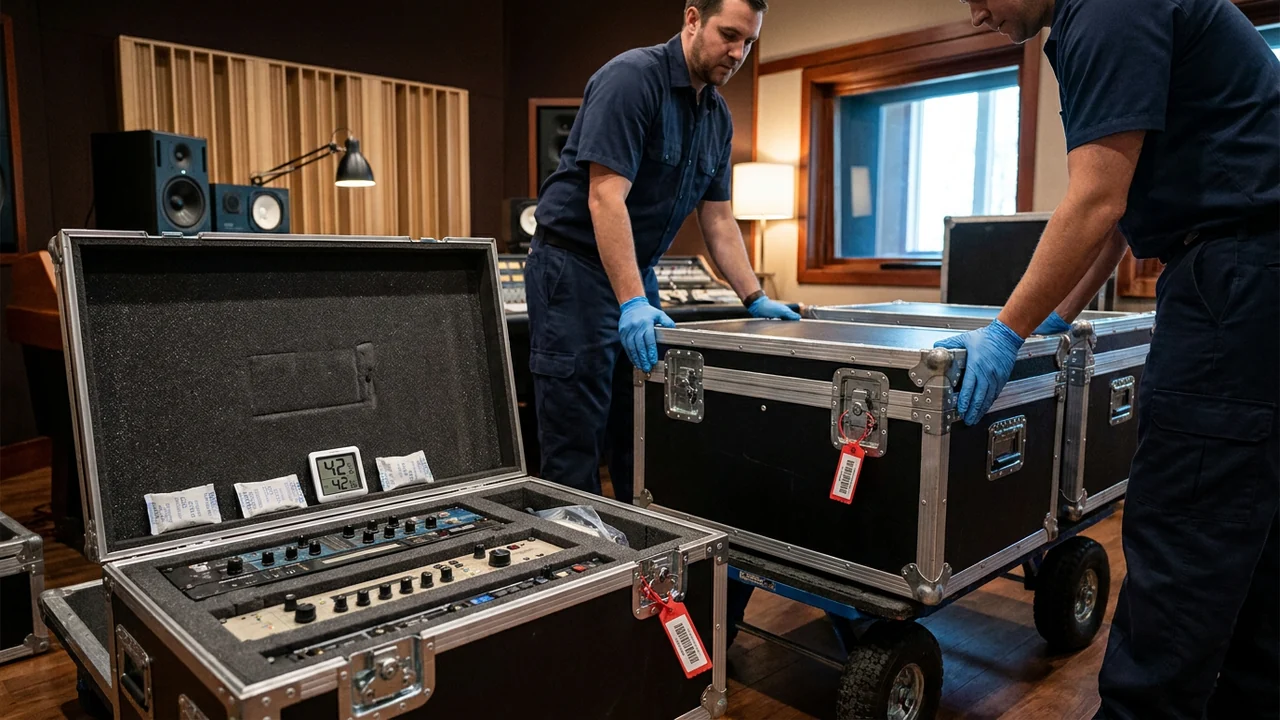
Many musical-instrument and studio claims fail not at the fire or water loss itself, but during the pack-out, vault storage, and re-installation phases. A general contents crew trained on kitchen dish-packs and sofa shrink-wrap can accidentally snap a cello soundpost by slackening all four strings, trap moisture against nitrocellulose lacquer inside sealed poly bags, or yank an entire 24-channel recording rack’s wiring harness without labeling a single XLR return.
In high-value music and broadcast rooms, pack-out mechanics and chain of custody are inseparable from technical preservation. Every physical movement—from disconnecting power amplifiers and pulling matched vacuum tubes to rigging a baby grand piano onto a padded skid board—must preserve both mechanical alignment and auditable ANSI/IICRC S320 provenance.
Just as critical is the back end of the job: returning a cleaned instrument or studio desk without independent recertification invites post-reset failure disputes. Handling & safety disclaimer: Rigging acoustic pianos, disconnecting high-voltage studio distribution, and adjusting instrument neck/bridge tension carry mechanical and electrical risk; use qualified piano movers, licensed electricians, and specialist luthiers or bench technicians rather than general pack-out labor.
Music & Pro A/V Pack-Out, Custody & Recertification Flow
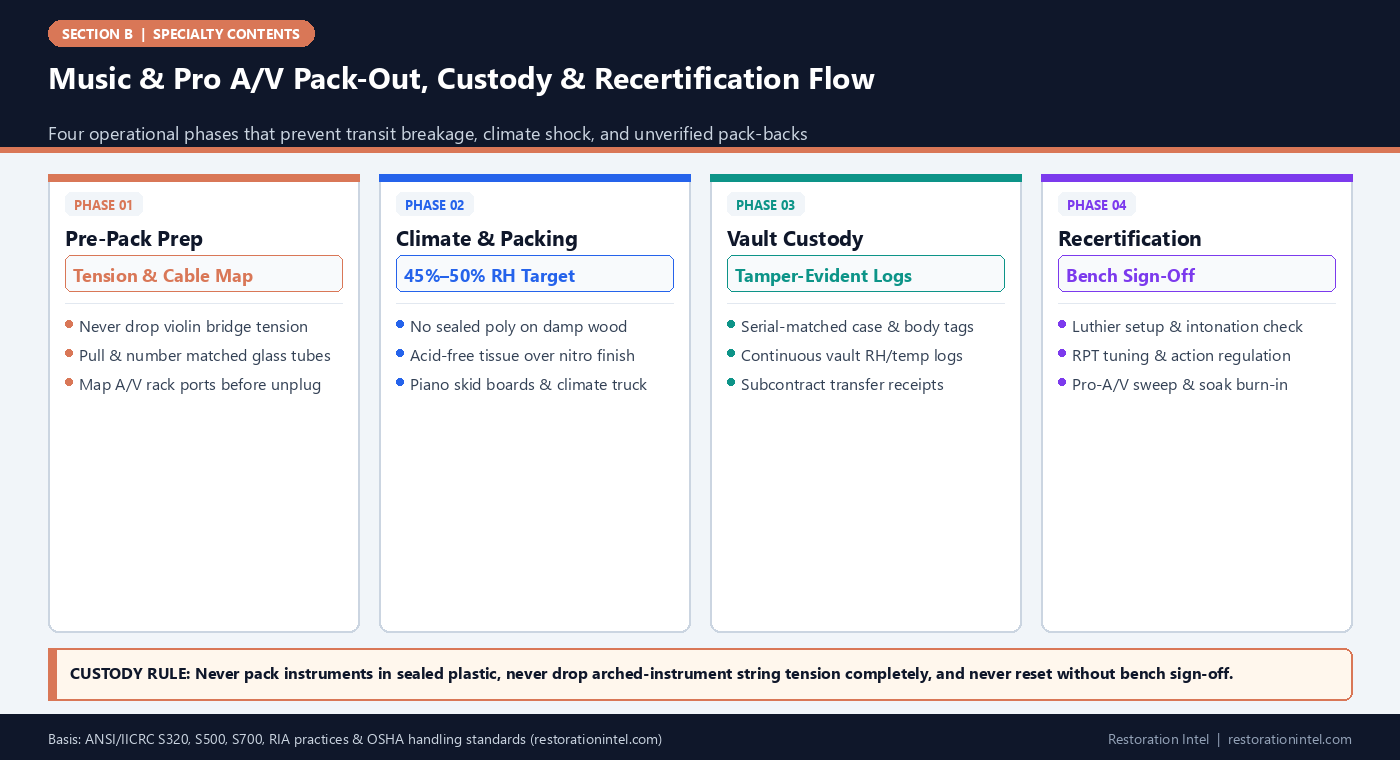
Instrument & Pro A/V Pack-Out, Vaulting & Recertification Protocol
Asset-specific preparation, packaging, climate targets, and post-restoration verification gates across music and studio claims.
| Asset Type | Pre-Pack Preparation | Protective Wrapping & Transit | Vault Climate Target | Recertification Before Pack-Back |
|---|---|---|---|---|
| Acoustic Guitars & Bowed Strings | Slack steel strings slightly (never drop violin/cello bridge tension) | Acid-free tissue buffer (no bubble wrap on nitro), rigid case | 45%–50% RH, 65–72 deg F continuous logging | Luthier neck relief, seam, intonation & setup sign-off |
| Grand & Upright Pianos | Remove music desk, lyre, and legs (grands); lock fallboard | Quilted moving blankets, piano skid board, liftgate air-ride | 45%–50% RH, stable +/- 5% swing ceiling | RPT pitch raise, fine tuning, action & damper check |
| Tube Amplifiers & Vintage Heads | Pull, label, and individually box matched vacuum tubes | Double-walled carton, dense corner foam, upright chassis orientation | Dry climate-controlled bay (< 50% RH) | Bias check, capacitor ESR check, load-bank test |
| Mixing Consoles & Outboard Racks | Color-code and photograph every XLR, TRS, DB25 & power port | Anti-static ESD wrap, shock-mounted flight cases or palletized crate | Dry, dust-filtered vault (< 50% RH) | Channel-by-channel audio sweep, fader & phantom check |
| Drum Kits, Cymbals & Percussion | Remove cymbals & snare; sleeve tom mounts to prevent rim gouging | Padded drum bags or nested dividers with felt spacers between cymbals | Moderate dry vault (40%–55% RH) | Bearing-edge inspection, lug torque & hardware check |
| Woodwinds & Brass | Empty water keys; place end-caps on tenons and neck receivers | Original fitted cases with breathable desiccants if needed | 45%–50% RH (critical for grenadilla woodwinds) | Repair-tech leak-light pad test & key alignment check |
String Tension, Soundposts, and Nitro-Safe Wrapping Rules
One of the most expensive mistakes pack-out crews make comes from following bad folk advice: loosening every string completely before shipping an instrument. On violins, violas, cellos, and upright basses, the internal spruce soundpost is held upright between the top and back plates purely by the downward pressure of the bridge and strings. Slacken the strings completely, and the soundpost drops inside the body—letting the bridge collapse and risking severe top-plate cracking during transit vibration.
Even on acoustic guitars, slight pitch reduction (a half-step to a whole-step) relieves neck stress safely without letting the truss rod back-bow the neck. Just as critical is finish contact: standard plastic bubble wrap and vinyl straps outgas plasticizers that chemically melt into nitrocellulose guitar finishes within days, embossing permanent dimple patterns into vintage sunbursts.
Wrap finished wood instruments in unbleached, acid-free tissue or soft cotton flannel before placing them inside fitted hard cases, and fill any internal headstock void with soft paper padding so sudden braking cannot snap an angled mahogany headstock.
- Never collapse bowed-string tension: Maintain enough string tension on violins and cellos to keep the bridge and soundpost seated, or place foam support blocks under the tailpiece and fingerboard.
- No bubble wrap on lacquer: Always interleave acid-free tissue or cotton cloth between nitrocellulose finishes and any polymer wrap.
- Isolate wet cases immediately: If a hard case absorbed smoke or water, tag the case for separate triage or disposal and pack the instrument into a clean, climate-buffered container.
Vacuum Tube Isolation, Rack Mapping, and ESD Controls
Recording studios rely on fragile glass vacuum tubes, heavy toroidal transformers, and sprawling rear-panel patch matrices. Moving a 75-pound tube guitar head or vintage Fairchild-style compressor with tubes left in their sockets invites glass breakage and bent socket pins on the first truck bump. Before lifting any tube unit, photograph the chassis layout, label every tube socket (V1, V2, matched power pair), pull each tube into an individual padded sleeve, and store the tube box inside the same master crate.
For multi-unit studio racks, follow the structured disconnection standards in Electronics Disconnection & Cable Mapping. Never cut zip-ties or pull DB25, optical ADAT, word-clock BNC, or custom TT patch cables without tagging both ends with matching destination IDs and capturing well-lit rear-rack photos.
Use anti-static ESD bags or pink anti-static bubble cushioning on exposed circuit boards, digital consoles, and PCIe audio interfaces, and never stack heavy power amplifiers atop sensitive outboard preamps.
- Tube-map photography: Label matched power tubes by exact socket order so biasing remains balanced on reassembly.
- Word-clock & patch tagging: Photograph rear studio racks with legible port labels before disconnecting a single umbilical snake.
- Piano & rack rigging safety: Follow OSHA 1910.132 PPE and certified piano-moving rigging when handling grand pianos or 200-pound console frames.
Climate-Controlled Vaulting and Tamper-Evident Chain of Custody
Because fine tonewoods and antique glues breathe continuously with ambient humidity, throwing packed instruments into an unconditioned metal storage pod or seasonal warehouse bay causes catastrophic splitting in winter and swollen glue joints in summer. Acoustic instruments, woodwinds, and pianos require dedicated climate-controlled storage held steadily near 45 to 50 percent relative humidity with minimal daily swing.
Chain of custody must track every transfer across three distinct hands: the loss-site pack-out crew, the restoration vault, and external craft subcontractors (luthiers, RPTs, or pro-audio repair benches). Every instrument case and A/V flight case should carry an external barcode/QR tag paired with a tamper-evident numbered seal—plus a pre-pack photo confirming the exact serial number inside that case—following Field Guide: Chain-of-Custody Form Elements.
When an external luthier or audio engineer picks up items for bench cleaning, execute a dated transfer manifest listing serial numbers, pre-existing dings, and included accessories (bows, power supplies, footswitches, proprietary dongles).
- Continuous vault hygrometer logs: Export weekly RH and temperature data from the vault zone housing instruments so carriers and owners have climate proof.
- Case-to-item pairing: Never allow an unlogged swap of bows, mouthpieces, or IEC/proprietary power bricks between cases.
- Subcontractor custody receipts: Require signed bench-intake and bench-release manifests for every off-site specialist repair.
Bench Recertification, Audio Sweep Testing, and Pack-Back Acceptance
A restoration company cannot truthfully declare an instrument or studio rack ‘restored’ simply because exterior smoke residue is gone. Acoustic and electronic systems require functional recertification by qualified specialists before pack-back. For stringed instruments, the luthier issues a signed bench checklist confirming seam integrity, neck relief, fret level, tuning stability, and acoustic setup.
For pianos, an RPT confirms pin torque, pitch raise stability (often requiring two tunings spaced weeks apart after relocation and climate adjustment), and clean pedal/damper action. For pro A/V consoles, amplifiers, and outboard compressors, the electronics bench delivers a test report verifying noise floor, total harmonic distortion (THD), phantom power rail voltages, fader smoothness, and thermal burn-in without recurring soot odor.
Before moving gear back into the building, confirm the structure itself has passed post-mitigation clearance—zero lingering smoke odor in HVAC ducts, dry framing, and stable target RH—so cleaned tonewoods and electronics are not re-contaminated on reset day.
- Pre-reset room clearance: Verify building HVAC odor clearance and stable 45%–50% RH before unloading pianos or studio racks.
- Written bench certs: Attach signed RPT, luthier, or audio-bench test sheets to the final pack-back packet for adjuster release of recoverable depreciation.
- Homeowner/engineer sign-off: Conduct a live power-on and acoustic play-test walkthrough at reset before closing the custody log.
Studio Acoustic Hardware, Hardware-Mounting Maps, and Reset Sequencing
Commercial recording rooms and home mastering suites rely on precise physical geometry: decoupled monitor stands, ceiling cloud brackets, acoustic diffuser arrays, and sub-floor isolation pads. When crews strip a room for structural drywall or flooring repairs without mapping bracket locations, studio owners lose calibrated listening positions even when every gear rack returns clean.
Before unbolting studio monitor mounts or wooden QRD diffusers, photograph wall cleats with laser-measured height notes, bag specialty isolation spikes and neoprene decoupling pucks in labeled hardware pouches attached to their parent stand, and sequence heavy rack re-installation after all dusty sanding, painting, and flooring cure windows have closed.
Pair final reset sign-offs with itemized billing and valuation records per B-65 Valuation & Policy Traps so recoverable depreciation releases cleanly once studio commissioning is complete.
- Bracket & spike pouching: Tape labeled zip-pouches holding monitor stand bolts and isolation cones directly to the stand column.
- Zero drywall-dust overlap: Hold studio rack and acoustic diffuser pack-back until contractors complete post-paint HEPA vacuuming and HVAC clearance.
- Commissioning walkthrough: Verify phantom power, monitor calibration, and talkback routing alongside the studio engineer on reset day.
Practitioner Verification Checklist (B-66)
- Map all studio rack rear connections with labeled photos and pull/number vacuum tubes into individual sleeves prior to transport.
- Buffer wood instruments in acid-free tissue inside rigid cases without dropping bowed-string bridge tension to zero.
- Maintain vault and transit conditions at 45% to 50% RH with logged hygrometer records for fine tonewoods and pianos.
- Execute tamper-evident serial tags and signed custody handoff forms whenever items transfer to off-site luthiers or audio benches.
- Require written specialist recertification (luthier setup, RPT tuning/torque check, or audio sweep report) before final pack-back sign-off.
Standards, Authority References & Related Reading
Primary standards, insurance definitions, and sibling Restoration Intel guides referenced in this brief:
- ANSI/IICRC S320 Standard for Professional Contents Restoration
- ANSI/IICRC S500 Water Damage Standard
- ANSI/IICRC S700 Fire & Smoke Restoration Standard
- Restoration Industry Association (RIA)
- OSHA 1910.132 Personal Protective Equipment Standard
- Related Guide: Musical Instruments, Recording Studios & Pro A/V: Scope & Hazard Boundaries
- Related Guide: Musical Instruments, Recording Studios & Pro A/V: Capture, Serial & Provenance Logging
- Related Guide: Musical Instruments, Recording Studios & Pro A/V: Cleanability vs Total-Loss Triage
- Related Guide: Musical Instruments, Recording Studios & Pro A/V: Valuation, LKQ Sourcing & Policy Traps
- Related Guide: Electronics Disconnection & Cable Mapping: Labeling AV Racks, Home Workstations, and Clinic Desks Before Unplugging
- Related Guide: Field Guide: Chain-of-Custody Form Elements & Pack-Out Sign-Off Template
.md twin for desk QA and team training.Frequently Asked Questions
Should pack-out crews completely loosen strings on violins and cellos before moving them?
No. Bowed orchestral instruments hold their internal spruce soundpost upright via bridge and string tension. Dropping tension completely can cause the soundpost to fall and damage the top plate during transit.
Why can bubble wrap damage vintage guitar finishes during storage?
Standard plastic bubble wrap contains plasticizers that react chemically with nitrocellulose lacquer, softening the finish and imprinting permanent bubble patterns onto vintage guitars.
What humidity range is safest for storing acoustic instruments and pianos in a restoration vault?
Most fine tonewood instruments and pianos stabilize safely around 45% to 50% relative humidity with gradual transitions and continuous digital data logging.
How should vacuum-tube amplifiers be prepared for pack-out?
Photograph the tube layout, label each tube with its exact socket position, remove and pack the glass tubes in individual padded sleeves inside the master crate, and transport the chassis upright.
What proves a restored studio console or piano is ready for pack-back?
Written third-party recertification—such as an audio technician’s channel-sweep and noise-floor report or a Registered Piano Technician’s tuning and action inspection—paired with an owner play-test sign-off.