Direct Answer: Valuing musical instruments and studio rigs requires navigating strict homeowners business-property sublimits, non-linear vintage appreciation, CITES Appendix I Brazilian rosewood and ivory trade restrictions, and Like Kind and Quality (LKQ) mismatches between hand-wired legacy gear and modern mass-market reissues.
.md twin for estimator QA and carrier file documentation.
Even when cleanability triage is clear, musical instruments and recording studios routinely collide with insurance valuation traps. A session guitarist loses a 1964 Fender Stratocaster and a rack of vintage outboard preamps in a house fire, only to watch a desk examiner apply a 50-year useful-life depreciation schedule or cap the entire studio under a $2,500 homeowners business-property sublimit. Conversely, an estimator who replaces a discontinued hand-wired tube console channel with a budget modern digital unit triggers an immediate Like Kind and Quality (LKQ) rejection from the policyholder.
Valuing instruments and pro A/V gear accurately requires looking past standard big-box retail catalogs. Vintage tonewoods, limited-run artisan builders, matched orchestral bows, and studio hardware operate in specialized secondary and collector markets governed by serial-year provenance, overhaul history, and international wildlife regulations such as CITES.
Getting the valuation packet right on the first pass prevents months of appraisal disputes. Legal & appraisal disclaimer: Restoration estimators are not licensed insurance coverage attorneys or certified USPAP musical-instrument appraisers; always verify policy sublimits against the insured’s declarations page and engage credentialed specialist appraisers or CITES authorities for disputed vintage or protected-species assets.
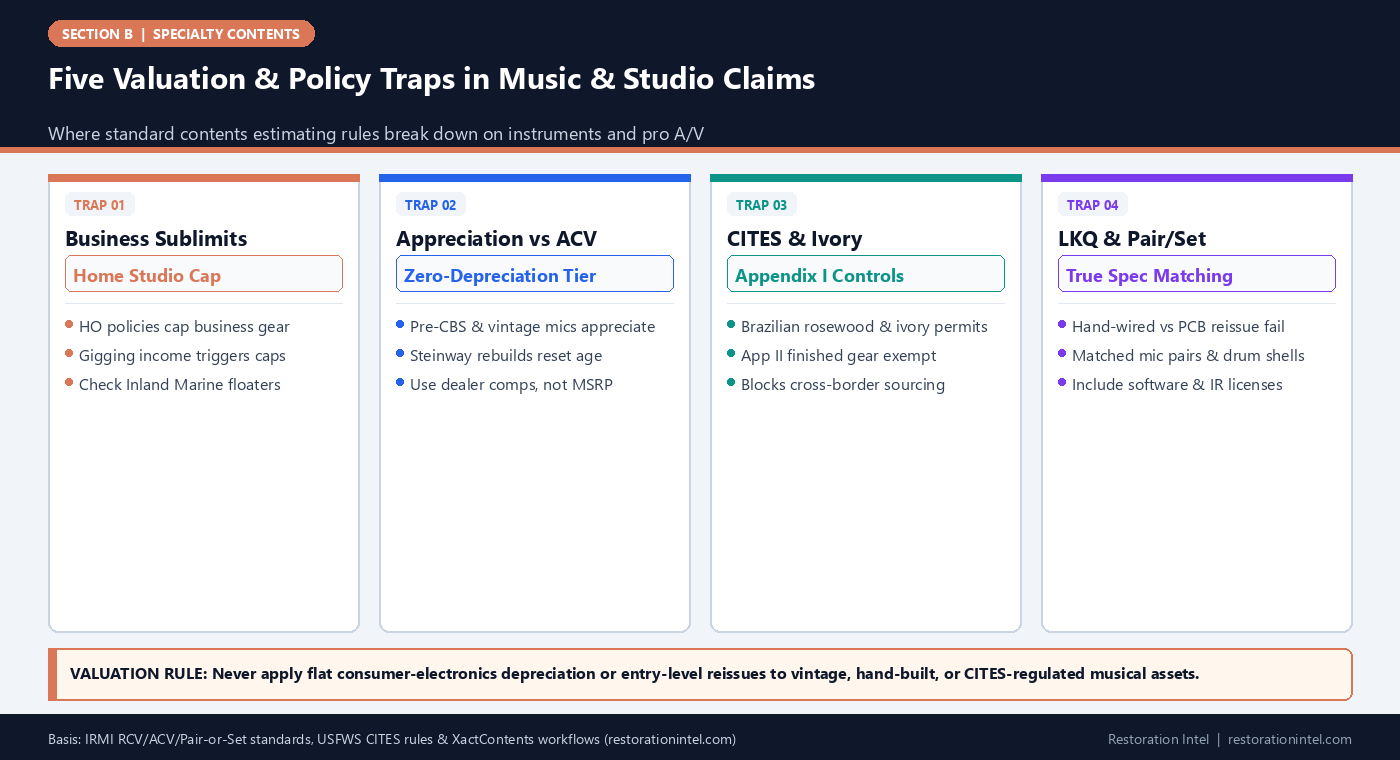
Five Valuation & Policy Traps in Music & Studio Claims
Instrument & Studio Valuation, LKQ & Policy Boundary Matrix
Practical valuation and policy checks across residential, scheduled, and commercial studio equipment schedules.
| Asset / Scenario | Primary Policy Trap | Valuation / LKQ Standard | Required Proof Packet | Common Carrier Pushback |
|---|---|---|---|---|
| Home Recording Studio / Gig Gear | Homeowners Coverage C 'business property' sublimit | Verify hobbyist vs commercial revenue & separate Inland Marine floater | Policy endorsements, tax Schedule C check, scheduled floater list | Capping entire studio at $2,500 on-premises business cap |
| Vintage Guitars, Violins & Brass (Pre-1980s) | Applying standard 10–15 yr useful-life depreciation | Market-value collector / zero-depreciation tier (market comp) | 3+ verified vintage dealer listings (Reverb, specialist luthiers), serial check | Trying to settle a 1962 Stratocaster with a modern reissue price |
| CITES Appendix I Items (Brazilian Rosewood / Ivory) | Illegal trade or blocked cross-border LKQ replacement | Pre-Convention provenance + domestic legal LKQ equivalent | Luthier species ID, pre-1975/pre-ban receipts, USFWS MIC/permits | Ignoring CITES restrictions on replacement neck/bow sourcing |
| Matched Pairs (Drum Kits, Stereo Mics, Monitors) | Partial-loss payout for one damaged piece in matched set | Pair or Set Clause / consequential matching valuation | Matched serial numbers, sequential factory stereo certs, wood-lot specs | Paying only 1/2 price on one destroyed vintage matched condenser |
| Rebuilt Grand Pianos & Restored Consoles | Chronological age depreciation ignoring major rebuilds | Effective-age reset via documented pinblock/soundboard rebuild | RPT/tech rebuild invoices, restringing receipts, pre-loss tuning logs | Depreciating a 1928 Steinway rebuilt 4 years ago by 80% |
| DAW Computers, Interfaces & Software Plugins | Rapid IT depreciation & omitting paid software/licenses | Separated hardware LKQ + license transfer/re-issue verification | iLok/eLicenser account manifests, DAW invoice history, custom rack BOM | Treating custom silent-rack studio PCs as generic office desktops |
Home Studio Business-Property Sublimits vs Inland Marine Floaters
The single sharpest coverage trap in residential music claims is the homeowners business-property sublimit. Standard HO-3 forms typically cap property used in any business—on or off the residence premises—at a low dollar threshold. If a homeowner records paying clients in a spare-bedroom studio, teaches paid guitar lessons on the premises, or tours professionally on weekends, the carrier may classify thousands of dollars of microphones, amps, and instruments as business personal property.
Before building an aggressive replacement schedule, estimators should flag whether the insured holds a dedicated Musical Instrument Floater, an Inland Marine equipment policy, or a commercial Business Personal Property (BPP) rider. Those scheduled policies frequently carry agreed-value or blanket replacement terms with broader perils (including transit and accidental breakage) and zero standard business sublimit.
Where unscheduled coverage is ambiguous, document strictly factual pre-loss use without volunteering legal conclusions, and separate clearly personal hobby gear from commercial studio rigs so the adjuster and insured can apply the declarations page accurately, as outlined in Sublimit Allocation Strategy.
- Check scheduled endorsements early: Ask the insured for any separate instrument floater or music-union equipment rider before coding estimates in XactContents.
- Separate personal vs. commercial lines: Do not co-mingle a family upright piano with commercial touring PA speakers on one undifferentiated line.
- Transit and off-premises flags: Note whether gear was damaged at home, in a rehearsal rental, or inside a band trailer.
Zero-Depreciation Vintage Gear, Rebuilt Pianos, and Collector Comps
Standard insurance depreciation tables treat electronics and consumer musical instruments as depreciating assets with 7- to 15-year lifespans. While that logic fits an entry-level digital keyboard or student trumpet, it collapses completely on vintage or artisan instruments. A pre-1970 American acoustic guitar, an Italian master violin, or a vintage Neumann U47 microphone typically holds or gains market value over time under Zero-Depreciation Categories.
Even instruments that are not strictly appreciating collectibles often undergo major structural overhauls that reset effective age. A 1930s Steinway grand piano that received a new soundboard, pinblock, hammers, and action regulation five years ago cannot fairly be depreciated 80 percent based on its 1930s serial number. Under effective-age reset principles, documented rebuilds anchor actual cash value (ACV) to post-rebuild condition.
To defend market-based valuation, replace generic retail MSRP guesses with three dated dealer comparables matching exact model year, finish, originality (original pickups, untouched solder joints, original case), and documented condition grade.
- Originality premium: Document whether vintage guitars or amps retained original transformers, speakers, and finishes, which drive dramatic price spreads.
- Rebuild invoice attachment: Include RPT restringing, re-pinning, or amp recap invoices to prove pre-loss effective age.
- Independent specialist appraisal: For single instruments exceeding carrier desk authority, attach a formal written appraisal from a recognized vintage dealer or luthier.
CITES Rosewood, Elephant Ivory, and Protected-Species Restrictions
Vintage stringed instruments, woodwinds, and orchestral bows frequently incorporate materials regulated by the Convention on International Trade in Endangered Species of Wild Fauna and Flora (CITES) and the U.S. Endangered Species Act, enforced by the U.S. Fish and Wildlife Service (USFWS). Understanding these rules matters both for valuation and for lawful replacement sourcing.
Under CITES Annotation #15, finished musical instruments, finished parts, and finished accessories containing Appendix II rosewoods (Dalbergia species such as Indian or Honduran rosewood) or African blackwood are generally exempt from CITES permit requirements for non-commercial movement, though bulk commercial wood trade remains regulated. By contrast, Appendix I Brazilian rosewood (Dalbergia nigra) and elephant ivory (found on vintage guitar nuts/saddles, piano keytops, and Pernambuco bow tips) have no finished-instrument or U.S. personal-effects exemption.
When a pre-ban Brazilian rosewood fingerboard or ivory-tipped bow is destroyed, an estimator cannot simply quote an overseas replacement ship-in without legal CITES pre-Convention documentation and designated-port clearance (or a USFWS Musical Instrument Certificate for cross-border travel). In domestic claims, luthier species verification and pre-ban provenance must accompany comparable domestic market pricing or lawful non-ivory synthetic/bone restoration alternatives.
- Species verification first: Never guess ‘Brazilian rosewood’ on a schedule without luthier wood-grain identification and serial-date corroboration.
- Ivory repair boundaries: Verify state and federal antique-ivory exemptions before assuming a damaged ivory bow tip or piano keyset can be replaced with real ivory.
- Cross-border sourcing delays: Account for USFWS inspection and permit lead times when quoting imported European or Japanese custom instruments.
Like Kind and Quality (LKQ) Traps on Hand-Wired Amps and Custom Studios
Like Kind and Quality (LKQ) disputes erupt whenever a desk examiner substitutes a modern entry-level reissue for a legacy or boutique original. A 1965 hand-wired point-to-point tube amplifier built with paper-bobbin transformers and solid pine cabinetry does not share the build quality, serviceability, or resale market of a modern circuit-board reissue carrying the same badge name.
Similarly, in recording studios, replacing a modular analog console or custom-matched outboard compressor rack with a low-cost USB mixer violates functional and sonic equivalence. Estimators must document circuit topology, transformer specs, preamps per channel, converter headroom, and boutique builder waitlists to establish true LKQ—whether that means sourcing an authentic vintage unit through a reputable dealer or specifying a modern boutique hand-wired equivalent.
Pair or Set dynamics also surface constantly. Under IRMI Pair or Set principles, destroying one speaker in a factory-matched studio monitor pair, one sequentially serialized stereo condenser microphone, or one shell in a custom exotic-veneer drum kit diminishes the usability and value of the surviving mate.
- Matched serial proofs: Photograph sequential serial numbers on stereo mic pairs and studio monitors to support Pair or Set claims.
- Spec-sheet comparisons: Build a side-by-side table comparing circuit design, channel count, and component grade when rejecting an insurer’s budget LKQ substitute.
- Custom acoustic millwork: Separate tenant-installed soundproof vocal booths and floating floors (Tenant Improvements vs. BPP) before pricing equipment totals.
Software Licenses, Session Drives, and Custom Cable Infrastructure
Recording studios and pro A/V rigs carry thousands of dollars in invisible assets that never show up on a visual room sweep. Paid digital audio workstation (DAW) software, hardware-dongled plugin suites (iLok/eLicenser), custom impulse-response libraries, and proprietary sample packs represent substantial capital value. While many software vendors allow license re-download if hardware dongles survive, physical USB security keys destroyed in a fire often trigger paid replacement-license or zero-downtime coverage fees.
Do not overlook custom studio cabling either. Balanced Mogami/Canare snake looms, custom Neutrik patch bays, Furman power conditioners, and bespoke pedalboard switching systems often add 15 to 25 percent to total rig replacement cost. Grouping them into a single ‘$200 miscellaneous cables’ line leaves huge unrecovered value on the table.
Finally, separate damaged hardware from active client master drives. If a RAID array or tape reel holds unbacked client masters, route it immediately to forensic data recovery rather than generic hardware replacement, following SPC-DATA-REC protocols.
- Itemize patch bays & snakes: Count channels, connector brands, and lengths on multicore snakes rather than lumping them as bulk wire.
- Hardware-key replacement fees: Document destroyed physical USB/iLok license keys and vendor replacement charges separately from workstation hardware.
- Verify sales tax & crating: Apply full freight, palletizing, and sales tax per RCV/ACV Freight Rules.
Practitioner Verification Checklist (B-65)
- Review the declarations page for homeowners business-property sublimits, Inland Marine floaters, or commercial BPP schedules before pricing.
- Document vintage serial numbers, originality, and major rebuild receipts to defend market-comp valuation or effective-age resets.
- Flag any suspected Brazilian rosewood or elephant ivory components for luthier species verification and CITES compliance review.
- Attach 3+ dealer comps and technical spec comparisons to defeat downgraded reissue LKQ substitutions on hand-wired gear.
- Itemize matched mic/monitor pairs, custom snake looms, patch bays, and destroyed physical license dongles alongside core instruments.
Standards, Authority References & Related Reading
Primary standards, insurance definitions, and sibling Restoration Intel guides referenced in this brief:
- ANSI/IICRC S320 Standard for Professional Contents Restoration
- IRMI Insurance Glossary: Replacement Cost Value (RCV)
- IRMI Insurance Glossary: Actual Cash Value (ACV)
- IRMI Insurance Glossary: Depreciation
- IRMI Insurance Glossary: Pair or Set Clause
- Verisk XactContents Platform Overview
- Related Guide: Musical Instruments, Recording Studios & Pro A/V: Cleanability vs Total-Loss Triage
- Related Guide: Musical Instruments, Recording Studios & Pro A/V: Pack-Out, Chain of Custody & Recertification
- Related Guide: Like Kind and Quality (LKQ) Replacement Matching: Rules for Discontinued Brands and Obsolete Models
- Related Guide: Zero-Depreciation Categories: Antiques, Fine Art, Collectibles, Bullion, and Appreciated Goods
- Related Guide: Non-Linear Depreciation Curves: Why Year-One Drops and Maintenance Rebuilds Break Flat-Line Math
- Related Guide: Pairs-and-Sets Clauses in Contents Claims: Matching China, Suits, Sectional Pieces, and Modular Systems
- Related Guide: Sublimit Allocation Strategy When Total-Loss Specialty Items Exceed Policy Caps
.md twin for desk QA and team training.Frequently Asked Questions
Are musical instruments inside a home recording studio subject to business-property sublimits?
Often yes, if the insured earns commercial income from recording, teaching, or touring and relies solely on an unendorsed homeowners policy. Estimators should always check for a Musical Instrument Floater or commercial BPP endorsement before coding the schedule.
How do adjusters value vintage guitars or studio microphones that cost more now than when new?
Verified vintage and collector-grade instruments generally fall outside standard useful-life depreciation tables. Valuation relies on documented market comparables from reputable vintage dealers matching the exact year, originality, and pre-loss condition.
How do CITES rules affect replacement of damaged rosewood or ivory instruments?
Under CITES Annotation #15, finished instruments using Appendix II rosewoods (like Indian rosewood) are broadly exempt from CITES permits for non-commercial movement. However, Appendix I Brazilian rosewood and elephant ivory have strict restrictions and no U.S. personal-effects exemption, requiring pre-Convention proof and permits for cross-border movement or trade.
Does a Pair or Set clause apply to matched studio microphones or drum kits?
Potentially yes. When one microphone in a factory-matched stereo pair or one shell in a custom drum set is destroyed and cannot be matched, Pair or Set policy provisions may govern the loss in value to the remaining piece.
Should studio cables and patch bays be itemized separately from consoles?
Yes. Custom studio snake looms, Neutrik patch bays, and boutique power distribution often cost thousands of dollars and should never be buried in a generic miscellaneous-cables allowance.