Direct Answer: Logging gyms and physical therapy studios accurately requires zone-and-bay asset mapping, dual serial capture on frames and attached touchscreen consoles, commercial-vs-residential grade verification, pre-loss wear documentation, and structured weight-rack bundling.
.md twin for estimator QA and carrier file documentation.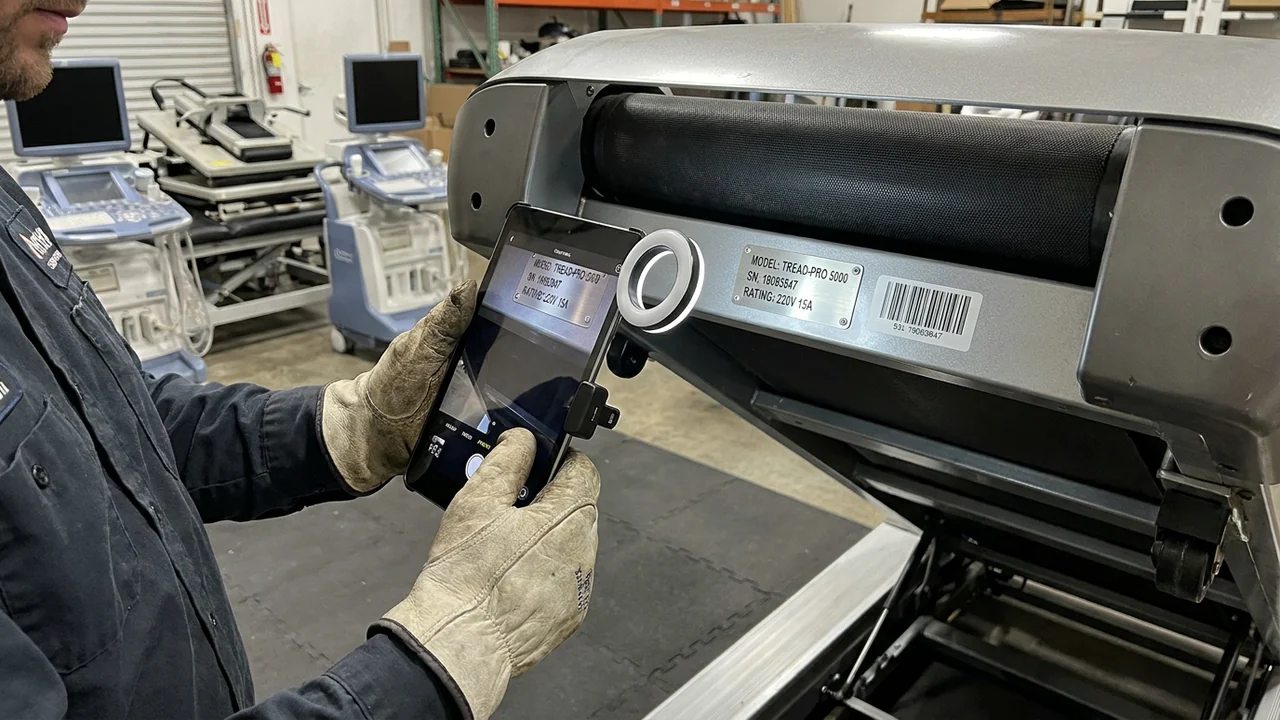
Walk into a 15,000-square-foot commercial gym or multi-room Pilates and physical therapy studio after a loss, and a naive contents spreadsheet breaks down within twenty minutes. You are staring at thirty nearly identical black-frame treadmills, forty spin bikes, two hundred urethane dumbbells, color-coded kettlebells, stacked Pilates Reformers, and rolling physical therapy modality carts—where a single overlooked model suffix or missing console serial can create a multi-thousand-dollar valuation error per machine.
Common field mistakes include logging a commercial 4.0-HP AC-drive treadmill as a generic home treadmill, snapping only the front brand logo while missing the hidden frame serial plate, failing to capture the separate serial number on an add-on touchscreen TV console, or letting two technicians double-log identical Life Fitness or Concept2 units across open floor bays.
Applying structured ANSI/IICRC S320 capture discipline and commercial rating-plate standards gives XactContents estimators exact evidence to defend commercial-grade pricing and pre-loss condition.
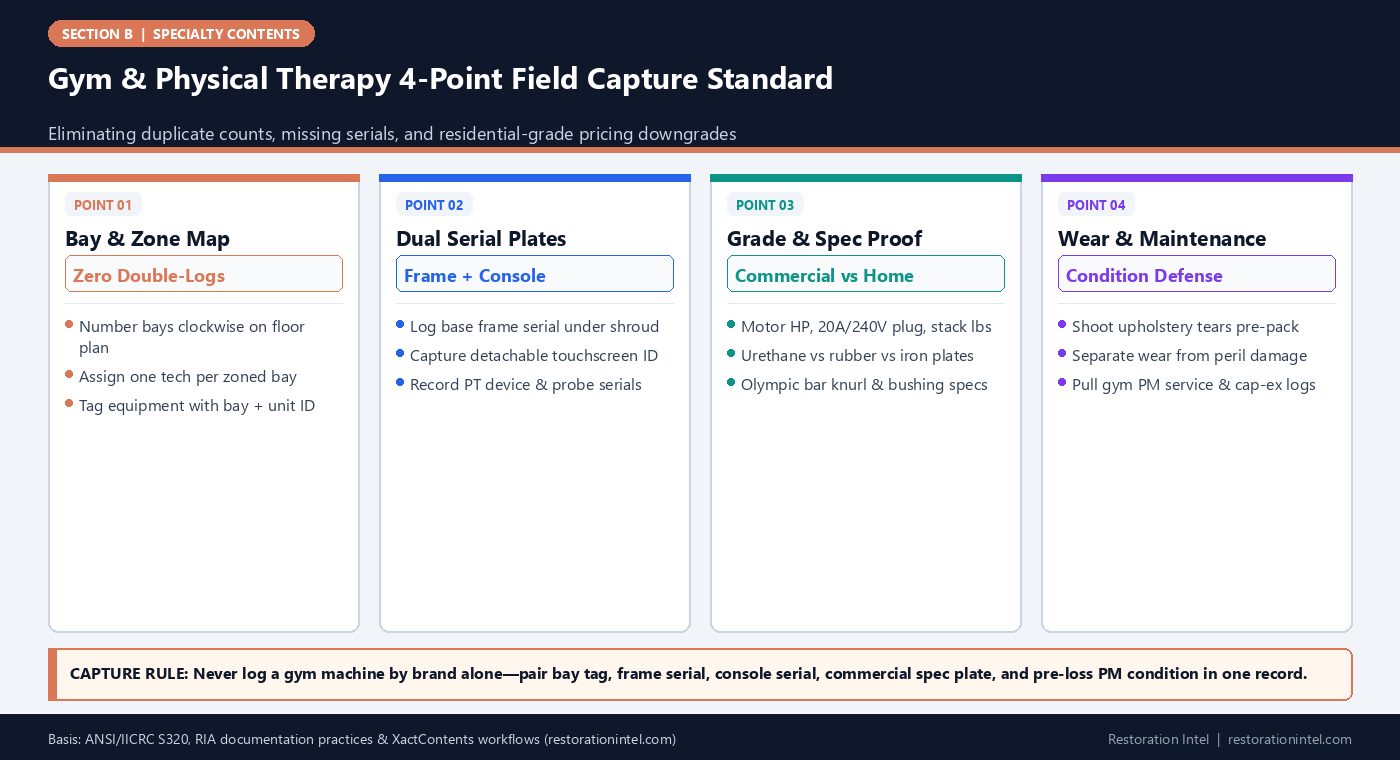
Gym & Physical Therapy 4-Point Field Capture Standard
Fitness & Physical Therapy Serial-Plate & Provenance Capture Guide
Where hidden serial plates sit, which sub-assemblies need separate logging, and how to prove commercial-grade specifications.
| Equipment Class | Hidden Serial Plate Location | Separate Sub-Assembly to Log | Commercial Grade Proof Points | Pre-Loss Condition / Wear Check |
|---|---|---|---|---|
| Commercial Treadmills & Ellipticals | Lower front cross-brace, inside motor hood, or rear power-cord plate | Detachable touchscreen/LED console, embedded TV tuner, CSAFE hub | AC drive motor rating, 20A/240V plug, max user weight, extended warranty tag | Running belt fraying, deck wax wear, side-rail scuffs, PM sticker date |
| Selectorized Weight Machines & Cable Towers | Rear base frame rail, bottom of weight-stack column, or top cam shroud | Incremental add-on weights, custom handle attachments, lat bars | Total stack weight (e.g., 210 vs 300 lb), steel gauge, shroud branding | Torn bolster vinyl, frayed cable jacket, pre-existing rust on guide rods |
| Spin Bikes, Air Bikes & Indoor Rowers | Bottom bracket underside, flywheel fork, or seat-post frame tube | Power-meter crank/pedals, wireless cadence monitor (PM5/console) | Magnetic eddy-current brake, belt drive vs chain, commercial fleet ID | Pedal strap wear, cracked saddle nose, foot-stretcher tears |
| Pilates Reformers, Towers & Stability Chairs | Underside of carriage rail, headboard underside, or tower upright | Jumpboards, sitting boxes, matched spring kits, maple pole/ropes | Solid hardwood/anodized rail spec, studio-tier upholstery & carriage | Carriage wheel flat-spots, rope fuzzing, vinyl seam cracking |
| PT Ultrasound, E-Stim & Traction Consoles | Rear chassis UDI/FDA medical label and rolling cart underside | Detachable 1/3 MHz ultrasound soundheads, lead-wire harnesses, belts | Clinical multi-channel spec, FDA device label, OEM calibration sticker | Last annual biomedical calibration date sticker and probe cable integrity |
| Dumbbells, Kettlebells, Barbells & Plates | End-cap weight embossing; barbell end-cap color/knurl rings | Multi-tier welded saddles/racks, fractional plates, spring collars | Urethane vs virgin rubber vs iron; 20 kg needle-bearing bar vs bushing | Loose dumbbell heads, chipped rubber coatings, bent barbell sleeves |
Zone-and-Bay Numbering to Stop Duplicate Counts Across Open Floors
Open-concept fitness facilities lack interior drywall partitions, making standard “Room 1 / Room 2” residential capture useless. When forty treadmills sit in four parallel rows across a 6,000-square-foot cardio deck, two technicians sweeping from opposite ends will inevitably double-log center rows or skip machines pushed aside during emergency water extraction.
Start Day-1 capture by sketching or marking a quick floor map divided into numbered operational zones (e.g., `Z1-Cardio`, `Z2-FreeWeight`, `Z3-Pilates`, `Z4-PT-Bay1`) and affixing sequential painter’s-tape or barcode bay tags (`C-01` through `C-40`) to every major machine before taking close-ups. That physical anchor guarantees every photo set ties to one exact machine.
Because commercial gyms frequently move equipment during structural drying, photographing the tagged machine in situ before mitigation manipulation—and keeping the barcode tag on the base frame—lets desk estimators reconcile surviving, packed-out, and condemned units effortlessly.
- Tag rows sequentially before shooting: Apply removable low-tack barcode tags to the front upright of every cardio and selectorized machine in a clockwise sweep.
- Photograph wide bay overviews first: Capture aisle-wide establishing frames showing tag numbers before zooming into individual serial plates.
- Separate gym-owned vs trainer-owned gear: Flag independent contractor kettlebell kits, PT personal tool bags, or member locker contents outside BPP.
Dual Serial Capture: Frame Chassis vs Touchscreen Consoles and PT Probes
Modern commercial cardio and physical therapy systems are modular assemblies, not single-SKU boxes. A Life Fitness, Precor, Matrix, or Technogym treadmill base frame carries one serial number near the power inlet, while its top-mounted 16-inch capacitive touchscreen console—often sold and serviced as a separate multi-thousand-dollar part—carries its own independent part and serial sticker on the back housing.
If water damages only the lower base frame while the upper console stays dry—or conversely if high-heat smoke melts the upper LCD screen while the steel deck survives—having both serial numbers logged per rating-plate location workflows allows targeted component replacement or accurate full-unit LKQ pricing.
The same modular rule governs physical therapy suites. On clinical ultrasound and combination e-stim consoles, always capture the chassis UDI/FDA medical device plate alongside individual serial numbers on detachable ultrasound transducer heads, laser cluster probes, and rolling therapy carts.
- Pop motor shrouds when safe: Once power is verified off, shoot the internal motor rating plate and lower MCB board sticker if the exterior frame tag is scuffed.
- Use oblique macro lighting: Faded foil serial decals on brushed steel uprights read cleanly when lit from a 30-degree side angle rather than direct phone flash.
- Log accessory trees with parent units: Pair detachable Pilates towers, treadmill entertainment receivers, and PT probe holders to the parent machine ID.
Proving Commercial-Grade Specs vs Residential Look-Alikes
Pricing downgrade is one of the fastest ways a gym claim leaks value. A residential folding treadmill from a big-box sporting goods store retails for a fraction of a commercial club-grade AC-motor treadmill engineered for twelve-hour daily usage. Similarly, urethane-encased pro-style dumbbells, calibrated competition bumper plates, and needle-bearing Olympic weightlifting bars carry vastly higher replacement costs than economy crumb-rubber plates or standard chrome fitness bars.
Field photos must prove the commercial tier visually so estimators never guess. Capture model suffixes explicitly (for example, commercial club series markings vs. light-commercial home variants), shoot the 20-amp or 240-volt plug blades, photograph weight-stack poundage decals, and capture barbell end-cap logos, knurl rings, and sleeve bearing details.
In Pilates and PT studios, capture manufacturer medallions and spring color codes on Reformers, wood-species grain on studio frames, and FDA Class II device labels on clinical rehabilitation machines.
- Shoot the weight-stack and plug: Heavy selectorized stacks (200–300+ lb) and commercial 20A/240V NEMA plugs immediately distinguish club gear from light-duty units.
- Distinguish urethane from rubber and iron: Macro shots of dumbbell end caps and bumper-plate collars prove material tier for XactContents pricing.
- Capture barbell end caps: Rogue, Eleiko, Uesaka, or Ivanko end-cap markings separate high-grade competition bars from generic gym bars.
Documenting Pre-Loss Wear, Upholstery Condition, and PM Logs
Commercial gym adjusters scrutinize condition aggressively because fitness equipment experiences heavy daily sweat, impact, and cable wear. Under condition vs. chronological age valuation and pre-existing damage inspection protocols, honest field logging separates pre-loss wear from acute peril damage—protecting contractor credibility and defending lower depreciation on well-maintained fleets.
Photograph bench upholstery seams, treadmill belt edges, cable coatings, and rubber dumbbell heads closely during intake. Note any pre-existing cracked vinyl, duct-taped pads, or out-of-order signs clearly on the capture log so an adjuster cannot accuse the insured of claiming years-old gym wear as smoke or water damage.
At the same time, request the facility’s preventive maintenance (PM) service binder, annual biomedical calibration stickers (crucial on PT ultrasound and e-stim units), and recent belt/cable replacement invoices. Documented quarterly service resets effective age and counters excessive blanket depreciation.
- Flag out-of-order machines on Day 1: Photograph any pre-loss ‘Out of Service’ tags or disassembled motor shrouds before mitigation starts.
- Collect PM and calibration binders: Quarterly cardio service invoices and annual PT biomedical stickers prove superior pre-loss maintenance.
- Record exact upholstery tears vs soot: Distinguishing pre-existing seam splits from acute water swelling or char builds instant trust at desk review.
Structured Bundling for Free Weights, Small Gear, and PT Consumables
A mid-sized strength gym or PT studio holds hundreds of small unserialized items: pairs of dumbbells from 2.5 lb to 120 lb, kettlebells, medicine balls, resistance bands, foam rollers, yoga blocks, ankle weights, PT kinesiology tape, ultrasound gel jugs, and disposable electrode packs. Logging every 5-pound dumbbell as a separate 10-photo line item stalls pack-out; logging a whole wall as “Misc gym weights — 1 lot” triggers immediate audit rejection.
Use structured rack-and-bin bundling: photograph each dumbbell rack shelf with a whiteboard or tablet card listing exact pair counts and poundages (e.g., “Urethane Dumbbell Set: 5–50 lb in 5 lb increments, 10 pairs = 550 lb total”), plus a macro shot showing brand and coating material. Group kettlebells, bumper plates, and PT small-goods cabinets by SKU family, weight/size range, and open-vs-sealed packaging state.
Always record the rack itself as a separate line item with tier count and dimensions so high-capacity welded storage saddles aren’t forgotten underneath the weights.
- Bundle weights by increment and material: Count pairs and sum total poundage per rack so estimators can verify per-pound and per-pair pricing cleanly.
- Separate open vs sealed PT consumables: Count sealed boxes of electrodes, tape, and therapy bands separately from opened treatment-cart bins.
- Log storage racks independently: Capture brand and tier count on dumbbell saddles, plate trees, and rolling PT supply carts.
Practitioner Verification Checklist (B-43)
- Map the open gym or studio into numbered bays and apply physical barcode/ID tags to every machine before starting detail capture.
- Log both the lower base-frame serial plate and the upper touchscreen/console serial (plus separate PT transducer probe serials) on modular gear.
- Photograph motor HP plates, 20A/240V plugs, weight-stack decals, barbell end caps, and urethane/rubber markings to prove commercial-grade specs.
- Document pre-existing upholstery wear, belt fraying, and out-of-order tags alongside the facility’s PM service and biomedical calibration logs.
- Bundle free weights, bumper plates, and PT consumables by rack, material tier, weight increment, and open-vs-sealed count rather than vague lump lots.
Standards, Authority References & Related Reading
Primary standards, insurance definitions, and sibling Restoration Intel guides referenced in this brief:
- ANSI/IICRC S320 Standard for Professional Contents Restoration
- Verisk XactContents Platform Overview
- Restoration Industry Association (RIA)
- OSHA 1910.132 Personal Protective Equipment Standard
- IRMI Insurance Glossary: Depreciation
- Related Guide: Fitness Centers, Gyms & Physical Therapy Studios: Scope & Hazard Boundaries
- Related Guide: Fitness Centers, Gyms & Physical Therapy Studios: Cleanability vs Total-Loss Triage
- Related Guide: Rating-Plate, Serial Number, and Asset-Tag Capture Standards for Commercial Equipment Claims
- Related Guide: Field Guide: Rating-Plate Locations Cheat Sheet Across Appliances, HVAC, Shop Gear, and Electronics
- Related Guide: Field Guide: Pre-Pack Inspection of Pre-Existing Damage and Wear-and-Tear Documentation
- Related Guide: Condition vs Chronological Age: Documenting Pre-Loss Care to Defend Lower Depreciation Percentages
.md twin for desk QA and team training.Frequently Asked Questions
Why do commercial treadmills and bikes need two serial numbers logged?
Commercial cardio units are modular: the heavy base frame and motor assembly carry one serial plate near the bottom rail or motor shroud, while detachable touchscreen consoles and embedded TVs carry separate serials and independent replacement pricing.
How do field techs prove a dumbbell or barbell set is commercial-grade rather than home quality?
Macro photographs of brand embossing, urethane vs. rubber vs. cast-iron coatings, Olympic barbell end-cap logos and knurl rings, and commercial welded storage racks give estimators objective proof for commercial-tier pricing.
How should hundreds of dumbbells, kettlebells, and PT bands be inventoried without wasting hours?
Bundle items systematically by rack or cabinet using a legible count card showing brand, material coating, exact weight increments, pair counts, and total poundage, plus separate line entries for the racks themselves.
Why collect gym preventive maintenance logs during a contents capture?
Cardio service contracts, belt/deck replacement invoices, and annual physical therapy biomedical calibration stickers document pre-loss care and lower effective age, defending against aggressive blanket depreciation.
Where are serial plates typically hidden on Pilates Reformers and PT modalities?
Pilates Reformer serial decals are usually tucked under the carriage frame rail or headboard underside, while physical therapy ultrasound and e-stim devices carry UDI/FDA serial labels on the rear chassis and separate serials on detachable transducer heads.