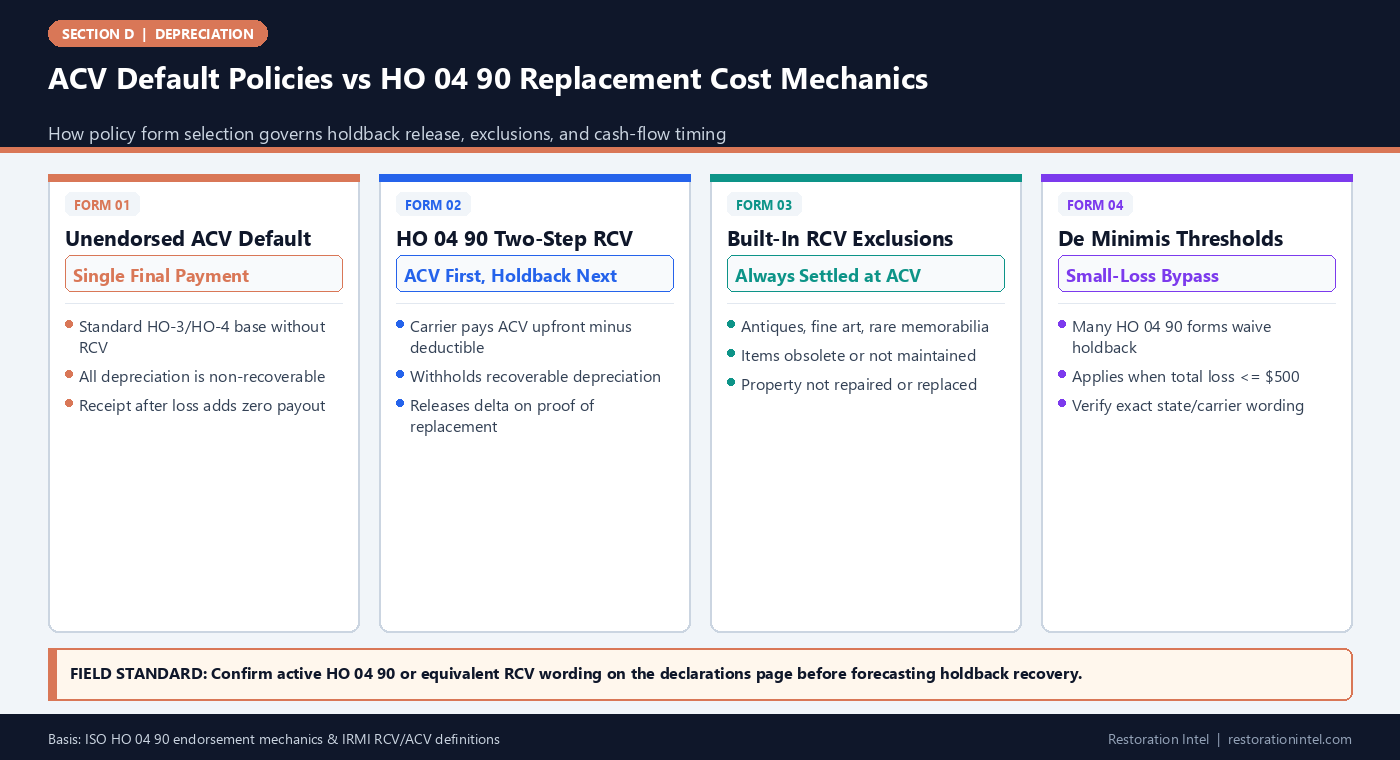
Direct Answer: Unendorsed homeowners policies settle personal property strictly at Actual Cash Value (ACV), leaving depreciation unrecoverable; adding an ISO HO 04 90 Personal Property Replacement Cost endorsement shifts settlement to a two-step RCV holdback model—while still excluding fine art, antiques, memorabilia, and obsolete items from replacement-cost recovery.
.md twin for estimator QA and carrier file documentation.
Before an estimator assigns a single recoverable depreciation column or promises an insured that depreciation will be paid back after shopping, someone has to verify whether the policy actually carries a Replacement Cost endorsement. A surprising share of older homeowners policies, landlord/dwelling policies, basic HO-8 forms, and budget renter policies default Coverage C personal property to strict Actual Cash Value (ACV).
When an insured adds the ISO HO 04 90 Personal Property Replacement Cost Loss Settlement endorsement—or buys a modern package policy with equivalent embedded wording—loss settlement transforms into a two-stage process tied to Replacement Cost Value (RCV). Yet even with HO 04 90 active, specific classes of property remain permanently locked at ACV, and recovery still depends on actually repairing or replacing the lost items within policy deadlines.
ACV Default Policies vs HO 04 90 Replacement Cost Mechanics
Side-by-Side Comparison: ACV Default vs HO 04 90 Replacement Cost Endorsement
Key operational differences that change how contents schedules are estimated, presented, and settled.
| Settlement Dimension | Unendorsed ACV Default Policy | HO 04 90 Replacement Cost Endorsement | Impact on Contents Schedule Setup |
|---|---|---|---|
| Initial Claim Payout | ACV (RCV minus physical depreciation and deductible) | ACV upfront (same initial cash formula) | Accurate age/condition grading matters equally under both forms |
| Recoverable Holdback | None—all depreciation is permanently deducted | Withheld depreciation paid once item is actually repaired/replaced | Must flag recoverable vs non-recoverable lines cleanly |
| Replacement Proof Required | Not applicable; insured spends settlement freely | Paid invoices/receipts showing actual replacement completed | Train insured early to save line-matched replacement receipts |
| Antiques, Art, & Collectibles | Settled at market/appraised ACV | Still settled at ACV/market value—explicitly excluded from RCV | Break zero-dep/appraised items into separate non-holdback bucket |
| Obsolete or Unusable Pre-Loss Goods | Minimal salvage/scrap ACV | Explicitly excluded from RCV; capped at ACV only | Document pre-loss operability to prevent wrongful exclusion |
| Replacement Time Limit | None post-ACV check | Strict notice/completion window (often 180 days unless extended) | Track multi-month rebuild delays against holdback deadlines |
Why Age and Condition Still Control Cash Flow Under HO 04 90
A dangerous misconception among restoration crews and insureds is that ‘we have Replacement Cost coverage, so depreciation does not really matter.’ In reality, HO 04 90 does not pay RCV on Day One. Like almost every property form, it settles in two steps: the carrier pays no more than the Actual Cash Value until actual repair or replacement is complete.
If an insured’s $40,000 residential contents loss is depreciated by an inflated 55 percent because field crews left age fields blank, the initial check drops to $18,000 before deductible. Many families cannot bridge a $22,000 out-of-pocket gap to go buy new beds, appliances, and clothing in order to unlock the recoverable holdback—effectively trapping them at ACV despite paying for an RCV endorsement.
- Initial liquidity driver: Fair, condition-based depreciation protects the upfront ACV check needed to fund replacement purchases.
- Partial tranche recovery: Most carriers release recoverable depreciation incrementally as batches of receipts are submitted rather than forcing all-or-nothing shopping.
- Small-loss immediate RCV: Standard HO 04 90 language often waives holdback entirely when total covered personal property loss is $500 or less—check the exact endorsement text.
Categories That Stay Locked at ACV Even With HO 04 90
Standard ISO HO 04 90 language explicitly carves out categories that never qualify for replacement-cost holdback, no matter how much the policyholder shops. These typically include antiques, fine arts, paintings, statuary, and similar articles that by their inherent nature cannot be replaced with new articles; memorabilia, souvenirs, collectors’ items, and similar articles whose age or history contributes to their value; and articles not maintained in good or workable condition.
It also excludes property that is outdated or obsolete and stored or not being used. Estimators who blindly put every household item into a single ‘recoverable depreciation’ bucket set insureds up for rude surprises when the desk examiner strips holdback eligibility off basement relics, vintage collectibles, or broken garage projects.
- Inherent-age carve-out: True antiques and fine art are settled at market ACV (usually with 0 percent wear deduction), not new-retail replacement cost.
- Active-use test: Distinguish stored-but-functional seasonal gear (ski equipment in summer) from obsolete junk (broken CRT monitors stacked in an attic).
- Schedule separation: Label non-RCV items clearly on the contents summary sheet so recoverable holdback expectations match policy text.
How Actual Replacement Cost Is Capped During Holdback Release
When an insured submits receipts to collect recoverable depreciation, the carrier pays the *least* of three figures on each line or claim: the agreed RCV of an identical/LKQ item, the amount actually and necessarily spent to repair or replace the item, or the applicable policy Coverage C limit / sublimit.
Suppose a sofa had an agreed RCV of $2,400, 25 percent depreciation ($600), and an initial ACV payout of $1,800. If the insured buys a replacement sofa on sale for $2,100, the carrier releases only $300 of the $600 holdback ($2,100 spent minus $1,800 paid)—not the full $600. Conversely, if the insured upgrades to a $3,500 designer sectional, the carrier caps total payout at the agreed $2,400 LKQ RCV. Understanding that ‘least-of’ cap prevents confusion across staff, independent, and public adjuster desks.
- Upgrade vs downgrade math: Spending less than agreed RCV reduces holdback recovery dollar-for-dollar; spending more never increases carrier liability past agreed RCV.
- Line-by-line vs aggregate matching: Policies and state practices vary on whether savings on one replaced item offset upgrades on another—clarify with the examiner before shopping.
- Tax and delivery included: Retain receipts showing sales tax and delivery fees on replaced items so recoverable tax holdbacks release alongside item principal.
Commercial BPP and Renter/Landlord Policy Parallels
Restoration estimators frequently step from residential losses into commercial Business Personal Property (BPP) or tenant-occupied properties without checking how valuation clauses shift. Under standard ISO CP 00 10 commercial forms, Valuation defaults to ACV unless the ‘Replacement Cost’ optional coverage is checked on the Declarations page—just like HO 04 90 in homeowners.
Similarly, landlord dwelling policies (DP-1 or DP-3) often provide limited or ACV-only personal property coverage for appliances and site furnishings left for tenant use, while condo unit-owner (HO-6) and tenant (HO-4) policies require verifying whether personal property replacement cost was added. Confirming the declarations page on Day One stops estimating teams from misquoting claim economics.
- Day-One policy check: Request the declarations page and endorsement list (confirming HO 04 90 or CP 00 10 RCV box) before issuing client expectations.
- Commercial stock rule: Even with Commercial RCV selected, finished ‘stock’ held for sale often follows specialized selling-price or wholesale valuation clauses rather than standard RCV.
- Sublimit override check: Remember that Coverage C special sublimits (e.g., $2,500 business property on premises) cap total recovery even under HO 04 90.
Practitioner Verification Checklist (D-19)
- Verify on the policy declarations page whether HO 04 90 (or equivalent RCV endorsement) is active before classifying depreciation as recoverable.
- Separate HO 04 90 ACV-only exclusions (antiques, fine art, memorabilia, non-working/obsolete goods) onto a non-holdback summary line.
- Document pre-loss condition and active usage thoroughly so initial ACV payouts give insureds realistic liquidity to replace essentials.
- Advise policyholders (within non-legal educational boundaries) that recoverable depreciation is capped at actual replacement spend up to agreed LKQ RCV.
- Track policy replacement-notice deadlines (typically 180 days unless extended) immediately on any multi-month structural rebuild.
Standards, Authority References & Related Reading
Primary standards, insurance definitions, and sibling Restoration Intel guides referenced in this brief:
- IRMI Insurance Glossary: Replacement Cost Value (RCV)
- IRMI Insurance Glossary: Actual Cash Value (ACV)
- IRMI Insurance Glossary: Depreciation
- Verisk Property Claims Solutions
- Related Guide: RCV vs ACV Fundamentals in Contents Claims: How Replacement Cost, Depreciation, and Holdbacks Actually Work
- Related Guide: Recoverable vs Non-Recoverable Depreciation: Policy Mechanics That Control Claim Cash Flow
- Related Guide: Zero-Depreciation Categories: Antiques, Fine Art, Collectibles, Bullion, and Appreciated Goods
- Related Guide: Managing Recoverable Depreciation Deadlines on Multi-Month Restoration Jobs
- Related Guide: Three Adjusters, Three Economies
.md twin for desk QA and team training.Frequently Asked Questions
Do all homeowners policies include Replacement Cost on personal property automatically?
No. Many standard homeowners policies default Coverage C personal property to Actual Cash Value unless the HO 04 90 endorsement or an enhanced package tier is purchased.
If a policy has HO 04 90, can the insured collect full RCV without replacing the items?
Generally no. Standard HO 04 90 language pays ACV upfront and requires proof of actual repair or replacement within the policy window before releasing recoverable depreciation—except sometimes on very small claims under $500.
Are antiques and collectibles upgraded to RCV under HO 04 90?
No. Standard HO 04 90 text explicitly excludes antiques, fine art, memorabilia, collectibles, and obsolete or unmaintained items from Replacement Cost settlement, leaving them at ACV or scheduled rider limits.
What happens if the insured replaces a lost item for less than the agreed RCV?
The carrier pays actual replacement cost spent minus the ACV already paid. The insured cannot pocket unused recoverable depreciation above what they actually spent to replace the item.