Direct Answer: Standard Pair or Set clauses do not automatically force a carrier to buy an entire new set when one piece is ruined; instead, they grant the insurer the option to either repair or replace the damaged piece to restore the set's pre-loss value, or pay the diminution in Actual Cash Value caused by breaking the matched pair or set.
.md twin for estimator QA and carrier file documentation.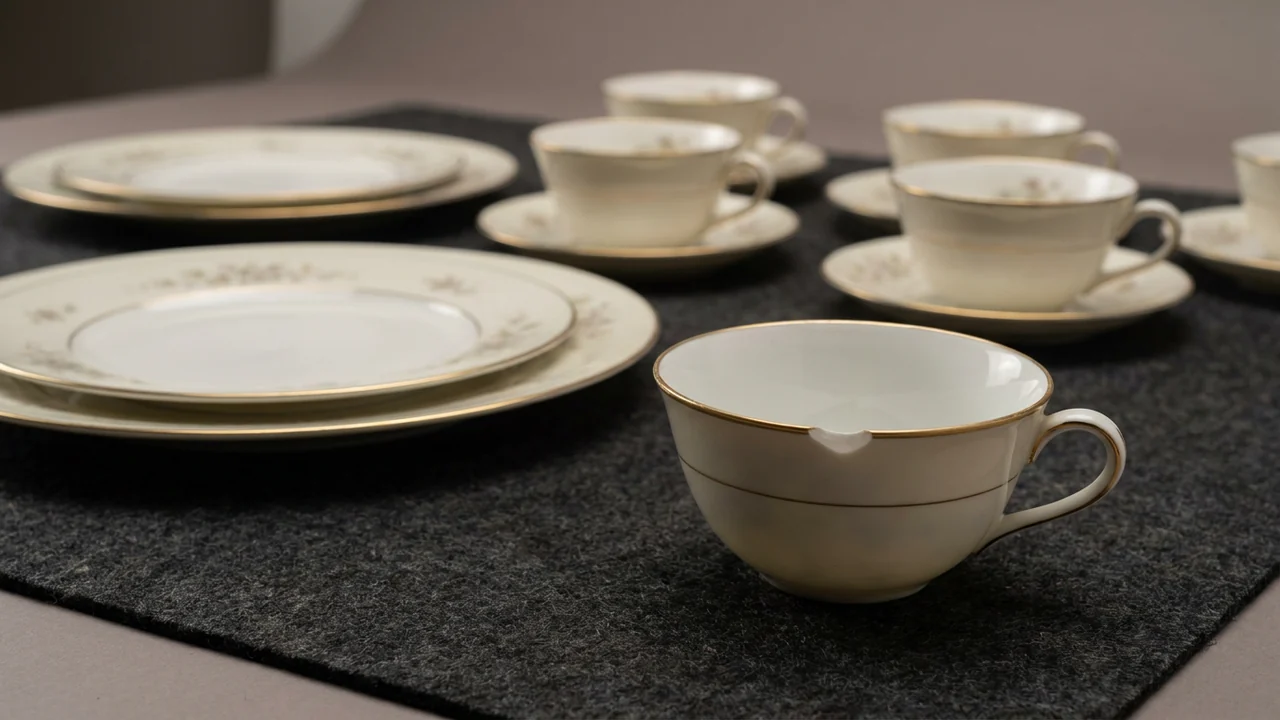
Few policy provisions are misquoted more often on residential contents claims than the Pair or Set clause. Policyholders frequently believe that burning one sleeve of a suit or shattering two plates from a twelve-piece dinnerware service entitles them to full replacement of the entire undamaged set. Conversely, some desk adjusters treat a ruined sectional wedge or single custom stereo speaker as a standalone unit worth one-fourth of the original purchase price, ignoring how breaking a matched system destroys utility.
Actual contract language—summarized in the IRMI Pair or Set Clause definition—sits squarely between those two extremes. Knowing the two explicit settlement options written into standard ISO personal property forms, and documenting replacement-market availability accurately, prevents prolonged matching stalemates on china, tailored apparel, modular furniture, and audio systems.
Pair or Set Settlement Mechanics in Contents Claims
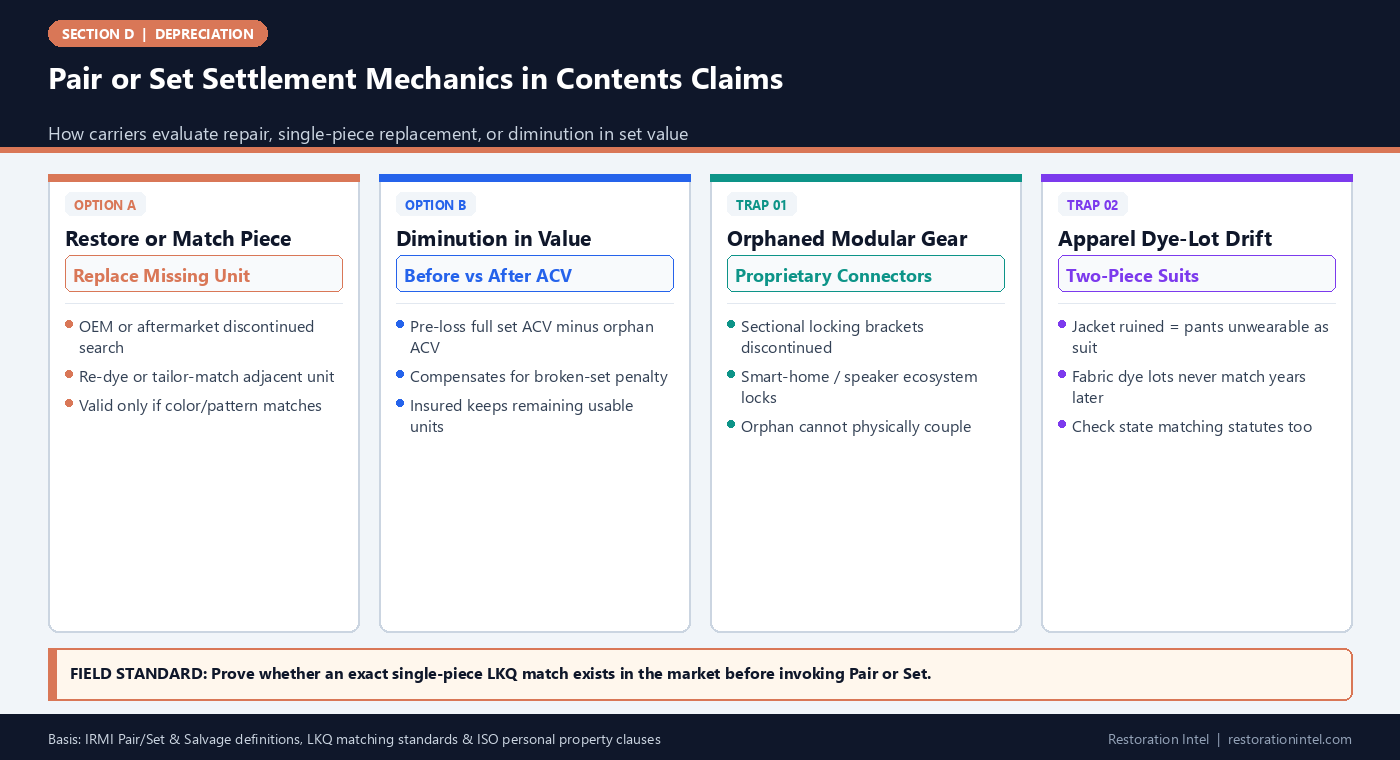
Pairs-and-Sets Application Matrix Across Four Contents Classes
How physical matching feasibility and market availability govern settlement across common paired or modular items.
| Item Type | Damage Scenario | Exact Match Feasibility | Carrier Settlement Path | Required Field & Desk Proof |
|---|---|---|---|---|
| Fine China & Crystal Stemware | 3 plates and 2 wine glasses broken from 12-person service | High via discontinued china/crystal replacement brokers if pattern active | Pay replacement cost of broken pieces + shipping; or diminution if unobtainable | Exact backstamp photo, pattern code, active replacement-broker quote |
| Tailored Two-Piece Business Suit | Suit trousers melted or smoke-ruined; jacket intact | Near zero—original bolt dye lot and fabric weave unavailable years later | Full suit RCV/ACV diminution minus any standalone blazer utility/salvage | Label showing matched suit SKU/lot, tailor note confirming unmatchable |
| Modular Sectional Sofa | Center armless wedge or motorized recliner soaked in Cat 3 water | Low if frame/fabric retired or proprietary latch brackets changed | Full sectional replacement if unmatchable & functionally impaired; or panel re-cover | Frame model tag, fabric code, OEM letter/screenshot showing retired line |
| Matched Stereo / Studio Monitors | One tower speaker destroyed by soot/water; mate undamaged | Moderate if active production; zero if discontinued or timbre-matched pair | Single speaker replacement if matched; pair replacement or diminution if retired | Serial pair sequence, spec sheet, discontinued OEM status proof |
| Matched Bedside Lamps / Nightstands | One lamp shattered or one nightstand warped by water | High if current retail line; low if vintage or seasonal import | Replace single unit if identical match exists; pay diminution if discontinued | Manufacturer SKU, finish close-up, search log showing zero exact stock |
What Standard Pair or Set Policy Language Actually Says
In standard ISO homeowners forms (such as HO 00 03), the Loss to a Pair or Set condition gives the insurer—not the insured—two settlement elections. The carrier may choose to: (1) repair or replace any part to restore the pair or set to its value before the loss; or (2) pay the difference between the Actual Cash Value of the property before and after the loss.
That second prong is where most contents disputes live. Notice it does not say ‘pay half of the set for one lost earring or one ruined shoe.’ If a pair of dress shoes worth $300 pre-loss ACV loses one shoe, the remaining single shoe has roughly $0 market value—so the before-and-after difference is virtually 100 percent of the pair’s ACV. Conversely, if two dinner plates break out of an eight-place everyday dish set where identical plates still sell individually for $18 each, Option 1 restores the set cleanly for $36.
- Distinguish true sets from collections: Eight mismatched coffee mugs are individual items; a numbered twelve-place Wedgwood pattern or matched stereo pair is a set.
- Quantify orphan utility honestly: A suit jacket may retain minor sport-coat value in rare cases, whereas a left ski boot or single wireless earbud has zero standalone market value.
- Check state matching rules: While most state matching statutes focus on siding and roofing under Coverage A, select jurisdictions and endorsements address interior uniformity—always verify local policy terms.
China, Flatware, and Discontinued Replacement Brokers
Fine china, sterling flatware, and crystal patterns present a unique middle ground because active secondary replacement houses maintain deep stock of discontinued patterns. Before claiming that a broken gravy boat or two missing salad plates render an entire 60-piece estate service ruined, estimators should photograph the backstamp and verify live replacement availability.
If an exact pattern piece in equivalent condition is available through an established replacement dealer, Option 1 applies: price the missing pieces plus insured shipping and crating. However, if the pattern is genuinely out of stock everywhere or only cracked/crazed seconds exist, document those failed search results so the claim transitions cleanly to Option 2 diminution or full LKQ replacement.
- Photograph backstamps and hallmarks: Pattern names often differ slightly across production decades even under the same manufacturer.
- Include shipping and matching risk: Replacement-broker prices must reflect freight, insurance, and tax—not bare list price.
- Watch Coverage C silverware caps: Sterling flatware sets can trip unscheduled silverware sublimits regardless of Pair or Set status.
Suits, Upholstered Sets, and Modular Furniture Coupling
Textiles and modular furniture fail matching tests for technical reasons that go beyond simple aesthetics. On a two-piece wool suit or custom-ordered sectional sofa, manufacturers weave fabric in finite dye lots; even if the exact fabric name remains in a catalog three years later, a newly woven replacement trouser or sectional cushion will visibly mismatch the sun-aged and cleaned companion piece.
Modular sectionals add a mechanical constraint: manufacturers frequently revise frame dimensions, leg heights, or under-frame alligator clips between model years. When a Category 3 water loss ruins two modular wedges, proving that the remaining chaise cannot physically latch onto a current-generation piece establishes total functional loss of the set—preventing a partial-unit settlement that leaves the insured with an unusable half-couch.
- Document mechanical latches: Photograph underside connector brackets, frame rails, and law tags on modular sectionals before disposal.
- Prove dye-lot variance: Note fabric wear, sun fade, and discontinued dye-lot status from the furniture dealer or tailor.
- Coordinate salvage rules: If the carrier pays full set replacement value, confirm whether the carrier claims salvage title to the undamaged companion pieces.
Modular Electronics, Smart Systems, and Salvage Disposition
Modern home audio, smart lighting hubs, wireless mesh routers, and modular battery tool platforms behave like pairs and sets even when sold as separate SKUs. Destroying a proprietary soundbar wireless subwoofer or a discontinued surround amplifier can render still-intact proprietary satellite speakers useless bricks because they cannot pair with current-generation receivers.
When scheduling orphaned electronics or tools, pair the physical damage line with a concise compatibility statement citing the OEM manual or discontinued support notice. Equally important, clarify salvage custody upfront: if a carrier settles for a full set under diminution or full RCV replacement, document whether the undamaged mate will be surrendered as carrier salvage, donated, or retained by the insured under an agreed salvage credit.
- Map ecosystem dependencies: Explicitly note proprietary wireless pairing, voltage docks, or app-lock dependencies on modular tech.
- Separate RCV holdback math: Remember that standard Pair or Set clause wording pays ACV diminution unless the Replacement Cost endorsement upgrades the recovery upon actual replacement.
- Avoid premature disposal of undamaged mates: Hold surviving set pieces until the adjuster confirms salvage waiver or pickup instructions in writing.
Practitioner Verification Checklist (D-18)
- Photograph exact pattern backstamps, suit dye-lot tags, sectional law tags, and modular hardware connectors before pack-out or disposal.
- Search current OEM catalogs and established discontinued-pattern brokers to prove whether a true single-piece LKQ match exists.
- Document physical, mechanical, or dye-lot incompatibility whenever a replacement piece cannot integrate with surviving set units.
- Calculate before-and-after set Actual Cash Value diminution clearly rather than asserting automatic full-set payout without proof.
- Hold surviving undamaged companion pieces until the carrier confirms salvage waiver, surrender, or owner-retention credit in writing.
Standards, Authority References & Related Reading
Primary standards, insurance definitions, and sibling Restoration Intel guides referenced in this brief:
- IRMI Insurance Glossary: Pair or Set Clause
- IRMI Insurance Glossary: Actual Cash Value (ACV)
- IRMI Insurance Glossary: Replacement Cost Value (RCV)
- IRMI Insurance Glossary: Salvage
- Related Guide: Like Kind and Quality (LKQ) Replacement Matching: Rules for Discontinued Brands and Obsolete Models
- Related Guide: Furniture Valuation and Depreciation: Solid Wood vs Veneer, Upholstery Grade, and Custom Joinery
- Related Guide: Zero-Depreciation Categories: Antiques, Fine Art, Collectibles, Bullion, and Appreciated Goods
- Related Guide: Salvage Credits and Buy-Back Rules When Insureds Keep Partially Damaged Contents
- Related Guide: Reconstruction Materials Matching & Like-Kind Quality Standards
.md twin for desk QA and team training.Frequently Asked Questions
Does the Pair or Set clause guarantee a brand-new full set if one piece breaks?
No. Under standard policy terms, the insurer can either repair/replace the damaged piece to restore the set’s pre-loss value or pay the difference between the set’s ACV before and after the loss.
When does losing one item justify replacing the entire set?
When no exact matching replacement piece is obtainable and the missing piece renders the remaining piece unusable or destroys virtually all of the set’s value—such as one shoe, one trouser leg of a suit, or an unmatchable modular sectional section.
What happens to the undamaged pieces if the carrier pays for a full set?
If the carrier pays full replacement value for the set rather than diminution less retained value, the carrier generally holds salvage rights to the undamaged pieces unless it waives salvage or applies an agreed owner-retention credit.
Do Pair or Set rules apply to commercial equipment too?
Commercial property policies vary, though many contain similar Pair, Set, or Parts clauses governing matched machinery or electronic assemblies; always verify the exact commercial form wording.