Direct Answer: Recoverable depreciation is temporarily withheld until replacement receipts prove actual spend under an RCV policy, whereas non-recoverable depreciation is permanently deducted due to policy valuation terms, sublimits, excluded classes, or missed replacement deadlines—and mixing the two distorts project cash flow.
.md twin for estimator QA and carrier file documentation.
Nothing blindsides a property owner faster at claim closeout than discovering that a large portion of withheld depreciation was never recoverable in the first place. On a complex loss, a single schedule can contain both recoverable depreciation—money waiting behind a replacement receipt—and non-recoverable depreciation that will never be paid regardless of how much the insured spends.
That split is governed by specific contract triggers inside residential forms like ISO HO 00 03 with HO 04 90 and commercial forms like ISO CP 00 10. Knowing which categories default to permanent ACV settlement, how policy sublimits freeze holdback eligibility, and how claim cash flow moves across multi-month pack-out and rebuild timelines allows restoration teams and estimators to set realistic expectations from day one.
Recoverable vs Non-Recoverable Depreciation Decision Matrix
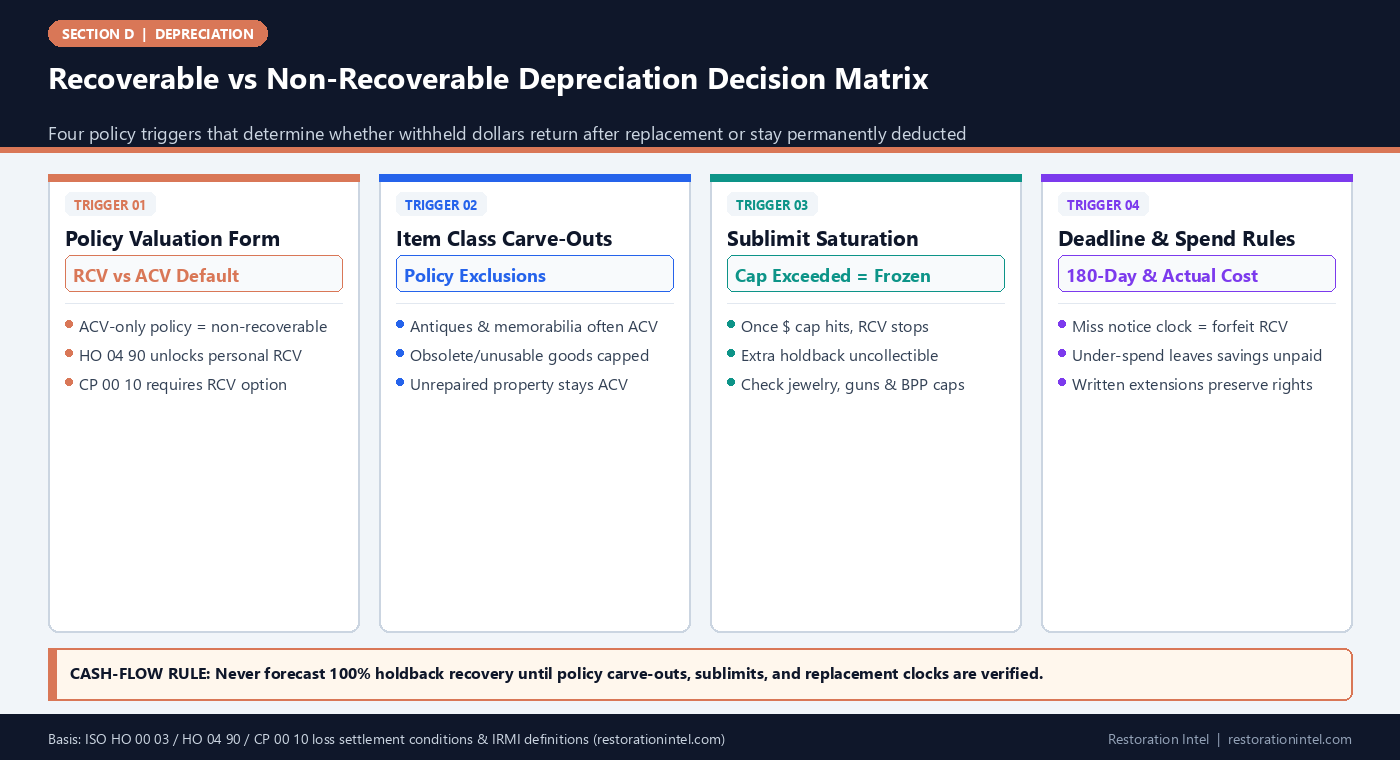
When Withheld Depreciation Is Recoverable vs Permanently Non-Recoverable
Contractual classification of depreciation holdbacks across common residential and commercial contents scenarios.
| Claim Scenario | Depreciation Type | Why It Applies | Cash-Flow Consequence | Required Action |
|---|---|---|---|---|
| Standard household furniture under HO 04 90 | Recoverable | Policy includes Personal Property Replacement Cost endorsement | Paid as ACV first; balance released upon itemized purchase | Track purchase receipts & submit before deadline |
| Same furniture under basic ACV-only policy | Non-Recoverable | No RCV endorsement attached to policy declarations | ACV payout is final settlement for contents | Set insured expectation immediately at intake |
| Fine art, antiques, or rare collectibles | Non-Recoverable (or Agreed Value) | HO 04 90 typically excludes property whose age/history sets value | Settled at ACV/market value with no replacement holdback | Verify scheduled floater or appraisal basis early |
| Item insureds choose NOT to replace (cash-out) | Non-Recoverable once waived | RCV clause pays holdback only if actual replacement occurs | Insured keeps initial ACV check permanently | Separate cash-out items on final holdback tracker |
| Business personal property over $2,500 home cap | Non-Recoverable above cap | Homeowners special limit caps total payout regardless of RCV | Holdback above sublimit cannot be collected | Re-check commercial policy or sublimit allocation |
| Missed 180-day RCV claim window without extension | Converted to Non-Recoverable | Insured failed to notify carrier of intent within policy window | Carrier closes claim at ACV permanently | Calendar deadline and request written extensions early |
Policy Architecture: What Makes Depreciation Recoverable in the First Place
By default, unendorsed homeowners forms such as ISO HO 00 03 settle Coverage C (Personal Property) on an Actual Cash Value basis. Without the HO 04 90 Personal Property Replacement Cost Loss Settlement endorsement—or a carrier’s proprietary equivalent—all depreciation on damaged contents is non-recoverable from the outset. Similarly, commercial property policies under ISO CP 00 10 default to ACV unless the Replacement Cost optional coverage is active on the declarations page.
Even when RCV coverage is active, standard endorsements carve out specific property classes from recoverable depreciation. Under typical HO 04 90 wording, antiques, fine arts, paintings, statuary, memorabilia, souvenirs, collectors items, and property not maintained in good or workable condition—or items outdated/obsolete and stored unused—remain settled at ACV or stated market value rather than new replacement cost.
- Verify declarations before promising RCV: Never assume every homeowner policy includes HO 04 90; confirm the endorsement code on page one of the policy.
- Check obsolescence & non-working carve-outs: Stored broken electronics or unused attic items often lose RCV eligibility under policy conditions.
- Distinguish Coverage A vs C rules: Structure and contents frequently carry different depreciation rules and sublimits inside the exact same claim.
How Cash Flow Unfolds Between Initial ACV and Final Holdback Release
On a large residential fire or commercial water loss, cash flow timing governs whether the insured can afford to replace essential furniture, clothing, and equipment while the building is still under reconstruction. Carriers typically issue the undisputed ACV payment first, subtracting the deductible from the initial disbursement. That means a homeowner with $60,000 in gross RCV, $18,000 in depreciation, and a $2,500 deductible receives $39,500 up front—not $60,000.
Recoverable depreciation then trickles back in tranches—or in one final reconciliation—as replacement purchases are verified. Some carriers allow rolling holdback draws as receipts arrive; others require one or two consolidated submissions. Failing to explain this staggered release creates avoidable tension when contractors or policyholders budget as though gross RCV arrives on day ten.
- Deduction order reality: Deductibles come out of the ACV check first, compressing early household liquidity.
- Rolling vs lump-sum draws: Ask the desk examiner early whether partial receipt packets can trigger interim holdback checks.
- Self-funded bridge gap: Insureds who cannot front cash for high-ticket replacements may need to prioritize essential items first to unlock rolling holdback funds.
Sublimits, Coinsurance, and Partial-Replacement Traps
Two policy mechanisms silently convert apparent recoverable depreciation into permanent non-recoverable deductions: category sublimits and commercial coinsurance penalties. Suppose a homeowner loses $9,000 RCV in firearms with $2,000 depreciation, resulting in $7,000 ACV, under a policy carrying a $2,500 theft-of-firearms sublimit. Because the carrier’s total liability caps at $2,500, the $2,000 depreciation column is completely academic—no holdback will ever be paid.
In commercial BPP claims under CP 00 10, coinsurance works similarly. If a business carries $100,000 of Coverage when an 80 percent coinsurance clause required $200,000 based on total inventory value, every dollar of recovery—including replacement holdback—is cut in half proportionally. Estimators who present gross RCV totals without flagging sublimits or coinsurance risk set policyholders up for severe financial shock.
- Sublimit ceiling check: Always flag jewelry, watches, furs, cash, bullion, watercraft, trailers, and home-business goods against policy caps.
- Receipt spend trap: Buying replacement goods below scheduled RCV permanently forfeits the unspent portion of the holdback.
- No cash-out on RCV holdbacks: Choosing not to replace a scheduled item leaves the settlement permanently at ACV.
Preventing Accidental Forfeiture on Multi-Month Claims
Most homeowners replacement cost endorsements give the insured 180 days from the date of loss to notify the insurer of their intent to claim additional replacement cost amounts, while some state statutes or carrier forms allow up to 12 to 24 months (or 180 days after ACV payment). When structural rebuilds drag past six months, families living in temporary housing naturally wait to buy new dining sets or bedroom suites until the house is finished.
If nobody tracks that clock and requests a written extension before day 180, the carrier can lawfully treat every remaining dollar of holdback as expired non-recoverable depreciation. Building a simple holdback ledger with target replacement dates protects the insured’s recovery across long projects, complementing workflow hygiene in Three Adjusters, Three Economies.
- Calendar day-150 warning: Send a written extension request at least 30 days before the policy’s RCV notice deadline expires.
- Bundle receipts cleanly: Tie each retail invoice to exact line-item IDs from the carrier-approved schedule.
- Separate cash-out vs replace lists: Help insureds identify which items they intend to replace vs leave at ACV.
Practitioner Verification Checklist (D-04)
- Confirm on the policy declarations page whether Coverage C / BPP carries an RCV endorsement or defaults to ACV-only.
- Tag any policy-excluded classes (antiques, fine art, unmaintained/obsolete items) as non-recoverable ACV on the initial schedule.
- Cross-check specialty categories against policy sublimits so uncollectible holdbacks are never presented as expected future cash.
- Provide the insured a clear Net ACV vs Maximum Recoverable Holdback breakdown showing deductible impact.
- Calendar the policy’s RCV replacement deadline and document written carrier extensions whenever structural rebuilds delay furniture delivery.
Standards, Authority References & Related Reading
Primary standards, insurance definitions, and sibling Restoration Intel guides referenced in this brief:
- IRMI Insurance Glossary: Depreciation
- IRMI Insurance Glossary: Replacement Cost Value (RCV)
- IRMI Insurance Glossary: Actual Cash Value (ACV)
- ANSI/IICRC S320 Standard for Professional Contents Restoration
- Related Guide: RCV vs ACV Fundamentals in Contents Claims: How Replacement Cost, Depreciation, and Holdbacks Actually Work
- Related Guide: Personal Property Replacement Cost Endorsements (HO 04 90) vs Actual Cash Value Default Policies
- Related Guide: Sublimit Allocation Strategy When Total-Loss Specialty Items Exceed Policy Caps
- Related Guide: Managing Recoverable Depreciation Deadlines on Multi-Month Restoration Jobs
- Related Guide: Three Adjusters, Three Economies
.md twin for desk QA and team training.Frequently Asked Questions
What is the difference between recoverable and non-recoverable depreciation?
Recoverable depreciation is withheld temporarily under an RCV policy and paid once the insured replaces the item and submits receipts. Non-recoverable depreciation is permanently deducted because the policy is ACV-only, the item is excluded from RCV, a sublimit is maxed out, or replacement deadlines expired.
Why would part of a replacement-cost policy still have non-recoverable depreciation?
Standard RCV endorsements like HO 04 90 exclude certain categories—such as antiques, fine art, memorabilia, or obsolete non-working items—and sublimited items stop paying once the dollar cap is reached.
Can an insured collect recoverable depreciation without buying a replacement?
No. Replacement cost provisions require actual repair or replacement to trigger holdback release. If the insured chooses not to replace an item, they retain the initial ACV payment.
How do multi-month structure repairs affect recoverable depreciation deadlines?
If structure reconstruction delays furniture or appliance purchases past the standard 180-day window, the insured should request a written deadline extension from the carrier before the clock expires.