Published November 14, 2026. By Will Tygart · Restoration Intel Editorial Desk.
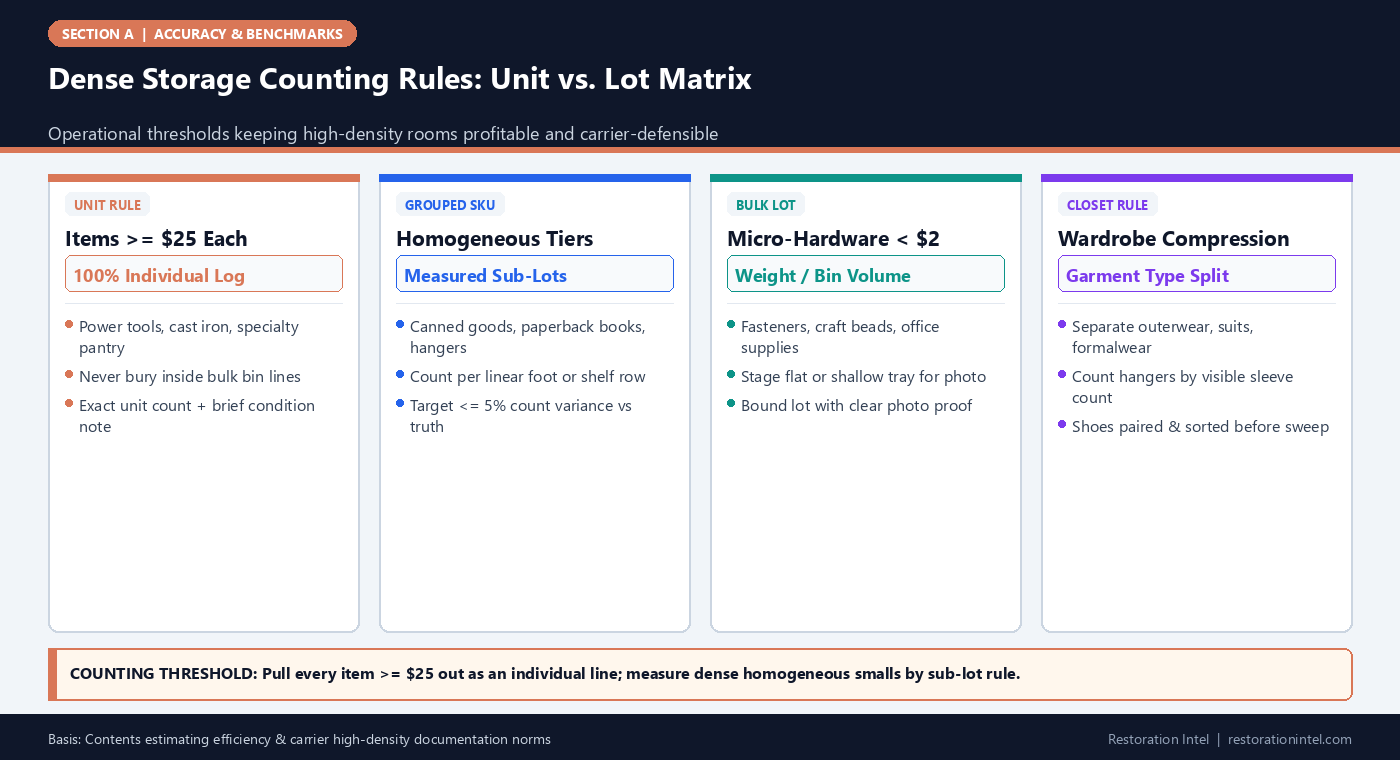
Direct answer. Dense storage requires explicit rules dividing countable unit assets from transparent lot-estimation zones — because neither guessing round numbers nor itemizing 2,000 screws individually survives both estimating economics and carrier scrutiny.
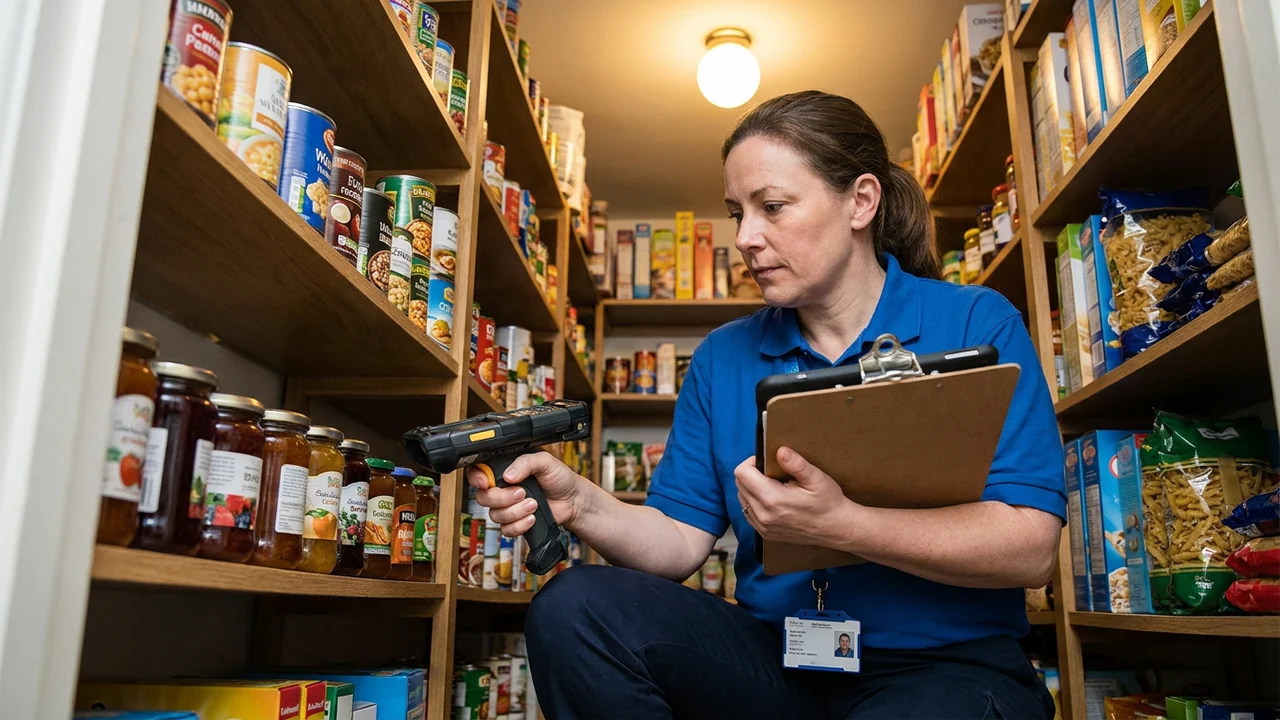
Open living rooms rarely sink a contents schedule’s time budget; utility basements, packed pantries, walk-in closets, and workshop pegboards do. A typical three-bay suburban garage or stocked chef pantry easily holds more distinct physical objects than the entire rest of the house combined — at a fraction of the per-unit dollar value.
Left without firm counting benchmarks, crews swing between two opposite errors. Overly literal technicians burn six billable hours listing single spices and 39¢ brass fittings individually, blowing labor budgets. Rushed technicians write ‘Garage Shelf Misc — Lot of 1’ across $4,500 worth of power tools and hardware, triggering instant adjuster disallowance. Clear thresholds solve both extremes.
Dense Storage Zone Benchmarks & Acceptable Variance Targets
| Storage Zone | Recommended Counting Unit | Exception Rule (Must Pull Individual) | Target Variance Tolerance | Photo Proof Minimum |
|---|---|---|---|---|
| Kitchen Pantry | Grouped shelf rows by package tier (dry goods, cans, spices) | Specialty countertop gadgets, espresso pods/machines, wine > $25/bottle | +/- 5% count accuracy | 1 wide open-door frame + 1 close shot per shelf depth layer |
| Walk-In Bedroom Closets | Garment counts split by textile/cleaning tier (suits, dresses, casual tops) | Designer handbags, fur/leather coats, fine watches, custom boots | +/- 3% on apparel; 0 misses on Tier 1 | Separate pan across upper shelf, mid rod, and floor shoe rack |
| Library & Home Bookcases | Linear-foot or shelf-count lots split hardcover vs trade paperback | First editions, textbooks, professional reference sets, framed art | +/- 5% total volume | Front spine shots sharp enough to read representative genres/publishers |
| Garage Pegboards & Hardware Bins | Tray/drawer bulk lots for fasteners & consumables | Power tools, torque wrenches, diagnostic scanners, welded tool chests | 0 misses on power/specialty tools | Pull drawers 75% open; tray-level top-down shot with scale reference |
Why Occluded Depth Breaks Naive Visual Counting
Whether a human estimator counts from walkthrough stills or a computer vision detector places bounding boxes on a shelf image, front-row occlusion creates systematic undercounting. Three cans deep on a 16-inch pantry shelf looks like one row of cans from hallway eye level. Thirty shirts squeezed tightly onto a four-foot closet rod obscure double-hung trousers behind jackets.
Testing teams routinely find 18 to 35 percent quantity undercounts in un-staggered pantry and bookcase audits when capture happens without shelf parting. Teaching technicians a five-second ‘fan and tilt’ gesture — sliding top garments sideways or angling the camera down 25 degrees over top pantry rows — cuts depth undercounts sharply without unloading every shelf onto the counter.
- Never multiply guessed hidden rows: Only count unseen rear depth when you physically part or pull the front column aside on camera.
- Audio narration multiplier: Speaking ’14 cans tomato sauce, three rows deep’ while framing the front column pairs visual evidence with spoken count precision.
Defining Defensible Bulk Lots Without Guessing
Adjusters reject vague bulk descriptions because ‘Box of Kitchen Stuff — $350’ gives desk review zero anchor to verify replacement reasonableness. Yet grouping truly low-unit-value commodities is essential for estimating throughput. The solution is bounded homogeneous lots.
Instead of a single lumped basement line, break dense zones into verifiable functional clusters: ‘Assorted Acrylic Craft Paints (approx. 45 x 2 oz bottles, visible open bin)’ or ‘Hardcover Fiction Books — 3 shelves, approx. 65 volumes’. Each line explains unit size, approximate count logic, and links directly to a sharp wide frame showing the entire lot.
- State whether containers are counted as paired sets (shoes, earrings, bookends) or single items to stop accidental 2x pricing errors.
- Segregate hazardous liquids, open half-used cleaning chemicals, and expired food items immediately so carrier policies don’t reject entire lots.
Auditing Dense Zones Before Leaving the Property
Dense storage is where rush fatigue hits end-of-day crews hardest. Before closing a residential loss site, field supervisors should run a quick five-minute audit spot-checking two enclosed zones — typically one hall closet and one garage workbench wall — against the active log.
Comparing visible tool counts or shoe pairs against line quantities catches systematic lot laziness before trucks pull away and prevents the expensive return-trip rework analyzed in our guide on the true cost of inventory rework.
Field Execution Checklist
- Extract every individual asset >= $25 before assigning any bulk lot summary to a dense shelf or drawer.
- Pull pantry front rows or fan tight hanger rods slightly while photographing so rear depth is visibly verified.
- Label grouped lines with explicit count basis (per pair, per linear foot, per visible tray) and quality tier.
- Verify open-lid/open-drawer overview photos cover 100 percent of bulk hardware or craft lots.
- Run a mandatory two-zone spot check on closets and garages prior to truck departure.
Related Restoration Intel Guides & Reference Standards
- Companion Brief (A-02): Item Count Recall vs Category Precision: Why Most Field Audits Measure the Wrong Metric
- Companion Brief (A-14): The True Cost of Inventory Rework: Quantifying Field Return Trips, Missing-Item Disputes, and Supplement Delays
- Companion Brief (F-02): Computer Vision Object Detection Messy Loss Rooms Limits
- Companion Brief (F-11): How Ai Inventory Systems Handle Sealed Boxes Totes Bulk Lots
- Internal Guide: A Pack-Out Record Is Not a Priced Inventory
- Primary Authority: ANSI/IICRC S320 Standard for Professional Contents Restoration
- Primary Authority: Verisk XactContents Platform Overview
- Primary Authority: Restoration Industry Association (RIA)
Frequently Asked Questions
When should restoration crews count individual pantry items versus using shelf lots?
Individual logging makes sense for high-value specialty pantry goods (olive oils, imported coffees, boxed appliances), whereas standard canned/dry goods can be logged as verified homogeneous shelf sub-lots supported by clear front-and-angled photos.
How do you stop closet coat counts from double-counting sleeves?
Train crews to count hanger hooks along the top rod rather than hanging fabric folds, separating bulky winter outerwear and formalwear from standard shirts before tallying.
Will insurance carriers pay for 1,000 individual screw lines in a garage?
No. Desk examiners expect sorted hardware organizers to be documented with drawer-open photos and valued as practical assortment kits or shop storage lots unless specialty aerospace/machinist fasteners exist.
What variance threshold is acceptable in dense bookcases or closets?
A +/- 5 percent quantity tolerance on low-value homogeneous commodities is broadly practical, provided zero high-value first editions, collectibles, or Tier 1 garments are buried inside the lot.
.md twin (quantity-counting-benchmarks-dense-storage-pantries-garages.md).