Published November 14, 2026. By Will Tygart · Restoration Intel Editorial Desk.
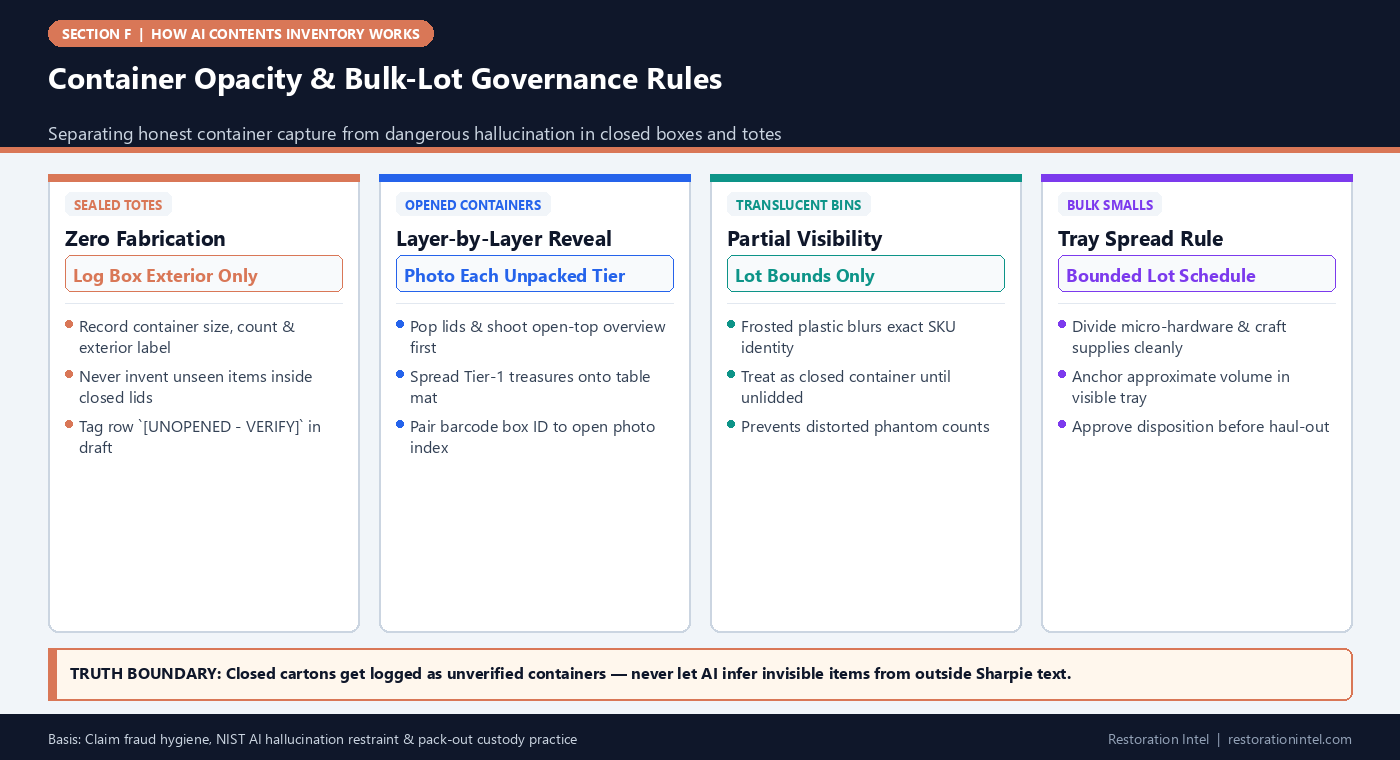
Direct answer. Responsible AI inventory tools never fabricate unseen interior items inside closed totes or taped moving cartons — they classify sealed containers explicitly as unverified storage units until technicians open lids, fan contents flat, or execute box-unpack protocols.
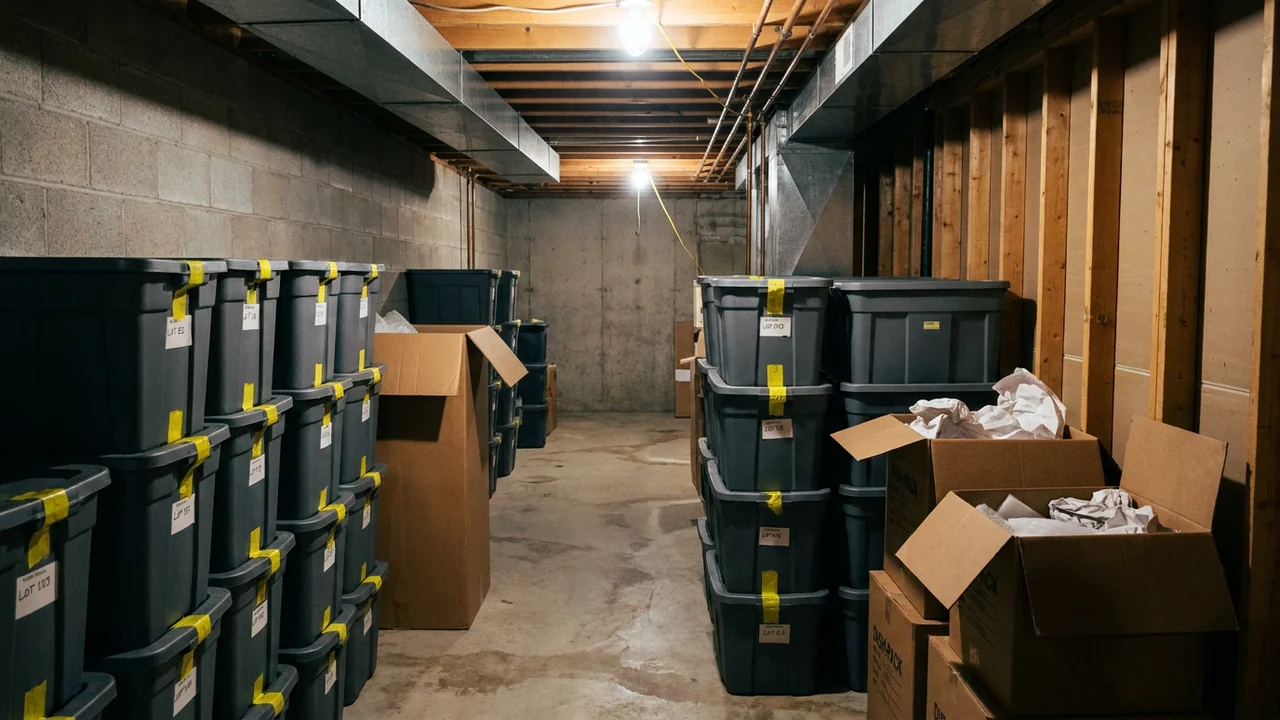
Open any flooded basement, attic crawlspace, or garage storage rack and a third of the cubic volume sits inside sealed translucent totes, taped cardboard cartons, or stacked tool cases. That moment exposes a critical ethical and technical boundary in AI capture.
Earlier vision-language demos occasionally tripped into dangerous extrapolation: seeing a faded Sharpie label reading `XMAS DECOR` or `KITCHEN POTS` on a sealed Sterilite bin and hallucinating fifteen itemized Hallmark ornaments or copper pans onto an insurance claim. Submitting guessed inventory inside closed containers violates carrier fraud guardrails and S320 documentation ethics.
Container Handling Matrix: Automated System Behavior vs. Field SOP
| Container State on Site | Safe AI Pipeline Behavior | Unsafe Hallucination Risk | Mandatory Field Crew Action |
|---|---|---|---|
| Taped Cardboard Carton (Unopened) | Detects `Cardboard Moving Box`, transcribes exterior handwritten label as Note (`Label: Holiday`), marks `[UNVERIFIED INTERIOR]` | Generates itemized line list of unseen kitchenware or holiday decor inside closed flaps | Leave flagged unverified until owner/adjuster authorizes opening or unpack onto table |
| Opaque / Frosted Plastic Tote | Logs container unit (`27-Gal Storage Tote w/ Lid`) and prompts crew alert to expose interior if salvageable | Estimates counts/models of buried garments or holiday lights seen vaguely through plastic | Snap lid open, photograph top layer clearly, and note deep contents verbally |
| Open Crate / Workshop Hardware Tray | Captures visible upper hardware layer cleanly as `Assorted Hardware / Craft Lot`; excludes hidden tray depths | Extrapolates uniform unit price for deep buried layers unseen by camera | Pull drawer slides 75% open; spread specialty tools out before sweep |
| Sealed Tool Chest / Pelican Case | Logs protective outer case (`Red 5-Drawer Rolling Tool Chest`) as asset + prompts drawer-open sub-captures | Guesses specific Snap-on wrench sets from brand decal alone | Unlock and shoot every individual tool drawer cleanly in sequence |
Why Exterior Box Text Never Equates to Claim Proof
Homeowners reuse moving cartons constantly. A garage box labeled `Bedding — Master` in black marker five years ago frequently holds half-used paint cans, holiday tinsel, or rusty garden shears today. Even when an exterior sticker matches original packing, water saturation or smoke penetration inside attic cartons requires physical inspection to prove loss damage before claiming replacement.
Audit-ready software stores exterior container notes strictly as metadata (`Handwritten box tag reads: China`) while prohibiting pricing insertion until open-lid visual confirmation happens.
- Audit vendor prompts ruthlessly: Ask software providers directly during demos what happens when you point their app at five taped cardboard boxes — if the export spawns itemized bowls inside, fail that vendor immediately.
- Separate pack-out transport boxes from pre-existing storage bins: When crews pack a house into clean restoration cartons, log open items BEFORE sealing flaps; for homeowner pre-packed bins, record exterior state first.
Handling Salvageable vs. Non-Salvageable Closed Totes Safely
In Category 3 flood basements or heavy fire losses where opening swollen moldy basement boxes risks spore spread inside uncontained rooms, technicians shouldn’t rip sealed bins open recklessly just to satisfy an app. Document total bin count and waterline elevation on camera, transport sealed contaminated bins to contained processing/staging zones or document authorization with the adjuster to verify selectively under PPE (OSHA 1910.132). Wait for written owner/carrier guidance before breaking contaminated containment seals inside clean living zones.
- Separate pre-existing homeowner packed cartons clearly from restoration pack-out cartons (`BOX-001`..`BOX-250`) using distinctive color labels.
- Record exterior container damage (mud tide height, soot streaks, bowed lid corners) prior to moving totes from origin.
Bridging Bulk Lots Cleanly Into Carrier Categories
Once containers are safely opened, grouping low-value uniform items (nuts/bolts, holiday ornaments, craft yarns) follows the exact bounded-lot thresholds set in Quantity Counting Benchmarks in Dense Storage — protecting crew labor without dropping schedule precision.
Field Execution Checklist
- Verify your capture software treats sealed boxes/totes strictly as unverified containers rather than guessing contents from labels.
- Open safe salvageable homeowner totes before sweeping so top layers and audio counts enter visual proof cleanly.
- Unlock rolling tool chests and cabinetry drawers drawer-by-drawer; never summarize closed tool stacks from outer badges.
- Preserve PPE and containment protocol before opening mold/sewage basement bins just for inventory photos.
- Pair every approved bulk lot row with a sharp open-top overview frame showing physical volume and commodity type.
Related Restoration Intel Guides & Reference Standards
- Companion Brief (A-05): Quantity Counting Benchmarks Dense Storage Pantries Garages
- Companion Brief (F-02): Computer Vision Object Detection in Messy Loss Rooms: Capabilities and Hard Physical Limits
- Companion Brief (F-16): How to Evaluate Any AI Contents Inventory Vendor: 12 Verification Questions Beyond Marketing Demos
- Companion Brief (A-11): Photo-to-Line-Item Traceability Standards for Carrier Audit Readiness
- Internal Guide: IICRC Cat 3 Contents Pack-Out Cleaning Protocol
- Primary Authority: NIST AI Risk Management Framework
- Primary Authority: ANSI/IICRC S320 Standard for Professional Contents Restoration
- Primary Authority: OSHA 1910.132 Personal Protective Equipment Standard
- Primary Authority: Verisk XactContents Platform Overview
Frequently Asked Questions
Can AI read the exterior label on a sealed moving box and estimate what's inside?
Technically an LLM could guess, yet doing so creates severe carrier fraud and accuracy risk because labels often misstate contents and fail physical damage proof.
How should sealed pre-loss storage bins be handled during pack-out?
Photograph exterior condition/stacking, move safely if salvageable or quarantine per hazard protocol, then photograph open-lid interior inspection under proper containment.
What if an attic holds 60 sealed homeowner storage boxes in a total fire collapse?
Establish clear exterior stack photos and coordinate selective sampling or insured-assisted verification rules directly with the claim adjuster before disposal.
What separates an acceptable bulk hardware lot from an unsubstantiated guess?
Visible open-tray/drawer photography showing item class, container density, and explicit unit extraction of any individual high-value power tools.
.md twin (how-ai-inventory-systems-handle-sealed-boxes-totes-bulk-lots.md).