Direct Answer: Safe specialty textile pack-out requires breathable unbleached muslin garment bags, acid-free tissue, and Kraft rug tubes—never sealed plastic over damp fibers—paired with barcode/RFID custody tracking to specialty wash plants and documented odor, dye-fastness, and dimensional recertification before reset.
.md twin for estimator QA and carrier file documentation.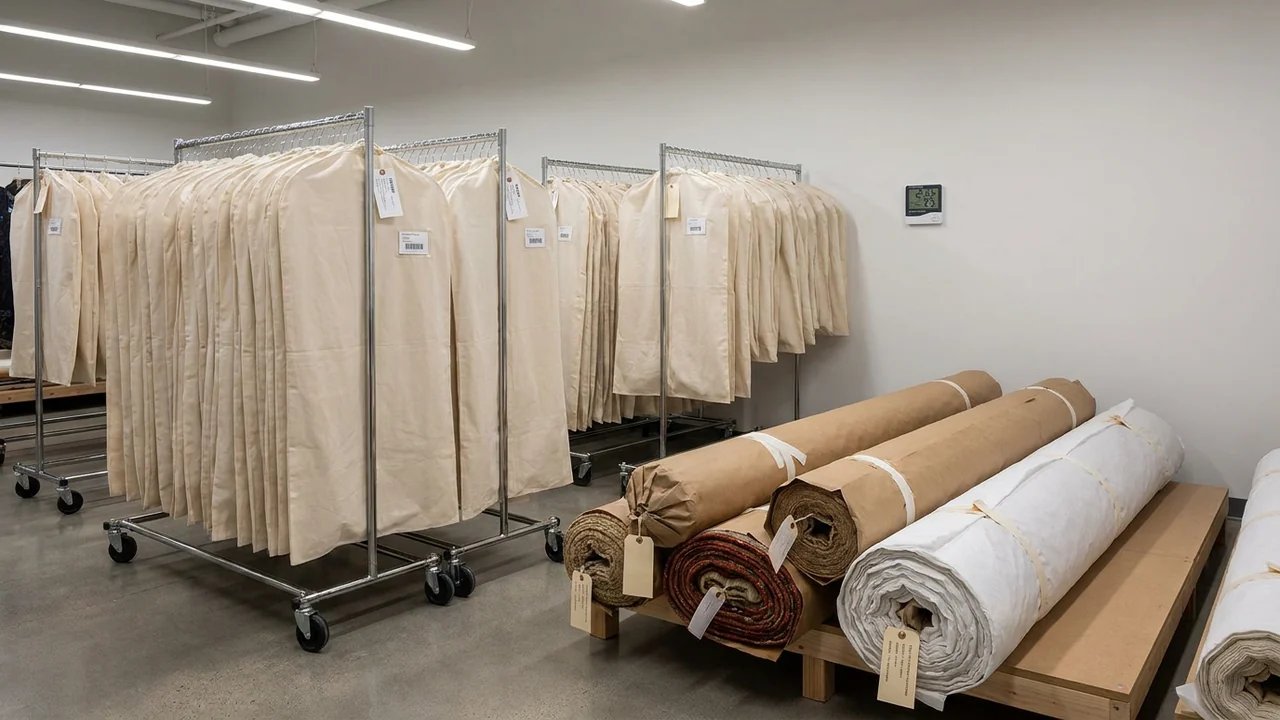
Even when a contents crew prices a couture closet or Oriental rug collection accurately, improper pack-out packaging can destroy the textiles between the loss site and the cleaning plant. The single most destructive mistake in emergency soft-goods handling is sealing damp, warm, or smoke-laden garments and rugs inside airtight poly bags or shrink-wrap. Trapped moisture immediately creates a micro-greenhouse that triggers rapid mold growth, accelerated dye migration (bleeding reds and indigos across adjacent ivory field yarns), latent leather stiffening, and permanent creases.
Equally damaging to carrier and homeowner trust is broken custody. When high-value rugs and couture gowns leave the home for a subcontracted rug-wash bath or specialty dry-cleaner without stitched or looped barcode tags, physical dimension logs, and dual-signature transfers, items go missing or return misattributed—the exact failure mode chronicled in Nobody Could Tell Me Where the Rug Was.
Executing pack-out, third-party vendor handoff, and return recertification under ANSI/IICRC S320 and Chain-of-Custody SOPs protects fragile natural fibers while giving homeowners and adjusters auditable proof at every stage.
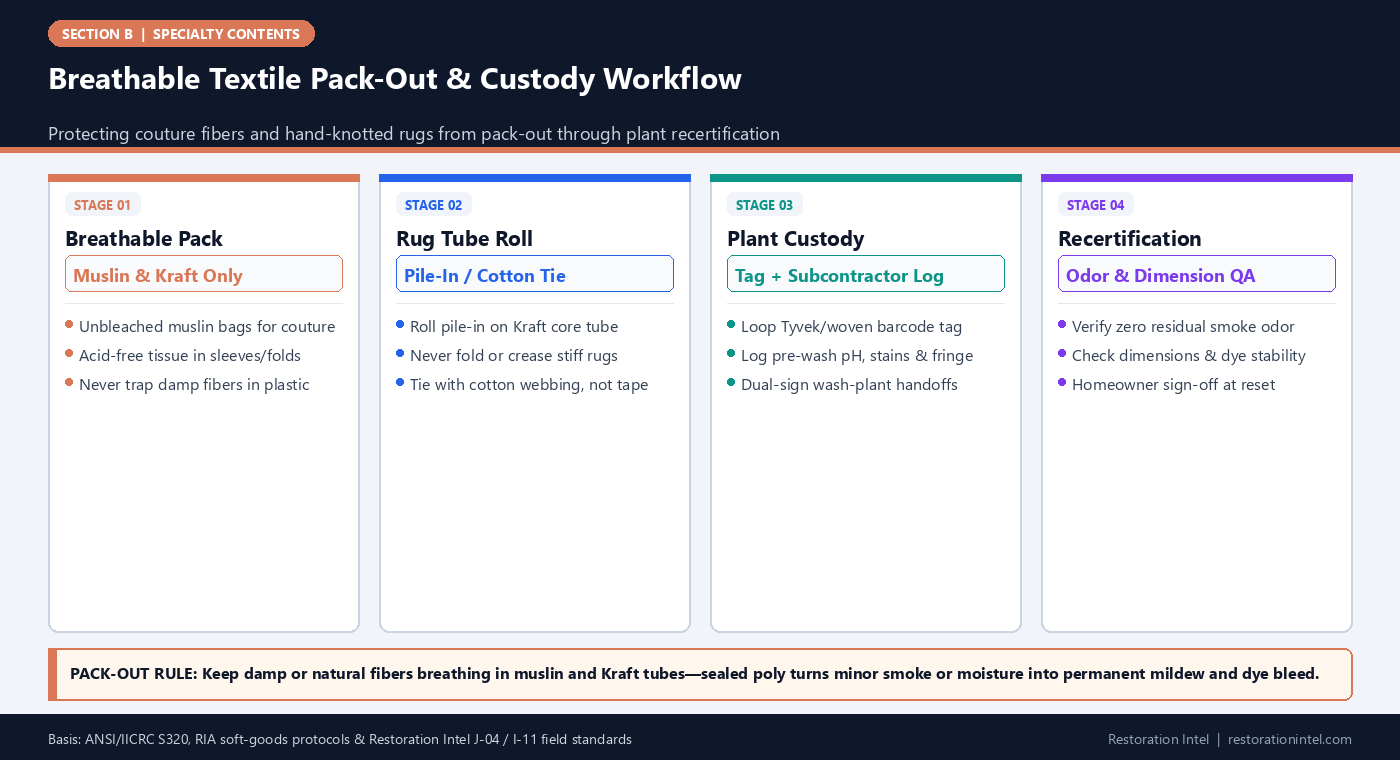
Breathable Textile Pack-Out & Custody Workflow
Specialty Textile & Rug Packaging, Custody & Recertification Matrix
Material-specific wrapping rules, transport constraints, and return acceptance gates for high-value wardrobes and rugs.
| Item Class | Approved Packaging Medium | Prohibited Packaging / Action | Processing / Cleaning Route | Recertification Sign-Off Metric |
|---|---|---|---|---|
| Couture Gowns & Beaded Eveningwear | Unbleached cotton muslin garment bag + acid-free tissue | Sealed dry-cleaner poly bags, wire hangers, masking tape on fabric | Hand spotting / hydrocarbon or wet-clean specialist atelier | Beading intact, zero odor, proper bust/hem form on padded hanger |
| Bespoke Wool & Cashmere Suiting | Wide contoured wood/padded hangers inside breathable wardrobe or muslin | Cramming flat boxes or folding wet wool lapels | Low-moisture dry-cleaning / Esporta or hydroxyl chamber if dry | Lapel roll intact, zero shrinkage, clean lining & pocket inspection |
| Furs, Shearling & Fine Leather | Breathable cotton shroud; climate-controlled transport (45-55°F target) | Plastic wrap, heat drying, ozone chambers (oxidizes pelts/oils) | Specialist furrier glazing, sawdust drum clean & conditioning | Supple pelt/skin flex test, zero hair slip, zero oxidized odor |
| Hand-Knotted Wool Oriental Rugs | Acid-free Kraft core tube + breathable Tyvek/Kraft outer wrap, cotton ties | Folding into squares, taping adhesive directly to fringe/pile, poly wrap | Certified rug plant: dusting, dye-fastness test, cold-water immersion wash | Zero musty/smoke odor, flat blocking, dye-bleed free, fringe combed |
| Silk & Metal-Thread Tapestry Rugs | Large-diameter padded Kraft tube + acid-free tissue interleaving | Creasing brittle silk warps or hanging wet by top edge | Conservation textile cleaner / controlled low-moisture surface extraction | Dimension check, fiber luster intact, zero metallic thread tarnish |
| Custom Silk/Linen Drapery & Valances | Long wardrobe boxes or padded Z-rack shrouds with pleated tissue | Bunching wet pleats into trash bags or crushing pinch-pleat headers | Ultrasonic / solvent specialty drapery cleaning + pleat re-steaming | Exact drop-length check (no shrinkage), intact lining & hooks |
Breathable Muslin & Kraft Rug Tubes vs Sealed Plastic Traps
Packaging choice at the loss site determines whether specialty textiles arrive at the restoration plant salvageable or ruined. Polyethylene garment bags and stretch-film wrap exist for dry, dust-free moving—not for post-fire or water-affected natural fibers. When residual humidity sits inside wool, silk, cashmere, leather, or cotton rug warps, sealing the item inside plastic blocks vapor transmission. Within hours, relative humidity inside the bag spikes toward saturation, turning dormant mold spores active and driving fugitive acid dyes across light-colored borders.
Even on completely dry smoke jobs, cheap dry-cleaner poly and PVC covers can off-gas plasticizers or trap volatile soot odors against delicate silk and fur pelts, accelerating yellowing. Instead, pack couture gowns, tailored jackets, and furs inside unbleached cotton muslin bags or breathable Tyvek shrouds, stuffing sleeves, shoulders, and pleated bodices gently with unbuffered or acid-free tissue paper on wide contoured hangers.
For Oriental and Persian rugs, never fold a rug into a square like a blanket—folding fractures dry brittle cotton warps and sets permanent creases in wool or silk foundations. Roll rugs loosely pile-in (nap facing inward to protect knots from abrasion) around rigid acid-free Kraft carpet tubes, wrap the exterior in breathable Kraft paper or spunbond polyolefin sheeting, and secure exclusively with cotton twill ties rather than adhesive packing tape. See Breathable vs Sealed Film Wrapping Rules for material-by-material containment guidance.
- Muslin over poly on natural fibers: Use breathable cotton muslin or Tyvek garment shrouds for wool, silk, cashmere, fur, and leather.
- Roll pile-in on Kraft tubes: Always roll hand-knotted rugs along the warp direction around a rigid Kraft core; never fold or kink.
- Never tape directly to fibers: Adhesive residue pulls silk pile and stains fringe; tie rolled tubes strictly with cotton webbing or twine.
Immediate Stabilization & Pest Isolation Before Vault Storage
Damp specialty textiles cannot sit in a staging truck or unconditioned vault over a weekend. If Category 1 or 2 water has wetted hand-knotted rugs or luxury apparel, prioritize immediate extraction and rapid controlled air-drying—or cold/frozen stabilization when dye bleed or massive volume prevents same-day plant washing. Never apply high heat to wet silk, wool, or fur: thermal shock shrinks wool felt irreversibly and cooks collagen inside fur pelts until skins tear like parchment.
Once stabilized and dry, climate-controlled vault storage must protect natural protein fibers from both humidity swings and biological pests. Wool, cashmere, and silk are primary targets for webbing clothes moths (Tineola bisselliella) and carpet beetles, especially when soot or food residue lingers on unwashed garments packed hastily from a home.
Keep uncleaned incoming textiles physically isolated from cleaned, recertified vault racks. Avoid throwing raw mothballs (naphthalene or paradichlorobenzene) or bare aromatic cedar blocks directly against couture silk or fur—chemical contact stains fabrics and leaves persistent odors that mimic smoke damage during homeowner inspection.
- Same-day wet triage: Route wet rugs and natural fibers straight to controlled drying tables or cold staging rather than leaving rolled tubes damp overnight.
- Zero high-heat or ozone on furs: Keep pelts and leathers out of ozone chambers and high-heat drying rooms to avoid embrittlement and crack failure.
- Quarantine clean vs dirty zones: Separate incoming soiled wardrobe racks from cleaned vault bays to prevent cross-odor transfer and moth migration.
Tagging, Vault Indexing & Subcontractor Wash-Plant Custody
Because restoration contractors routinely subcontract hand-knotted rug immersion washing and couture hand-finishing to specialized plants, custody gaps happen at the loading dock. As illustrated in Nobody Could Tell Me Where the Rug Was, writing “3 rugs to rug cleaner” on a clipboard guarantees lost-item claims when two Sarouks look similar to a driver.
Every garment and rug must carry a physical, wash-resistant identifier tied cleanly to the master digital inventory before leaving the home. For couture garments, loop Tyvek barcode/QR tags through buttonholes or hanger necks—never pin safety pins through silk chiffon or leather! For Oriental rugs, stitch or tie numbered cloth/Tyvek lot tags onto a secure corner binding and record exact pre-wash measurements (width × length to the half-inch), fringe condition, existing moth grazing, and dye-bleed spots.
Require dual-signature chain-of-custody logs (J-04 Custody Protocol) at every handoff: home pack-out, restoration warehouse intake, wash-plant pickup, wash-plant return, and final vault rack assignment.
- Zero pins through delicate fabric: Loop barcode tags around hangers or secure cloth labels without puncturing silk, lace, or leather.
- Pre-wash dimension & flaw log: Record exact rug measurements and pre-existing wear before immersion so post-wash shrinkage or old splits are never disputed.
- Rack-and-bay telemetry: Index rolled rug tubes on dedicated cantilevered cradle racks—never stack heavy boxes atop rolled rugs.
Specialty Processing Documentation: Immersion Rug Baths & Couture Cleaning
Carrier auditors expect more than a generic subcontractor invoice reading “Cleaned 4 Oriental Rugs — $2,800.” Defensible processing records document the specific technical sequence performed at the plant so adjusters see why hand-knotted rug restoration costs more per square foot than carpet steam cleaning.
For hand-knotted rugs, a certified wash plant performs dry soil dusting/badgering to remove abrasive grit deep in the knot base, pH and wet dye-fastness spot testing across every color family, controlled cold-water full immersion or low-moisture wash with wool-safe surfactants, freshwater rinsing, centrifugal extraction (rather than gravity hang-drying heavy saturated wool that stretches warps), and flat tension-frame or temperature-controlled drying.
For couture and bespoke suiting, log the separation between wet-cleaning/Esporta protein-safe cycles, hydrocarbon or silicone dry-cleaning solvents, and specialized hand-spotting/deodorization. Retaining plant test sheets and batch logs provides airtight justification for specialty pricing tiers under ANSI/IICRC S320.
- Attach plant process tickets: Pair subcontractor invoices with dye-fastness test notes, dusting logs, and wash-method records.
- Document fringe and blocking labor: Separate routine washing from specialized fringe whitening, moth-treatment, or blocking labor.
- Preserve test-wash photos: Photograph soot release and pre/post-treatment clarity under standardized white-balanced lighting.
Recertification, Odor Clearance & Homeowner Reset Sign-Off
A luxury wardrobe or heirloom rug is never ready for return merely because the plant invoice says “complete.” Before scheduling delivery, run an internal recertification bench check in a clean, odor-neutral inspection room. Verify sensory odor clearance on warmed wool and silk seams (residual fire odor often hides inside thick shoulder pads and heavy rug backings until warmed), measure returned rug dimensions against intake baselines, inspect couture linings and beadwork, and confirm garments are pressed, re-stuffed with fresh acid-free tissue, and shrouded in clean breathable covers.
During homeowner reset (J-22 Reset Protocol), unroll every rug and inspect each couture piece alongside the client in natural daylight rather than dropping sealed boxes in a hallway. Capture post-reset placement photos and obtain itemized line-by-line acceptance signatures.
If any garment shows latent shrinkage, unresolved smoke odor, or dye transfer discovered at unrolling, log an immediate exception ticket on the reset manifest rather than arguing at the curb—protecting claim integrity and preventing surprise post-settlement disputes.
- Warm-seam odor test: Check underarms, collars, shoulder pads, and dense rug warp backs in a neutral room before clearing for delivery.
- Daylight unroll verification: Unroll every Oriental rug with the homeowner present to verify flatness, fringe condition, and color clarity.
- Exception-logged reset sheet: Capture itemized sign-off and document any residual flaw immediately as an open supplemental or warranty item.
Practitioner Verification Checklist (B-71)
- Package couture garments, bespoke suiting, and furs strictly in breathable unbleached muslin or Tyvek shrouds with acid-free tissue—never sealed poly over damp fibers.
- Roll Oriental and silk rugs pile-in around rigid acid-free Kraft tubes tied with cotton webbing; never fold rugs or apply adhesive tape to fringe or pile.
- Attach wash-resistant barcode/QR tags via non-piercing loops or stitched cloth labels and log exact rug dimensions and pre-existing flaws prior to wash-plant handoff.
- Obtain dual-signature chain-of-custody transfers at pack-out, plant pickup, plant return, and cantilevered cradle-rack vault placement.
- Perform pre-delivery odor, dimensional, and finish recertification in a clean room and execute daylight unroll sign-off with the homeowner at reset.
Standards, Authority References & Related Reading
Primary standards, insurance definitions, and sibling Restoration Intel guides referenced in this brief:
- ANSI/IICRC S320 Standard for Professional Contents Restoration
- ANSI/IICRC S700 Fire & Smoke Restoration Standard
- Restoration Industry Association (RIA)
- IRMI Insurance Glossary: Salvage
- Verisk XactContents Platform Overview
- Related Guide: Specialty Textiles, Couture Wardrobe & Oriental Rugs: Scope & Hazard Boundaries
- Related Guide: Specialty Textiles, Couture Wardrobe & Oriental Rugs: Capture, Serial & Provenance Logging
- Related Guide: Specialty Textiles, Couture Wardrobe & Oriental Rugs: Cleanability vs Total-Loss Triage
- Related Guide: Specialty Textiles, Couture Wardrobe & Oriental Rugs: Valuation, LKQ Sourcing & Policy Traps
- Related Guide: Nobody Could Tell Me Where the Rug Was
- Related Guide: Field Guide: Chain-of-Custody Form Elements & Pack-Out Sign-Off Template
- Related Guide: Field Guide: Homeowner Reset, Unpack Verification, and Missing/Damaged Item Reconciliation Protocol
- Related Guide: Upholstery, Mattress, and Soft-Furniture Wrapping: Breathable vs Sealed Film Rules by Loss State
.md twin for desk QA and team training.Frequently Asked Questions
Why should damp Oriental rugs or wool suits never be sealed in plastic bags during pack-out?
Sealing residual moisture inside airtight plastic creates high internal humidity that accelerates mold germination within 24 to 48 hours, triggers fugitive dye bleeding across light rug yarns, and traps acidic odors against natural protein fibers.
Should Oriental rugs be rolled pile-in or pile-out on Kraft tubes?
Roll hand-knotted rugs pile-in (nap facing inward) around a rigid acid-free Kraft core tube along the warp direction. This shields the delicate wool or silk pile from abrasion while preventing sharp creases that crack dry cotton warps.
Can fur coats or leather couture go into an ozone deodorization chamber?
No. High-concentration ozone oxidizes natural oils in leather and fur pelts, causing irreversible drying, stiffness, and tearing, and can degrade silk elasticity. Use specialist furrier glazing, hydroxyls only when manufacturer-safe, or low-heat clean-air ventilation.
How do you track garments without damaging delicate silk or lace?
Never pierce couture silk, chiffon, or leather with safety pins or staple tags. Loop Tyvek or woven barcode tags through buttonholes, hanger necks, or seam loops, and photograph the tag alongside the maker label.
What should happen if residual smoke odor is detected at homeowner reset?
Log the item immediately as an open exception on the reset reconciliation sheet, pull the piece back to the clean-zone plant for secondary treatment or specialist reassessment, and notify the adjuster rather than leaving disputed items unlogged.