Direct Answer: Cleanability triage for couture garments, furs, and Oriental rugs hinges on pre-treatment dye-bleed and tensile swatch testing, fiber-specific temperature and solvent limits (never hot-drying fur pelts or wet-washing structured tailoring or viscose), avoiding ozone/hydroxyl oxidation on silks and elastomers, and comparing specialist conservation bids against replacement value.
.md twin for estimator QA and carrier file documentation.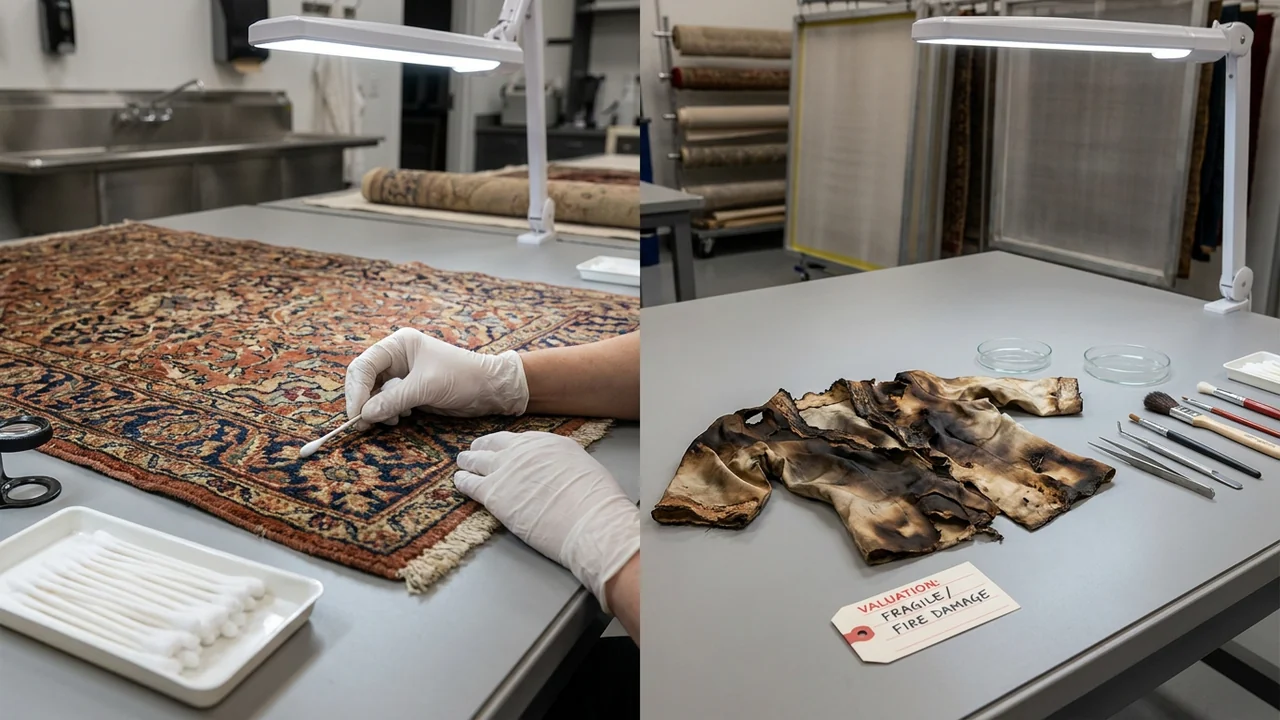
Deciding whether a smoke-damaged Hermes silk scarf, a water-stained Tabriz rug, or a soot-coated mink coat can be cleaned—or must be condemned as a total loss—requires forensic chemistry and textile craft, not guesswork. A restoration plant that skips pre-testing and sends an unverified lot through a standard solvent or aqueous wash cycle risks bleeding crimson madder dye across cream silk warps, gelatinizing leather pelts into rigid cardboard, or shattering weighted antique silk.
Equally dangerous is assuming that gentle ‘airing out’ in a standard ozone or hydroxyl chamber solves smoke odor safely. Oxidizing gases and excessive heat silently break down protein fibroin in silk, turn natural latex rug backings brittle, and snap elastic waistbands, spandex blends, and delicate rubberized couture trims.
Under ANSI/IICRC S320, cleanability triage balances technical restorability with economic feasibility. Conservator & furrier disclaimer: Restoration contractors should rely on documented test results from certified master rug cleaners, couture dry-cleaners, furriers, or textile conservators before committing to full-piece processing or submitting total-loss determinations.
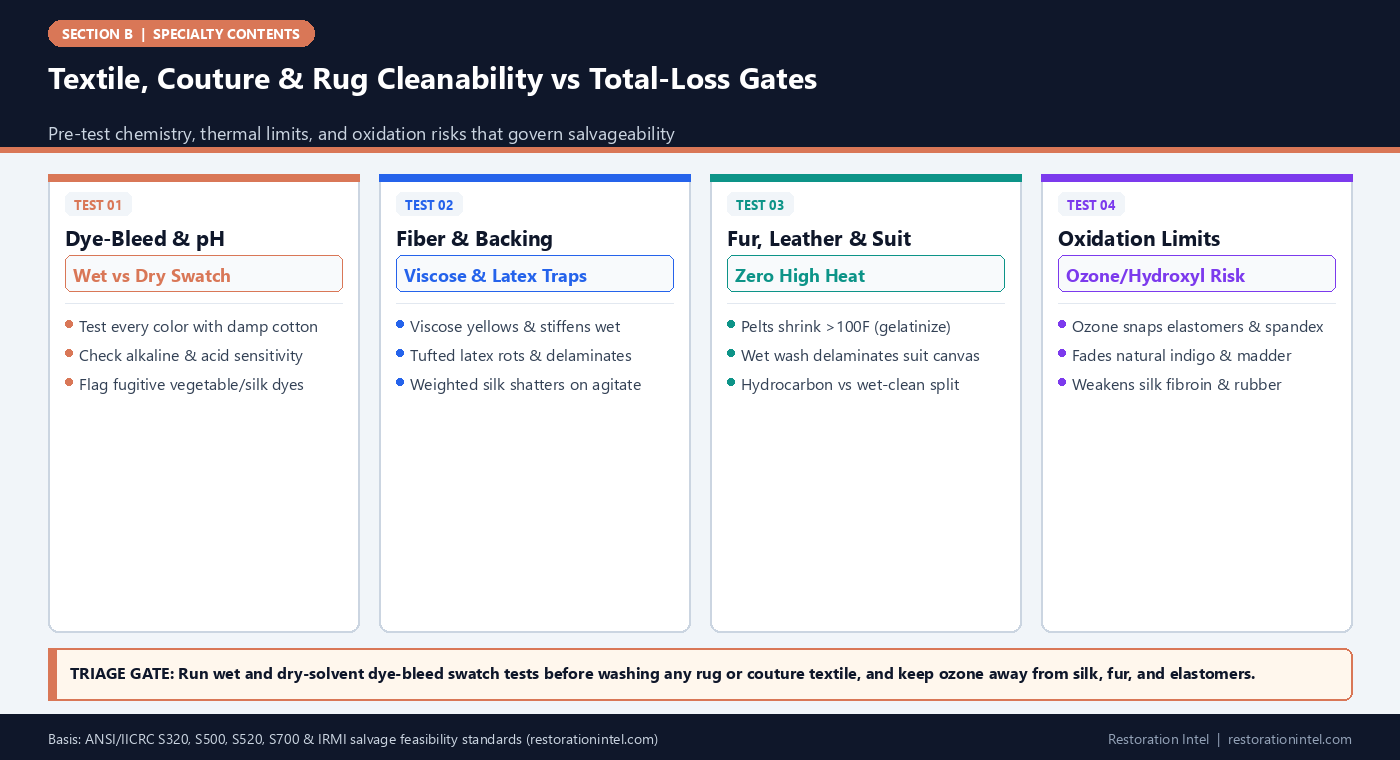
Textile, Couture & Rug Cleanability vs Total-Loss Gates
Specialty Textile & Rug Cleanability Test and Total-Loss Decision Matrix
Diagnostic swatch tests, safe processing ceilings, and non-salvageable triggers across couture, leather/fur, and fine rugs.
| Material / Construction | Mandatory Pre-Clean Test | Safe Processing Pathway | Total-Loss / Non-Salvageable Trigger | Economic & Policy Cross-Check |
|---|---|---|---|---|
| Hand-Knotted Wool Rugs (Natural Dyes) | Wet + neutral-pH + dry-solvent crocking test per dye color | Cold-water immersion wash, dye-lock rinse, flatbed dry | Severe fugitive dye bleed, cotton warp dry-rot, Cat 3 sewage | Master rug plant bid vs certified appraisal ACV |
| Pure Mulberry Silk Rugs & Tapestries | Distilled-water & hydrocarbon solvent spot check | Low-moisture hand-grooming or specialist silk immersion | Water-ring cellulose lock, shattered fibers, irreversible soot | Conservator bid often approaches/exceeds ACV |
| Viscose / Art-Silk / Bamboo Rugs | Micro-damp blot test for stiffening and yellow browning | Dry-compound / ultra-low-moisture specialist care only | Wet stiffness, fiber matting, pervasive brown water wicking | Often total loss when saturated; cheap replacement vs clean |
| Hand-Tufted Rugs (Latex + Canvas Back) | Pull-test canvas glue bond & damp corner check | Surface low-moisture only; avoid full saturation | Latex powdering/delamination, persistent mold/urine odor in glue | Document latex failure before condemning under S500/S700 |
| Couture Silk, Wool Suiting & Beaded Gowns | Colorfastness & trim solvent-dissolve test (sequins/glue) | Gentle hydrocarbon/silicone dry clean or hand spot-clean | Shrunk horsehair interlining, dissolved adhesive, heat-set protein soot | Couture specialist quote vs ACV feasibility |
| Furs, Shearling & Designer Leather | Pelt tear-strength & moisture-shrinkage check | Furrier sawdust drum clean + low-temp controlled glazing | Pelts shrunk or gelatinized by heat/water, active mold in hide | Furrier non-salvageable letter + replacement comp |
Wet-Clean vs Dry-Solvent Dye-Bleed Swatch Testing on Oriental Rugs
Before a hand-knotted rug touches water or dry-cleaning fluid, a master rug technician tests every distinct dye color—especially saturated reds, indigos, oranges, and dark browns—using both distilled water, mild acidic/neutral wool detergent, and dry hydrocarbon solvent on clean white cotton blotters. Pressing the dampened swab firmly onto the pile for 30 to 60 seconds reveals immediately whether dyes are crock-prone or fugitive.
Vegetable dyes used in older village rugs and over-dyed modern pieces can bleed catastrophically if exposed to alkaline detergents or hot water. When a color fails the aqueous test, the rug plant may either stabilize fugitive dyes with controlled acidic setting agents prior to cold immersion, pivot to low-moisture dry-solvent extraction, or document that soot/urine removal cannot proceed without irreversible color run.
Two modern materials fool field estimators regularly: viscose (rayon/bamboo ‘art silk’) and latex-backed tufted rugs. Viscose loses roughly half its tensile strength when wet, mats permanently, and develops stubborn brown cellulose wicking. Hand-tufted rugs hold their yarns together with natural latex adhesive behind a cotton cloth; soaking or heavy smoke often breaks that latex down into chalky white dust, forcing total-loss condemnation.
- Test every color block: A Persian rug may have nine stable dyes and one unstable synthetic repair yarn that bleeds across the entire border.
- Viscose warning: Never promise full water-stain recovery on viscose or bamboo-silk rugs; pre-test a hidden edge for permanent pile stiffness.
- Tufted latex check: Gently flex the rug backing—powdery white residue or crunching indicates irreversible latex degradation.
Couture Garment Construction: Interlinings, Weighted Silk, and Trims
Couture and bespoke garments fail from the inside out when subjected to aggressive restoration laundry. Tailored men’s and women’s jackets use layered internal horsehair canvas, shoulder pads, fusible interlinings, and basted silk linings that shrink at different rates if immersed in water or tumbled hot. Even on ‘dry clean’ machines, harsh perchloroethylene (perc) dissolves plastic sequins, bead adhesives, bonded leather trims, and designer coated buttons.
Antique and vintage silks present an even sharper failure line: historical weighting with tin or iron salts leaves the fabric crisp when dry but prone to spontaneous shattering along fold lines once dampened or agitated. Similarly, heavy protein smoke from kitchen fires under ANSI/IICRC S700 bonds greasy lipids onto raw silk and cashmere, requiring delicate multiple-pass hydrocarbon baths that fragile seams may not survive.
When a test garment shrinks, ripples along fusible lapels, or loses decorative trims in a gentle hydrocarbon test, stop further processing across identical construction pieces and document the test failure for total-loss adjustment.
- Button & trim solvent test: Test decorative buttons, coated zippers, and glued crystals with a drop of dry-cleaning solvent before batching.
- Avoid aqueous Esporta on structured tailoring: Reserve specialized wet-wash systems for athletic gear and non-structured washable textiles unless tested safe.
- Shattered silk flag: Document brittle, splitting vintage silk edges prior to handling so failure is recorded as pre-existing or peril-triggered, not wash damage.
Fur Pelts, Exotic Leathers, and Thermal Shrinkage Thresholds
Fur garments, shearling coats, and fine calfskin or lambskin designer bags are biological collagen matrices tanned with oils and waxes—not woven threads. Once water penetrates a fur pelt and drives out natural tanning oils, or once ambient fire/drying heat rises above safe thresholds (roughly 100 to 110 degrees Fahrenheit), collagen fibers contract and gelatinize. The pelt shrinks irreversibly, turns brittle as parchment, and splits along stitching seams the moment the coat is lifted.
Never send fur or fine leather through standard drying cabinets, heated garment tunnels, or aqueous washing. Restorable furs with light dry soot or smoke odor go strictly to licensed furriers for non-aqueous sawdust-and-solvent drum cleaning, air tumble glazing, and controlled cold-vault deodorization.
If water saturation caused visible pelt stiffening, hairline cracks along the leather backing, or active S520 mold penetration into hide pores, obtain a written non-salvageable evaluation from the furrier rather than attempting DIY conditioning.
- Backing tear test (furrier only): A furrier gently flexes the skin side under the lining to verify whether collagen remains supple or has turned brittle.
- Zero heated tunnels: Prohibit steam finishing tunnels and high-heat drying cabinets on all fur, shearling, suede, and aniline leathers.
- Exotic skin precautions: Python, alligator, and ostrich accessories require specialty leather-conservator assessment because solvents strip scale glazes.
Why Ozone and Hydroxyl Threaten Silks, Elastomers, and Natural Dyes
Odor removal is the phase where specialty textiles suffer silent delayed damage. High-output ozone generators oxidize double carbon bonds rapidly—which destroys smoke molecules, but also shreds natural rubber, spandex/Lycra elastomers, elastic waistbands, coated rainwear membranes, and natural latex backing on rugs. Even moderate ozone exposure can oxidize natural indigo and madder dyes on antique rugs, shifting rich colors toward flat pale tones and embrittling silk fibroin.
While hydroxyl radicals operate at far lower ambient risk than high-concentration ozone, extended multi-day chamber cycles at elevated temperature or UV exposure still carry fading and elastomer-fatigue risk on priceless silks and rubberized trims. When odor persists after safe specialist cleaning (such as furrier sawdust drumming or master rug immersion), rely on enclosed activated-carbon absorption, extended fresh-air resting, or specialist vapor-phase neutralizing agents tested on hidden hems.
Never push a damaged couture piece through repeated aggressive ozone shocks simply to chase a zero-odor metric; if safe cleaning cannot eliminate smoke odor, document olfactory failure under S700 non-salvageable criteria.
- Elastomer quarantine: Pull stretch couture, rubberized trim, spandex linings, and latex-backed rugs out of any ozone deodorization schedule.
- Activated-carbon alternative: Use sealed activated-carbon wardrobe vaults to draw residual volatile odors off delicate silks over several days without oxidation.
- Written odor-failure sign-off: Have the specialty cleaner certify when residual smoke odor remains embedded after maximum safe cleaning passes.
Economic Feasibility: When Conservation Costs Exceed Value
Technical cleanability is only half of triage; economic feasibility under D-13 Cleaning vs ACV and IRMI salvage standards decides the rest. Restoring a heavily smoked, water-wicked hand-tufted viscose rug or a damaged fast-fashion silk dress through multiple specialist cycles can easily cost $600 to $1,200 on an item worth $500 to replace.
Conversely, on a $28,000 antique Tabriz rug or a $9,500 couture gown, spending $2,200 at a master rug cleaner or textile conservator is overwhelmingly economical—provided pre-tests confirm zero dye bleed and structural soundness. Present both quotes side by side for the desk adjuster: itemized conservation/cleaning bid, test results, and verified replacement/ACV benchmark.
Follow up approved salvageable lots with strict custody tracking under rug custody controls and B-71 Pack-Out & Recertification.
- Side-by-side bid packet: Pair the master rug or couture quote directly against verified replacement pricing so adjusters approve cleanly.
- Partial-success warning: Flag items where cleaning removes soot safely but leaves permanent heat distortion or faint tide stains.
- Witness-bin condemned pieces: Retain non-salvageable textiles in labeled witness bins until adjuster disposal sign-off.
Practitioner Verification Checklist (B-69)
- Perform wet, neutral-pH, and dry-solvent dye-bleed cotton-swab tests on every color of a hand-knotted rug before washing.
- Flag viscose/art-silk pile and crumbling latex-backed tufted rugs for likely total loss when saturated or heavily smoked.
- Test couture trims, sequins, and interlinings with gentle hydrocarbon solvent and prohibit aqueous wet-wash on structured tailoring.
- Quarantine furs, exotic leathers, silks, spandex blends, and natural-dyed rugs away from high-heat tunnels and ozone chambers.
- Compare specialist conservation bids directly against verified ACV/RCV benchmarks to substantiate total-loss vs. restoration decisions.
Standards, Authority References & Related Reading
Primary standards, insurance definitions, and sibling Restoration Intel guides referenced in this brief:
- ANSI/IICRC S320 Standard for Professional Contents Restoration
- ANSI/IICRC S500 Water Damage Standard
- ANSI/IICRC S520 Mold Remediation Standard
- ANSI/IICRC S700 Fire & Smoke Restoration Standard
- IRMI Insurance Glossary: Salvage
- Related Guide: Specialty Textiles, Couture Wardrobe & Oriental Rugs: Scope & Hazard Boundaries
- Related Guide: Specialty Textiles, Couture Wardrobe & Oriental Rugs: Capture, Serial & Provenance Logging
- Related Guide: Specialty Textiles, Couture Wardrobe & Oriental Rugs: Valuation, LKQ Sourcing & Policy Traps
- Related Guide: Specialty Textiles, Couture Wardrobe & Oriental Rugs: Pack-Out, Chain of Custody & Recertification
- Related Guide: Cleaning Cost vs Depreciated ACV: Navigating the Economic Feasibility Trap on Restorable Contents
- Related Guide: Structure Fire, Smoke & Protein-Residue Losses: Non-Salvageable vs Restorable Criteria
- Related Guide: Nobody Could Tell Me Where the Rug Was
.md twin for desk QA and team training.Frequently Asked Questions
Why do master rug cleaners perform dye-bleed swatch tests before washing an Oriental rug?
Vegetable dyes and over-dyed yarns can bleed across light wool or silk foundations when exposed to water or alkaline detergents. Swab testing every color identifies fugitive dyes before irreversible bleeding occurs.
Can wet-damaged viscose or bamboo-silk rugs usually be saved?
Rarely. Viscose loses significant tensile strength when wet and suffers permanent pile stiffness and yellow-brown cellulosic browning, frequently making soaked viscose rugs a total loss.
What happens if a wet fur coat is dried in a warm restoration drying room?
Heat above safe furrier limits shrinks and gelatinizes the tanned collagen pelt, turning the backing brittle so seams tear permanently when worn or handled.
Is ozone safe for deodorizing silk dresses, spandex activewear, or wool rugs?
No. Ozone oxidizes rubber/spandex elastomers until they snap, weakens silk fibroin, degrades natural latex rug backings, and fades sensitive natural dyes.
How do you justify declaring a cleanable-looking couture garment a total loss?
Combine specialist dry-cleaner or conservator test notes (showing interlining delamination, trim dissolution, or embedded odor after safe passes) with a side-by-side quote showing conservation cost exceeds replacement or ACV.