Direct Answer: Zero-touch provenance logging for fine art, antiques, silverware, and collectibles pairs raking-light front and back photos with sharp macros of signatures, edition fractions, sterling hallmarks, collector slab serials, and paper authenticity records—turning unpriced heirlooms into auditable valuation dossiers.
.md twin for estimator QA and carrier file documentation.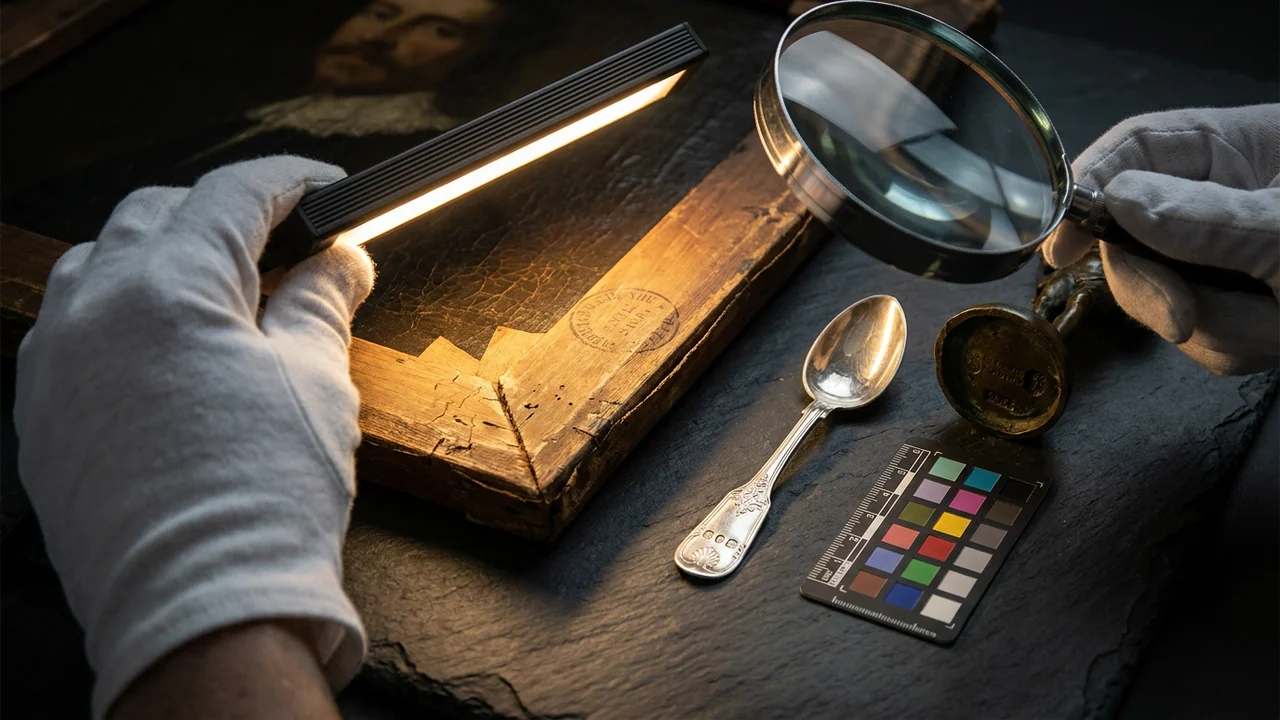
An insurance inventory line reading “Oil painting in gold frame — Living Room — $2,500” or “Silver tea set — 5 pieces” practically guarantees a dispute. Without artist attribution, dimensions, medium, edition number, verso gallery labels, or sterling maker’s hallmarks, neither a carrier examiner nor a USPAP-compliant appraiser can separate a $150 decorative reproduction from a $45,000 museum-provenance original or tell sterling silver from electroplated nickel.
At the same time, B-47’s conservation hold forbids aggressive handling. Field specialists must capture museum-grade forensic imagery using non-contact lighting, calibrated color/scale cards held adjacent to—never resting on—the surface, and methodical recto-to-verso inspection protocols.
Built on ANSI/IICRC S320, NIST forensic imaging discipline, and macro lighting standards, this guide maps every mark to capture before anything leaves the wall. Appraisal & conservation disclaimer: Photographic logging establishes physical evidence for review; formal authentication and valuation require credentialed USPAP appraisers and AIC conservators.
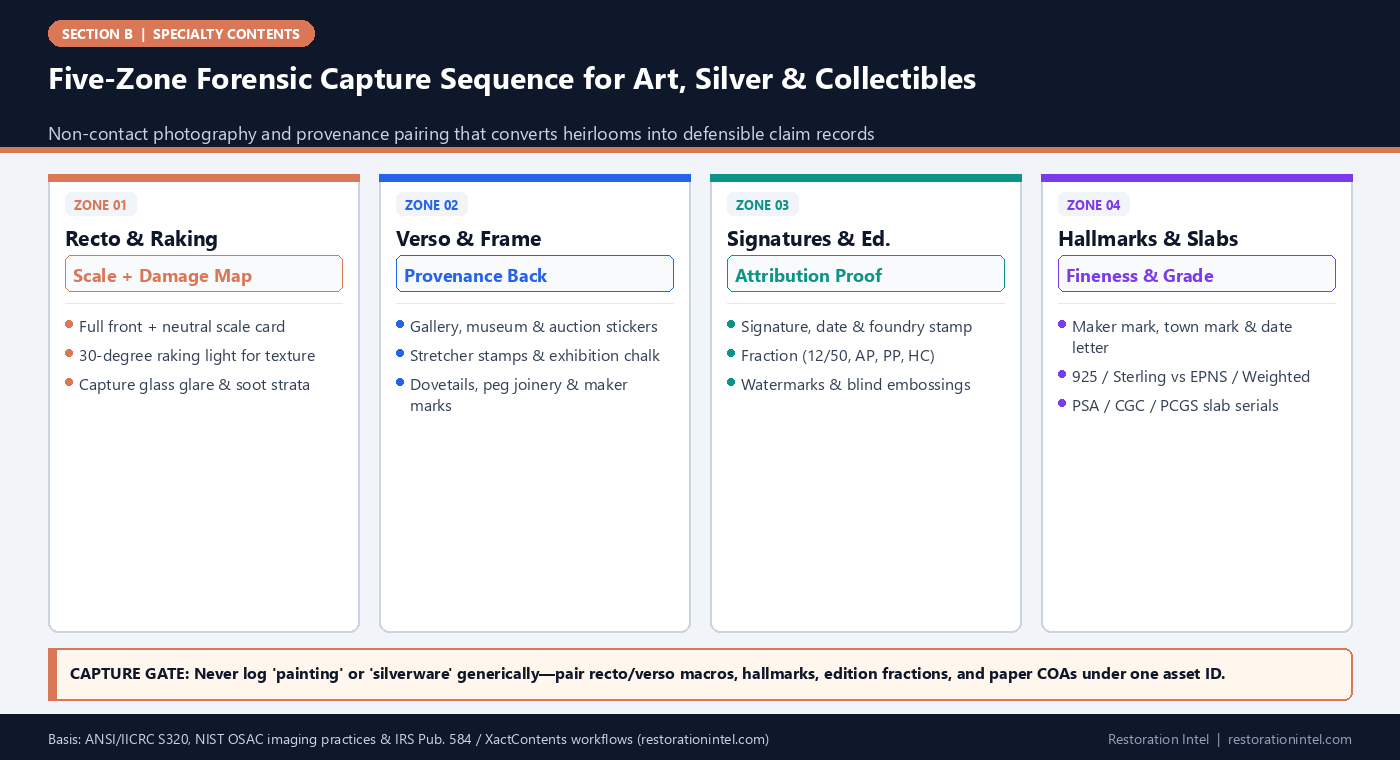
Five-Zone Forensic Capture Sequence for Art, Silver & Collectibles
Fine Art, Antiques, Silverware & Collectibles Macro & Provenance Capture Matrix
Exact diagnostic marks, non-contact capture methods, and high-value traps across specialty categories.
| Asset Category | Mandatory Marks to Photograph | Non-Contact Capture Technique | Critical Distinction Captured | Paper / Digital Provenance Pair |
|---|---|---|---|---|
| Paintings & Framed Works on Paper | Artist signature, date, verso stretcher stamps, gallery/auction labels, framer tags | Zero-flash front shot + 30° raking LED light; mirror/borescope behind safely hung frames | Original oil/watercolor vs giclée/offset print (dot matrix vs brushwork) | Gallery invoice, exhibition catalog, prior USPAP appraisal |
| Limited Edition Prints & Bronzes | Pencil edition fraction (e.g., 14/75, AP), publisher chop mark, bronze foundry seal | Cross-polarized or angled macro light to read faint pencil marks & incised patina stamps | Numbered lifetime edition vs open-run posthumous restrike | Certificate of Authenticity (COA), publisher receipt, estate ledger |
| Sterling Silverware & Hollowware | Maker's mark, fineness (925, Sterling, Lion Passant), town mark, date letter, pattern name | Diffused daylight or bounced LED against white paper tent to kill mirror glare | Solid sterling vs silverplate (EPNS/A1) vs 'Sterling Weighted' base | Pattern inventory count, gram/troy-oz tally (if safely weighed), family registry |
| Period Antiques & Furniture | Cabinetmaker labels, drawer dovetails, lock-plate stamps, underside chalk/brands | Shoot exterior elevations, open drawer joinery, hardware backs & veneer grain | Period 18th/19th-c. joinery & original brass vs 20th-c. revival copy | Dealer bill of sale, restoration history, auction lot listing |
| Trading Cards, Comics & Numismatics | Grading company (PSA/BGS/CGC/PCGS/NGC), grade, slab cert barcode & serial | Shoot slab front/back flat without flash glare; verify cert number sharp on zoom | Authenticated graded slab vs raw ungraded card/coin | Grading registry lookup screenshot, auction invoice, binder list |
| Porcelain, Crystal & Luxury Collectibles | Underglaze backstamps, incised factory marks, acid-etched crystal signatures, box labels | Soft diffused macro over dark/neutral mat; never press down on cracked bases | First-quality factory mark vs factory second (slash mark) or reproduction | Original fitted presentation box, COA, specialty club registry |
Zero-Touch Recto, Verso, and Raking-Light Documentation
Standard overhead room photography leaves fine art looking flat and hides both true medium and physical loss damage. To document a painting, print, or antique safely under conservation-first intake, shoot a straight-on full frame with an adjacent metric scale and color-reference card held just outside the frame—never taped onto gilding or rested against canvas.
Immediately follow with a low-angle raking-light exposure: hold an LED flashlight 20 to 30 degrees off the plane of the artwork. Raking light reveals impasto texture, stretcher-bar impressions, canvas slackening, water tide lines, and soot streaks that flat flash erases. Under magnification, it also helps appraisers distinguish genuine oil brushwork or etching plate marks from mechanical halftone dots on reproductions.
Never yank fragile frames off walls solely to inspect backs if wire or canvas is unstable; use a lighted inspection mirror along the verso gap first, and document gallery stickers, auction lot tags, and framer labels only once an authorized handler or conservator safely lowers the piece.
- Adjacent scale only: Hold rulers and asset tags beside—never touching—paint, gilding, or fragile antique varnish.
- Raking-light proof: Capture at least one oblique side-lit frame on every painting or cabinet veneer to document surface distortion and soot.
- Verso goldmine: Back-of-frame gallery stamps, museum loan numbers, and exhibition stickers often establish provenance worth more than the signature alone.
Decoding Signatures, Edition Fractions, and Foundry Marks
For prints, photographs, and bronzes, market value hinges on exact edition status rather than image subject alone. A signed lithograph numbered 14/50 or marked AP (Artist’s Proof) carries a completely different market valuation than an unsigned poster or a posthumous unlimited edition.
Capture tight macro shots of every pencil signature, blind-embossed publisher chop mark in the paper margin, plate signature, and incised foundry mark near the base of bronze or ceramic sculptures. Kill on-camera flash and use bounced warm light so graphite pencil signatures do not disappear under glass glazing.
Record exact visible dimensions (sight size inside the mat and overall frame exterior) alongside medium notes—without guessing authenticity in the claim text. Phrase descriptions neutrally as “Framed oil-on-canvas bearing signature ‘J. Smith’ lower right” until an appraiser verifies attribution.
- Capture full fraction strings: Shoot the entire margin inscription including
AP,PP,HC, roman numerals, and publisher blind stamps. - Bronze & stone bases: Inspect rear plinths and bottom rims for foundry stamps, copyright dates, and cast numbers.
- Neutral attribution wording: Record visible inscriptions verbatim without asserting unverified authenticity as a field technician.
Sterling Silver Hallmarks, Weighted Bases, and Pattern Logging
Silverware losses are chronically under-documented when crews toss assorted pieces into a box labeled “1 box silver utensils.” Value diverges sharply between solid sterling (925, Sterling, or British Lion Passant hallmarks), continental 800 silver, coin silver, silver-weighted bases (marked Sterling Weighted or Cement Filled), and silverplate marked EPNS, EPBM, or A1.
Mirror-bright silver reflects camera flashes into unreadable white streaks. Surround the hallmark area with a curved white index card or folding light tent to bounce soft, even illumination onto the tiny punch stamps, and macro-shoot the maker’s mark, town assay mark, date letter, and fineness stamp.
For flatware sets, group and count pieces strictly by exact form—dinner knives, luncheon forks, salad forks, teaspoons, serving spoons—noting monograms and original fitted felt chests, which directly impacts Pairs-and-Sets valuation.
- Tent-diffuse hallmark macros: Use a white paper card to block harsh reflections when shooting tiny silver assay punches.
- Separate solid vs weighted vs plate: Never lump
Sterling Weightedcandlesticks orEPNStrays into solid-sterling weight math. - Exact flatware piece counts: Tally every utensil type and monogram pattern cleanly for pattern-matching replacement lookup.
Collector Slabs, Antiques Joinery, and Tamper-Evident Logs
Modern collectibles—sports cards, comic books, coins, watches, and autographed memorabilia—rely heavily on third-party grading encapsulation (PSA, BGS, CGC, PCGS, NGC) and tamper-evident holograms. Photograph the full slab front and back so the numeric grade, variant label, certification number, and barcode remain razor-sharp on screen zoom.
If water or soot entered a cabinet holding graded slabs, photograph moisture droplets, warping, or label staining through the intact acrylic case without cracking it open. On antique furniture, document hand-cut dovetails, wooden pegs, original backboards, maker paper labels inside center drawers, and period hardware backs—details that prove authentic period construction over modern reproductions.
Following collectible documentation standards, pair every macro image in XactContents with the specific cabinet, binder, or shelf zone where it sat.
- Cert-number verification: Pinch-zoom every PSA/CGC/PCGS slab photo on site to confirm every serial digit is legible.
- Joinery & underside evidence: Shoot drawer dovetails, lock plates, and underside maker stencils on period furniture.
- Fitted box retention: Log original watch boxes, porcelain presentation cases, and COA inserts alongside the objects.
Pairing Physical Captures With Provenance Dossiers Safely
Physical object photos tell only half the story. The remaining proof sits in the owner’s desk drawers, safe-deposit records, or email archives: original gallery bills of sale, auction invoices, insurance schedules, exhibition history, and prior appraisals structured similarly to IRS Publication 584 workbook records.
Ask the insured early for copies of Certificates of Authenticity, prior valuation schedules, and digital receipts, linking each document directly to its asset ID. At the same time, respect security and privacy boundaries outlined in high-sensitivity exclusions: vaulted jewelry, bullion, and confidential security alarm layouts should be inventoried cleanly with the owner without broadcasting home storage details on open crew tablets.
- One-to-one COA pairing: Attach scanned bills of sale, COAs, and auction receipts directly to the matching numbered inventory line.
- Surviving-box recovery: Check closets and attics for empty numbered boxes and velvet cases that confirm edition provenance.
- Access-controlled logs: Restrict high-value fine-art and bullion location files to lead estimators, adjusters, and the insured.
Practitioner Verification Checklist (B-48)
- Shoot straight-on front photos with an adjacent metric scale and color reference card—never rest tags or rulers against artwork surfaces.
- Capture 20–30° raking-light photos on paintings, prints, and period wood surfaces to document texture, craquelure, warping, and soot.
- Log artist signatures, edition fractions (e.g., 14/50, AP), blind publisher stamps, foundry seals, and verso gallery/auction labels.
- Use diffused bounced lighting to macro-capture sterling silver hallmarks, fineness stamps (925/Sterling vs EPNS/Weighted), and flatware pattern counts.
- Verify sharp legibility of grading-slab serial numbers (PSA/CGC/PCGS/NGC) and antique drawer joinery/maker labels before leaving the room.
- Link matching Certificates of Authenticity, gallery invoices, and prior USPAP appraisals to each asset ID under access-controlled storage.
Standards, Authority References & Related Reading
Primary standards, insurance definitions, and sibling Restoration Intel guides referenced in this brief:
- ANSI/IICRC S320 Standard for Professional Contents Restoration
- Verisk XactContents Platform Overview
- NIST Organization of Scientific Area Committees for Forensic Science
- IRS Publication 584: Casualty, Disaster, and Theft Loss Workbook
- Restoration Industry Association (RIA)
- Related Guide: Fine Art, Antiques, Silverware & Collectibles: Scope & Hazard Boundaries
- Related Guide: SPC-ART-CONSERVE: The Painting Gets an Expert Before It Gets a Number
- Related Guide: Fine Art, Antiques, Silverware & Collectibles: Valuation, LKQ Sourcing & Policy Traps
- Related Guide: Pre-Loss Documentation for Collectibles, Wine Cellars, and Memorabilia Without Full Appraisal Fees
- Related Guide: Macro Lighting & Focus Technique for Faded Serial Tags, Brass Nameplates, and Dark Utility Closets
.md twin for desk QA and team training.Frequently Asked Questions
Why should field technicians avoid writing 'authentic Picasso' or similar attribution claims in raw inventory notes?
Field technicians document physical inscriptions, signatures, and labels—not legal authenticity. Using neutral phrasing such as ‘signed lower right’ preserves credibility until a qualified USPAP appraiser or specialist verifies provenance.
How do you photograph sterling silver hallmarks cleanly without blinding flash glare?
Turn off the camera flash and wrap a white index card or small light-diffusing tent around the hallmark area, bouncing soft LED light sideways across the stamped punch marks.
What does 'Sterling Weighted' mean on candlesticks or salt shakers?
It means a thin outer shell of sterling silver surrounds a non-silver core such as pitch, rosin, or plaster for stability. Weighted pieces cannot be valued by gross scale weight as solid sterling.
What information on a collectible grading slab is most important to capture?
Ensure the grading company (such as PSA, BGS, CGC, PCGS, or NGC), numerical grade, variant/label notes, and full certification serial number and barcode are razor-sharp and legible.
Should technicians remove framed paintings from the wall just to photograph the back?
Only if the artwork is structurally stable and authorized. On soot-exposed or fragile pieces under a Conservation Hold, use an inspection mirror first and wait for a qualified art handler or conservator.