Direct Answer: Replacement Cost Value (RCV) is defined by current market cost to replace with Like Kind and Quality at the time of loss or replacement—not historical purchase price—so when inflation or tariff shocks push new retail prices 20 to 40 percent above original receipts, estimators must attach live OEM/retail quotes and exact spec-match proof to defeat outdated price anchoring.
.md twin for estimator QA and carrier file documentation.
During periods of stable consumer pricing, an estimator could glance at a four-year-old purchase receipt for a refrigerator, dining table, or commercial espresso grinder and expect the current Replacement Cost Value (RCV) to sit within a few percent of what the insured originally paid. Supply-chain disruptions, imported steel and cabinetry tariffs, and rapid appliance price resets shattered that assumption.
Today, it is routine to see a five-year-old mid-range washer, imported sectional, or power-tool kit retail for 25 to 45 percent more than its original receipt price—even when accounting for identical or stripped-down modern specs. Because IRMI defines Replacement Cost as the current cost to replace damaged property with new property of Like Kind and Quality without deduction for depreciation, tying RCV to stale historical receipts violates basic indemnity math. The challenge for practitioners is proving those sudden cost jumps cleanly inside XactContents and carrier desk reviews.
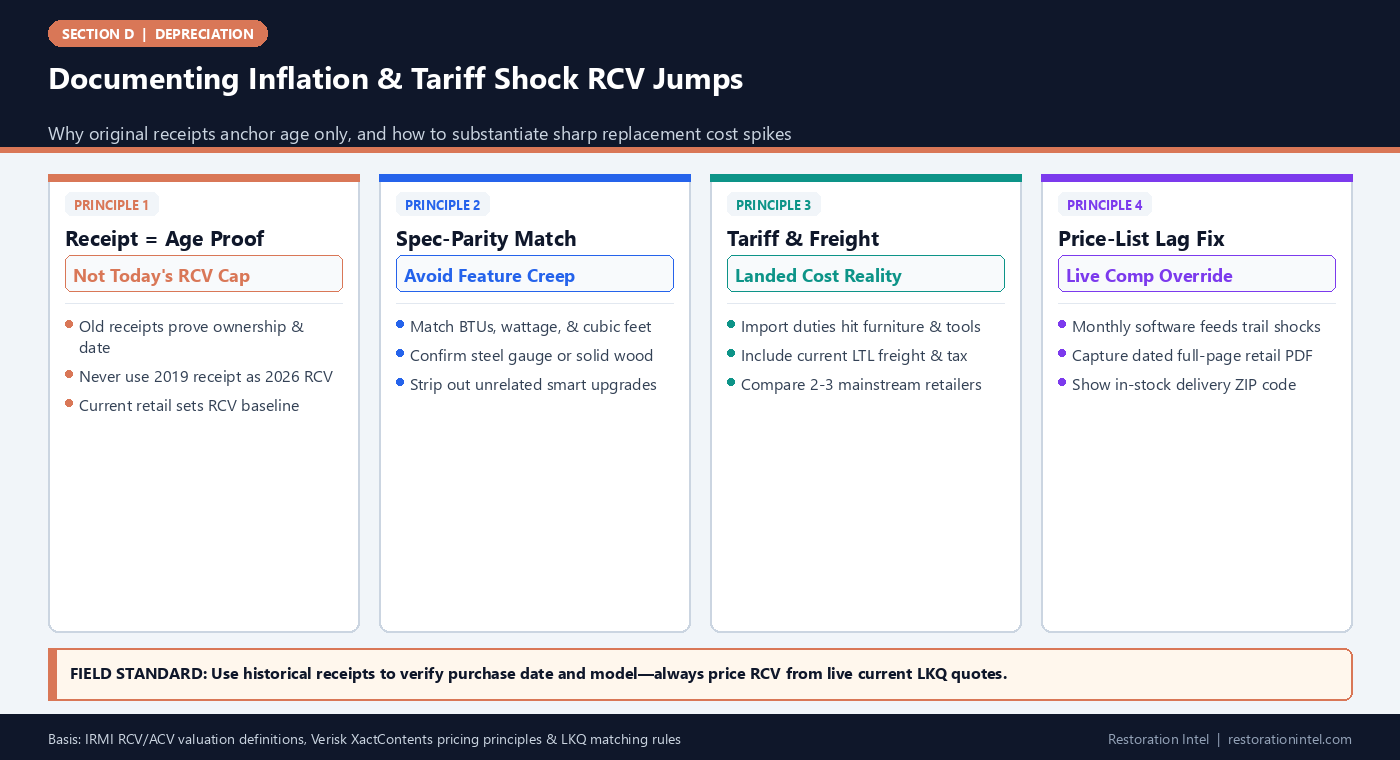
Documenting Inflation & Tariff Shock RCV Jumps
Historical Receipt Anchoring vs Live Market LKQ Verification
How inflation and tariff shifts affect four major contents categories and what proof desk examiners require to approve higher RCV.
| Category | Why Historical Price Understates RCV | Software Catalog Lag Risk | Examiner-Accepted Proof Standard | Hidden Spec Trap to Avoid |
|---|---|---|---|---|
| Imported Hardwood & Upholstered Furniture | Container freight, lumber, and import tariff increases reset MSRP tiers | Generic 'Medium Grade Sofa' averages lag custom/imported tier spikes | Current manufacturer or dealer listing matching frame, fill, & fabric grade | Comparing solid wood original to modern veneer knockoff |
| Major Appliances & HVAC Accessories | Component tariffs, refrigerant mandates, and energy-efficiency redesigns | Discontinued SKU defaults drop to lower-tier entry replacements | OEM successor model sheet matching capacity, finish, & cycle specs | Accepting downgraded capacity just to match old receipt dollars |
| Corded & Cordless Power Tools | Battery-cell, copper winding, and import duty price resets | Quarterly catalog updates miss sudden manufacturer MSRP jumps | Live quotes from two national distributors for exact tool/kit SKU | Priced bare-tool only when loss included charger and battery packs |
| Bicycles, Sporting, & Outdoor Gear | Frame alloy/carbon tariffs and component-group MSRP increases | Software groups mid-tier bikes with department-store averages | Bike-shop or OEM spec-sheet comp matching drivetrain & frame material | Ignoring assembly, rack, and custom accessory add-ons |
| Commercial Kitchen & Shop Equipment | Stainless steel surcharges, commercial shipping, and UL listing updates | Regional residential catalogs underprice NSF-certified commercial units | Commercial dealer quote including liftgate freight & crating | Using consumer countertop comps for NSF commercial gear |
Why Historical Purchase Receipts Are Age Evidence—Not Valuation Ceilings
A recurring mistake at both the policyholder and desk-examiner levels happens when someone pulls a six-year-old credit-card receipt for a $1,100 washer or a $2,800 dining set and enters that historical figure as the Replacement Cost Value. When the examiner then deducts 40 percent depreciation from $1,100 to arrive at a $660 ACV—even though an identical replacement model now retails for $1,550—the insured is shorted twice: first by an artificially depressed RCV, and second by an ACV calculated against yesterday’s dollars.
Under standard property insurance indemnity, both RCV and ACV (traditionally RCV at the time of loss less depreciation) look forward to what it costs to replace the item in today’s market, not backward to what the item cost years ago. Historical receipts are golden evidence for proving ownership, exact model SKU, and chronological age—but current retail listings determine RCV.
- Separate the two columns: Record ‘Original Purchase Price’ strictly as a reference note when helpful, while entering verified current retail cost in the RCV field.
- Educate insureds early: Remind homeowners not to under-report lost items on worksheets simply because they remember buying them on clearance five years prior.
- Check deflation exceptions honestly: Maintain credibility by letting electronics (such as 4K TVs) reflect current *lower* retail prices when tech deflation lowered LKQ cost.
When Estimating Software Price Lists Lag Sudden Tariff and Supply Shocks
Monthly or quarterly estimating database updates inside XactContents and Symbility provide reliable baselines during normal markets. However, when sudden tariffs, port bottlenecks, or manufacturer price-sheet resets hit specific product categories mid-quarter, static catalog averages lag live retail shelves by weeks or months.
Whenever a static catalog line trails live replacement pricing by a material margin, do not silently overwrite the number without documentation. Export or print a full-page timestamped PDF of the live manufacturer or national retailer listing showing the SKU, delivery ZIP code, stock status, and total landed price, and attach it directly to the line item in your supplement or schedule.
- Use two independent comps on big jumps: When current RCV exceeds historical cost or catalog defaults by more than 25 percent, include quotes from two reputable sellers.
- Verify real availability: Exclude ‘out of stock’ zombie pages and inflated third-party marketplace scalper listings that distort legitimate market pricing.
- Document shrinkflation & material downgrades: Show clearly when a newer low-cost SKU switched from solid steel or solid oak to plastic or particleboard—requiring a higher-priced tier for true LKQ.
Isolating True Inflation From Unjustified Spec Creep
Examiners grow understandably skeptical when ‘inflation adjustments’ double as disguised upgrades—such as replacing a 2018 entry-level top-mount refrigerator with a 2026 French-door smart-screen model. The cleanest way to win rapid approval on tariff-shocked pricing is proving strict technical parity side-by-side.
Build a two-line spec bridge in the estimator note: list the damaged item’s core attributes (dimensions, motor horsepower, stainless thickness, fabric rub count, or BTU output) next to the current successor SKU’s identical attributes. When the examiner sees that the same manufacturer’s closest spec-for-spec successor jumped from $1,400 to $1,950 due to list-price resets, the variance looks objective rather than opportunistic.
- Anchor to the OEM successor: Manufacturer replacement-chart cross-references are the fastest way to prove spec continuity.
- Account for bundled accessories: Verify whether historical prices included racks, extra batteries, or stands that are now unbundled.
- Flag freight and crating surcharges separately: Keep tariff-driven LTL freight or white-glove delivery increases itemized in their proper shipping column rather than hidden inside unit MSRP.
Aligning ACV and Recoverable Holdbacks When Prices Keep Moving
On multi-month rebuilds, replacement prices can continue climbing between the date-of-loss schedule and the month when the insured actually repurchases contents after Certificate of Occupancy. Under standard claims settlement workflows, if an insured has HO 04 90 Replacement Cost coverage and submits paid receipts showing that the exact agreed LKQ item now costs more at replacement than estimated at date of loss, supplemental RCV adjustments are routinely requested—up to policy limits.
However, carriers closely scrutinize whether price increases reflect genuine market inflation for the same LKQ spec versus buyer upgrades. Saving dated initial comps alongside final replacement purchase invoices gives examiners an airtight bridge from original loss valuation to final recoverable payout.
- Preserve initial quote snapshots: Archive full-page PDFs of every high-value comp at submission time because live URLs expire within weeks.
- Compare receipt SKUs against original LKQ specs: Flag any model changes on final purchase receipts before requesting supplemental inflation adjustments.
- Watch Coverage C limit compression: Remind teams on near-limit fires that sharp price inflation across hundreds of items can push total RCV past Coverage C limits faster than historical estimates suggested.
Practitioner Verification Checklist (D-22)
- Use historical purchase receipts strictly to verify ownership, model specs, and chronological age—never as an automatic RCV ceiling.
- Pull live, timestamped quotes from mainstream or OEM retailers whenever software price lists lag sudden tariff or inflation spikes.
- Prove strict spec parity (dimensions, capacity, materials, power rating) alongside the current LKQ comp so price jumps are not misread as upgrades.
- Exclude third-party marketplace price-gouging or out-of-stock placeholder listings when documenting market RCV.
- Monitor aggregate inflated RCV against total Coverage C policy limits early on large residential or commercial losses.
Standards, Authority References & Related Reading
Primary standards, insurance definitions, and sibling Restoration Intel guides referenced in this brief:
- IRMI Insurance Glossary: Replacement Cost Value (RCV)
- IRMI Insurance Glossary: Actual Cash Value (ACV)
- Verisk XactContents Platform Overview
- Verisk Property Claims Solutions
- Related Guide: RCV vs ACV Fundamentals in Contents Claims: How Replacement Cost, Depreciation, and Holdbacks Actually Work
- Related Guide: Sales Tax, Shipping, and Crating in RCV and ACV Contents Settlements
- Related Guide: Like Kind and Quality (LKQ) Replacement Matching: Rules for Discontinued Brands and Obsolete Models
- Related Guide: Estimating Software Price Lists vs Live Retail Links: Audit Rules for Verifying Contents Line Pricing
- Related Guide: Three Adjusters, Three Economies
.md twin for desk QA and team training.Frequently Asked Questions
If I still have the receipt from five years ago, am I capped at what I originally paid?
No. Standard Replacement Cost Value (RCV) measures what it costs to replace the item today with Like Kind and Quality. If prices rose due to inflation or tariffs, current market price governs—up to policy limits.
Why do estimating software price lists sometimes differ from current store prices?
Software catalogs update on periodic cycles and rely on blended regional feeds, which can lag abrupt manufacturer MSRP increases, tariff adjustments, or freight surcharges.
What proof convinces an adjuster to override a lower historical receipt or software price?
Full-page, dated PDF captures or printouts from reputable national or OEM dealers showing the exact in-stock successor SKU matching original specs, plus local delivery ZIP pricing.
What if electronics prices went down since purchase instead of up?
Like Kind and Quality works both ways: if a comparable new television or computer with equal or better specs costs less today than five years ago, current lower retail price sets the RCV.