Published November 14, 2026. By Will Tygart · Restoration Intel Editorial Desk.
Direct answer. A blind room audit tests any contents workflow by staging a real, pre-inventoried multi-zone test space against a sealed ground-truth manifest and scoring manual, barcode, and AI pipelines on recall, taxonomy accuracy, labor minutes, and XactContents export parity using neutral Adjuster Desk rubrics.
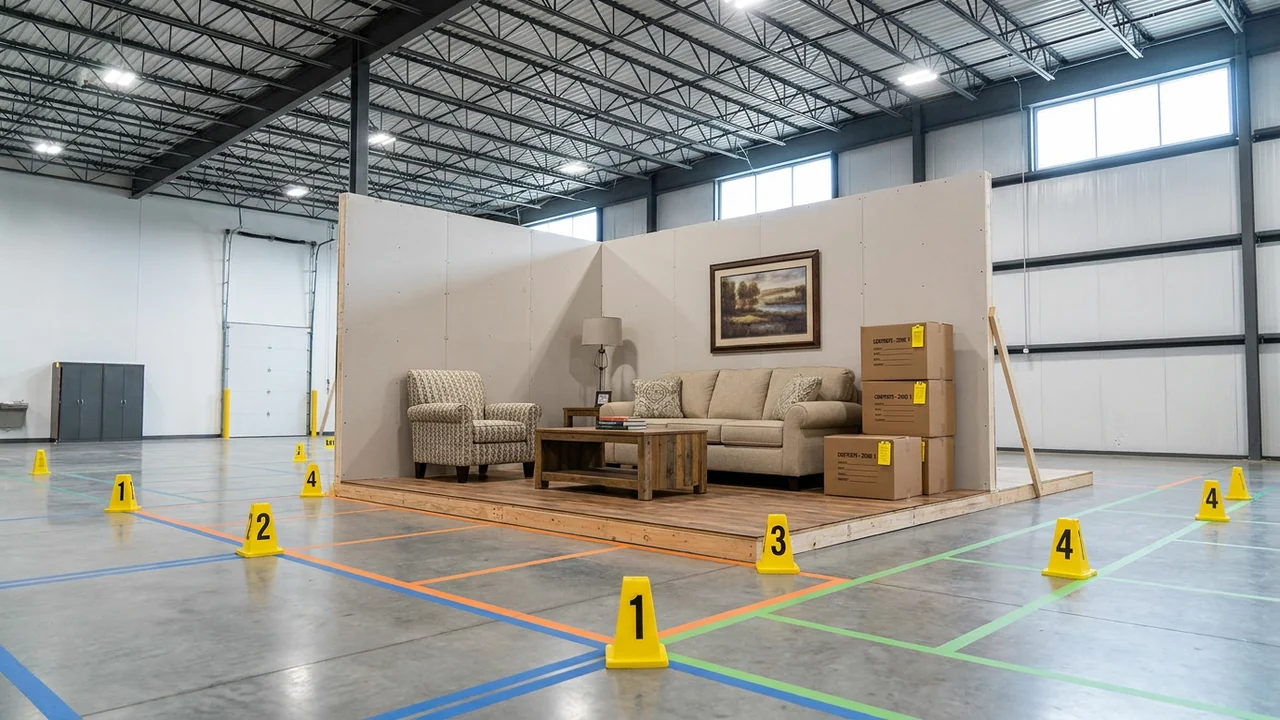
Software demos almost always showcase bright, tidy living rooms with five pieces of designer furniture and spotless serial labels. Real loss sites offer smoke-hazed basements, half-open pantry cabinets, mismatched hardware totes, and technicians working under time pressure. Testing a workflow inside a vendor’s curated demo environment measures sales choreography, not field performance.
Borrowing the editorial testbench mindset from The Adjuster Desk: One Standard, Two Chairs, restoration owners can stage a neutral blind room audit in half a day inside an existing warehouse bay or training suite. Because both field crews and automated pipelines face the exact same locked room manifest under identical clock rules, you replace marketing anecdotes with clean public audit math.
Standardized Blind Audit Test Bay Item Mix (100-Item Reference Blueprint)
A balanced 100-item test room exposes occlusion, OCR distortion, bulk counting, and taxonomy weaknesses in one 30-minute pass.
| Test Zone | Item Mix Count | Specific Traps Intentionally Staged | Primary Metric Tested |
|---|---|---|---|
| 1. Open Living / Office Zone | 25 items | Mixed custom woodwork vs veneer, curved monitor backplate, stacked decor, multi-cord desk electronics | Category precision & quality tier grading |
| 2. Dense Pantry / Closet Bay | 35 items | Nested cookware, 12+ identical canned/boxed SKUs, hanging garments 3-deep on rod, opaque floor bin | Quantity counting & occlusion limits |
| 3. Utility / Appliance Corner | 15 items | Soot-smudged washer rating tag, low-contrast stainless serial plate, tangled power tool cords | OCR/brand/model capture accuracy |
| 4. Fragile / Sublimit Drawer | 15 items | 2 pieces costume vs fine jewelry mix, vintage camera lens, framed artwork glass glare, small collectibles | Fine detail capture & sublimit flagging |
| 5. Sealed & Bulk Containers | 10 units (3 boxes + loose) | 2 taped moving boxes labeled broadly + 1 open bin with layered hardware trays | Container transparency vs hallucination restraint |
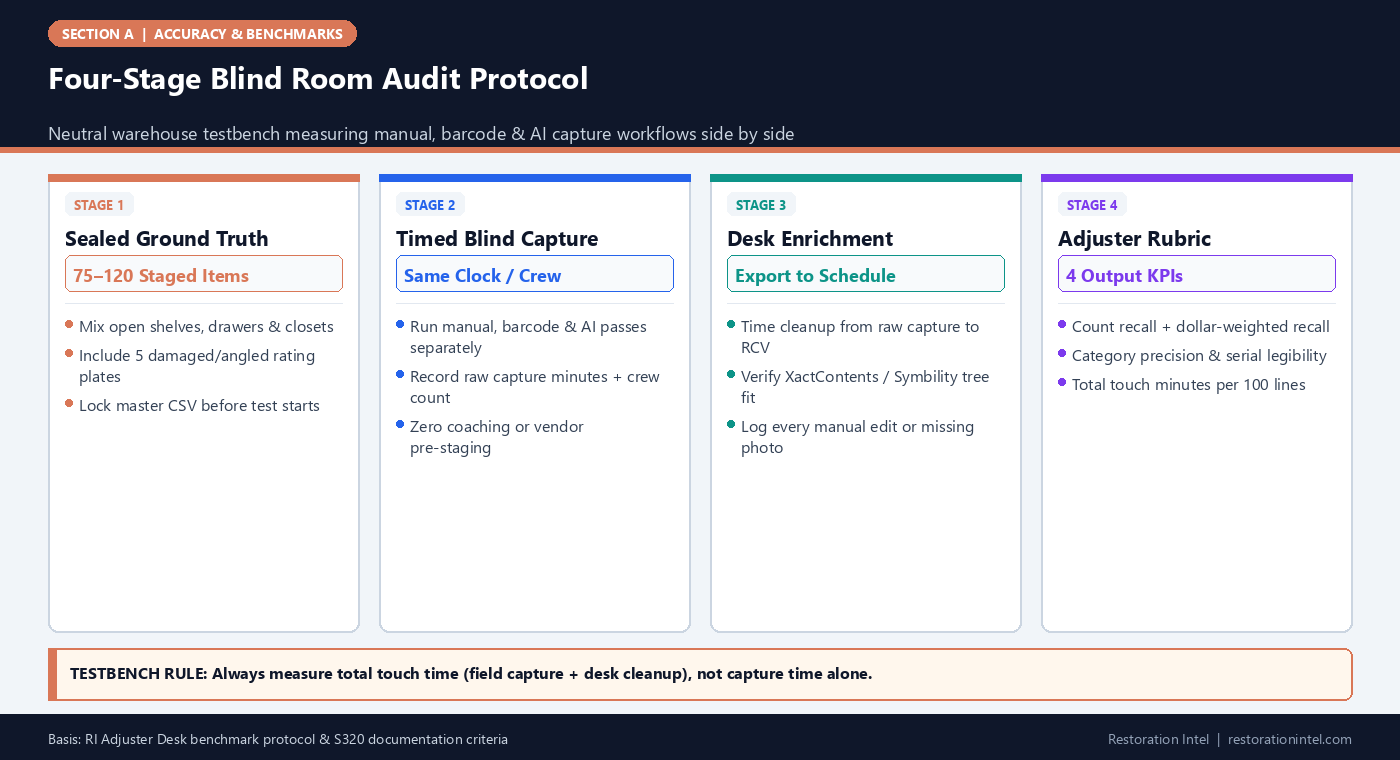
Why Total Touch Time Beats Field Capture Speed Alone
The most common trap in technology trials is timing only the technician in the room. A phone walkthrough that finishes a bedroom in four minutes looks five times faster than manual barcode logging — until an estimator at the office spends forty minutes renaming ‘brown box’, correcting 18 unit quantities, and re-entering missed appliance models from blurry frames.
A valid blind room audit records two separate clocks: Field Clock Minutes (arrival to capture complete) and Desk Cleanup Minutes (ingestion to carrier-ready export passing internal QA). Adding those two clocks together reveals true labor cost per 100 carrier-accepted lines.
- Enforce a 48-hour cooling window between competing runs by different crews, or use independent estimators during cleanup scoring.
- Track how many lines require opening external retail tabs manually versus automated catalog/LKQ match.
Scoring the Output Against Carrier Desk Criteria
Once each workflow produces an exported CSV or ESX-ready schedule, score it against the sealed ground-truth manifest using four binary/numeric checks. Does the line map cleanly to the true physical item? Does the category belong in the right XactContents or Symbility bucket? Is the model number accurate without character errors (such as swapping 0 for O or 8 for B)? And does every line have a linked photo clear enough that an independent adjuster would approve it on first review?
By reusing the same audit bay quarterly, restoration teams also measure whether internal crew training improves inter-rater consistency — linking tech coaching directly to verifiable schedule accuracy.
Preventing Subtle Bias During Vendor Trials
Never let an outside software rep adjust lighting specifically for their run or hand-pick items from your test shelf after viewing the manifest. Lighting should replicate typical temporary job-site work lights (one overhead shop lamp plus ambient window light), and technicians must capture closed doors/drawers strictly according to your normal pack-out SOP.
If testing an AI inventory vendor, demand raw export files within the promised turnaround SLA rather than cleaned slides presented a week later.
Field Execution Checklist
- Build and lock a 75–120 item ground-truth spreadsheet with SKU/model photos before exposing the bay to any crew or tool.
- Include obscured labels, stacked pantry rows, and sealed boxes so workflows are stress-tested on realistic friction.
- Record Field Capture Time AND Estimator Desk Cleanup Time separately to expose hidden post-processing labor.
- Grade outputs blindly using an estimator who did not witness the capture pass.
- Verify that exported schedules include clickable photo linkage per line item before grading carrier readiness.
Related Restoration Intel Guides & Reference Standards
- Companion Brief (A-01): How Restoration Teams Should Define and Measure Contents Inventory Accuracy
- Companion Brief (A-07): Manual Spreadsheet Logging vs Mobile Barcode vs Computer Vision Capture: Time-and-Accuracy Tradeoffs
- Companion Brief (A-10): Inter-Rater Reliability Between Contents Estimators and Field Technicians
- Companion Brief (F-16): How To Evaluate Ai Contents Inventory Vendor 12 Questions
- Internal Guide: The Adjuster Desk: One Standard, Two Chairs
- Primary Authority: ANSI/IICRC S320 Standard for Professional Contents Restoration
- Primary Authority: Verisk XactContents Platform Overview
- Primary Authority: Symbility Claims Support Portal
- Primary Authority: NIST AI Risk Management Framework
Frequently Asked Questions
How long does it take to build a warehouse blind test bay?
Most restoration shops can stage a permanent 100-item mock bedroom/kitchen corner in 3 to 4 hours using donated or salvage-cleared household goods plus printed SKU ground-truth sheets.
Should estimators know which workflow produced each blind export?
No. Strip tool branding from exported spreadsheets and assign blind run IDs (Run A, Run B) so desk reviewers grade line clarity and photo quality objectively.
Why put sealed boxes inside an accuracy audit?
To test whether software or crews responsibly record containers as unverified lots rather than guessing interior items from outside labels.
What minimum sample size prevents lucky streaks?
At least 75 to 100 distinct items spanning three room-density profiles (open furniture, dense smalls, and tagged equipment) avoids skew from oversized living room objects.
.md twin (designing-blind-room-audit-test-contents-inventory-workflow.md).