Published November 14, 2026. By Will Tygart · Restoration Intel Editorial Desk.
Direct answer. Inter-rater reliability measures how consistently different technicians and estimators classify, quality-grade, and assign cleanability on identical items — and written calibration rules routinely cut schedule rewrite time and carrier variance faster than software upgrades.

Give two seasoned contents technicians the exact same smoke-damaged sectional sofa, five boxes of mixed dishware, and a slightly corroded treadmill. Without shared calibration rules, Tech A logs the sofa as Average quality, Moderate smoke, Cleanable, while Tech B logs Custom tier, Heavy soot, Replace. Left unchecked across a ten-person team, internal variance becomes wider than the gap between your schedule and an aggressive desk examiner’s.
Inter-rater reliability is the operational discipline of getting field crews, warehouse technicians, and office estimators to call identical evidence the same way. When two raters reach 90+ percent agreement on tier, damage grade, and restore-vs-replace boundaries, estimator desk review shifts from guessing field intent to high-speed QA.
Common Field-vs-Estimator Disagreements & Shop Calibration Anchors
| Decision Axis | Unaligned Subjective Labels | Typical Variance Spread | Objective Shop Calibration Anchor |
|---|---|---|---|
| Furniture Quality Tier | ‘Nice sofa’ vs ‘Builder oak’ vs ‘Custom sectional’ | Up to 2.5x RCV difference in estimating trees | Anchor to frame joinery, solid wood vs laminate underside, cushion fill, and maker badge photo |
| Smoke / Soot Severity | ‘Smoky’, ‘Dirty’, ‘Ruined’ used inconsistently | Flips cleaning tier rates and ozone/ultrasonic scope | Anchor to visible char/peeling, wet-vs-dry particulate smear check, and heat distortion |
| Apparel & Linen Counting | Bundle vs piece counts; folding vs hanger rules | 20–40% line-item quantity variance | Anchor explicitly to garment type unit rule + set-vs-single tag dictionary |
| Non-Salvageable Threshold | Field packs cheap particleboard; desk condemns later | Wastes pack-out & vault storage labor | Apply visible swelling/delamination + estimated clean >= 60-70% replacement on site |
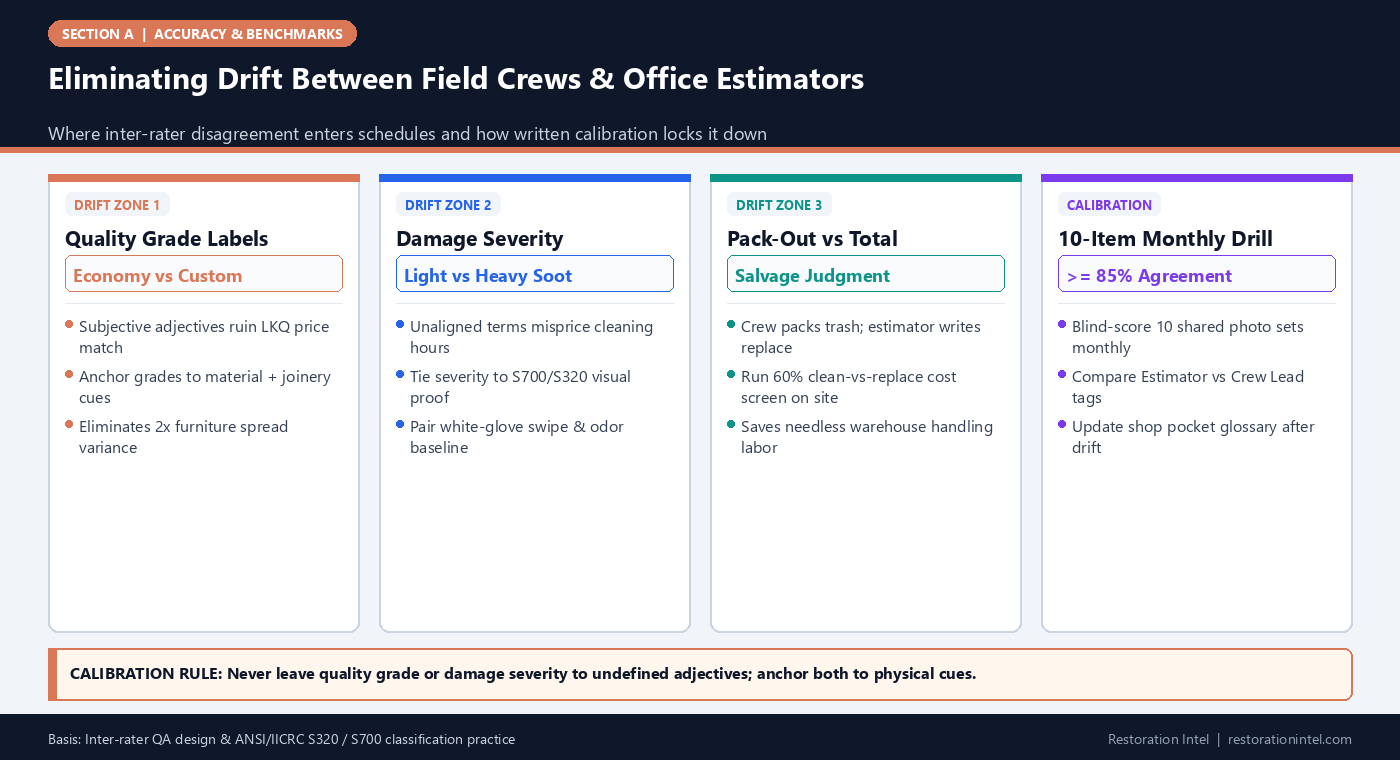
Why Silent Disagreement Burns Estimating Margin
When estimators distrust field condition notes, they spend extra hours calling project managers, zooming in on blurry background corners, or downgrading items to safe mid-tier defaults just to avoid carrier disputes. Worse, field crews occasionally haul particleboard shelving or cheap waterlogged smalls back to the warehouse only for estimators to look at XactContents pricing and ask why anyone paid labor to pack $90 flat-pack furniture.
Building a shared visual glossary backed by S320 condition descriptors aligns both chairs before anyone lifts a box.
- Ban vague qualifiers: Remove words like ‘nice’, ‘old’, ‘ruined’, and ‘misc bunch’ from intake drop-downs.
- Standardize condition photos: One wide context shot + one defect macro makes field intent legible to any estimator.
Running a 20-Minute Monthly Photo Calibration Drill
High-reliability teams test inter-rater agreement the same way medical and aviation QA programs do: using small blind calibration drills. Once a month, pull ten real loss item photos from closed jobs — covering upholstered furniture, charred cabinetry contents, electronics, and closet textiles — and ask your field leads and estimators to independently assign Quality Tier, Damage Severity, and Clean-vs-Replace recommendation.
Review only the three items where raters diverged widest. Usually you uncover an unspoken rule gap (for example, one crew lead treats water-swollen MDF as repairable while estimators always condemn it). Document that agreed rule inside a laminated pocket field reference card so every new seasonal helper makes identical triage calls on Day 1.
- Score agreement formally: percentage of shared decisions matching across Lead Estimator, Warehouse Manager, and Crew Leads.
- Pair field photography examples showing side-by-side ‘Cleanable Light Soot’ vs ‘Heat-Damaged Condemnation’ on common kitchen finishes.
Connecting Calibration to Consistent AI & Barcode Supervision
Structured human calibration also determines how cleanly teams supervise computer vision tools. When internal estimators agree on category trees and confidence rules, human-in-the-loop escalation queues clear rapidly instead of producing contradictory manual edits — keeping both multi-tech manual pack-outs and automated capture desks aligned on one shared truth standard. Teams that skip internal calibration merely amplify contradictory manual corrections inside software training workflows, creating inconsistent pricing across different estimators working the exact same branch territory. Tracking monthly calibration score drift gives supervisors an early warning whenever turnover or storm rush starts loosening condition standards.
Field Execution Checklist
- Publish a 1-page visual Quality Tier & Damage Severity shop card defining Economy, Average, High, and Custom grades with physical underside/tag cues.
- Hold a 20-minute monthly calibration huddle scoring 10 blind item photo sets across field leads and estimators.
- Target >= 85 percent agreement on quality tier and clean-vs-replace decisions across crews.
- Flag and resolve recurring disagreements between warehouse cleaners and office estimators immediately on closed files.
- Tie on-site total-loss condemnation triggers directly to visible swelling, delamination, or >65 percent clean-to-RCV ratio.
Related Restoration Intel Guides & Reference Standards
- Companion Brief (A-03): Designing a Blind Room Audit to Test Any Contents Inventory Workflow
- Companion Brief (A-15): Total-Loss Threshold Accuracy: Auditing When Cleaning Costs Exceed Replacement Value
- Companion Brief (F-10): Confidence Scoring Human In The Loop Escalation Ai Contents
- Internal Guide: S320 Public Review Is Open
- Internal Guide: The Adjuster Desk: One Standard, Two Chairs
- Primary Authority: ANSI/IICRC S320 Standard for Professional Contents Restoration
- Primary Authority: ANSI/IICRC S700 Fire & Smoke Restoration Standard
- Primary Authority: Verisk XactContents Platform Overview
- Primary Authority: Restoration Industry Association (RIA)
Frequently Asked Questions
How is inter-rater reliability measured practically without complex math?
Run a 10-item shared photo quiz across raters and calculate percentage agreement on category bucket, quality tier, and clean-vs-replace decision.
Why do technicians over-pack non-salvageable items?
Without clear total-loss triggers and estimator feedback, field crews fear throwing away salvageable property and default to boxing everything.
Does S320 define condition grading terminology?
Yes — ANSI/IICRC S320 provides structured professional expectations around pre-existing condition, loss damage documentation, and salvageability triage.
Should subcontractors join internal calibration drills?
Anyone generating capture photos or cleaning scope used in your prime estimate should share the exact same condition and tier definitions.
.md twin (inter-rater-reliability-contents-estimators-field-technicians.md).