Published November 14, 2026. By Will Tygart · Restoration Intel Editorial Desk.
Direct answer. Computer vision reliably detects distinct, un-occluded household furnishings and large appliances in clear lighting, yet hits hard physical limits inside deep shelves, tangled cords, smoke-blackened rooms, transparent glass overlaps, and packed closets.
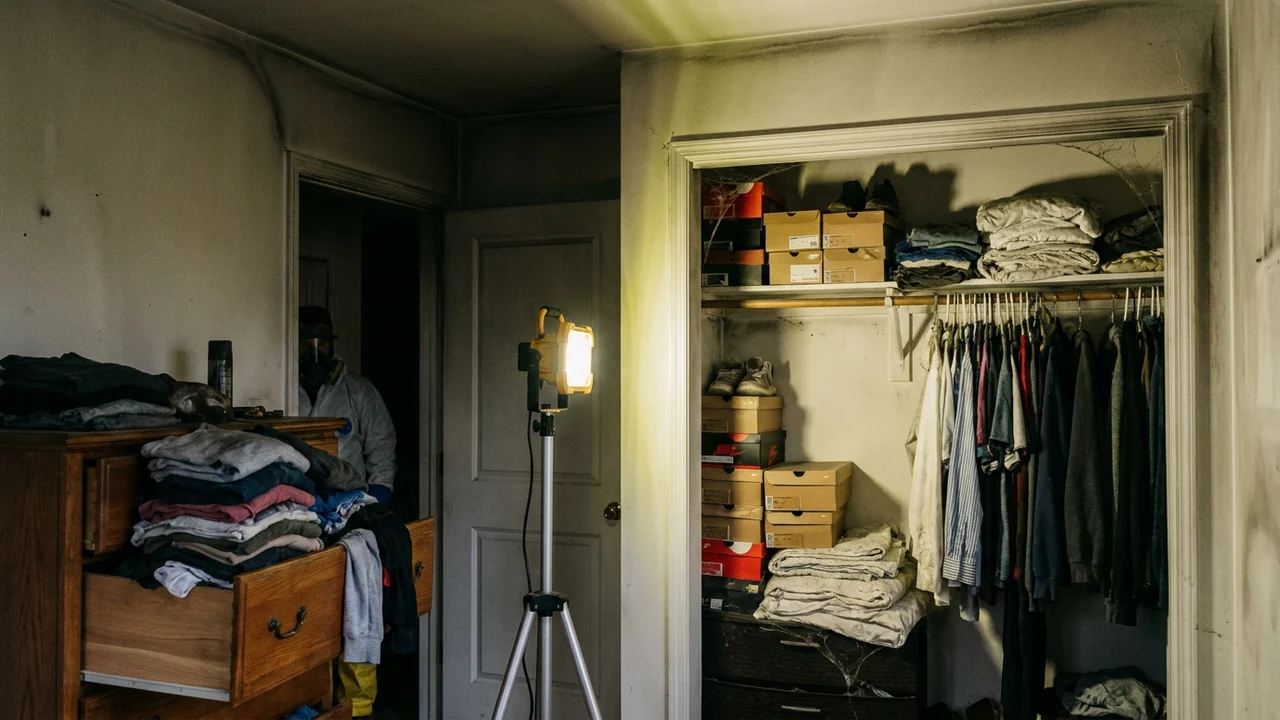
Modern object-detection architectures excel at recognizing well-lit standalone objects — identifying a leather armchair, microwave, flat-screen television, or dining set in milliseconds. That baseline visual skill easily impresses observers inside staged conference demos.
Real property losses rarely stay neat. Fire hoses knock boxes askew, waterlogged ceiling drywall collapses across dresser drawers, soot turns dark plastic cabinetry matte charcoal, and dense garage shelves pack three layers of tools behind one painted bucket. Knowing exactly what computer vision handles effortlessly versus where optical physics breaks down prevents costly blind spots in field operations.
Computer Vision Reliability Map by Loss-Room Obstacle
| Physical Room Obstacle | Why Vision Models Struggle | Symptom in Draft Schedule | Operational Field Fix |
|---|---|---|---|
| Dense Layered Shelving (Pantries/Garages) | Front containers physically block pixels of rear items | Undercounted rows (reads 6 visible cans instead of 18 stacked deep) | Pull front column aside cleanly or narrate stack count aloud |
| Heavy Soot / Char Deposition | Carbon particulate removes color & texture contrast | Dark silhouettes flagged as generic ‘unidentified object’ or skipped | Bring temporary LED worklight panels; shoot macro on cleaned/clear edges |
| Glassware, Chrome & Mirrors | Transparent refractions merge background clutter into foreground | Phantom ghost boxes or false merges across glass dining tops | Shoot crystal/china spaced on contrasting packing paper or open pad |
| Tangled Power Cords & Hardware Bins | Overlapping linear wires defeat clean bounding-box boundaries | Groups 8 shop tools into 1 generic box or misses nested smalls | Fan hand tools flat onto workbench mat before sweep |
| Lookalike Material Tiers | Pixels alone rarely distinguish laminated MDF from solid cherry | Wrong quality-grade presets distort furniture RCV by 2x+ | State solid wood/brand maker out loud or photograph drawer dovetails |
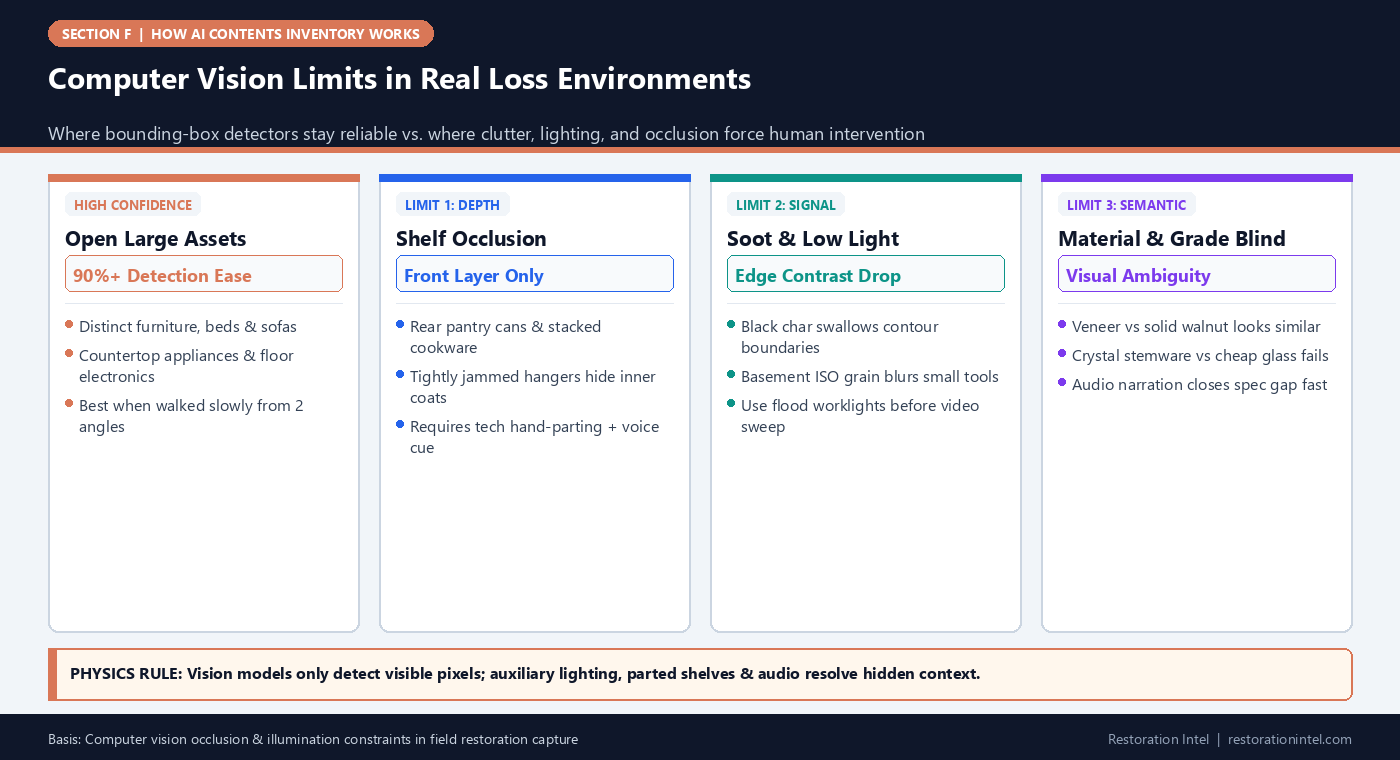
Why Bounded Pixels Cannot Infer Hidden Depth or Material Weight
Vision models process two-dimensional color grids (plus optional depth sensors on high-end devices). They cannot tell whether a solid brass lamp weighs twelve pounds or two ounces of plated plastic, cannot sense whether a soggy dresser bottom is swollen pressboard, and cannot see a Nikon DSLR tucked behind three winter parkas.
Similarly, cluttered piles containing overlapped silhouettes break non-maximum suppression thresholds cleanly in clean warehouses yet merge objects erroneously inside collapsed attic framing. Expecting any camera detector to outperform physical line-of-sight guarantees omission errors.
- Lighting threshold discipline: Floodlights save far more detection accuracy than higher cloud server budgets — dim ISO sensor noise destroys fine textures before upload even begins.
- De-layer before scanning valuable surfaces: Pulling mixed jewelry trays or tool drawers cleanly onto a contrasting moving blanket lets vision separate every item cleanly.
Pairing Vision With Speech and Tactile Inspections
In practice, the fastest crews never expect vision alone to solve messy closets. Instead, they lean on vision for what eyes see instantly — room furnishings, large visible gear, layout context — while speaking hidden facts (‘drawer 2 full of stainless flatware, 48 pieces’) and flagging non-visual damage like smoke odor explicitly. Combining automated camera object proposals with concise spoken technician notes bridges optical blind spots cleanly without forcing crews back into slow clipboard typing.
- Verify open drawers extend 75 percent outward during panning so nested utensils and bundled hand tools avoid top-shadow obscuration.
- Keep loose items spaced apart cleanly on matte work mats rather than stacking shiny glass and metal parts into single cluttered piles.
Audit Safeguards Against Silent Vision Omissions
Reviewing drafted schedules side-by-side against four-corner room stills catches missing zones within two minutes. Whenever a draft room tab shows suspiciously low line counts inside a garage, kitchen, or walk-in closet, estimators immediately inspect room lighting and demand supplemental shelf stills before approving — keeping silent model omission errors out of final settlement packets.
Field Execution Checklist
- Illuminate darkened smoke or basement rooms with portable LED worklights before starting camera sweeps.
- Pull drawer trays 75 percent open and fan hanging closet garments sideways so hidden layers enter camera line-of-sight.
- Lay overlapped small high-value tools or dishware pieces flat against contrasting packing paper before scanning.
- Speak material quality (‘solid oak dovetail’) and hidden stack counts aloud rather than trusting raw pixels alone.
- Cross-check drafted line counts per room against corner stills to spot silent vision drop-outs immediately.
Related Restoration Intel Guides & Reference Standards
- Companion Brief (F-01): How AI Contents Inventory Works End-to-End: From Field Capture to Carrier-Ready Schedule
- Companion Brief (F-03): Voice-Narrated Inventory Capture: How Speech Recognition Combines With Video to Resolve Ambiguous Items
- Companion Brief (F-06): Multimodal Fusion: Combining Visual Clues, Room Context, and Audio Descriptions Into One Line Item
- Companion Brief (A-05): Quantity Counting Benchmarks Dense Storage Pantries Garages
- Companion Brief (A-02): Item Count Recall Vs Category Precision Contents Audits
- Primary Authority: NIST AI Risk Management Framework
- Primary Authority: ANSI/IICRC S320 Standard for Professional Contents Restoration
- Primary Authority: OSHA 1910.132 Personal Protective Equipment Standard
Frequently Asked Questions
Do LiDAR sensors on newer phones fix closed-shelf occlusion?
No. LiDAR improves 3D room dimensions and distance estimation, yet laser pulses still stop at the front face of opaque boxes or pantry jars.
Why does heavy smoke film confuse object detection so much?
Thick matte soot flattens color cues and smooths bevel shadows that neural object detectors rely on to tell black appliances from dark cabinetry.
Can spreading fragile collectibles onto bright kraft paper improve detection?
Yes — high-contrast matte neutral paper eliminates tabletop wood-grain clutter and makes glass/metal silhouettes separate cleanly.
Should technicians clear collapsed drywall off furniture before AI video capture?
Document the collapsed debris burden first for structural/peril proof, then expose underlying contents safely under proper PPE before detailed capture.
.md twin (computer-vision-object-detection-messy-loss-rooms-limits.md).