Published November 14, 2026. By Will Tygart · Restoration Intel Editorial Desk.
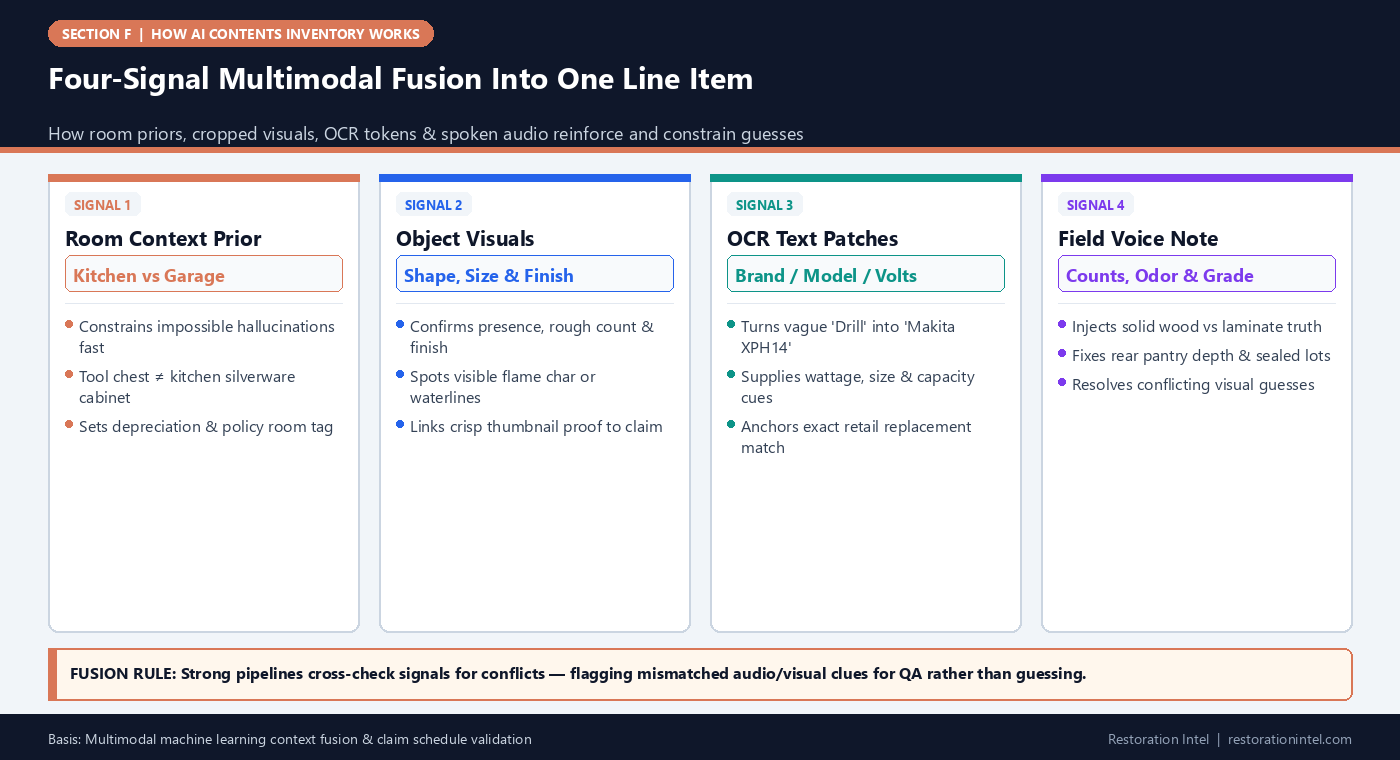
Direct answer. Multimodal fusion merges pixels, room-context metadata, OCR text, and field audio transcripts to score candidate item definitions together — preventing absurd isolated guesses like logging a commercial kitchen blender as a laboratory centrifuge or calling solid walnut particleboard.
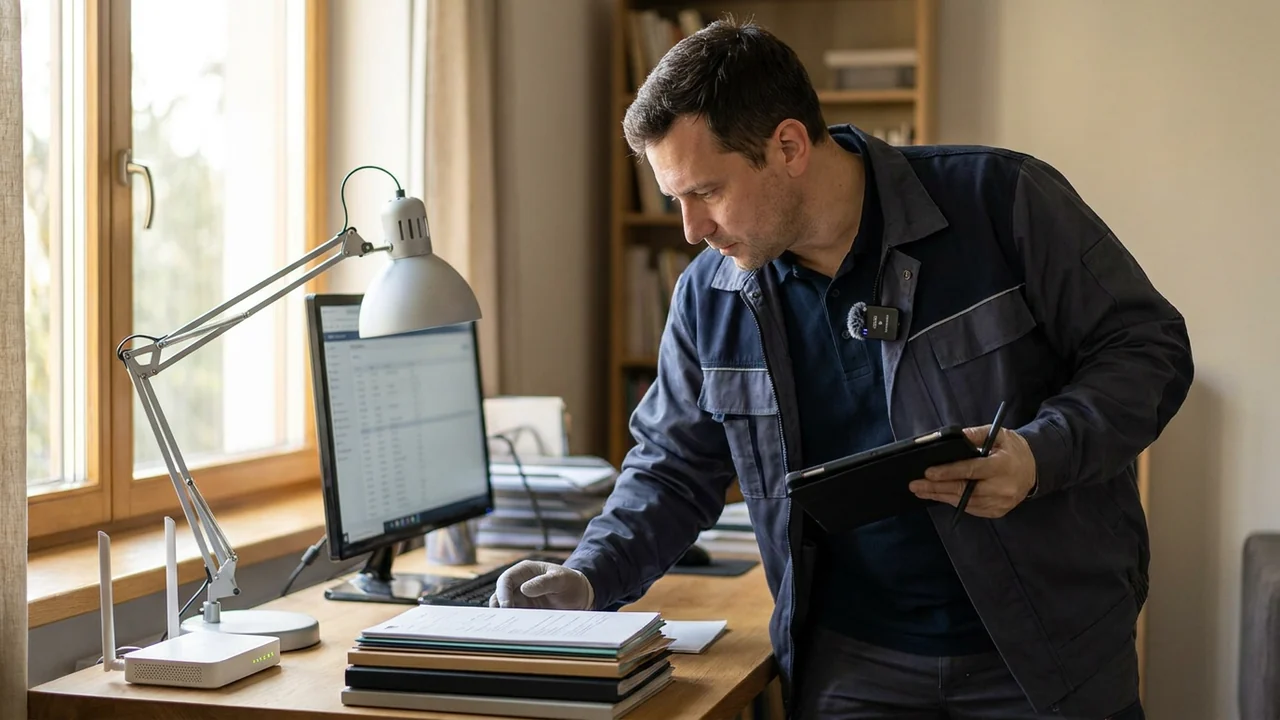
Show a cropped picture of a stainless cylindrical tank with zero background and even a human estimator might hesitate: pressure cooker, paint pot, humidifier reservoir, or laboratory autoclave? Put that exact crop inside a residential kitchen frame, read the spoken tag ‘Instant Pot Duo 8-quart, light smoke’, and verify the front LCD graphic — ambiguity disappears in half a second.
Early single-modal tools processed photos in narrow crops, generating notorious category hallucinations. Modern multimodal AI pipelines fuse visual object crops, global room priors, OCR tokens, and synchronized ASR voice narration into a single unified probability decision — much closer to how seasoned human estimators actually think.
How Multimodal Signals Resolve Specific Estimating Ambiguities
| Ambiguous Object Example | Vision-Only Failure Mode | Context + OCR Signal Added | Audio Signal Contribution | Fused Carrier-Grade Output |
|---|---|---|---|---|
| Wooden Dining Credenza | Logs generic ‘brown cabinet’ — zero quality tier clarity | Dining Room frame + brass hardware + inlay detail | ‘Solid cherry, Ethan Allen badge inside drawer, smoke odor’ | Cherry Credenza — High Quality Tier, Ozone/Clean Scope |
| Stack of Plastic Organizers | Counts 1 large box or hallucinates visible front caps | Garage pegboard bay context | ‘Three drawers metric sockets, Husky brand, oil soot’ | 3-Drawer Mechanics Socket Assortment (Husky) w/ Context Photo |
| Compact Countertop Motor Base | Could be smoothie blender, food processor, or grinder | Kitchen island + OCR `Vitamix E310` front bezel | ‘Cracked pitcher lid from heat warp’ | Vitamix Explorian E310 Blender — Replace / Non-Salvage Proof |
| White Cylindrical Clinic Unit | Mistaken for home humidifier or air purifier | Dental Operatory room + Bio-hazard signage + OCR `Midmark` | ‘Autoclave sterilizer, water damaged base’ | Commercial Dental Autoclave — Route to Specialist Subcontract |
Why Room Context Stops Absurd Category Hallucinations
In classic image-only recognition benchmarks, objects photographed slightly skewed often map to bizarre lookalikes — mistaking a curled extension cable for a vacuum hose, or flagging a decorative ceramic urn in a foyer as a kitchen crockpot. Injecting room classification (`Master Bathroom` vs `Machine Shop`) acts as an immediate Bayesian guard rail.
Room awareness also preserves claim-level location hierarchy required by XactContents and homeowner policy schedules, preventing technicians from having to re-sort 400 lines by floor afterward.
- Announce room transitions clearly: Pausing three seconds at every doorway (`Entering Upstairs Bedroom 2`) keeps context models locked even across open-plan lofts.
- Flag cross-room displacement: If fire crews dragged living-room chairs onto the porch during suppression, state origin room aloud so schedules reflect insured truth.
Handling Signal Conflicts Cleanly Instead of Averaging
What should happen when visual evidence shows six dining chairs yet spoken audio accidentally says ‘four chairs’, or OCR detects `LG` while the spoken memo says `Samsung`? Mature multimodal systems never silently flip a coin between conflicting inputs.
Instead, signal divergence automatically drops confidence scores below the escalation bar and flags that row inside the Human-in-the-Loop QA queue with both visual crop and speech snippet side-by-side. Preserving audit conflict logs lets senior estimators clear discrepancies in seconds rather than debugging hidden model guesses weeks after carrier upload.
- Store separate confidence origins (`vision`, `ocr`, `asr`) per line attribute so QA reviewers immediately spot which input disagreed.
- Give explicit audio peril tags (`smells of heavy protein fire`, `swollen MDF bottom`) deterministic weight over clean exterior photos.
Field Capture Synergy Across Small and Large Crews
By letting cameras capture geometry, OCR capture sharp stamped print, and speech capture invisible condition/count facts concurrently, multimodal fusion fits real job-site ergonomics far better than forcing one overworked technician to tap endless mobile drop-downs across cramped smoky hallways.
Field Execution Checklist
- Verbally announce clear room transitions (`Entering Kitchen`, `Garage West Bay`) at every doorway threshold.
- Pair global room corner shots with zoomed close-ups so both context priors and OCR tokens inform the same object.
- Keep spoken audio focused on facts cameras miss (material tier, odor, hidden depth, worn digits) rather than repeating obvious colors.
- Configure QA workflows to flag Audio-vs-Visual conflicts explicitly for human review instead of silently picking one.
- State original room location explicitly if suppression or mitigation teams already moved contents onto porches or driveways.
Related Restoration Intel Guides & Reference Standards
- Companion Brief (F-01): How AI Contents Inventory Works End-to-End: From Field Capture to Carrier-Ready Schedule
- Companion Brief (F-03): Voice-Narrated Inventory Capture: How Speech Recognition Combines With Video to Resolve Ambiguous Items
- Companion Brief (F-05): How OCR Extracts Brand, Model, and Serial Numbers — and When Soot or Glare Breaks It
- Companion Brief (F-10): Confidence Scoring and Human-in-the-Loop (HITL) Escalation Thresholds in AI Contents Workflows
- Companion Brief (A-10): Inter Rater Reliability Contents Estimators Field Technicians
- Primary Authority: NIST AI Risk Management Framework
- Primary Authority: Verisk XactContents Platform Overview
- Primary Authority: ANSI/IICRC S320 Standard for Professional Contents Restoration
Frequently Asked Questions
What does multimodal mean in practical restoration terms?
It means combining multiple independent input streams — video/photo pixels, room context, text OCR, and technician audio — to identify and price one line item accurately.
What happens when voice narration contradicts the photo?
Well-designed pipelines reduce confidence and highlight the conflict to an estimator so human eyes resolve the exact truth cleanly.
Do techs have to capture audio on every single everyday item?
No. Visual+context handles clear standard furnishings nicely; audio gives huge leverage on material grades, hidden shelf stacks, damaged tags, and odor/peril notes.
Why is announcing doorway transitions important?
Open-concept homes blur Living/Dining/Kitchen boundaries; speaking the room name anchors subsequent items into the right policy room tab automatically.
.md twin (multimodal-fusion-visual-room-context-audio-contents.md).