Published November 14, 2026. By Will Tygart · Restoration Intel Editorial Desk.
Direct answer. Optical Character Recognition runs a two-step text-detection plus sequence-recognition pipeline that excels on crisp high-contrast labels, yet breaks predictably on curved tool housings, soot smudges, and foil glare — making regex validation and human quick-confirm essential safeguards.
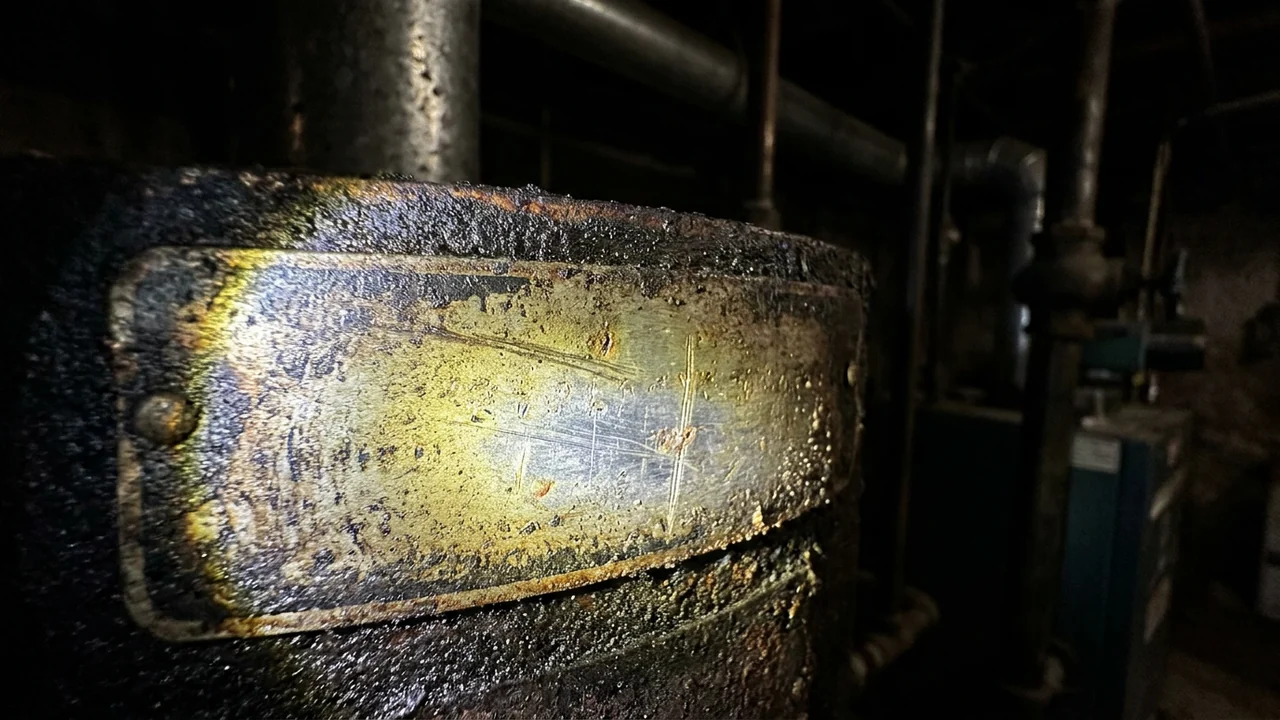
Estimators love when software auto-populates `GE Profile PVD28BYNFS` straight from a snapshot, yet groan when that same pipeline turns a greasy furnace plate into `PVD2B8YMF5`. In parts and equipment estimating, a single misread digit inside a long alphanumeric model ID breaks automated retail lookups completely.
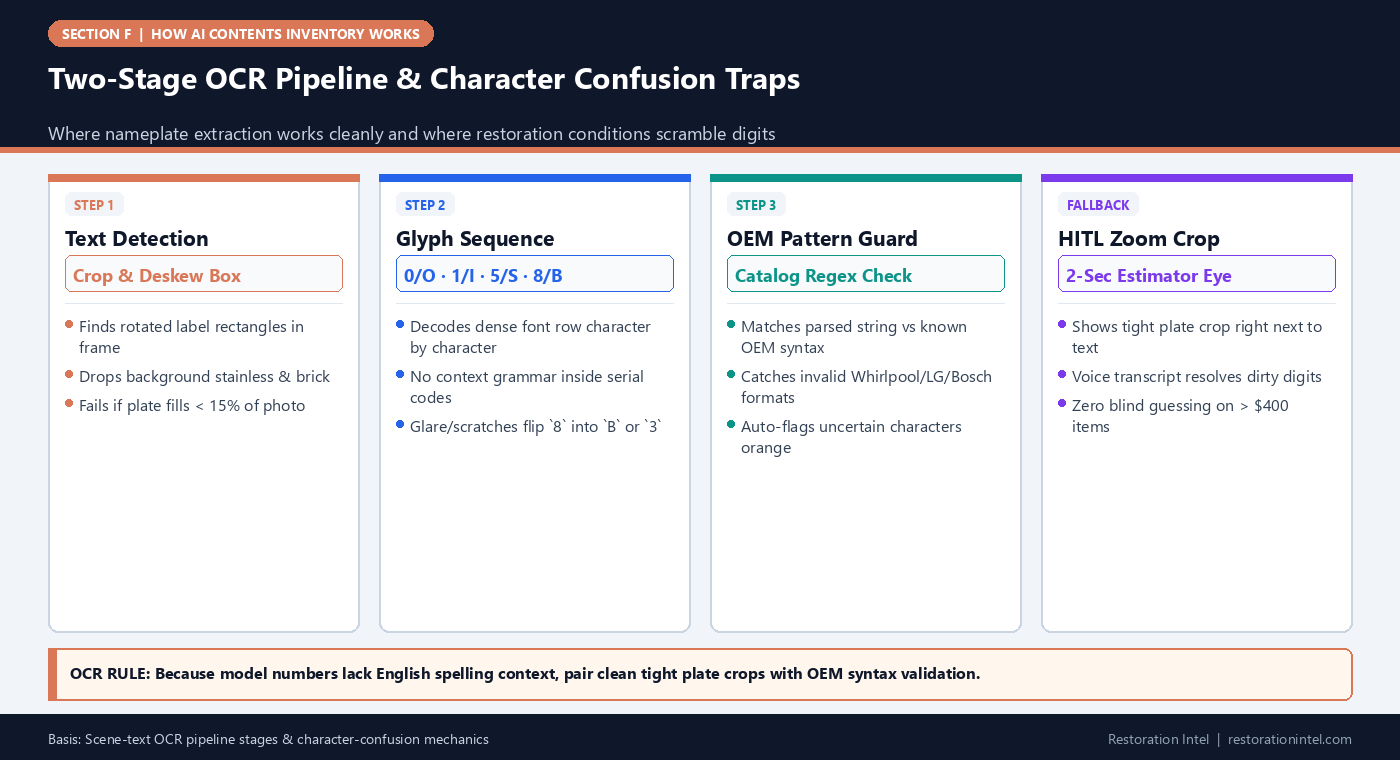
Understanding how OCR actually reads text in the wild demystifies why clean labels look magical while slightly angled or dirty tags silently fail. Every commercial OCR module splits into two distinct phases: first locating text blocks inside cluttered scenes, and second decoding individual character glyph sequences.
OCR Breakdown Triggers in Restoration Environments
| OCR Breakdown Mode | What Happens Technically | Common Field Example | Automated Guardrail / Human Recovery |
|---|---|---|---|
| 1. Specular Foil Clipping | Flash reflection drives plate luminance to 255 pure white across glyph rows | Silver LG fridge door sticker shows unreadable white hole over `Model No.` | Off-axis lighting capture + human highlight re-shoot |
| 2. Glyphs Without Semantic Context | Unlike reading prose (`Kitchen`), serial numbers (`480B19S`) lack dictionary fallback | Model `WFW5620HW0` shifts subtly to `WFW56Z0HWO` | Validate extracted strings against OEM model catalog regex & format templates |
| 3. Low Contrast Stamped Steel | Unpainted aluminum embossing blends into identical metal grain under flat light | Stamped sump pump casing or commercial Hobart motor plate invisible to text detector | Raking side LED cast shadow + spoken confirmation |
| 4. Vertical & Multi-Column Bleed | OCR merges adjacent voltage spec text (`120V 60HZ`) straight into model string | `MGR6600FZ` pulls adjacent `12A` text cleanly into fake non-existent SKU | Line-field visual crop QA displaying isolated Model field beside label crop |
Why Reading Model Numbers Is Harder Than Reading Receipts
Everyday document OCR on grocery receipts or shipping invoices leans heavily on language priors: if a pixel smudge turns `T0TAL` slightly fuzzy, the language model easily predicts `TOTAL`. Appliance model strings and serial numbers enjoy zero English spelling safety nets. Any arbitrary blend of digits and capital letters looks equally plausible on raw characters alone.
Unless an inventory system checks extracted OCR strings against real OEM manufacturer prefixes (for example knowing Samsung washers open with `WF` or Bosch dishwashers use `SHP`/`SHE`), tiny character flips like `5`/`S` or `0`/`O` pass quietly downstream and produce zero retail catalog matches.
- Crop verification UI: Good estimating workflows show the tightly cropped nameplate image directly next to the extracted text box so reviewers verify ten digits in two seconds.
- Distinguish Model from Serial: Many plates pack both tightly together; make sure pricing lookups query Model/Part SKU while Custody logs store unique Serial.
Curved Housings, Heat Blistering, and Label Angles
On round drill housings, wet-vac tanks, or cylindrical compressors, text curves away from the lens plane so edge characters shrink nonlinearly. Standard rectangular perspective de-warping helps mild tilt (<20 degrees), yet struggles on tight radii. As outlined in our benchmark companion OCR & Rating-Plate Readability Thresholds, two overlapping square-on shots — left edge + right edge — reliably defeat cylindrical curve errors and ensure full model suffixes survive cleanly.
- Hold smartphone cameras square against flat plates (`<= 20-degree` tilt) rather than crouching casually at steep hallway angles.
- Confirm zero trailing digit clipping along sticker margins before turning the appliance back toward the wall or wrapping it in transit pads.
Combining OCR With Audio Dictation When Plates Fade
Whenever heat damage, acid etching, or oil stains wipe half the ink off a steel tag, human eyes tilting a flashlight back and forth often recover characters static pixels miss. Speaking the visible characters out loud while snapping the smudged proof photo preserves both audit defense and clean catalog matching without waiting on office follow-up callbacks. Pairing visual evidence with real-time verbal verification keeps carrier documentation unimpeachable even under severe soot and heat distortion.
Field Execution Checklist
- Fill roughly half the camera width with the rating plate, keeping the lens parallel and flash turned OFF.
- Validate parsed OCR model numbers against active manufacturer SKU syntax before pricing.
- Audit character pairs `0/O`, `1/I`, `5/S`, `8/B`, and `2/Z` carefully inside review queues.
- Separate Model Number (catalog lookup) cleanly from Serial Number (unique asset/warranty proof).
- Keep tightly cropped plate thumbnails pinned right beside extracted text inside QA workspaces.
Related Restoration Intel Guides & Reference Standards
- Companion Brief (A-12): OCR and Rating-Plate Readability Thresholds in Damaged Appliances and Mechanical Equipment
- Companion Brief (A-04): Brand and Model Identification Accuracy: Where Field Capture Fails Under Loss Conditions
- Companion Brief (F-04): Continuous Video Keyframe Sampling vs Discrete Still Photography in Contents Capture
- Companion Brief (F-06): Multimodal Fusion: Combining Visual Clues, Room Context, and Audio Descriptions Into One Line Item
- Companion Brief (F-09): Automated Pricing Lookup & LKQ Matching: Static Price Lists vs Live Retail Catalog Retrieval
- Primary Authority: NIST AI Risk Management Framework
- Primary Authority: Verisk XactContents Platform Overview
- Primary Authority: ANSI/IICRC S320 Standard for Professional Contents Restoration
Frequently Asked Questions
What does OCR stand for and what does it actually do?
Optical Character Recognition locates printed or stamped text regions inside images and converts pixel shapes into searchable ASCII/UTF-8 text strings.
Why did OCR fail completely on my stainless steel range tag?
Stainless and brushed silver foil badges act like mirrors under direct camera flash or sharp overhead light, blinding character contrast.
Can AI read embossed text stamped with zero ink?
Only when oblique raking side lighting creates dark shadows inside the recessed letters — flat diffuse lighting hides bare-metal embossing.
Should estimators manually type every serial number even if OCR runs?
No: let OCR draft text from crisp plates, keep human quick-confirm focused strictly on low-confidence digits and Tier-1 >$400 assets.
.md twin (how-ocr-extracts-brand-model-serial-numbers-soot-glare.md).