Published November 14, 2026. By Will Tygart · Restoration Intel Editorial Desk.
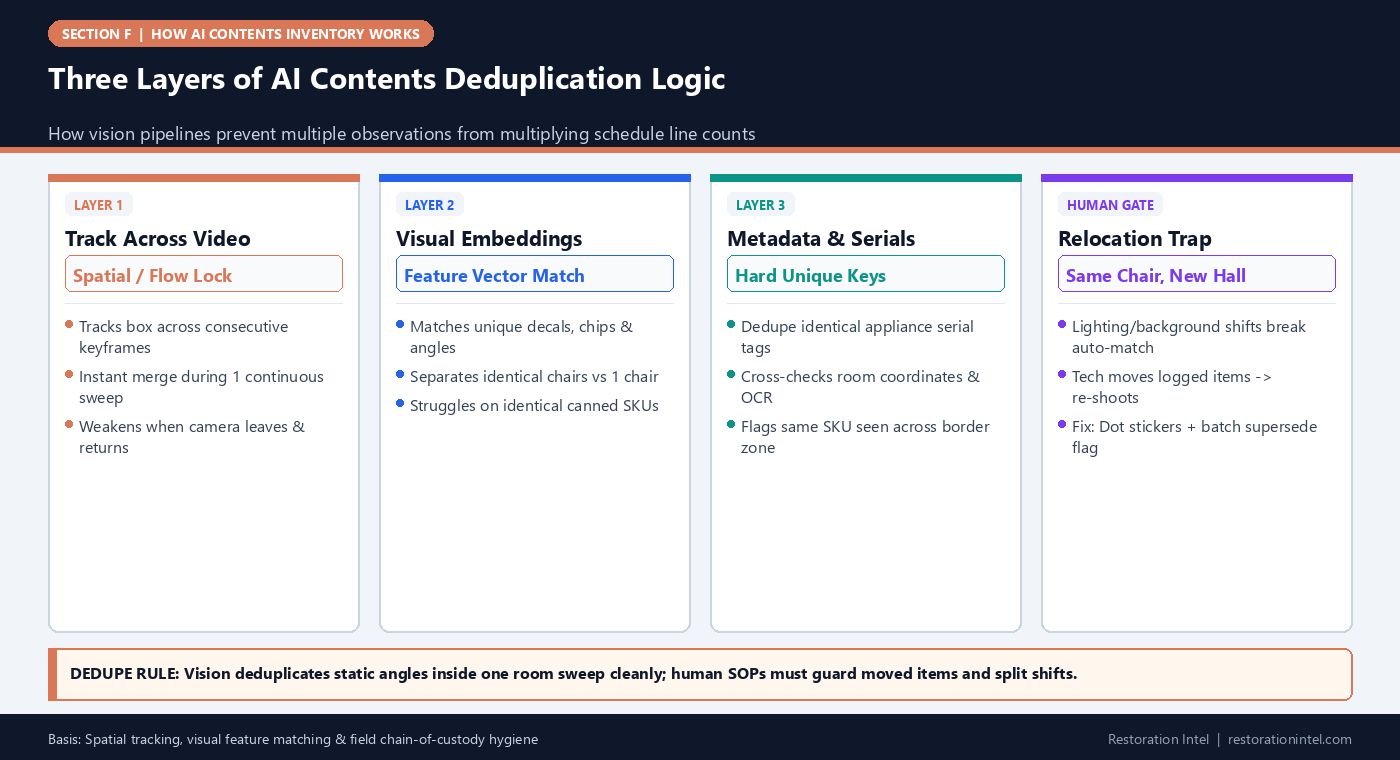
Direct answer. Deduplication prevents double-counting by clustering overlapping camera angles via visual embeddings, geometric spatial tracking, and temporal proximity — yet still fails whenever physical objects are moved to new rooms or re-shot hours later unless operational tagging governs workflows.
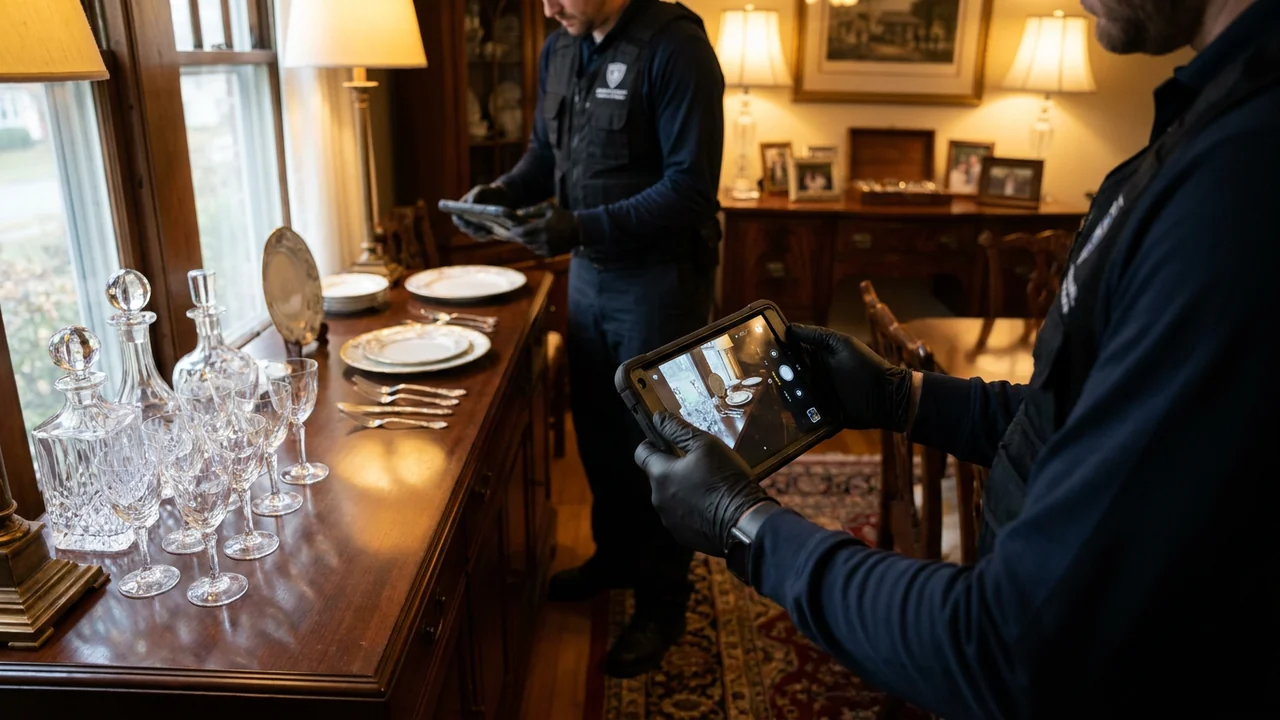
Take three steps inside a living room holding a recording smartphone: you pass the coffee table once walking clockwise, catch its corner again scanning the far bookshelf, and frame it a third time backing out toward the kitchen. Humans effortlessly register that all twelve appearances represent one coffee table. Without deliberate deduplication engineering, frame-by-frame detectors happily bill the insurance carrier for six coffee tables.
Deduplication turns raw multi-angle frame detections into unique physical assets. Yet software logic alone has distinct boundaries — especially across multi-day or multi-technician pack-outs detailed in our benchmark guide on split-shift duplicate failures.
Where Automated Deduplication Works vs. Where It Breaks
| Capture Scenario | Automated Dedupe Capability | Failure / False-Merge Risk | Required Operational Control |
|---|---|---|---|
| 1. Continuous 360° Walk in 1 Room | High — optical flow & overlapping keyframes track objects smoothly | Very rapid blind turns break tracklet continuity temporarily | Keep horizontal pan cadence smooth with gentle overlaps |
| 2. Legitimate Identical Twins (4 Dining Chairs) | Moderate — tracks distinct spatial positions inside same frame | Over-aggressive appearance matching could collapse 4 matching chairs into 1 | Frame full set of 4 in wide context shot + state count aloud (`4 chairs`) |
| 3. Multi-Tech Adjacent Room Borders | Low-to-Moderate — separate upload timelines & perspective angles | Same open-plan island barstool billed in Kitchen AND Living Room | Explicit doorway boundary map + one tech per zone rule |
| 4. Relocated Staging / Day-2 Reshoot | Low — background floor, lighting, and occlusion completely changed | Carried espresso machine in hallway logged twice | Physical ‘LOGGED’ color dots + deprecate superseded AM batches |
Balancing False Splits Against Dangerous False Merges
Tuning deduplication sensitivity creates an unavoidable seesaw. Set visual similarity matching too loosely (`merge things that look alike in this room`) and six identical folding banquet chairs or twelve matching chrome barstools risk collapsing erroneously into `Qty 1`. Set it too strictly (`only merge exact pixel overlaps`) and orbiting around one sectional sofa creates three phantom sofas.
Well-engineered pipelines preserve true multiples by leaning heavily on co-visibility (if two identical chairs appear together inside the same wide establishing frame, they are definitively separate objects) combined with audio count locks (‘set of six walnut chairs’).
- Anchor every set with a full wide shot: Always capture matching dining chairs, bookshelves, or nightstands together in one clear frame before stepping in for close-ups.
- Verify high-price singles cleanly: Never rely on visual similarity alone to merge appliances — check distinct Serial Numbers (`SN`) so twin garage freezers stay two legitimate lines.
Physical-Digital Handoff During Split Shifts & Pack-Outs
Whenever a crew shifts items across thresholds — pulling pantry goods onto folding kitchen tables or clearing hallway lanes — background changes defeat feature embeddings reliably. As covered in multi-tech duplicate failures, physical `LOGGED` color stickers and strict ‘deprecate morning re-shoots’ rules protect schedule credibility far more reliably than post-hoc pixel guesswork. Pair physical room-ownership tape lines with unique batch IDs whenever crews break larger residential estates across multiple days.
- Assign clean visual zone boundaries (`Kitchen West Wall` vs `Dining Island`) before unbagging or staging packed moving cartons.
- Train relief crews never to point capture apps into hallway holding zones unless tagged clearly as uninventoried incoming debris.
Pre-Submission QA Filters That Catch What Algorithms Miss
Estimators should never assume deduplication finished the job cleanly. Running a 60-second check sorting adjacent rooms (`Kitchen` / `Dining` / `Hallway`) by identical unit prices, model strings, and duplicate image hashes spots lingering duplicates cleanly prior to carrier export — shielding your claim file from needless credibility headaches.
Field Execution Checklist
- Shoot one wide establishing frame capturing full sets (6 dining chairs, paired lamps) together so matching objects don’t collapse.
- Keep continuous sweeps smooth without sharp whip-pans that break spatial object tracking.
- Tag items physically (`LOGGED` dot stickers or assigned Box IDs) before carrying them into hallway staging piles.
- Supersede older image sets explicitly if a room gets re-photographed on Day 2 for better lighting.
- Audit `Hallway`, `Foyer`, and adjacent room borders on every export for twin descriptions or duplicate serial strings.
Related Restoration Intel Guides & Reference Standards
- Companion Brief (A-13): How Duplicate Detection Fails During Multi-Tech Re-Uploads and Split-Shift Pack-Outs
- Companion Brief (F-04): Continuous Video Keyframe Sampling vs Discrete Still Photography in Contents Capture
- Companion Brief (F-06): Multimodal Fusion: Combining Visual Clues, Room Context, and Audio Descriptions Into One Line Item
- Companion Brief (A-09): Statistical Qa Sampling Large Pack Outs Box Verification
- Internal Guide: A Pack-Out Record Is Not a Priced Inventory
- Primary Authority: NIST AI Risk Management Framework
- Primary Authority: ANSI/IICRC S320 Standard for Professional Contents Restoration
- Primary Authority: Verisk XactContents Platform Overview
Frequently Asked Questions
Why do AI tools sometimes collapse four matching dining chairs into one line?
If each chair is only shot tight one-by-one from slightly different angles without a wide establishing frame showing all four simultaneously, embeddings may assume one chair was filmed four times.
What proves two identical refrigerators or monitors are legitimately separate?
Capturing crisp separate wide context shots showing both units in space plus distinct serial numbers on their rating plates.
Does box barcoding interact with AI deduplication?
Yes — linking each capture batch directly to unique room/container barcodes stops two crews from re-inventorying packed boxes.
When should estimators override automated dedupe clusters?
Whenever confidence sits mid-range across room doorways or multi-tech timestamps — two-second visual confirmation protects both margin and carrier audit fairness.
.md twin (deduplication-logic-overlapping-angles-re-shoots-multi-tech.md).