Direct Answer: When an insurer pays a total-loss settlement on a damaged item, title and salvage rights transfer to the carrier under standard salvage principles; if the insured elects to keep the item anyway, the settlement is reduced by an agreed salvage credit (owner-retention buy-back), paired with clear documentation releasing the restoration contractor from post-claim odor or safety liability.
.md twin for estimator QA and carrier file documentation.
Total-loss contents claims are not always all-or-nothing physical disposals. Frequently, an item crosses the economic feasibility threshold for professional restoration—meaning cleaning or refinishing under ANSI/IICRC S320 costs more than the item’s depreciated value, or a high-end refrigerator sustains cosmetic side-panel dents that do not stop it from cooling. In those cases, the homeowner or business owner often asks: ‘If the insurance company totals it out, can I keep it for the garage or workshop?’
The answer turns on insurance salvage doctrine. An insured cannot simultaneously collect 100 percent total-loss indemnity and retain full uncredited ownership of valuable damaged property. Handling owner-retention buy-backs cleanly—without overcharging the insured on phantom scrap values or exposing the restoration contractor to liability for keeping contaminated goods—requires clear math and written custody sign-offs.
Salvage Credits & Owner-Retention Rules in Contents Claims
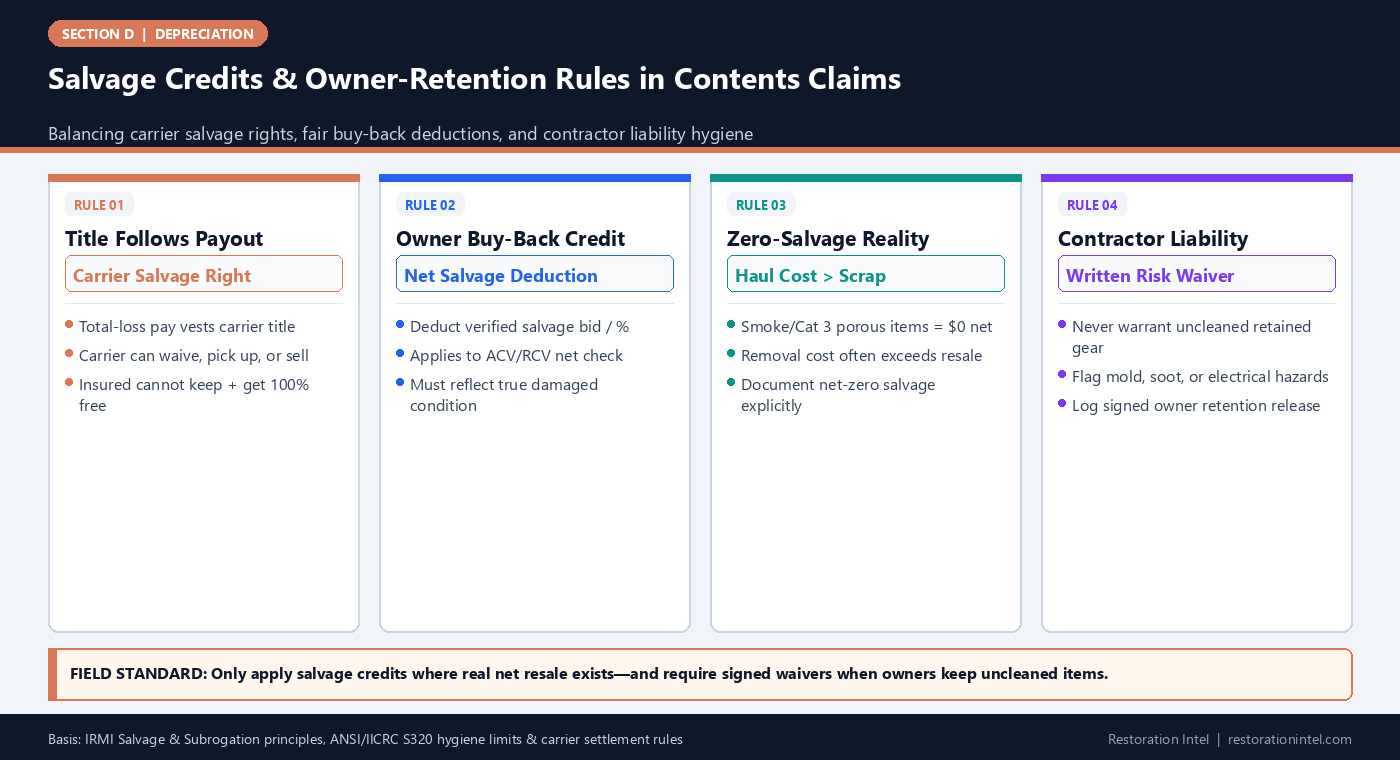
Salvage & Owner-Retention Decision Matrix Across Common Partially Damaged Goods
How net salvage value, buy-back credits, and safety/contamination exclusions behave across five recurring retention requests.
| Damaged Asset Scenario | True Net Salvage Value | Carrier Election | Fair Owner Buy-Back / Credit Basis | Contractor & Subrogation Guardrail |
|---|---|---|---|---|
| Cosmetically Dented Stainless Fridge (Functional) | Moderate—30-50% of undamaged ACV in scratch-and-dent market | Often approves owner retention or liquidates via salvage vendor | Verified local scratch-and-dent bid or agreed 25-40% ACV credit | Confirm model defect isn't under subrogation hold first |
| Lightly Smoke-Tainted Garage Tools / Metal Shelving | Low to Moderate—cleanable steel retains utility if odor tolerated | Commonly waives pickup if net salvage < pickup freight cost | Agreed modest percentage (often 10-20% ACV) or $0 waiver | Release contractor from odor warranty on uncleaned tools |
| Solid Wood Dresser With Water-Stained Base | Low—refinishing cost approaches used resale value | Usually waives physical pickup; allows owner retention | Minimal local used-furniture wholesale quote minus haul cost | Document pre-existing vs loss stain clearly |
| Cat 3 Sewage / Mold-Impacted Upholstered Sofa | Zero or Negative (disposal cost exceeds scrap) | Must prohibit resale; zero salvage value | $0 credit—item must be condemned/disposed, not retained | Written health hazard warning if insured refuses disposal |
| Electronics With Soot Exposure or Moisture Alert | Near Zero for retail; minor parts value only | Either waives or takes for subrogation/e-waste audit | Zero or nominal parts credit; never price at working used market | Never certify fire/water-exposed electronics as safe to energize |
Why Total-Loss Payment Transfers Salvage Rights to the Carrier
Under foundational indemnity law and the IRMI Salvage definition, the purpose of property insurance is to make the policyholder whole—not to allow double recovery. When an insurer pays the full total-loss settlement (whether ACV or RCV) for a damaged item, the insurer acquires the legal right to take possession of the damaged property and sell it to offset part of its claim payout.
In commercial losses and high-value residential claims (specialty machinery, restaurant equipment, pristine luxury appliances with minor cosmetic scuffs, or salvageable retail inventory), carriers routinely dispatch dedicated salvage liquidators to bid on and pick up totaled goods. On ordinary residential household furniture, however, pickup freight and warehouse sorting usually cost more than the damaged item would bring at auction—prompting carriers either to waive salvage or offer owner retention.
- Never discard high-salvage items early: Before hauling away damaged commercial equipment or high-value appliances, ask the adjuster in writing whether salvage pickup is elected.
- Separate salvage from subrogation holds: Under subrogation, an origin appliance (such as a failed dishwasher hose or lithium battery pack) must never be sold for salvage or discarded—preserve it untouched for forensic inspection.
- Clarify title transfer timing: Ownership does not pass to a third-party buyer or disposal vendor until authorized by both insured and insurer.
Calculating Fair Owner-Retention Buy-Back Credits Without Overcharging
Disputes erupt when an adjuster demands an arbitrary 50 percent salvage deduction because a homeowner wants to keep a smoke-smelling solid oak bookshelf or a cosmetically scratched commercial freezer. Salvage value is *not* half of new retail price—it is the net wholesale amount a salvage buyer would realistically pay *as-is, where-is*, minus the cost of picking it up, storing it, and listing it for resale.
If a damaged dining table has an undamaged ACV of $600, would cost $250 in two-person freight to haul to a liquidator’s warehouse, and would fetch $225 at a salvage auction in smoke-hazed condition, its *net* salvage recovery to the carrier is actually negative (-$25). Presenting that exact net-salvage math—rather than guessing an arbitrary percentage—persuades examiners either to waive salvage completely or agree to a modest, realistic retention credit.
- Use net-of-freight math: Always subtract realistic pickup, labor, and auction commission costs from gross resale value before setting a buy-back credit.
- Avoid used-retail comparisons: Never let a desk examiner price damaged salvage at clean Craigslist or Facebook Marketplace retail asking prices.
- Verify how RCV holdback interacts: Clarify whether an agreed owner-retention credit reduces only the ACV payout or caps recoverable RCV if the insured never actually buys a replacement.
Health, Safety, and Contractor Liability on Retained Damaged Contents
Restoration contractors walk into serious liability traps whenever an insured insists on keeping partially damaged contents that were never professionally remediated. Under ANSI/IICRC S320 standards, porous textiles, upholstered furniture, and mattresses exposed to Category 3 sewage, heavy mycotoxin mold, or toxic synthetic fire soot cannot be safely returned to living spaces without verified decontamination—and often cannot be restored at all.
If a contractor totals out a smoke-saturated mattress or wet electronic amplifier as economically non-restorable, and the homeowner decides to keep it under an owner-retention credit, the contractor must never deliver it back into a freshly remediated house without explicit written warnings. Doing so can cross-contaminate cleaned rooms with soot odor or mold spores—leading the homeowner to blame the restoration firm months later for ‘failed odor control.’
- Mandatory written hold-harmless release: Record exact line IDs of retained items alongside signed acknowledgement that restoration/cleaning was declined and no odor or safety warranty applies.
- Refuse unsafe energization: Technicians must never plug in or test fire/water-compromised electronics or electrical appliances just to help an owner evaluate retention.
- Separate retained goods during reset: Clearly segregate owner-retained garage/workshop items from remediated clean-vault deliveries.
Accounting for Salvage Credits Cleanly on the Final Valuation Sheet
Salvage credits become confusing when estimators bake the buy-back percentage directly into the item’s RCV or inflate depreciation to achieve the same net dollar result. Manipulating RCV or depreciation hides the true transaction and breaks downstream audit checks if the claim goes to appraisal or replacement-receipt review.
Always keep Gross RCV, Depreciation, and Gross ACV untouched at their accurate factual values, and record Owner-Retention Salvage Credit as an explicit bottom-line or line-adjacent deduction column. That transparency shows the desk examiner, the insured, and any future auditor exactly what the item was worth, why it was totaled, and how much credit was applied for retention.
- Preserve Gross RCV/ACV integrity: Never artificially lower RCV or inflate depreciation to simulate a salvage deduction.
- Track carrier waiver emails: Save written confirmation whenever an adjuster waives salvage pickup at $0 credit so no surprise deduction appears on the final check.
- Reconcile release forms: Attach the signed owner-retention and non-salvage disposal logs side-by-side in the final claim packet.
Practitioner Verification Checklist (D-24)
- Confirm in writing with the adjuster whether the carrier claims salvage pickup, waives salvage, or authorizes an owner-retention credit before disposing of high-value totaled goods.
- Calculate owner-retention buy-back credits using true net as-is salvage value minus pickup/freight costs—not clean retail or arbitrary 50 percent cuts.
- Exclude origin appliances or failed components under active subrogation review from any salvage sale, buy-back, or disposal.
- Require a signed Customer Retention & Risk Waiver releasing the restoration contractor from odor, mold, or electrical safety liability on uncleaned retained items.
- Display salvage credits in a dedicated deduction column on the valuation summary rather than altering Gross RCV or depreciation percentages.
Standards, Authority References & Related Reading
Primary standards, insurance definitions, and sibling Restoration Intel guides referenced in this brief:
- IRMI Insurance Glossary: Salvage
- IRMI Insurance Glossary: Actual Cash Value (ACV)
- IRMI Insurance Glossary: Subrogation
- ANSI/IICRC S320 Standard for Professional Contents Restoration
- Related Guide: Cleaning Cost vs Depreciated ACV: Navigating the Economic Feasibility Trap on Restorable Contents
- Related Guide: Pairs-and-Sets Clauses in Contents Claims: Matching China, Suits, Sectional Pieces, and Modular Systems
- Related Guide: Field Guide: Non-Salvageable Disposal Authorization & Witness-Log Template
- Related Guide: Field Guide: Customer Release & Authorization Language Checklist (Work Auth, Cleaning Risk, and Disposal)
- Related Guide: The Adjuster Desk: One Standard, Two Chairs
.md twin for desk QA and team training.Frequently Asked Questions
Can a policyholder keep a totaled item and still collect 100 percent of its replacement payout?
Usually no, unless the carrier formally waives salvage rights at $0 value. Under standard salvage rules, paying a total loss gives the insurer salvage title—so keeping the item requires an agreed salvage credit deduction.
How is a fair owner-retention salvage credit calculated?
It should reflect what a salvage liquidator would actually pay for the item in its damaged condition minus pickup, handling, and auction expenses. If removal exceeds scrap value, net salvage is $0.
Should restoration contractors haul owner-retained smoky furniture back into a cleaned home?
Not without a clear written warning and signed waiver—and Category 3 sewage or hazardous mold items should never be moved back into living spaces due to cross-contamination and health risks.
What if a damaged appliance caused the fire or water leak?
Never dispose of or sell an origin appliance for salvage. It must be preserved unaltered under strict chain-of-custody rules for carrier subrogation inspection.