Direct Answer: Estimating software price lists accelerate high-volume commodity scheduling, while live retail links verify exact SKU matches and market shifts; passing carrier audits requires matching identical technical specs, archiving full-page dated PDFs, excluding third-party scalper listings, and never double-counting shipping or sales tax across both tools.
.md twin for estimator QA and carrier file documentation.
Every contents estimator navigates a constant tension between two pricing engines. On one side sit structured estimating databases—led by Verisk XactContents and Symbility—which supply standardized category trees, regional price lists, and rapid bulk-line defaults. On the other side sits the live web: OEM storefronts, national big-box retailers, and specialty dealers carrying exact model-year specs and real-time promotional or tariff-adjusted pricing.
Neither source is infallible. Software defaults flatten prosumer features into generic averages and can lag sudden MSRP shifts, while unvetted web links routinely pull dead URLs, third-party marketplace gougers, or out-of-stock placeholder pages that desk examiners reject on sight. Establishing strict verification rules across both sources turns pricing review from a battle of screenshots into a predictable estimating workflow.
Software Price Lists vs Live Retail Links: Audit Rules
Pricing Source Selection & Audit Failure Checks
Deciding when to rely on estimating catalog defaults versus live retail verification—and how to keep each source audit-clean.
| Pricing Scenario | Preferred Primary Source | Mandatory Audit Check | Common Submission Error | Examiner Correction / Outcome |
|---|---|---|---|---|
| Dense Everyday Commodities (Utensils, Basics, Linens) | Estimating Software Price List (XactContents / Symbility) | Verify quality grade matches home tier (Economy / Avg / High) | Pulling boutique luxury links for standard starter-home basics | Examiner resets lines back to regional catalog average |
| Major Appliances & Consumer Electronics | Live Authorized Retail / OEM Successor Link | Confirm exact model capacity, finish, & authorized seller in stock | Linking an out-of-stock 2019 page or inflated 3P reseller listing | Examiner rejects link and substitutes entry-level store model |
| Discontinued Specialty Tools / Audio / Hobbies | Live Retail LKQ Spec-Equivalent + OEM Spec Sheet | Document technical parity (amps, torque, wattage, frame alloy) | Submitting bare URL with zero note explaining why model changed | Desk audit flags model mismatch and delays approval |
| Regional Sales Tax & Freight | Software Summary Tax Engine (single layer) | Strip tax out of manually entered live web prices before import | Typing tax-inclusive checkout total into pre-tax RCV column | Software adds sales tax a second time—instant audit rejection |
| Clearance / Flash-Sale Outliers | Standard Everyday Retail Price (Non-Clearance) | Verify item is broadly purchasable at stated normal retail price | Using single expired flash-sale price or liquidation closeout | Under-values true RCV needed when insured actually shops |
Where Software Price Lists Excel—and Where They Distort
Estimating software catalogs shine across the middle 70 percent of residential contents: bath towels, everyday dinnerware, standard hand tools, bookshelves, bedding, and basic apparel. Because regional price lists inside Verisk platforms and Symbility continuously normalize local market averages, using catalog pricing for standard commodities eliminates hundreds of tedious browser lookups and applies sales tax and depreciation uniformly.
Where catalog averages break down is spec-sensitive or high-variance gear. A generic catalog line for ‘Espresso Machine — High Grade’ might price at $450 while the destroyed dual-boiler Italian prosumer machine retails at $2,400. Conversely, an estimator selecting ‘Luxury’ blindly across an average suburban closet overstates RCV. Knowing exactly which categories require leaving catalog defaults for live retail verification keeps estimating hours focused where dollar impact is real.
- Verify price-list date and region: Confirm the estimate uses the loss-date or current active regional price list for the property’s ZIP code before running any pricing.
- Audit catalog quality tiers: Spot-check what specific brand/model benchmark your software uses for ‘Average’ versus ‘High’ versus ‘Premium’ in key rooms.
- Use live links selectively: Escalate to live retail verification for Tier 1 assets, commercial gear, custom pieces, and tariff-shocked categories.
Four Live-Link Disqualifiers That Trigger Automatic Desk Rejections
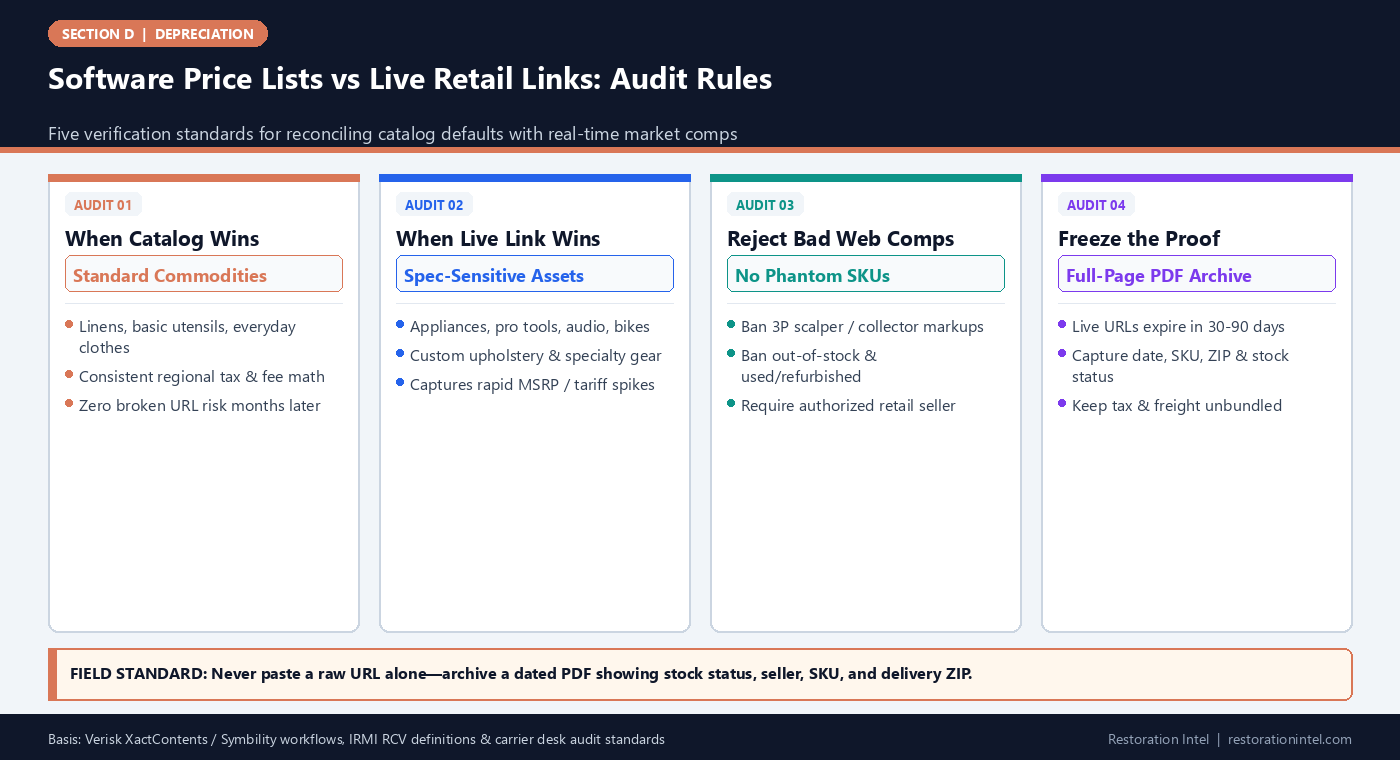
When estimators attach web links to justify custom RCV overrides, desk examiners spot bad comps in seconds. The top four disqualifiers are: (1) third-party marketplace scalpers listing a discontinued $180 coffee maker for $899; (2) out-of-stock or ‘currently unavailable’ catalog pages that cannot actually be purchased; (3) used, refurbished, or open-box listings on auction sites when quoting *new* Replacement Cost Value; and (4) non-equivalent luxury brands substituted without technical justification.
Every live comp submitted for RCV substantiation must represent an item that is *actually available for purchase new today* from a legitimate manufacturer or mainstream retailer at normal everyday retail pricing. Filtering out marketplace noise before submission protects your entire schedule from credibility audits.
- Check seller-of-record: On multi-vendor marketplaces, confirm ‘Ships from and sold by’ lists the primary retailer or OEM rather than an unvetted third-party reseller.
- Verify ‘Add to Cart’ availability: Never cite a link showing ‘Out of Stock’ or ‘Discontinued’ as a live purchase price.
- Exclude used/refurbished from RCV: Used or refurbished listings may help gauge secondary ACV on rare collectibles, but never set RCV on standard household goods.
Why Raw URLs Expire—and How to Archive Verifiable Proof
Retail URLs are notoriously fragile. Product pages rotate SKUs, change promotional pricing overnight, or throw 404 errors six weeks later when a desk examiner—or an appraisal umpire—clicks the link inside a spreadsheet. Submitting an Excel sheet packed with raw hyperlinks and no saved visual proof almost guarantees broken-link rework.
Establish a zero-exception archiving rule for every manual price override: print or save the full browser page as a clean PDF (or full-page PNG) showing the complete URL bar, capture date, product title, SKU/model number, specification table, in-stock badge, and unit price. Store that archived snapshot in a line-keyed evidence folder so the proof remains auditable even if the retailer deletes the webpage the next morning.
- Include delivery ZIP code: Big-box appliance and building-material prices fluctuate by regional market—make sure the screenshot reflects the loss ZIP code.
- Capture core specs on page 1: If specifications sit below the fold, print the full page to PDF so dimensions and wattage appear alongside the price.
- Name files by line ID: Save comps cleanly (e.g.,
L108_Bosch_Dishwasher_Comp.pdf) rather than genericdownload(4).pdffilenames.
Preventing Sales Tax, Shipping, and Bundle Double-Counting
The most common math error when mixing estimating software and live retail comps is double-counting tax and freight. Most contents software automatically applies the local sales tax rate—and sometimes delivery percentages—to the entire RCV column during summary calculation. If an estimator types a checkout screenshot total that already includes 8.5 percent sales tax and $129 freight directly into the unit price field, the software taxes the tax and inflates the line.
Always enter *pre-tax, pre-shipping unit merchandise price* in the RCV unit field, and verify whether freight/white-glove delivery belongs in a dedicated delivery column or separate shipping line item. Running a 30-second tax-strip check on manual web entries eliminates one of the easiest red flags for carrier audit software to catch.
- Strip checkout tax before entry: Only enter base merchandise price into taxed RCV unit fields.
- Separate freight and installation: Keep LTL shipping, crating, and appliance hookup itemized cleanly in designated lines.
- Watch promo/rebate illusions: Ignore mail-in rebates or conditional credit-card sign-up discounts that do not reflect true standalone retail cost.
Practitioner Verification Checklist (D-25)
- Use estimating software regional price lists for standard household commodities and reserve live retail links for Tier 1, custom, commercial, or price-shocked lines.
- Verify every live retail comp shows an in-stock, brand-new item sold by an authorized OEM or mainstream retailer—rejecting third-party scalpers and used listings.
- Archive every live price override as a dated full-page PDF showing URL, SKU, key specs, stock status, and delivery ZIP code.
- Enter strictly pre-tax, pre-shipping merchandise prices into software unit RCV fields so tax engines never double-tax the line.
- Document technical parity (capacity, materials, wattage) in a short line note whenever a live link replaces a discontinued model.
Standards, Authority References & Related Reading
Primary standards, insurance definitions, and sibling Restoration Intel guides referenced in this brief:
- Verisk XactContents Platform Overview
- Verisk Xactimate Estimating Platform
- Symbility Claims Support Portal
- IRMI Insurance Glossary: Replacement Cost Value (RCV)
- Related Guide: Sales Tax, Shipping, and Crating in RCV and ACV Contents Settlements
- Related Guide: Like Kind and Quality (LKQ) Replacement Matching: Rules for Discontinued Brands and Obsolete Models
- Related Guide: High-Inflation and Tariff Shock Pricing: Documenting Sudden Replacement Cost Jumps vs Historical Purchase Price
- Related Guide: Field Guide: Verisk XactContents & Symbility Field-Mapping Reference Sheet
- Related Guide: Xactimate vs. Symbility
.md twin for desk QA and team training.Frequently Asked Questions
Are estimating software price lists always accurate for contents claims?
They are reliable for everyday household commodities, but generic category averages often underprice pro-grade tools, custom furniture, and commercial equipment or lag sudden tariff/MSRP shifts.
Why do adjusters reject Amazon or marketplace links on contents schedules?
Adjusters reject third-party marketplace links that show inflated scalper pricing on discontinued models, out-of-stock pages, or unverified resellers rather than authorized everyday retail pricing.
Is pasting a URL into the spreadsheet enough to prove a replacement price?
No. Live URLs change pricing or expire within weeks. Always archive a dated full-page PDF or screenshot showing the URL, SKU, in-stock status, and delivery ZIP code.
How do you avoid double-counting sales tax when using live web prices?
Enter only the pre-tax, pre-shipping merchandise price into the estimating software’s unit RCV column so the platform’s tax engine calculates local sales tax accurately once.