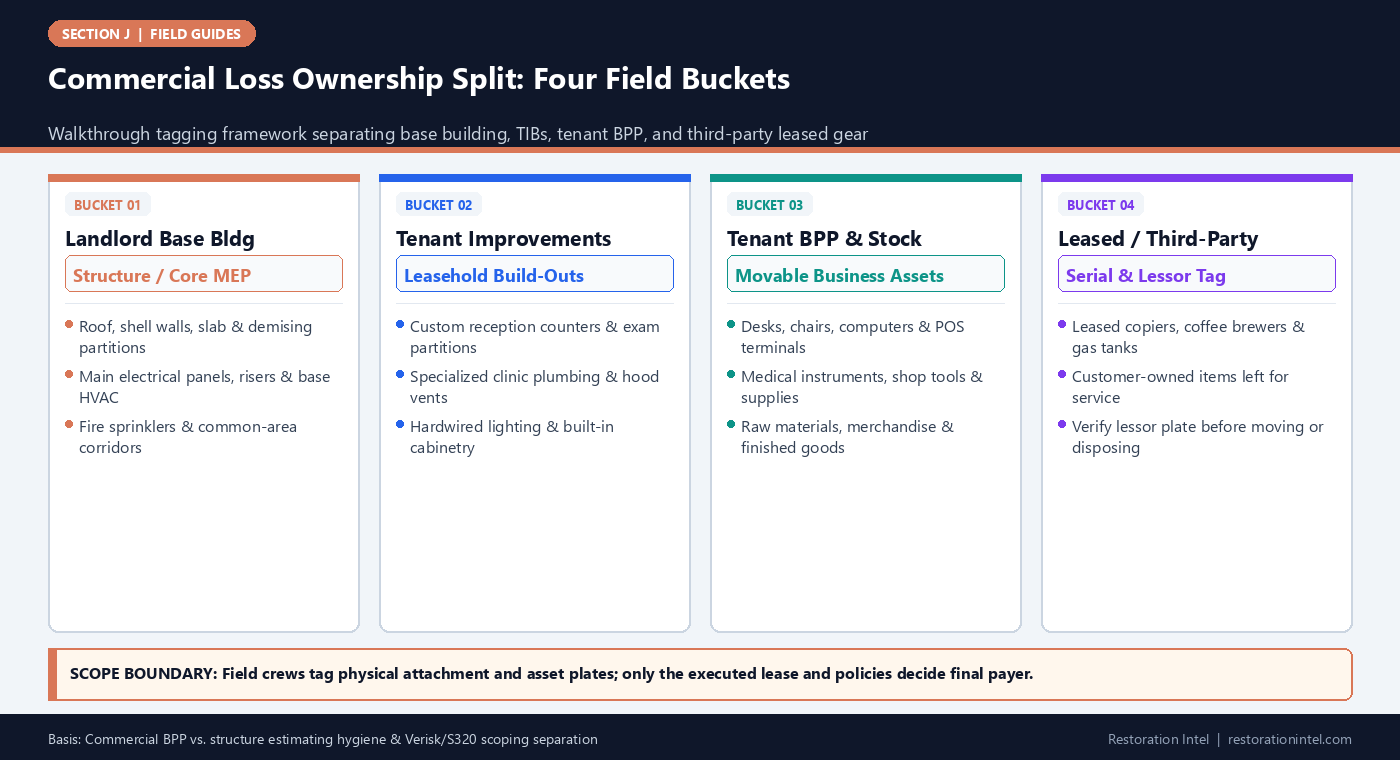
Direct Answer: During commercial losses, field teams should separate property into four provisional buckets — Building Envelope and Landlord Systems, Tenant Improvements and Betterments (TIBs), Tenant Business Personal Property (BPP), and Leased or Third-Party Assets — while explicitly noting that the executed commercial lease and policy endorsements govern final coverage allocation.
.md twin for estimator QA and carrier file documentation.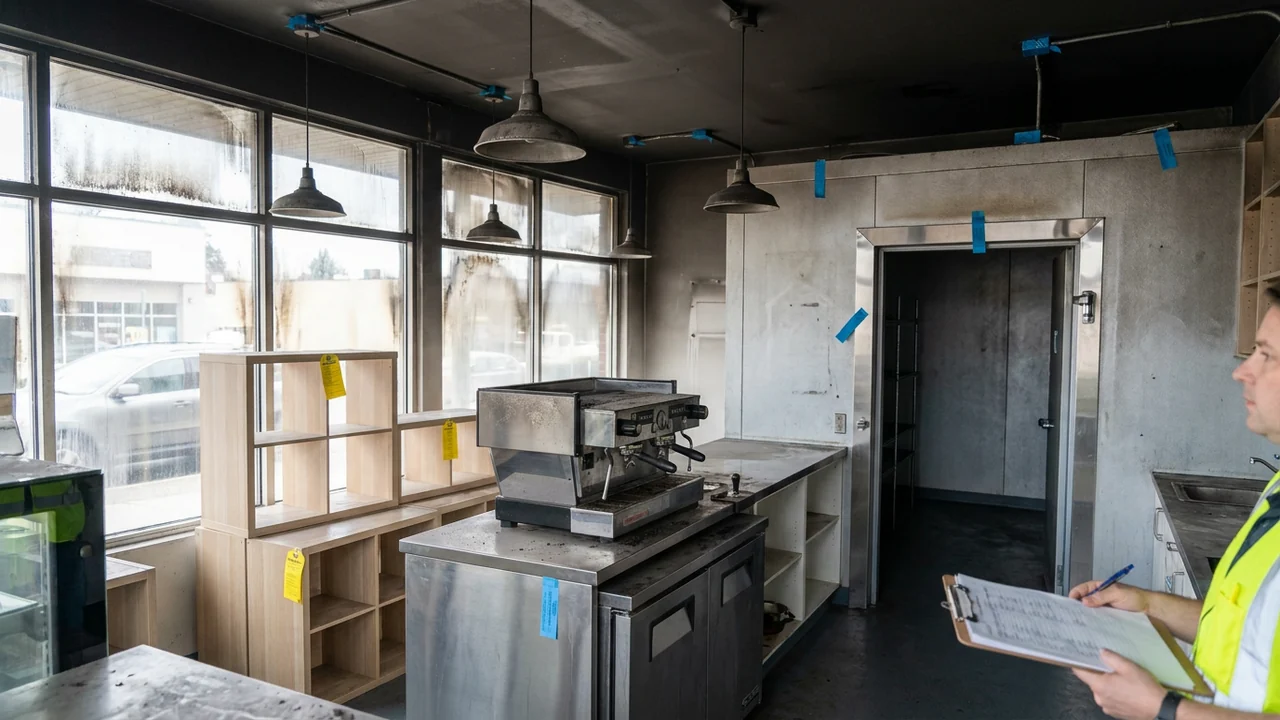
Commercial water and fire losses stall fastest when restoration invoices mix landlord base-building repairs with tenant personal property or leasehold build-outs. On Day 1 in a strip-mall clinic, restaurant, or multi-suite office, crews walk into one continuous room containing rooftop HVAC ductwork, custom millwork reception counters, leased copiers, IT server racks, and boxed retail stock.
While restoration teams never issue coverage verdicts — final responsibility always rests on the signed lease agreement and respective commercial property policies — field estimators and contents leads must tag ownership indicators cleanly at walkthrough. Keeping tenant BPP segregated from landlord mechanicals and Xactimate structural scopes aligns with ANSI/IICRC S320 custody discipline and eliminates carrier kickbacks.
Commercial Loss Ownership Split: Four Field Buckets
Commercial Tenant vs. Landlord Quick-Reference Field Split
Use this operational split during commercial walkthroughs to route line items into the proper estimate schedule, subject to lease and policy verification.
| Asset / Building Component | Typical Field Classification | Physical / Tagging Cue on Site | Estimating Tool Routing | Critical Lease / Policy Caveat |
|---|---|---|---|---|
| Exterior Shell, Roof, Slab & Common Hallways | Landlord Building Coverage | Structural framing, shared stairwells, building-wide utility mains | Structure Estimate (Landlord File) | Triple-net (NNN) leases may shift maintenance costs, not casualty ownership |
| Base-Building HVAC Rooftop Units & Sprinklers | Landlord Building Coverage | Feeds entire building or predates tenant suite build-out | Structure Estimate (Landlord File) | Dedicated supplemental server-room cooling units often belong to tenant TIBs |
| Custom Reception Desks, Partition Walls & Millwork | Tenant Improvements & Betterments (TIBs) | Permanently affixed to slab/wall specifically for tenant brand/workflow | Separate TIB Sub-Schedule (Pending Lease) | Many commercial leases deem affixed TIBs landlord property upon installation or insure under tenant BPP endorsement |
| Restaurant Walk-In Coolers & Type-1 Hood Systems | Disputed / Lease-Dependent (TIB vs. Equipment) | Bolted panels, roof penetrations, dedicated grease exhaust ductwork | Isolate in Dedicated Trade Equipment Group | Review lease fixture-removal clause before pack-out or demolition |
| Modular Cubicles, Desks, Chairs & File Cabinets | Tenant Business Personal Property (BPP) | Freestanding, movable without structural demolition, bolted only for seismic tip | Contents Schedule (XactContents / BPP) | Confirm whether modular walls attach to building power whips or plug cleanly |
| Servers, Workstations, POS & Exam Equipment | Tenant BPP (or Leased Equipment) | Asset tags, IT inventory stickers, serial plates, lease vendor decals | Contents Schedule + IT/OEM Triage | Check property-tax/leasing stickers; leased MFPs and medical devices require lessor notice |
| Retail Stock, Raw Ingredients & Finished Goods | Tenant Commercial Stock / Inventory | Barcoded SKUs, wholesale cartons, point-of-sale shelf merchandise | Commercial Stock Loss Schedule | Separate wholesale replacement cost from retail selling price per policy valuation |
| Customer Property in Custody (Dry Cleaner, Auto, Repair) | Bailee / Property of Others | Claim check tickets, work-order tags, customer-labeled bins | Isolated Bailee Sub-Schedule | Requires specialized bailee coverage verification and immediate customer notification |
Drawing the Physical Line Between Affixed TIBs and Movable BPP
The single greyest area on commercial jobs is the boundary between Tenant Improvements and Betterments (custom drywall partitions, plumbed dental chairs, hardwired pendant lighting, built-in salon stations) and freestanding Business Personal Property. If a mitigation crew rips out wet custom millwork without tagging it separately from base drywall, the landlord carrier and tenant carrier can spend months bouncing the supplement back and forth.
Field leads do not need to read forty-page commercial leases on the sidewalk to prevent that gridlock. Simply separate physical scope into clean, tagged sub-buckets during the initial walk: base shell/MEP, tenant-specific affixed build-outs, and freestanding contents. When both adjusters receive segregated photo folders and sub-schedules, they can settle allocation cleanly using the lease without re-inspecting debris.
- Photograph attachment points: Shoot where a counter, rack, or partition meets the floor and electrical box — hardwired conduit and adhesive masonry anchors signal TIBs, while cord-and-plug units signal BPP.
- Never dispose of disputed fixtures unphotographed: Capture rating plates and build-out dimensions before demolition so landlord and tenant estimators share identical proof.
- Flag walk-ins and specialized plumbing separately: Commercial refrigeration, grease traps, and medical gas lines frequently have bespoke lease clauses.
Isolating Leased Assets, Vendor Equipment, and Customer Bailee Goods
Commercial suites routinely contain high-value equipment the tenant does not own: leased multifunction copiers, commercial dishwashers, beverage dispensers, CO2 cylinders, security panels, and point-of-sale terminals. Packing, cleaning, or condemning a leased unit without checking the side-panel lessor sticker creates immediate contract liability.
Equally sensitive are third-party goods in the tenant’s care, custody, or control — garments at a dry cleaner, patient samples, vehicles in a bay, or electronics on a repair bench. Segregate those assets immediately using distinct physical tags and never co-mingle them with the tenant’s owned office furniture.
- Scan every vendor decal: Photograph leasing company phone numbers, contract IDs, and asset barcodes on copiers, brewers, and medical analyzers.
- Log bailee property under an isolated room/zone code: Attach work-order or customer ticket numbers without opening private customer records.
- Hold demolition/disposal on leased gear: Notify the tenant’s office manager so the lessor can inspect or retrieve damaged leased hardware.
Aligning Walkthrough Output With Xactimate and XactContents Workflows
Once physical buckets are tagged in the field, estimating desks should export cleanly into carrier-expected structures inside XactContents and Xactimate. Never drop commercial retail stock into the same depreciation profile as office furniture, and never bury structural drying or leasehold cabinet replacement inside a personal property box list.
Asking the insured’s facility manager for three baseline documents on Day 1 — the landlord contact, the commercial lease section covering casualty/improvements, and the fixed-asset/lease register — gives estimators the context needed for clean packet assembly.
- Keep commercial stock wholesale-ready: Document SKU quantities and wholesale vendor invoices separately from office fixtures (see commercial stock valuation rules).
- Separate mitigation from contents invoices: Keep structural extraction and air-scrubbing clean under landlord/building authorizations when required.
- Insert an explicit scope disclaimer: Note on every preliminary split schedule that classification reflects observed physical attachment pending lease and policy review.
Practitioner Verification Checklist (J-14)
- Separate commercial walkthrough tags into four distinct buckets: Landlord Base Building, Tenant Improvements (TIBs), Tenant BPP/Stock, and Leased/Bailee Property.
- Photograph physical attachment points (hardwired conduit, slab bolts, plumbing tie-ins vs. cord-and-plug freestanding) on all disputed fixtures.
- Capture lessor/vendor service decals and contract IDs on copiers, POS hardware, beverage systems, and clinic analyzers before moving or cleaning.
- Isolate customer property (bailee items) and commercial wholesale inventory into dedicated sub-schedules separate from office furniture.
- Request landlord contact details, casualty lease provisions, and the fixed-asset register during the Day-1 commercial walkthrough.
Standards, Authority References & Related Reading
Primary standards, insurance definitions, and sibling Restoration Intel guides referenced in this brief:
- ANSI/IICRC S320 Standard for Professional Contents Restoration
- Verisk Property Claims Solutions
- Verisk Xactimate Estimating Platform
- Verisk XactContents Platform Overview
- Related Guide: Stock, Consumables, and Perishables Valuation in Commercial BPP Claims: Wholesale Cost vs Selling Price
- Related Guide: Field Guide: HIPAA, FERPA, and Trade-Secret Privacy Rules During Commercial & Clinic Pack-Outs
- Related Guide: Field Guide: Verisk XactContents & Symbility Field-Mapping Reference Sheet
- Related Guide: Field Guide: Claim Submission Packet QA Checklist (Pre-Send Estimator Gate)
- Related Guide: Which Xactimate Line Items Do Adjusters Actually Approve?
.md twin for desk QA and team training.Frequently Asked Questions
Who pays for damaged Tenant Improvements and Betterments (TIBs) after a commercial fire?
It depends entirely on the commercial lease language and each party’s property insurance endorsements. Field teams should isolate TIBs in their own tagged group so both adjusters can allocate payment without re-scoping.
Can restoration crews pack out or discard a leased office copier?
Never without written authorization from the tenant and notice to the leasing company. Leased equipment remains the property of the lessor, who typically requires inspection or pickup.
Why separate commercial retail stock from office desks and fixtures?
Commercial stock is typically valued differently (often wholesale replacement cost rather than retail selling price, with no physical wear depreciation on fresh goods), whereas desks and computers depreciate over useful life.
What makes a walk-in cooler or reception counter a TIB instead of BPP?
Permanence of attachment, structural tie-ins (drain lines, roof exhaust penetrations, hardwired electrical), and whether removal causes material building damage are key field indicators pending lease review.