Direct Answer: Standard estimating useful-life tables place household electronics at roughly 3-7 years, major appliances at 10-15 years, everyday apparel at 3-6 years, and solid wood furnishings at 15-25+ years — though these 40 category ranges serve strictly as baseline orientation because carrier depreciation schedules, quality tier, and documented pre-loss condition govern final ACV settlement.
.md twin for estimator QA and carrier file documentation.
Every experienced contents estimator runs a mental sanity check before exporting an XactContents schedule: did a five-year-old solid oak dining table get assigned a five-year disposable lifespan, or did a cheap ink-jet printer get priced on a twenty-year curve? When category codes slip in the field, wrong depreciation tables follow silently behind them.
The reference matrix below consolidates typical industry estimating ranges across 40 common residential and office categories, grouped into seven operational asset classes aligned with IRMI depreciation fundamentals and IRS casualty property norms. Always remember that individual insurance carriers publish proprietary depreciation schedules — and verified pre-loss condition grades or rebuilds modify effective age — so treat these ranges as estimator QA benchmarks rather than fixed legal caps.
Useful-Life Bands Across 40 Household & Office Categories
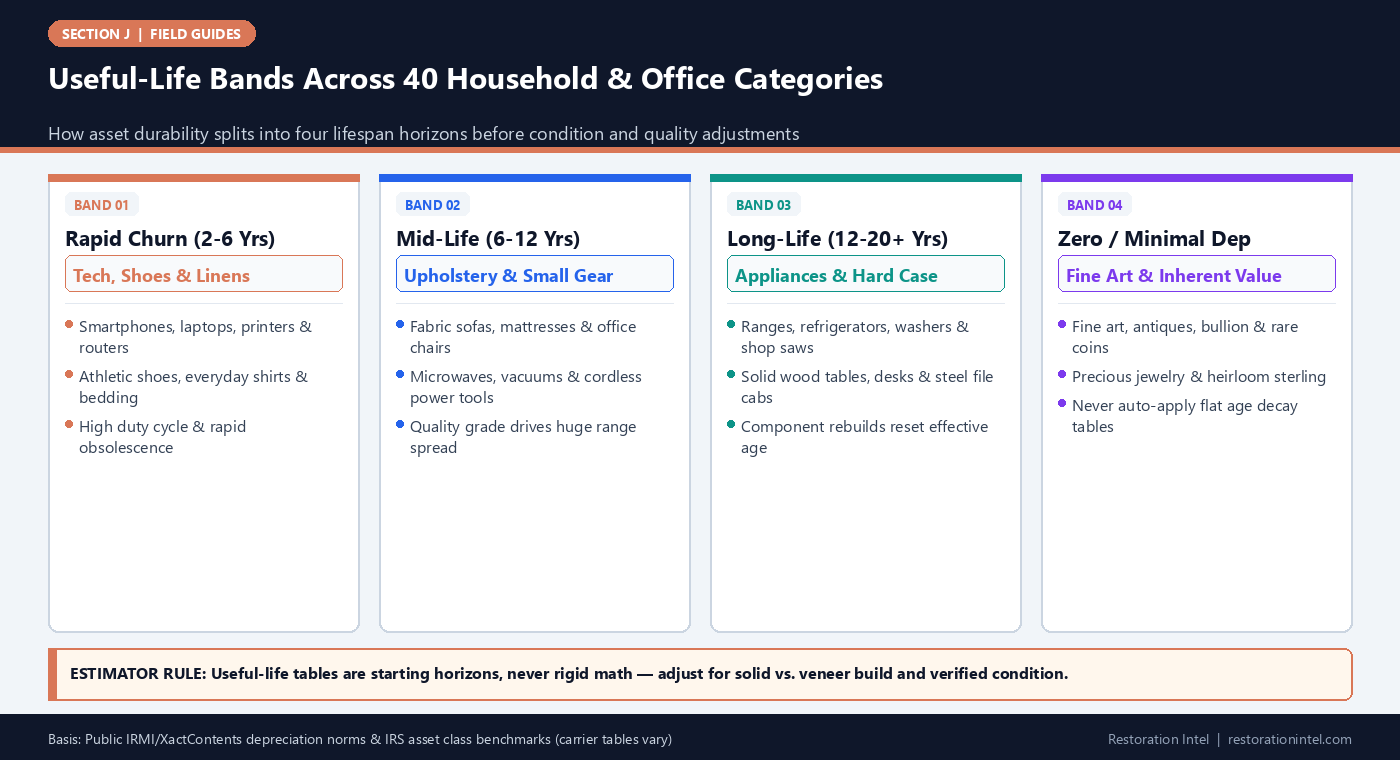
40-Category Household & Office Useful-Life Quick-Reference Table
Typical industry useful-life orientation ranges across 40 core categories (items 1-40). Actual ACV settlements depend on carrier tables, build tier, and documented condition.
| Asset Group | 40 Covered Household & Office Categories (Numbered 1-40) | Typical Useful-Life Range | Primary Depreciation Driver | Estimator QA Red Flag |
|---|---|---|---|---|
| Group A: Major Appliances (1-6) | (1) Refrigerators & Freezers: 12-16 yrs; (2) Ranges/Ovens: 13-18 yrs; (3) Dishwashers: 9-12 yrs; (4) Washers & Dryers: 10-14 yrs; (5) Built-In Microwaves: 7-10 yrs; (6) Window/Portable AC Units: 7-10 yrs | 7–18 years (prosumer gas ranges extend higher) | Mechanical duty cycle, compressor/board cost vs. unit RCV | Lumping commercial/prosumer Wolf/Sub-Zero gear into economy builder-grade tables |
| Group B: Small Appliances & Housewares (7-12) | (7) Countertop Espresso/Coffee Makers: 4-8 yrs; (8) Stand Mixers (Metal Gear): 15-25 yrs; (9) Blenders/Toasters: 4-7 yrs; (10) Upright/Stick Vacuums: 4-8 yrs; (11) Stainless/Cast-Iron Cookware: 15-30+ yrs; (12) Everyday Ceramic Dinnerware/Glassware: 8-15 yrs | 4–30+ years (cast iron & pro mixers outlast plastics) | Plastic motor housings vs. solid metal/enamel construction | Depreciating heirloom cast-iron skillets or KitchenAid mixers like disposable plastic blenders |
| Group C: Consumer & Office Electronics (13-19) | (13) Smartphones & Tablets: 3-5 yrs; (14) Laptops & Desktop PCs: 4-6 yrs; (15) Smart TVs & Monitors: 5-8 yrs; (16) Inkjet/Laser Printers & Scanners: 4-7 yrs; (17) Network Routers/NAS: 4-6 yrs; (18) Audio Receivers/Speakers: 8-18 yrs; (19) Mirrorless/DSLR Cameras & Lenses: 6-15 yrs | 3–18 years (optical lenses & hi-fi speakers hold longest) | Rapid processor/panel obsolescence vs. stable passive acoustics/optics | Applying 4-year computer decay to high-end passive bookshelf speakers or prime camera lenses |
| Group D: Residential Furniture & Bedding (20-26) | (20) Upholstered Fabric Sofas/Sectionals: 7-12 yrs; (21) Full-Grain Leather Sofas: 12-20 yrs; (22) Solid Hardwood Dining/Bedroom Sets: 20-35+ yrs; (23) Particleboard/Veneer Casegoods: 5-10 yrs; (24) Mattresses & Box Springs: 8-10 yrs; (25) Machine-Made Area Rugs: 6-12 yrs; (26) Hand-Knotted Wool/Silk Rugs: 25-50+ yrs | 5–50+ years (construction material dictates spread) | Frame joinery, solid timber vs. MDF, foam density & knot count | Using generic 'Furniture' defaults that over-depreciate solid oak or hand-knotted rugs |
| Group E: Office Furnishings & Commercial Gear (27-31) | (27) Ergonomic Mesh/Task Chairs: 7-12 yrs; (28) Commercial Laminate/Steel Desks: 12-20 yrs; (29) Steel Lateral File Cabinets: 20-30 yrs; (30) Commercial Copiers/MFPs: 5-8 yrs; (31) POS Terminals & Barcode Scanners: 5-7 yrs | 5–30 years (steel storage far outlasts digital office gear) | Rolling/hydraulic wear on chairs vs. static steel chassis longevity | Failing to separate Herman Miller/Steelcase commercial seating from $99 flat-pack chairs |
| Group F: Apparel, Footwear & Soft Goods (32-36) | (32) Everyday Shirts, Pants & Casual Wear: 3-5 yrs; (33) Tailored Wool Suits & Outerwear Coats: 6-12 yrs; (34) Athletic Sneakers & Work Boots: 2-4 yrs; (35) Bed Sheets, Towels & Pillows: 3-6 yrs; (36) Custom Tailored Draperies & Blinds: 10-18 yrs | 2–18 years (outerwear & custom drapery far exceed basics) | Wash cycle abrasion, sole wear, and seasonal rotation frequency | Applying flat 50%+ blanket depreciation across lightly worn wool coats or custom drapery |
| Group G: Tools, Yard & Specialty Non-Depreciating (37-40) | (37) Stationary Bench/Shop Tools (Table Saws, Drill Presses): 15-30 yrs; (38) Cordless Power Tools & Lawn Mowers: 6-10 yrs; (39) Bicycles & Home Gym Equipment: 8-15 yrs; (40) Fine Art, Antiques, Bullion & Rare Collectibles: Non-Depreciating (Appraised FMV) | 6–30+ yrs / Non-Depreciating (#40) | Battery cell decay vs. cast-iron induction longevity vs. market appreciation | Applying linear age depreciation to Category 40 antiques, original art, or precious metals |
Why Material Quality Splits Useful Life Inside the Same Room
Two sofas sitting in adjacent living rooms rarely belong on the same depreciation schedule. A mass-market stapled-pine sofa with polyester foam sags noticeably after five to seven years of family use, whereas a kiln-dried hardwood, eight-way hand-tied full-grain leather sofa routinely delivers fifteen to twenty years of crisp service. Treating both identically under one generic `Sofa — 10-year life` shortcut penalizes quality homeowners.
The same divergence holds across kitchenware, office seating, and rugs: cast-iron Dutch ovens and pro-grade stand mixers routinely outlive cheap nonstick pans by two decades, and hand-knotted Persian wool rugs hold structural integrity decades past tufted synthetic carpets. Capturing construction cues (dovetail drawers, solid wood grain edges, Herman Miller tags, cast-iron weight) lets estimators select the matching useful-life category defensibly.
- Tag material tier explicitly: Record `Solid Oak` vs. `Laminate MDF` and `Full-Grain Leather` vs. `Bonded Faux Leather` on Day 1.
- Separate passive optics/acoustics from digital electronics: Camera lenses and passive hi-fi speakers retain functional life far longer than laptops or smart TVs.
- Guard Category 40 assets from auto-depreciation: Original art, antiques over 100 years, rare coins, and precious jewelry do not follow standard physical wear-out curves.
Effective Age Resets and Non-Linear Component Rebuilds
Chronological purchase date does not always equal remaining economic useful life. A twelve-year-old commercial espresso machine that underwent a documented boiler and pump rebuild eighteen months before the loss — or a ten-year-old heirloom armchair completely reupholstered and re-webbed — carries a much lower effective age than an untouched original unit.
Under IRMI ACV principles, useful-life estimates reflect remaining physical utility. Documenting service invoices, reupholstery receipts, or new replacement motor serial stickers lets estimators present a fair effective-age narrative instead of letting raw purchase year trigger an unfair maximum depreciation cap.
- Collect maintenance and rebuild receipts: Ask homeowners and clinic managers for recent appliance repairs, furniture reupholstery, or PC RAM/SSD upgrades.
- Cross-check against Condition Grade (J-18): High-tier `Mint` or `Good` condition photos corroborate lower effective age when receipts are lost in the fire.
- Watch carrier depreciation floors: Many carriers cap maximum physical depreciation on functional items in active daily use (confirm policy/state rules).
Using the 40-Category Table as a Pre-Send Estimator Audit Check
Before pushing an XactContents or Symbility file into carrier review, sort the exported grid by depreciation percentage and by category code. Outliers jump off the screen immediately: a 1-year-old stainless skillet depreciated 60 percent because someone picked a `Disposable Utensil` code, or a 10-year-old inkjet printer coded under `Commercial Heavy Equipment.`
Auditing those mismatches takes ten minutes and prevents desk examiners from questioning your broader valuation logic across the entire claim. Always include a clear note in the submission packet stating that baseline ranges follow standard industry orientation subject to the policy’s governing ACV/RCV terms and verified RCV vs. ACV structure.
- Sort by category and check extremes: Verify every item in Group C (Electronics) and Group G (Tools/Collectibles) mapped to the right lifespan family.
- Keep commercial stock separate: Never run depreciation tables against fresh wholesale retail inventory waiting for sale.
- Pair ages with source attribution: Flag homeowner-reported ages clearly vs. rating-plate manufacture dates decoded during inspection.
Practitioner Verification Checklist (J-19)
- Verify every scheduled line maps to the exact material/durability sub-category across the 40 groups (solid wood vs. MDF, prosumer vs. entry appliance, wool vs. synthetic rug).
- Never apply linear age depreciation to Category 40 assets (fine art, certified antiques, bullion, or appreciated collectibles).
- Separate long-life optical/acoustic equipment (camera lenses, passive speakers) from short-life digital processors (laptops, tablets, printers).
- Document documented rebuilds, reupholstery, or component replacements to support lower effective age on well-maintained older assets.
- Sort the pre-send schedule by depreciation percentage to catch miscoded outliers before carrier desk review.
Standards, Authority References & Related Reading
Primary standards, insurance definitions, and sibling Restoration Intel guides referenced in this brief:
- IRMI Insurance Glossary: Depreciation
- IRMI Insurance Glossary: Actual Cash Value (ACV)
- Verisk XactContents Platform Overview
- IRS Publication 547: Casualties, Disasters, and Thefts
- Related Guide: How Useful-Life Depreciation Tables Work — and Where Adjusters and Contractors Misapply Them
- Related Guide: Condition vs Chronological Age: Documenting Pre-Loss Care to Defend Lower Depreciation Percentages
- Related Guide: Electronics and Rapid-Obsolescence Depreciation: Handling Computers, TVs, and Smart Devices Fairly
- Related Guide: Furniture Valuation and Depreciation: Solid Wood vs Veneer, Upholstery Grade, and Custom Joinery
- Related Guide: Field Guide: Condition-Grade Definitions Rubric (New / Mint / Good / Fair / Poor / Damaged)
.md twin for desk QA and team training.Frequently Asked Questions
Are useful-life tables identical across every insurance carrier?
No. Carriers maintain proprietary depreciation guidelines and state-specific ACV rules. These 40 ranges provide standard industry orientation for estimator QA checks rather than a fixed carrier mandate.
Why do solid wood furniture and hand-knotted rugs have much wider useful-life ranges than veneer pieces?
Solid hardwood joinery and dense hand-knotted wool withstand decades of use and can be refinished or repaired, whereas particleboard veneers and synthetic tufted rugs degrade irreversibly within 5 to 12 years.
Should standard age depreciation apply to fine art or antiques?
Usually no. Appreciated antiques, original fine art, bullion, and rare collectibles are valued on fair market or appraised value rather than wearing out on a linear lifespan curve.
What if a 12-year-old sofa or espresso machine was recently rebuilt or reupholstered?
Save the invoice or show fresh upholstery/component photos in the claim packet so the desk reviewer evaluates effective age rather than penalizing solely by original purchase year.