Direct Answer: Managing non-salvageable lists and high-dollar exceptions requires separating undisputed total-loss criteria from borderline salvage testing, enforcing pre-disposal photo verification, respecting carrier salvage and subrogation holds, and routing scheduled or specialty assets to qualified appraisers early.
.md twin for estimator QA and carrier file documentation.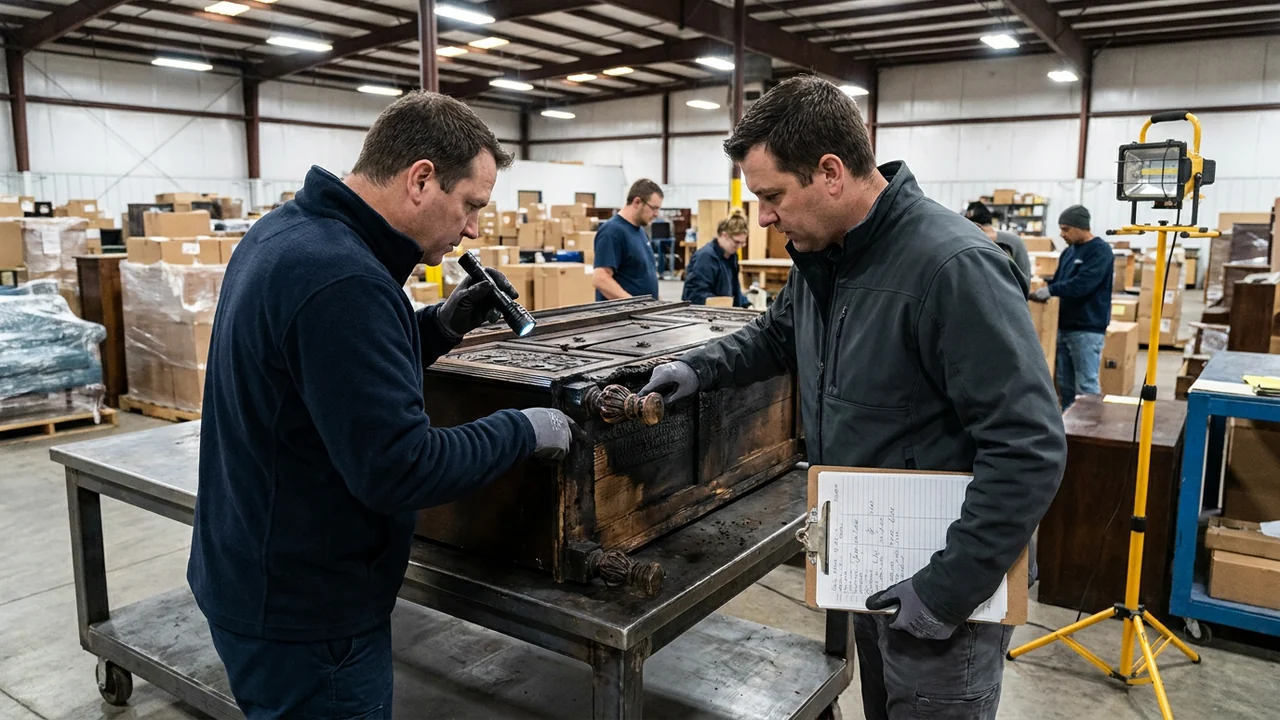
Routine household contents rarely stall a claim. What stalls claims for months are two overlapping friction zones: non-salvageable total-loss lists where the carrier questions whether items could have been cleaned, and high-dollar exceptions—fine art, luxury watches, custom machinery, commercial electronics, or specialty collectibles—where standard estimating databases break down.
Across the adjuster interface, each role views these exceptions through a sharp lens. The desk examiner guards against economic waste (paying to pack and clean an item whose restoration cost exceeds replacement value, or paying RCV on an asset that was actually cleanable), while also watching carrier rights to salvage and subrogation. Meanwhile, the field IA needs clear physical criteria to verify total-loss claims on site, and the PA must ensure the policyholder receives full fair indemnity without violating policy cooperation duties.
Ground rules rooted in ANSI/IICRC S320 technical feasibility, RIA cleaning economics, and transparent quarantine staging convert emotional high-dollar standoffs into documented decisions.
Non-Salvageable & High-Dollar Exception Decision Workflow
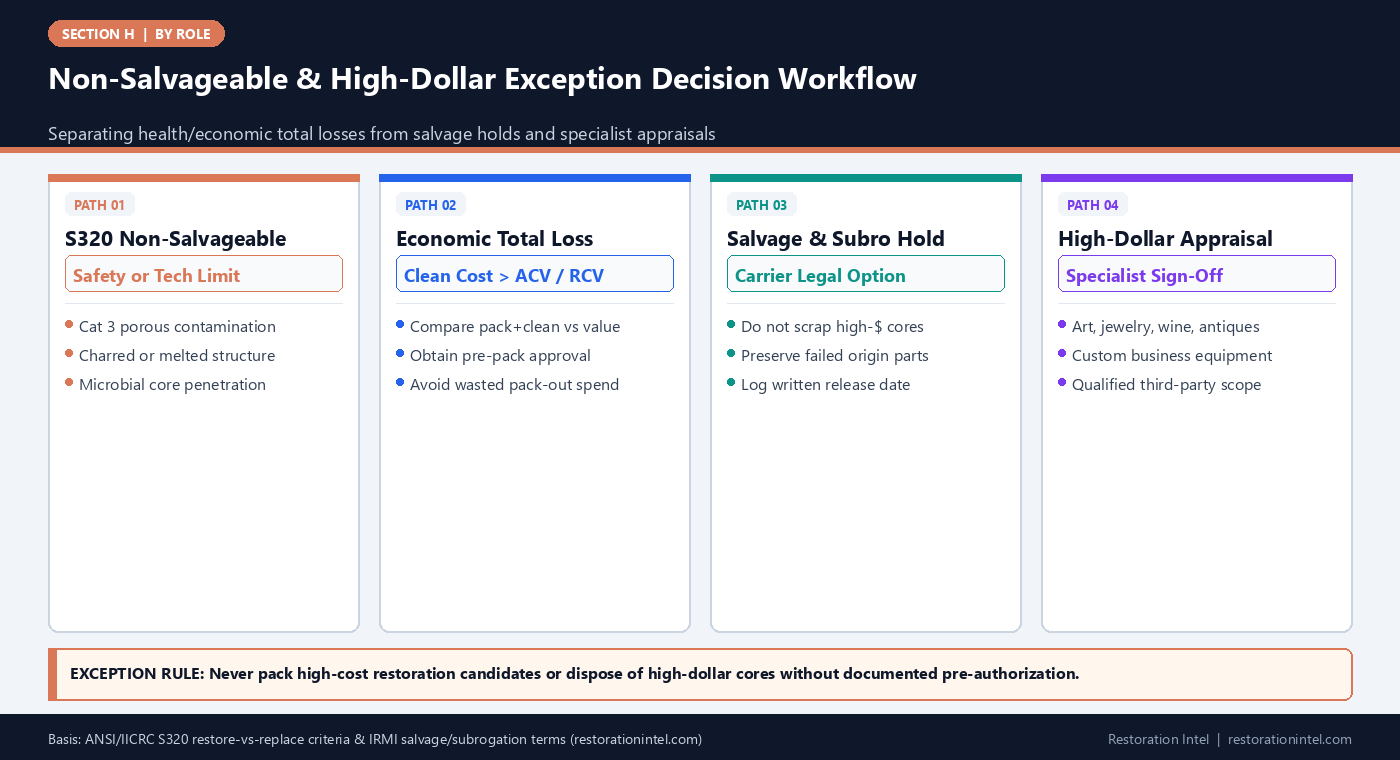
Non-Salvageable & High-Dollar Exception Matrix Across Claim Roles
Criteria and verification steps required before declaring items non-salvageable, executing disposal, or settling high-value exceptions.
| Exception Scenario | Technical / Policy Trigger | Required Evidence Packet | Carrier Salvage / Subro Risk | Approved Workflow Action |
|---|---|---|---|---|
| Category 3 Porous Total Loss | Sewage or flood saturation of mattresses, particleboard, or upholstery | Wicking-height photo, moisture reading, room contamination map | Low salvage value; verify biohazard disposal compliance | Document in situ, clear health hazards, hold durable frames if requested |
| Economic Total Loss (Pack-Clean > Value) | Estimated pack, transport, clean, and store exceeds item ACV/RCV | Side-by-side restoration quote vs verified LKQ replacement price | Carrier may waive cleaning and settle ACV/RCV directly | Present economic comparison to IA/desk before packing onto truck |
| High-Dollar Electronics & Appliances | Water, soot, or power surge affecting prosumer/commercial units | Rating plate, internal board/soot photo, OEM diagnostic report | High subrogation or salvage-broker recovery potential | Hold unit intact until qualified electronics tech or carrier clears release |
| Fine Art, Rugs & Heirlooms | Smoke, water, or mold impact on unique or non-fungible property | Front/back photos, maker signature, provenance, conservator bid | Restorability vs diminution in value often requires specialist | Route to accredited art/textile conservator prior to any wipe-down |
| Suspected Origin Components | Appliance, battery, hose, or wiring suspected in fire or water origin | Undisturbed in-situ 360-degree photos and secured evidence log | Spoliation of evidence can forfeit multi-million carrier recovery | Freeze disturbance; transfer custody per carrier forensic protocol |
| Scheduled Jewelry & Firearms | High-value items covered by scheduled floater or fixed sublimit | Policy schedule match, appraisal/serial verification, damage inspection | Carrier salvage right applies if paid as full total loss | Coordinate directly with desk examiner on settlement vs salvage surrender |
Distinguishing Technical Non-Salvageability From Economic Total Loss
Field crews and adjusters frequently blur two completely different total-loss justifications. Technical non-salvageability means the item cannot be safely returned to pre-loss sanitary or structural condition regardless of budget—for example, particleboard furniture swollen by standing water, upholstered cushions saturated by Category 3 blackwater, or electronics with acid-corroded circuit boards following PVC wire combustion.
Economic total loss means the item *could* technically be cleaned or repaired, but the combined cost of pack-out labor, specialty cleaning, deodorization, and storage equals or exceeds the item’s replacement cost or ACV. Under ANSI/IICRC S320 and carrier cost-containment rules, packing out a $220 flat-pack bookcase only to bill $350 in transport and soot cleaning creates avoidable claim waste.
Desk examiners approve non-salvageable lists far faster when both categories are tagged separately. Technical total losses cite material porosity, peril category, and safety standards; economic total losses attach a clear cost-benefit note before the crew ever loads the truck.
- Tag the exact basis: Label every non-salvageable row explicitly as ‘Technical / Health Non-Salvageable’ or ‘Economic Total Loss (Rest Cost > Value)’.
- Pre-pack economic screening: Catch low-value, labor-heavy items (laminate shelving, basic lamps, inexpensive linens) at walkthrough so they are settled rather than packed.
- Conservator exception for sentimental goods: Flag heirlooms where the insured elects cleaning despite high cost, with written carrier or customer-pay agreement.
Navigating Carrier Salvage Rights and Subrogation Evidence Holds
When an insurer pays total-loss replacement value on a high-dollar asset—such as a commercial refrigeration unit, luxury watch, damaged vehicle parts, or salvageable industrial tooling—the policy generally grants the insurer the right to take possession of the damaged property under IRMI salvage provisions. Contractors or policyholders who unilaterally sell, donate, or scrap paid total-loss hardware before securing a written salvage waiver expose the claim to settlement offsets.
An even steeper legal risk arises under subrogation law. If a dishwasher supply valve, lithium battery pack, or faulty HVAC control triggered the loss, discarding that component during contents demolition can constitute spoliation of evidence, wiping out the carrier’s third-party recovery.
Shared discipline across the desk examiner, IA, and PA requires a simple quarantine rule: any high-dollar total-loss asset or potential origin component remains tagged and held intact until the carrier issues written disposal or salvage-release instructions.
- Written release before scrapping: Never haul high-dollar mechanicals, electronics, or luxury goods without a dated carrier salvage waiver.
- Origin-evidence chain of custody: Seal suspected failure components in labeled, tamper-evident storage pending forensic engineer pickup.
- Salvage credit transparency: If the insured wishes to retain a lightly damaged total-loss item, document the agreed salvage deduction transparently in writing.
Managing High-Dollar Specialty Exceptions Without Breaking Standard SLAs
Standard contents pricing engines excel at everyday retail goods—appliances, clothing, kitchenware, and mass-market furniture. They fail when applied blindly to custom millwork, signed fine art, vintage musical instruments, rare books, or specialized medical and manufacturing equipment. Forcing a $15,000 restored grand piano or an archival textile collection through generic catalog lookups produces arbitrary numbers that neither a desk examiner nor a PA can defend.
The disciplined operational move is bifurcating the claim file early: route the 95 percent standard household schedule through normal capture and LKQ estimating so initial ACV payments flow on schedule, while isolating the 5 percent high-dollar exceptions onto a dedicated specialist track.
On that specialist track, desk examiners, IAs, and PAs agree on neutral third-party evaluation steps—certified art conservator test-cleaning bids, manufacturer service-center diagnostics, or accredited USPAP-compliant personal property appraisals—backed by clear turnaround dates.
- Bifurcate standard vs specialty tracks: Never hold a 400-line residential settlement hostage waiting on a single fine-art appraisal.
- Diagnostic proof for complex equipment: Require written OEM or authorized technician inspection reports before declaring specialized machinery total loss.
- Confirm policy scheduling early: Verify whether high-dollar exceptions sit under general Coverage C sublimits or separate scheduled personal property endorsements.
Resolving Borderline Restore-vs-Replace Disputes Objectively
Between unmistakably ruined debris and clearly cleanable hard goods lies a stubborn middle band: lightly smoke-exposed wood heirlooms, water-wicked high-end rugs, and soot-coated commercial electronics. A PA may push for full replacement citing residual odor concerns, while a desk examiner insists on specialized cleaning citing RIA technical success rates.
Breaking that stalemate requires verifiable physical evidence rather than dueling opinions. Running a documented, small-scale test restoration—using ozone-free hydroxyl or dry-sponge soot removal, or submitting one rug to a master cleaner with pre- and post-test inspection photos—establishes whether pre-loss appearance and odor neutrality are actually achievable.
Equally important, written test criteria agreed upfront across the IA, PA, and desk examiner ensure that if the test restoration fails to meet objective S320 cleanliness and odor benchmarks, the item transitions cleanly to non-salvageable replacement without repeating the argument.
- Pre-agreed test-clean benchmarks: Define measurable pass/fail criteria (odor, dye bleed, veneer stability) with the IA and desk before testing delicate items.
- Warranty & safety boundary: Respect manufacturer warranty voidances and UL electrical safety limits when deciding whether wet/smoked electronics can be returned to service.
- Transparent vendor test logs: Attach dated diagnostic invoices and close-up post-test images directly to the disputed schedule line.
Practitioner Verification Checklist (H-29)
- Separate technical/health non-salvageable lines from economic total-loss lines (cleaning cost > value) with pre-pack cost comparisons.
- Complete in-situ wide, damage, and rating-plate photos before clearing any non-salvageable item, keeping durable assets held until IA sign-off when required.
- Hold high-dollar mechanicals, electronics, and suspected origin components in documented quarantine until written carrier salvage or subrogation release arrives.
- Bifurcate standard household goods from high-dollar specialty assets so routine ACV payments release while specialist appraisals proceed.
- Resolve borderline restore-vs-replace disputes through documented diagnostic testing or agreed test-clean benchmarks rather than unverified opinion.
Standards, Authority References & Related Reading
Primary standards, insurance definitions, and sibling Restoration Intel guides referenced in this brief:
- ANSI/IICRC S320 Standard for Professional Contents Restoration
- Restoration Industry Association (RIA)
- IRMI Insurance Glossary: Salvage
- IRMI Insurance Glossary: Subrogation
- Related Guide: Adjuster Interface (Desk Examiner, IA & Public Adjuster): Pricing, LKQ Sourcing & Valuation Defensibility
- Related Guide: Adjuster Interface (Desk Examiner, IA & Public Adjuster): Quality Assurance Review & Pre-Submission Audit
- Related Guide: The Adjuster Desk: One Standard, Two Chairs
- Related Guide: Which Xactimate Line Items Do Adjusters Actually Approve?
- Related Guide: A Pack-Out Record Is Not a Priced Inventory
.md twin for desk QA and team training.Frequently Asked Questions
When does a contents item qualify as an economic total loss?
An item is an economic total loss when the combined cost of pack-out, transport, specialty cleaning, deodorization, and storage equals or exceeds its replacement value or agreed ACV, making restoration financially wasteful.
Can a policyholder keep a total-loss item after receiving full settlement?
Generally only with explicit carrier agreement and an agreed salvage deduction. Under standard insurance principles, paying full total-loss value transfers salvage rights to the insurer unless waived in writing.
What happens if a crew discards a broken appliance that caused a water or fire loss?
Discarding suspected origin components without carrier authorization can cause spoliation of evidence, potentially impairing the insurer’s subrogation recovery and creating severe claim disputes.
How should high-dollar artwork or custom machinery be handled in XactContents?
Isolate them as dedicated exception lines linked to specialist conservator bids, OEM diagnostics, or accredited appraisals rather than forcing generic catalog estimates.