Direct Answer: Accurate pre-loss contents valuation prevents co-insurance underinsurance penalties by reconciling tax-depreciated accounting ledgers against current floor-level Replacement Cost Value (RCV), unrecorded CapEx, and seasonal inventory swings before renewal.
.md twin for estimator QA and carrier file documentation.
Most commercial policyholders and large facility operators discover co-insurance penalties only after a partial fire or sprinkler discharge—the worst possible moment. Because commercial Business Personal Property (BPP) policies frequently tie full partial-loss payouts to carrying coverage limits equal to 80%, 90%, or 100% of total insurable value at the time of loss, relying on outdated estimates or tax-depreciated book numbers quietly sets a financial trap.
When a facility carries a $500,000 BPP limit on equipment and inventory that actually costs $1,000,000 to replace on the open market, an 80% co-insurance clause turns a $200,000 partial smoke loss into a severely reduced payout—even though the loss itself sits well below the $500,000 policy cap. Pre-loss contents valuation closes that visibility gap while there is still time to adjust limits.
Practical scope boundary: Restoration estimators and contents specialists build physical asset counts and current replacement-cost reference schedules for operational readiness and underwriting support—they do not act as licensed insurance brokers, rate coverage adequacy, or provide legal interpretation of policy clauses. Business owners and facility directors must review actual co-insurance percentages, agreed-value endorsements, and RCV versus ACV definitions directly with their licensed broker or carrier.
Why Financial Ledgers Trigger Co-Insurance Penalties
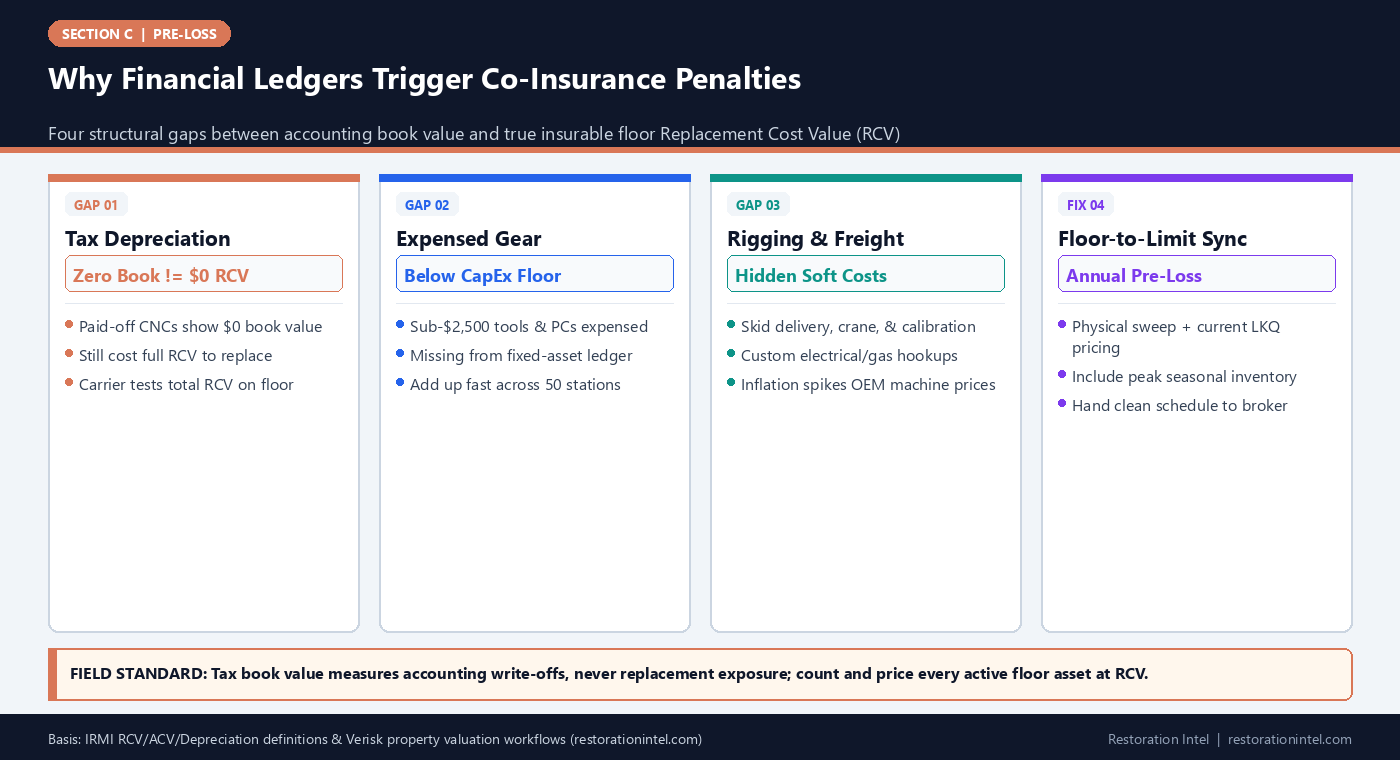
Common Sources of Pre-Loss Valuation Drift vs Physical Floor Reality
Where accounting schedules and quick renewal guesses systematically understate insurable BPP value before a loss.
| Valuation Blind Spot | Why Accounting Reports Miss It | Pre-Loss Field Capture Correction | Estimator Valuation Input | Operational Benefit Pre-Renewal |
|---|---|---|---|---|
| Fully Depreciated Machinery | Written down to zero on tax books over 5–7 years | Photograph every working machine's OEM plate regardless of age | Current LKQ new-unit quote via Verisk / dealer catalog | Prevents millions in unlisted active equipment value |
| Expensed Small Tools & IT | Items under $1,000–$2,500 expensed directly to OpEx | Count workstation bundles, hand tools, & POS peripherals by zone | Bundle-verified unit pricing inside XactContents | Captures dense mid-tier gear omitted from CapEx lists |
| Peak Seasonal Stock Swings | Year-end balance sheet captured during low-inventory month | Document max rack capacity and seasonal stock peaks | Peak-stock unit count x landed replacement cost | Flags temporary peak-season endorsement needs to broker |
| Freight, Rigging & Calibration | Ledger records bare equipment invoice from years ago | Note crane access, cleanroom setup, & calibration seals | Include freight/rigging allowances in RCV reference | Aligns pre-loss baseline with real restoration replacement |
| Tenant Betterments & Signage | Amortized leasehold spend buried in facility accounts | Capture custom build-outs, shelving, & illuminated signage | Separate non-movable upgrades from movable BPP | Stops double-counting or omitting tenant-installed fixtures |
| Inflation & Discontinued Specs | Historical purchase price locked at 2016–2019 cost | Match obsolete models to current compliant OEM equivalents | Verified current-model LKQ replacement benchmarks | Eliminates multi-year price-index lag before renewal |
How Co-Insurance Math Turns Under-Valued Baselines Into Partial-Loss Cuts
Co-insurance exists to encourage policyholders to carry limits close to actual property value rather than insuring a million-dollar warehouse for a fraction of its worth while still expecting full payment on smaller fires. Under standard commercial valuation mechanics explained in IRMI Replacement Cost Value (RCV) and IRMI Actual Cash Value (ACV) references, the carrier evaluates total insurable value on the floor at the time of loss against the required co-insurance percentage.
Consider an illustrative textbook arithmetic example (purely mathematical, not a specific policy ruling): suppose a business holds $1,000,000 in actual RCV contents on the floor, and the policy includes an 80% co-insurance requirement—meaning the required limit is $800,000. If the insured only carried a $500,000 limit based on outdated tax records, the carried-to-required ratio is $500,000 divided by $800,000, or 62.5%. On a $200,000 partial water or smoke loss, the penalty formula limits recovery to 62.5% of the loss ($125,000) minus the deductible.
Notice the painful irony: the policyholder never even approached the $500,000 policy ceiling, yet still absorbed a massive shortfall solely because total floor value was understated before the loss. Accurate pre-loss floor valuation gives owners and brokers the hard numbers needed to calibrate limits or evaluate agreed-value options prior to binding.
- Did-over-should ratio: Under standard co-insurance formulas, carrying less than the required percentage of total floor value reduces partial-loss payouts proportionally.
- RCV vs ACV check: Confirm with the broker whether the valuation clause tests total value at RCV or depreciated ACV before building the schedule.
- Non-UPL reminder: Estimators supply verified physical asset quantities and market pricing; only licensed brokers or carriers advise on policy limits.
Why Fixed-Asset Ledgers and Tax Books Always Mislead Estimators
When a facility manager hands over an Excel depreciation schedule from the company controller as a ‘pre-loss contents list,’ experienced restoration estimators immediately treat it as a starting clue—never a finished valuation. Accounting ledgers are built for tax compliance and GAAP amortization, not physical disaster recovery. A commercial bakery’s $95,000 deck oven installed eight years ago may sit on the tax schedule at $0 net book value, yet replacing that same oven after a kitchen fire costs $120,000 plus freight and hood tie-ins.
At the opposite end of the ledger, capitalization thresholds hide huge pools of active equipment. Most businesses expense purchases under $1,500 or $2,500 directly to operating supplies—meaning dozens of laptops, barcode scanners, ergonomic chairs, cordless drill kits, pallet jacks, and stainless prep tables never appear on any fixed-asset report.
On top of hardware omissions, accounting invoices rarely reflect current supplier inflation or specialty installation requirements. Aligning physical walkthrough counts with The Adjuster Desk documentation norms turns blind ledger assumptions into verifiable floor reality.
- Zero-book equipment sweep: Walk every active production bay and count fully depreciated machines still generating revenue.
- OpEx bundle tally: Group expensed tools, workstations, and small appliances by room so high-volume low-unit-cost items are counted accurately.
- Landed-cost realism: Flag special rigging, crane lifts, calibration, and freight requirements alongside OEM equipment quotes.
Building a Zone-by-Zone Physical RCV Baseline With Estimator Tools
Preventing valuation drift requires pairing visual room sweeps with structured estimating taxonomy. Instead of guessing a lump-sum dollar figure per square foot, pre-loss teams divide the facility into numbered operational zones—Reception, Admin Suite, Lab Bay A, Warehouse Rack Rows 1–8—and capture wide room views, serial plates for major equipment, and grouped counts for consumables.
Estimators then map those verified counts into XactContents or Verisk Property Claims pricing workflows, recording both current LKQ replacement cost and observed physical condition/age. Having both RCV and condition notes documented gives the policyholder transparent numbers whether a future policy evaluates total value on an RCV or ACV basis.
For stockrooms and retail backrooms, pair static shelving photos with ERP cycle-count exports showing minimum, average, and peak seasonal inventory turns. Recording peak holiday or harvest stock levels ensures co-insurance calculations aren’t blindsided if a loss occurs during the busiest quarter of the year.
- Zone-indexed pricing: Tie every line item in the valuation workbook to a physical room/zone ID for fast annual re-audits.
- Owned vs leased split: Flag leased copiers, vendor-owned vending units, and customer consignment goods separately so owned limits aren’t inflated or distorted.
- Condition & age notes: Record install year and observable wear to support accurate depreciation modeling when required.
Annual Pre-Renewal Reconciliation and Post-Loss Settlement Acceleration
A pre-loss valuation baseline only protects against co-insurance penalties if it stays synchronized with property changes. New equipment installations, office build-outs, warehouse racking expansions, and multi-site asset transfers should trigger lightweight delta updates rather than waiting five years for a full re-survey. Scheduling an annual 60-day pre-renewal refresh gives the finance lead and insurance broker time to adjust limits or request agreed-value endorsements cleanly.
If a fire, pipe burst, or windstorm does strike, that same pre-loss valuation schedule becomes the single strongest shield against post-loss disputes. Instead of spending months rebuilding a destroyed inventory from ashes while the carrier tests whether total values exceeded policy limits, the estimator reconciles surviving vs damaged zones directly against the verified pre-loss file.
Clean pre-loss schedules also support tax casualty reporting frameworks such as IRS Publication 547 and speed partial-loss advances so restoration cash flow keeps moving.
- 60-day pre-renewal review: Run an annual ledger-to-floor delta check two months before commercial policy renewal.
- CapEx trigger rule: Automatically append serial photos and RCV quotes whenever new equipment purchases exceed internal thresholds.
- Post-loss reconciliation lock: Use the pre-loss baseline on Day 1 to prove surviving asset values and isolate exact damaged-zone totals.
Practitioner Verification Checklist (C-09)
- Audit active floor spaces physically rather than relying solely on tax-depreciated fixed-asset ledgers that carry working equipment at zero book value.
- Include expensed small tools, IT peripherals, furniture clusters, and shop supplies omitted below accounting capitalization thresholds.
- Document current LKQ replacement prices, freight/rigging requirements, and peak seasonal inventory levels inside a zone-indexed schedule.
- Separate tenant-owned contents, leased third-party equipment, and structural leasehold improvements cleanly to avoid valuation distortion.
- Deliver the completed pre-loss valuation summary to the client’s licensed insurance broker 60 days prior to renewal (without advising on policy terms or coverage).
Standards, Authority References & Related Reading
Primary standards, insurance definitions, and sibling Restoration Intel guides referenced in this brief:
- IRMI Insurance Glossary: Replacement Cost Value (RCV)
- IRMI Insurance Glossary: Actual Cash Value (ACV)
- IRMI Insurance Glossary: Depreciation
- Verisk XactContents Platform Overview
- Verisk Property Claims Solutions
- IRS Publication 547: Casualties, Disasters, and Thefts
- Related Guide: Commercial Business Personal Property (BPP) Pre-Loss Schedules: Aligning Fixed Asset Ledgers with Physical Reality
- Related Guide: High-Value Personal Property Sublimits: Identifying Jewelry, Firearms, Silver, and Art Before a Loss
- Related Guide: Pre-Loss Baseline Refresh Cadence: Triggering Updates After Remodels, CapEx, and Holiday Acquisitions
- Related Guide: Warehouse & Stockroom Pre-Loss Controls: Pairing ERP Cycle Counts with Visual Zone Maps
- Related Guide: From Pre-Loss File to Day-1 Claim Schedule: How Estimators Reconcile Surviving vs Damaged Items After a Loss
- Related Guide: The Adjuster Desk: One Standard, Two Chairs
.md twin for desk QA and team training.Frequently Asked Questions
Why isn't an accounting fixed-asset depreciation schedule enough to prevent a co-insurance penalty?
Accounting schedules reflect tax write-offs and historical purchase prices, often listing working machinery at zero book value while omitting expensed tools and inflation. Insurance co-insurance clauses test actual current property value (typically RCV or ACV) on the floor at loss time.
Can a restoration contractor tell a business owner what BPP limit or co-insurance percentage to buy?
No. Restoration contractors and estimators document physical asset counts, model specs, and current replacement-cost pricing inputs. Selecting policy limits, co-insurance percentages, or agreed-value endorsements requires a licensed insurance broker or carrier.
Why do seasonal businesses get hit hardest by co-insurance penalties?
If a warehouse or retailer sets limits based on an off-peak winter inventory snapshot and suffers a fire during peak autumn stocking, total floor value at the moment of loss may far exceed the required co-insurance threshold.
Should freight, rigging, and installation setup be noted in pre-loss machinery baselines?
Yes. Commercial equipment replacement often carries substantial rigging, crane, electrical tie-in, and calibration costs; noting those physical setup requirements prevents understated equipment baselines.